
Verwandte Artikel zu Last Chance to See
Inhaltsangabe
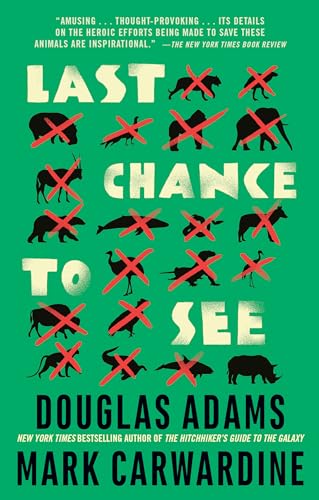
New York Times bestselling author Douglas Adams and zoologist Mark Carwardine take off around the world in search of exotic, endangered creatures.
Join them as they encounter the animal kingdom in its stunning beauty, astonishing variety, and imminent peril: the giant Komodo dragon of Indonesia, the helpless but loveable Kakapo of New Zealand, the blind river dolphins of China, the white rhinos of Zaire, the rare birds of Mauritius island in the Indian Ocean. Hilarious and poignant—as only Douglas Adams can be—Last Chance to See is an entertaining and arresting odyssey through the Earth’s magnificent wildlife galaxy.
Praise for Last Chance to See
“Lively, sharply satirical, brilliantly written . . . shows how human care can undo what human carelessness has wrought.”—The Atlantic
“These authors don’t hesitate to present the alarming facts: More than 1,000 species of animals (and plants) become extinct every year. . . . Perhaps Adams and Carwardine, with their witty science, will help prevent such misadventures in the future.”—Boston Sunday Herald
“Very funny and moving . . . The glimpses of rare fauna seem to have enlarged [Adams’s] thinking, enlivened his world; and so might the animals do for us all, if we were to help them live.”—The Washington Post Book World
“[Adams] invites us to enter into a conspiracy of laughter and caring.”—Los Angeles Times
“Amusing . . . thought-provoking . . . Its details on the heroic efforts being made to save these animals are inspirational.”—The New York Times Book Review
Die Inhaltsangabe kann sich auf eine andere Ausgabe dieses Titels beziehen.
Über die Autorin bzw. den Autor
Douglas Adams was born in 1952 and educated at Cambridge. He was the author of five books in the Hitchhiker’s Trilogy, including The Hitchhiker’s Guide to the Galaxy; The Restaurant at the End of the Universe; Life, the Universe and Everything; So Long, and Thanks for All the Fish; and Mostly Harmless. His other works include Dirk Gently’s Holistic Detective Agency; The Long Dark Tea-Time of the Soul; The Meaning of Liff and The Deeper Meaning of Liff (with John Lloyd); and Last Chance to See (with Mark Carwardine). His last book was the bestselling collection, The Salmon of Doubt, published posthumously in May 2002.
Mark Carwardine is a zoologist, an outspoken conservationist, an award-winning writer, a BBC radio and TV presenter, a widely published wildlife photographer, a bestselling author, a wildlife tour operator and leader, a lecturer, and a magazine columnist. He co-presented the popular BBC TV series Last Chance to See with actor and comedian Stephen Fry, in which the unlikely duo followed in the footsteps of Carwardine’s original travels with Douglas Adams. Carwardine has written more than fifty books, including Field Guide to Whales, Dolphins and Porpoises; Mark Carwardine’s Guide to Whale Watching in North America; Mark Carwardine’s Guide to Whale Watching in Britain and Europe; Extreme Nature; The Guinness Book of Animal Records; Mark Carwardine’s Ultimate Wildlife Experiences; The Shark-Watcher’s Handbook; and On the Trail of the Whale.
Von der hinteren Coverseite
"Very funny and moving...The glimpses of rare fauna seem to have enlarged [Adams'] thinking, enlivened his world; and so might the animals do for us all, if we were to help them live."
THE WASHINGTON POST BOOK WORLD
Join bestselling author Douglas Adams and zooligist Mark Carwardine as they take off around the world in search of exotic, endangered creatures. Hilarious and poignant--as only Douglas Adams can be--LAST CHANCE TO SEE is an entertaining and arresting odyssey through the Earth's magnificent wildlife galaxy.
Aus dem Klappentext
Dieser Bericht einer einjährigen Reise zu den vom Aussterben bedrohten Tierarten dieser Welt zeugt von der Faszination, die Lebewesen wie das Fingertier, das Kakapo, der Komodo-Waran und viele andere auf uns Menschen ausüben.
Zusammenfassung
Douglas Adams, Autor des Bestsellers The Hitchhiker's Guide to the Galaxy, hat dem Leser bereits in der Vergangenheit viele unglaubliche Lebewesen vorgestellt. In diesem außerordentlichen Buch jedoch lädt er den Leser zu einer Entdeckungsreise in eine Welt ein, die von außergewöhnlichen, exotischen und vom Aussterben bedrohten Arten bewohnt ist, die hier in Wort und Bild festgehalten sind. Mit 16 Seiten atemberaubender Farbfotos.
Zusammenfassung
In Hitchhiker's Trilogy und in seinen Bestseller-Romanen um Dirk Gently hat Douglas Adams seine Millionen von Fans auf wilde Exkursionen durch Zeit und Raum mitgenommen. Last Chance to See setzt diese Reise fort -- aber diesmal ist das Reiseziel die Erde, der Zeitpunkt ist die Gegenwart, und jedes Wort ist wahr. Abwechselnd ergreifend und urkomisch, bietet dieses Buch einen Einblick in die Welt der exotischen, vom Aussterben bedrohten Tiere dieser Erde.
Auszug. © Genehmigter Nachdruck. Alle Rechte vorbehalten.
TWIG
TECHNOLOGY
THIS ISN’T AT ALL WHAT I expected. In 1985, by some sort of journalistic accident, I was sent to Madagascar with Mark Carwardine to look for an almost extinct form of lemur called the aye-aye. None of the three of us had met before. I had never met Mark, Mark had never met me, and no one, apparently, had seen an aye-aye in years.
This was the idea of the Observer Colour Magazine, to throw us all in at the deep end. Mark is an extremely experienced and knowledgeable zoologist who was working at that time for the World Wildlife Fund, and his role, essentially, was to be the one who knew what he was talking about. My role, and one for which I was entirely qualified, was to be an extremely ignorant non-zoologist to whom everything that happened would come as a complete surprise. All the aye-aye had to do was do what aye-ayes have been doing for millions of years; sit in a tree and hide.
The aye-aye is a nocturnal lemur. It is a very strange-looking creature that seems to have been assembled from bits of other animals. It looks a little like a large cat with a bat’s ears, a beaver’s teeth, a tail like a large ostrich feather, a middle finger like a long dead twig, and enormous eyes that seem to peer past you into a totally different world which exists just over your left shoulder.
Like virtually everything that lives on Madagascar, it does not exist anywhere else on earth. Its origins date back to a period in earth’s history when Madagascar was still part of mainland Africa (which itself had been part of the gigantic supercontinent of Gondwanaland), at which time the ancestors of the Madagascan lemurs were the dominant primate in all the world. When Madagascar sheered off into the Indian Ocean, it became entirely isolated from all the evolutionary changes that took place in the rest of the world. It is a life raft from a different time. It is now almost like a tiny, fragile, separate planet.
The major evolutionary change that passed Madagascar by was the arrival of the monkeys. These were descended from the same ancestors as the lemurs, but they had bigger brains, and were aggressive competitors for the same habitat. Where the lemurs had been content to hang around in trees having a good time, the monkeys were ambitious, and interested in all sorts of things, especially twigs, with which they found they could do all kinds of things that they couldn’t do by themselves—dig for things, probe things, hit things. The monkeys took over the world and the lemur branch of the primate family died out everywhere—other than on Madagascar, which for millions of years the monkeys never reached.
Then fifteen hundred years ago, the monkeys finally arrived, or at least the monkeys’ descendants—us. Thanks to astounding advances in twig technology, we arrived in canoes, then boats, and finally airplanes, and once again started to compete for use of the same habitat, only this time with fire and machetes and domesticated animals, with asphalt and concrete. The lemurs are once again fighting for survival.
My airplane full of monkey descendants arrived at Antananarivo airport. Mark, who had gone out ahead to make the arrangements for the expedition, met me for the first time there and explained the setup.
“Everything’s gone wrong,” he said.
He was tall, dark, and laconic and had a slight nervous tic. He explained that he used to be just tall, dark, and laconic, but that the events of the last few days had rather got to him. At least he tried to explain this. He had lost his voice, he croaked, due to a lot of recent shouting.
“I nearly telexed you not to come,” he said. “The whole thing’s a nightmare. I’ve been here for five days and I’m still waiting for something to go right. The Ambassador in Brussels promised me that the Ministry of Agriculture would be able to provide us with two Land Rovers and a helicopter. Turns out all they’ve got is a moped and it doesn’t work.
“The Ambassador in Brussels also assured me that we could drive right to the north, but the road suddenly turns out to be impassable because it’s being rebuilt by the Chinese, only we’re not supposed to know that. And exactly what is meant by ‘suddenly’ I don’t know because they’ve apparently been at it for ten years.
“Anyway, I think I’ve managed to sort something out, but we have to hurry,” he added. “The plane to the jungle leaves in two hours and we have to be on it. We’ve just got time to dump your surplus baggage at the hotel if we’re quick. Er, some of it is surplus, isn’t it?” He looked anxiously at the pile of bags that I was lugging, and then with increasing alarm at the cases of Nikon camera bodies, lenses, and tripods that our photographer, Alain le Garsmeur, who had been with me on the plane, was busy loading into the minibus.
“Oh, that reminds me,” Mark said, “I’ve just found out that we probably won’t be allowed to take any film out of the country.”
I climbed rather numbly into the minibus. After thirteen hours on the plane from Paris, I was tired and disoriented and had been looking forward to a shower, a shave, a good night’s sleep, and then maybe a gentle morning trying gradually to find Madagascar on the map over a pot of tea. I tried to pull myself together and get a grip. I suddenly had not the faintest idea what I, a writer of humorous science-fiction adventures, was doing here. I sat blinking in the glare of the tropical sun and wondered what on earth Mark was expecting of me. He was hurrying around, tipping one porter, patiently explaining to another porter that he hadn’t actually carried any of our bags, conducting profound negotiations with the driver, and gradually pulling some sort of order out of the chaos.
Madagascar, I thought. Aye-aye, I thought. A nearly extinct lemur. Heading out to the jungle in two hours’ time. I desperately needed to sound bright and intelligent.
“Er, do you think we’re actually going to get to see this animal?” I asked Mark as he climbed in and slammed the door. He grinned at me.
“Well, the Ambassador in Brussels said we haven’t got a hope in hell,” he said, “so we may just be in with a chance. Welcome,” he added as we started the slow pothole slalom into town, “to Madagascar.”
Antananarivo is pronounced Tananarive, and for much of this century has been spelt that way as well. When the French took over Madagascar at the end of the last century (“colonised” is probably too kind a word for moving in on a country that was doing perfectly well for itself but which the French simply took a fancy to), they were impatient with the curious Malagasy habit of not bothering to pronounce the first and last syllables of place names. They decided, in their rational Gallic way, that if that was how the names were pronounced then they could damn well be spelt that way too. It would be rather as if someone had taken over England and told us that from now on we would be spelling Leicester “Lester” and liking it. We might be forced to spell it that way, but we wouldn’t like it, and neither did the Malagasy. As soon as they managed to divest themselves of French rule, in 1960, they promptly reinstated all the old spellings and just kept the cooking and the bureaucracy. One of the more peculiar things that has happened to me is that as a result of an idea I had as a penniless hitchhiker sleeping in fields and telephone boxes, publishers now...
„Über diesen Titel“ kann sich auf eine andere Ausgabe dieses Titels beziehen.
Suchergebnisse für Last Chance to See

Beispielbild für diese ISBN
Last Chance to See
Anbieter: World of Books (was SecondSale), Montgomery, IL, USA
Verkäuferbewertung 5 von 5 Sternen

Paperback. Zustand: Fair. New York Times bestselling author Douglas Adams and zoologist Mark Carwardine take off around the world in search of exotic, endangered creatures. Join them as they encounter the animal kingdom in its stunning beauty, astonishing variety, and imminent peril: the giant Komodo dragon of Indonesia, the helpless but loveable Kakapo of New Zealand, the blind river dolphins of China, the white rhinos of Zaire, the rare birds of Mauritius island in the Indian Ocean. Hilarious and poignant--as only Douglas Adams can be--Last Chance to See is an entertaining and arresting odyssey through the Earth's magnificent wildlife galaxy. Praise for Last Chance to See "Lively, sharply satirical, brilliantly written . . . shows how human care can undo what human carelessness has wrought."--The Atlantic "These authors don't hesitate to present the alarming facts: More than 1,000 species of animals (and plants) become extinct every year. . . . Perhaps Adams and Carwardine, with their witty science, will help prevent such misadventures in the future."--Boston Sunday Herald "Very funny and moving . . . The glimpses of rare fauna seem to have enlarged [Adams's] thinking, enlivened his world; and so might the animals do for us all, if we were to help them live."--The Washington Post Book World "[Adams] invites us to enter into a conspiracy of laughter and caring."--Los Angeles Times "Amusing . . . thought-provoking . . . Its details on the heroic efforts being made to save these animals are inspirational."--The New York Times Book Review. Artikel-Nr. 00103881810
Gebraucht kaufen
EUR 3,67
Versand gratis
Versand innerhalb von USA
Versand innerhalb von USA
Anzahl: 9 verfügbar
Beispielbild für diese ISBN
Last Chance to See
Anbieter: World of Books (was SecondSale), Montgomery, IL, USA
Verkäuferbewertung 5 von 5 Sternen
Paperback. Zustand: Good. New York Times bestselling author Douglas Adams and zoologist Mark Carwardine take off around the world in search of exotic, endangered creatures. Join them as they encounter the animal kingdom in its stunning beauty, astonishing variety, and imminent peril: the giant Komodo dragon of Indonesia, the helpless but loveable Kakapo of New Zealand, the blind river dolphins of China, the white rhinos of Zaire, the rare birds of Mauritius island in the Indian Ocean. Hilarious and poignant--as only Douglas Adams can be--Last Chance to See is an entertaining and arresting odyssey through the Earth's magnificent wildlife galaxy. Praise for Last Chance to See "Lively, sharply satirical, brilliantly written . . . shows how human care can undo what human carelessness has wrought."--The Atlantic "These authors don't hesitate to present the alarming facts: More than 1,000 species of animals (and plants) become extinct every year. . . . Perhaps Adams and Carwardine, with their witty science, will help prevent such misadventures in the future."--Boston Sunday Herald "Very funny and moving . . . The glimpses of rare fauna seem to have enlarged [Adams's] thinking, enlivened his world; and so might the animals do for us all, if we were to help them live."--The Washington Post Book World "[Adams] invites us to enter into a conspiracy of laughter and caring."--Los Angeles Times "Amusing . . . thought-provoking . . . Its details on the heroic efforts being made to save these animals are inspirational."--The New York Times Book Review. Artikel-Nr. 00105850422
Gebraucht kaufen
EUR 3,67
Versand gratis
Versand innerhalb von USA
Versand innerhalb von USA
Anzahl: 7 verfügbar
Foto des Verkäufers
Last Chance to See
Anbieter: Dream Books Co., Denver, CO, USA
Verkäuferbewertung 5 von 5 Sternen
Zustand: good. Gently used with minimal wear on the corners and cover. A few pages may contain light highlighting or writing, but the text remains fully legible. Dust jacket may be missing, and supplemental materials like CDs or codes may not be included. May be ex-library with library markings. Ships promptly! Artikel-Nr. DBV.0345371984.G
Gebraucht kaufen
EUR 3,80
Versand gratis
Versand innerhalb von USA
Versand innerhalb von USA
Anzahl: 2 verfügbar
Beispielbild für diese ISBN
Last Chance to See
Verlag:
Ballantine Books (edition Reprint), 1992
ISBN 10: 0345371984
ISBN 13: 9780345371980
Gebraucht
Paperback
Anbieter: BooksRun, Philadelphia, PA, USA
Verkäuferbewertung 5 von 5 Sternen
Paperback. Zustand: Fair. Reprint. The item might be beaten up but readable. May contain markings or highlighting, as well as stains, bent corners, or any other major defect, but the text is not obscured in any way. Artikel-Nr. 0345371984-7-1
Gebraucht kaufen
EUR 4,27
Versand gratis
Versand innerhalb von USA
Versand innerhalb von USA
Anzahl: 1 verfügbar
Beispielbild für diese ISBN
Last Chance to See
Verlag:
Ballantine Books (edition Reprint), 1992
ISBN 10: 0345371984
ISBN 13: 9780345371980
Gebraucht
Paperback
Anbieter: BooksRun, Philadelphia, PA, USA
Verkäuferbewertung 5 von 5 Sternen
Paperback. Zustand: Very Good. Reprint. It's a well-cared-for item that has seen limited use. The item may show minor signs of wear. All the text is legible, with all pages included. It may have slight markings and/or highlighting. Artikel-Nr. 0345371984-11-1
Gebraucht kaufen
EUR 4,27
Versand gratis
Versand innerhalb von USA
Versand innerhalb von USA
Anzahl: 1 verfügbar
Foto des Verkäufers
Last Chance to See
Anbieter: Dream Books Co., Denver, CO, USA
Verkäuferbewertung 5 von 5 Sternen
Zustand: acceptable. This copy has clearly been enjoyedâ"expect noticeable shelf wear and some minor creases to the cover. Binding is strong, and all pages are legible. May contain previous library markings or stamps. Artikel-Nr. DBV.0345371984.A
Gebraucht kaufen
EUR 4,45
Versand gratis
Versand innerhalb von USA
Versand innerhalb von USA
Anzahl: 1 verfügbar
Beispielbild für diese ISBN
Last Chance to See
Verlag:
Random House Publishing Group, 1992
ISBN 10: 0345371984
ISBN 13: 9780345371980
Gebraucht
Softcover
Anbieter: Better World Books, Mishawaka, IN, USA
Verkäuferbewertung 5 von 5 Sternen
Zustand: Good. Reprint. Pages intact with minimal writing/highlighting. The binding may be loose and creased. Dust jackets/supplements are not included. Stock photo provided. Product includes identifying sticker. Better World Books: Buy Books. Do Good. Artikel-Nr. 3207394-6
Gebraucht kaufen
EUR 6,09
Versand gratis
Versand innerhalb von USA
Versand innerhalb von USA
Anzahl: Mehr als 20 verfügbar
Beispielbild für diese ISBN
Last Chance to See
Verlag:
Random House Publishing Group, 1992
ISBN 10: 0345371984
ISBN 13: 9780345371980
Gebraucht
Softcover
Anbieter: Better World Books, Mishawaka, IN, USA
Verkäuferbewertung 5 von 5 Sternen
Zustand: Good. Reprint. Former library copy. Pages intact with minimal writing/highlighting. The binding may be loose and creased. Dust jackets/supplements are not included. Includes library markings. Stock photo provided. Product includes identifying sticker. Better World Books: Buy Books. Do Good. Artikel-Nr. 3207395-6
Gebraucht kaufen
EUR 6,09
Versand gratis
Versand innerhalb von USA
Versand innerhalb von USA
Anzahl: 2 verfügbar
Beispielbild für diese ISBN
Last Chance to See
Anbieter: ThriftBooks-Reno, Reno, NV, USA
Verkäuferbewertung 5 von 5 Sternen
Paperback. Zustand: Good. No Jacket. Pages can have notes/highlighting. Spine may show signs of wear. ~ ThriftBooks: Read More, Spend Less. Artikel-Nr. G0345371984I3N00
Gebraucht kaufen
EUR 6,15
Versand gratis
Versand innerhalb von USA
Versand innerhalb von USA
Anzahl: 2 verfügbar
Beispielbild für diese ISBN
Last Chance to See
Anbieter: ThriftBooks-Phoenix, Phoenix, AZ, USA
Verkäuferbewertung 5 von 5 Sternen
Paperback. Zustand: Good. No Jacket. Pages can have notes/highlighting. Spine may show signs of wear. ~ ThriftBooks: Read More, Spend Less. Artikel-Nr. G0345371984I3N00
Gebraucht kaufen
EUR 6,15
Versand gratis
Versand innerhalb von USA
Versand innerhalb von USA
Anzahl: 1 verfügbar