
Verwandte Artikel zu Australian Literature: An Anthology of Writing from...
Inhaltsangabe
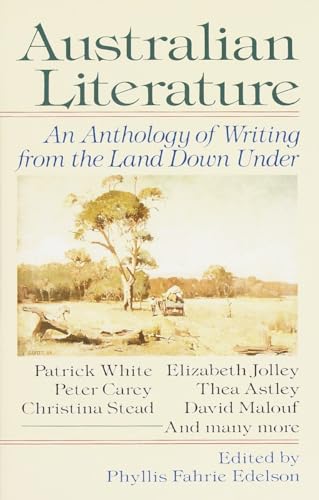
Spanning more than a century, Australian Literature crystallizes a spirit, style, and ethos found nowhere else in world literature. These captivating selections in Australian Literature come from major voices, both famous and lesser known, and encompass short stories, memoirs, novels and aboriginal writings. Resonant or wryly witty, charming or disturbing, they explore themes deeply rooted in the Australian experience—shaping the land, the legacies of the convict past, the displacement of the aborigine, the search for a national identity, sex, love, and commitment.
Including these stories:
“The Drover’s Wife” by Henry Lawson
“The Chosen Vessel” by Barbara Baynton
“The Loaded Dog” by Henry Lawson
From The Tree of Man by Patrick White
“The Night We Watched for Wallabies” by Steele Rudd
“A Gentleman’s Agreement” by Elizabeth Jolley
“Northern Belle” by Thea Astley
“The Cooboo” by Katharine Susannah Prichard
From Dr. Wooreddy’s Prescription for Enduring the Ending of the World by Colin Johnson
“Going Home” by Archie Weller
From Wanamurraganya: The Story of Jack McPhee by Sally Morgan
“Breaking a Man’s Spirit” by Marcus Clarke
“Absalom Day’s Promotion” by Price Warung
“The First Days” by A. B. Facey
“In the Trenches” by A. B. Facey
From The Merry-Go-Round in the Sea by Randolph Stow
“The Kyogle Line” by David Malouf
“American Dreams” by Peter Carey
“Willy-wagtails by Moonlight” by Patrick White
“A Good Marriage” by Olga Masters
“Civilization and Its Discontents” by Helen Garner
“The Train Will Shortly Arrive” by Frank Moorhouse
“Two Hanged Women” by Henry Handel Richardson
“Brown Seaweed and Old Fish Nets” by Christina Stead
“The Woman at the Window” by Marian Eldridge
“A Woman with Black Hair” by Beverley Farmer
“Blood and Water” by Tim Winton
Die Inhaltsangabe kann sich auf eine andere Ausgabe dieses Titels beziehen.
Über die Autorin bzw. den Autor
Phyllis Fahrie Edelson was a professor and chair of the department of English and Communications at Pace University. She was a founding member of the American Association for Australian Literary Studies and book review editor of Antipodes, the first American journal of Australian Studies. After retiring from Pace, Edelson worked as a docent at the Morgan Library and Museum in New York City. She passed away in July 2016.
Von der hinteren Coverseite
Spanning more than a century, Australian Literature crystallizes a spirit, style, and ethos found nowhere else in world literature. These captivating selections in Australian Literature come from major voices, both famous and lesser known, and encompass short stories, memoirs, novels and aboriginal writings. Resonant or wryly witty, charming or disturbing, they explore themes deeply rooted in the Australian experience - shaping the land, the legacies of the convict past, the displacement of the aborigine, the search for a national identity, sex, love, and commitment.
Aus dem Klappentext
e than a century, Australian Literature crystallizes a spirit, style, and ethos found nowhere else in world literature. These captivating selections in Australian Literature come from major voices, both famous and lesser known, and encompass short stories, memoirs, novels and aboriginal writings. Resonant or wryly witty, charming or disturbing, they explore themes deeply rooted in the Australian experience - shaping the land, the legacies of the convict past, the displacement of the aborigine, the search for a national identity, sex, love, and commitment.
Auszug. © Genehmigter Nachdruck. Alle Rechte vorbehalten.
INTRODUCTION
——
I am a “White convert.” This phrase is used by teachers and scholars in the field of Australian literature to identify enthusiasts who find their way to Australian fiction through the works of the novelist Patrick White.
It was during the late 1960s in a Boston hotel room that, by chance, I found a copy of White’s novel Voss. I was there for a teachers’ conference, but, as things turned out, that night I was the student. Turning the pages of White’s masterpiece, I was exhilarated and read until dawn. I learned that a great voice, a major writer in English, was alive and well and living in Australia. All I remember about that conference now is my reaction to Patrick White, contemplating what I read, wondering what else was out there. As soon as I got home, I looked for his work, but not much was then readily available. From London I got his other books, which confirmed my first impression. I had encountered a literary giant.
Most of his fiction is set at the other end of the world, Australia, a place to which I, like many Americans at the time, had not given much thought. White’s novels led me to investigate the literature further, and I found that there is, in fact, a storehouse of strong and delightful fiction, a treasury, written by Australians. Much of this fiction is in one way or another actually about Australia, at once both faintly familiar and strange.
Australia seemed to me to be the distant home of distant family. I felt both the strangeness of the writing and the tug of a common bond. That I, or any American, should experience a lingering sense of knowing is not surprising. The United States and Australia are, after all, parts of the new world built of immigrant dreams and colonial economics. History records that in the British Empire both were colonies, seen as children, all bound to the founding mother, England, by ties of sentiment as well as trade.
Nineteenth-century observers tell us just how closely the United States and Australia were linked in the colonial mind. In 1885, for example, a Melbourne statesman envisioned Australia as becoming “a second United States in the Southern Hemisphere.”1 And a Victorian writer impressed with the good manners of Australians described them as having an “American smartness” tempered by an “Australian softness,” of which he greatly approved.2 There were and are resemblances, serious and substantial parallels, between the United States and Australia, including our common language, our pioneer experience, our historical encounter with native peoples, and, of course, our tradition of democratic political values.
My recognition of national kinship, the sense that I knew these people from somewhere way back, made Australian novels and short fiction accessible and comfortable for me. However, the more I read, the more I took note of significant differences between American and Australian national experiences. Probing deeply into their country’s history and culture, Australian writers tell a distinctive story. Their fiction reveals, underneath the surface similarities, a unique heritage.
It can be a real surprise for an American to discover, for example, just how different the land of Australia is from North America, how harsh and forbidding it was to early colonists. Unlike fertile, well-watered North America, Australia’s river systems are scanty, its rainfall modest. As the first Australian literature—diaries, journals, and official reports—suggests, the continent was not a place that early settlers could easily call home. They took possession of a flat land, a large part of it desert, that seemed immense.
Everything about it was strange to European eyes. There were trees whose bark fell off in sheets, birds that could not fly, and egg-laying mammals. In the very center of the land early settlers found a “dead heart.” The sand and stone of the Outback penetrated deeply into the Australian psyche, even though most Australians settled in the forest and woodland coastal basins. Early Europeans were struck by the vast silence. We find in their writing such phrases as “the trackless immeasurable desert,” the “awful silence,”3 the “indescribable solitude [of] untenanted wastes.”4 This reaction to the land persists, finding its way into contemporary literature.
In fact, a number of central themes in Australian literature have their roots in the Australian national experience. Knowing something of Australia’s history enriches the reader’s pleasure in its fiction.
A Brief History of Australia and Its Literature
Early Australian literature can be traced back in time to well before the British arrived on the continent. For there was in Europe a literature about Australia, a number of legends that whispered of gold in a southern continent inhabited by a savage race. It was legend that spurred the exploration of the great land mass that stretched out between Africa and America, called on old maps terra australis. Although the Portuguese and the Dutch visited the continent with their ships, looking for gold or other marketable resources, the English came to stay. They did not come, however, for typical colonial reasons.
To look at colonial origins, it is necessary to go back to the English explorer Captain James Cook, who visited the east coast of Australia in the ship Endeavour in 1770 and found a good harbor just south of present-day Sydney. The expedition’s passengers busily collected specimens of strange plants, suggesting the name for the spot—Botany Bay. Cook annexed the eastern coast of Australia for England and called it New South Wales. The captain is justly celebrated in Australian poetry, but the settlers who followed him are of much greater literary concern. Most of them arrived in chains.
Following the war of independence with its American colonies, England was forced to find a new place to dump its overflow of convicts. That place was Australia. Eleven vessels arrived in Australia in January 1788: two armed ships, three cargo boats, and six transports loaded with convict passengers. These new settlers, already exiled from their own society thanks to their prison terms, were exiled once again, this time dispatched across an ocean to an unknown world.
Australia was a strange settlement and certainly didn’t fit the notion of “colony” that Americans associate with their own historical beginnings. Convicts and their guards, a special corps of military police, made up the community. Survival was a question and near-starvation a reality for a few years, but gradually the new place took shape. Convicts worked on government farms or officers’ lands.5 The guards accumulated large property holdings, backed by supplies, seed, and free convict labor, courtesy of the English Crown. While they policed the convicts, many of them also prospered in business, particularly the rum trade, buying from incoming ships and selling at a profit.
The ladder of social class was firmly constructed right from the beginning. Convicts serving time were at the bottom. Convicts who, for various reasons, were allowed to work on their own were known as ticket-of-leave workers and were a step above. In time, some convicts were pardoned or their sentences expired; they were called emancipists and stood a rung higher, but of course below those who came to the colony as free settlers. Civil officers sent by the Crown were near the top of the social ladder, while the military officer corps was the “aristocracy” of the prison settlement, at least insofar as power was concerned.
...
„Über diesen Titel“ kann sich auf eine andere Ausgabe dieses Titels beziehen.
Suchergebnisse für Australian Literature: An Anthology of Writing from...

Beispielbild für diese ISBN
Australian Literature: An Anthology of Writing from the Land Down Under
Verlag:
Random House Publishing Group, 1993
ISBN 10: 0345368002
ISBN 13: 9780345368003
Gebraucht
Softcover
Anbieter: World of Books (was SecondSale), Montgomery, IL, USA
Verkäuferbewertung 5 von 5 Sternen

Zustand: Good. Item in good condition. Textbooks may not include supplemental items i.e. CDs, access codes etc. Artikel-Nr. 00102554009
Gebraucht kaufen
EUR 4,69
Versand gratis
Versand innerhalb von USA
Versand innerhalb von USA
Anzahl: 2 verfügbar
Beispielbild für diese ISBN
Australian Literature: An Anthology of Writing from the Land Down Under
Anbieter: ThriftBooks-Atlanta, AUSTELL, GA, USA
Verkäuferbewertung 5 von 5 Sternen
Paperback. Zustand: Good. No Jacket. Pages can have notes/highlighting. Spine may show signs of wear. ~ ThriftBooks: Read More, Spend Less. Artikel-Nr. G0345368002I3N00
Gebraucht kaufen
EUR 7,39
Versand gratis
Versand innerhalb von USA
Versand innerhalb von USA
Anzahl: 1 verfügbar
Beispielbild für diese ISBN
Australian Literature : An Anthology of Writing from the Land down Under
Verlag:
Random House Publishing Group, 1993
ISBN 10: 0345368002
ISBN 13: 9780345368003
Gebraucht
Softcover
Erstausgabe
Anbieter: Better World Books Ltd, Dunfermline, Vereinigtes Königreich
Verkäuferbewertung 5 von 5 Sternen
Zustand: Good. 1st Edition. Pages intact with minimal writing/highlighting. The binding may be loose and creased. Dust jackets/supplements are not included. Stock photo provided. Product includes identifying sticker. Better World Books: Buy Books. Do Good. Artikel-Nr. 2283854-6
Gebraucht kaufen
EUR 5,64
EUR 5,85 Versand
Versand von Vereinigtes Königreich nach USA
Versand von Vereinigtes Königreich nach USA
Anzahl: 1 verfügbar
Beispielbild für diese ISBN
Australian Literature: An Anthology of Writing from the Land Down Under
Verlag:
Ballantine Books, New York, 1993
ISBN 10: 0345368002
ISBN 13: 9780345368003
Gebraucht
softcover
Anbieter: Abacus Bookshop, Pittsford, NY, USA
Verkäuferbewertung 5 von 5 Sternen
softcover. Zustand: Fine copy. 2nd prt. 8vo, 304 pp., With contributions by Henry Lawson, Barbara Baynton, Patrick White, Steele Rudd, Elizabeth Jolley, Thea Astley, Katharine Susannah Prichard, Colin Johnson, Archie Weller, Sally Morgan, Jack McPhee, Marcus Clarke, Peter Carey and others. Artikel-Nr. 091429
Gebraucht kaufen
EUR 8,93
EUR 3,47 Versand
Versand innerhalb von USA
Versand innerhalb von USA
Anzahl: 1 verfügbar
Beispielbild für diese ISBN
Australian Literature: An Anthology of Writing from the Land Down Under
Verlag:
Random House Publishing Group, 1993
ISBN 10: 0345368002
ISBN 13: 9780345368003
Gebraucht
Softcover
Anbieter: Anybook.com, Lincoln, Vereinigtes Königreich
Verkäuferbewertung 5 von 5 Sternen
Zustand: Good. This is an ex-library book and may have the usual library/used-book markings inside.This book has soft covers. In good all round condition. Please note the Image in this listing is a stock photo and may not match the covers of the actual item,500grams, ISBN:9780345368003. Artikel-Nr. 2930372
Gebraucht kaufen
EUR 5,18
EUR 15,91 Versand
Versand von Vereinigtes Königreich nach USA
Versand von Vereinigtes Königreich nach USA
Anzahl: 1 verfügbar
Beispielbild für diese ISBN
Australian Literature: An Anthology of Writing from the Land Down Under
Verlag:
Random House Publishing Group, 1993
ISBN 10: 0345368002
ISBN 13: 9780345368003
Neu
Softcover
Anbieter: Ria Christie Collections, Uxbridge, Vereinigtes Königreich
Verkäuferbewertung 5 von 5 Sternen
Zustand: New. In. Artikel-Nr. ria9780345368003_new
Neu kaufen
EUR 20,14
EUR 14,01 Versand
Versand von Vereinigtes Königreich nach USA
Versand von Vereinigtes Königreich nach USA
Anzahl: Mehr als 20 verfügbar
Beispielbild für diese ISBN
Australian Literature: An Anthology of Writing from the Land down under
Anbieter: Revaluation Books, Exeter, Vereinigtes Königreich
Verkäuferbewertung 5 von 5 Sternen
Paperback. Zustand: Brand New. 1st edition. 304 pages. 8.00x5.25x0.50 inches. In Stock. Artikel-Nr. x-0345368002
Neu kaufen
EUR 23,17
EUR 11,70 Versand
Versand von Vereinigtes Königreich nach USA
Versand von Vereinigtes Königreich nach USA
Anzahl: 2 verfügbar
Beispielbild für diese ISBN
Australian Literature: An Anthology of Writing from the Land Down Under
Verlag:
Random House Publishing Group, 1993
ISBN 10: 0345368002
ISBN 13: 9780345368003
Neu
Softcover
Anbieter: Kennys Bookstore, Olney, MD, USA
Verkäuferbewertung 5 von 5 Sternen
Zustand: New. Artikel-Nr. V9780345368003
Neu kaufen
EUR 29,10
EUR 9,10 Versand
Versand innerhalb von USA
Versand innerhalb von USA
Anzahl: Mehr als 20 verfügbar