
Verwandte Artikel zu Food and Healing: How What You Eat Determines Your...
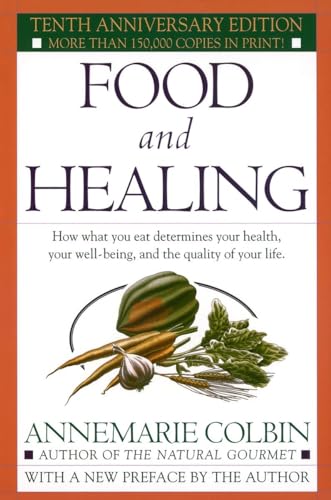
Food and Healing: How What You Eat Determines Your Health, Your Well-Being, and the Quality of Your Life - Softcover
Inhaltsangabe
Yes, you are what you eat. For everyone who wonders why, in this era of advanced medicine, we still suffer so much serious illness, Food and Healing is essential reading.
“An eminently practical, authoritative, and supportive guide to making everyday decisions about eating that can transform our lives. Food and Healing is a remarkable achievement.”—Richard Grossman, Director, The Health in Medicine Project, Montefiore Medical Center
Annemarie Colbin, founder of New York's renowned Natural Gourmet Cookery School and author of The Book of Whole Meals, argues passionately that we must take responsibility for our own health and rely less on modern medicine, which still seems to focus on trying to cure rather than prevent illness. Eating well, she shows, is the first step toward better health.
Drawing on an impressive range of thinking—from Eastern philosophy to current medical journals—Colbin shatters many myths not only about the “Standard American Diet” but also about some of the quirky and unhealthy food fads of recent years. What emerges is one of the first complete works on:
• How food affects our moods
• The healing qualities of specific foods
• The role of diet in preventing illness
• How to tailor a diet approach that is right for you
“I recommend it to my patients. . . . It's an excellent book to help people understand the relationship between what they eat and how they feel.”—Stephen Rechtstaffen, M.D. Director, Omega Institute for Holistic Studies
“Have a look at this important, well-thought-out book.”—Bon Appetit
Die Inhaltsangabe kann sich auf eine andere Ausgabe dieses Titels beziehen.
Über die Autorin bzw. den Autor
Annemarie Colbin, PhD, was the founder of the Natural Gourmet Institute and the author of Food and Healing, The Book of Whole Meals, and The Natural Gourmet, which received a National IACP Seagram Book Award. Her work was featured in The New York Times, Good Housekeeping, Longevity, Natural Health, New Age Journal, and Vegetarian Times, and she made numerous media appearances. She died in 2015.
Von der hinteren Coverseite
The best book on how your diet impacts your health has gotten even better! For this tenth anniversary edition, Annemarie Colbin has updated her classic to include the latest information on new dietary systems, low-fat eating, food combining, and alternative medicine. Food and Healing continues to be the touchstone guide to improving your life by changing the way you eat. Drawing on an impressive range of thinking, from Oriental philosophy to contemporary medical journals, Colbin shatters many myths not only about the "Standard American Diet" but also about some of the quirky unhealthy food fads that continue to crop up across the country. Inside, you'll discover the crucial role of diet in preventing illness, how to tailor a diet approach that is right for you, the remarkable healing qualities of specific foods, how food affects your moods. Annemarie Colbin argues passionately that we must take responsibility for our own health and rely less on modern medicine, which - even now - seems to focus on trying to cure rather than prevent illness. She shows that eating well is the first step toward better health.
Aus dem Klappentext
o, Colbin's Food and Healing stood at the forefront of the food revolution, exploring the link between diet and health. In this anniversary edition, she provides updates on recent dietary systems, including low-fat, food combining, and alternative medicine.
Auszug. © Genehmigter Nachdruck. Alle Rechte vorbehalten.
One:
Health Today
HOW ARE WE?
Unfortunately, not so well. Official reports on the condition of our health proclaim loudly that “Americans today are healthier than ever,”1 but even a perfunctory glance at the statistics tables tells us differently. Although life-expectancy rates appear to have increased, that increase is deceptive: The child born today can expect to live twenty-six years longer than a child born in 1900, but the person who has already reached forty-five today can expect to live only four or five years longer than his counterpart did at the start of the century.2 Moreover, during the past thirty years, mortality for the fifteen-to-twenty-four age group has increased fivefold, mostly because of traffic accidents, homicide, and suicide; it is still, unfortunately, on the rise.
And is a long life necessarily a healthier life? Childhood problems that were rare a generation ago are now so prevalent that they are called “the new morbidity”3: learning difficulties, behavioral disturbances, speech and hearing difficulties, faulty vision, serious dental misalignment. The average child loses three permanent teeth to decay by age eleven, eight or nine by age seventeen; and 94 percent of adolescents have cavities in their permanent teeth.
Dental diseases, especially caries and periodontal disease, constitute the most prevalent health problem in the nation. Ninety-eight percent of the population is affected, and over 19 million adults have lost all their teeth. Familiarity breeds contempt, so dental problems are generally considered “normal.” Yet at least one dentist refers to tooth decay as a degenerative disease that may possibly be a precursor to diabetes.
Equally severe is the incidence of acute respiratory illnesses: Each year, there are an estimated 200 to 250 million cases, and some 2.4 million people (10 percent of the population) contract pneumonia.
A few more facts: Acute gastroenteritis—inflammation of the stomach and intestines—follows colds in frequency of appearance; women are diagnosed and treated for 850,000 cases of pelvic inflammatory diseases yearly; and every year there may be as many as one million new cases of genital herpes, plus several million recurrences, as well as 120,000 cases of hepatitis and 18,000 of bacterial meningitis.
Tuberculosis may have long relinquished its place as one of the leading causes of death, but there were still over 27,000 cases in 1981, 1,900 of which were fatal. Among children, TB is on the rise. Other infectious diseases may take as many as 300,000 lives yearly. The most publicized and feared disorder of all, cancer, now takes an estimated one out of every five lives, or 20 percent of all deaths, up from a 5 percent mortality rate in 1900. In the mid-1980s it trails only accidents and violence as a killer of children and adolescents, a statistic not often noted. Major cardiovascular diseases are now the cause of 48 percent of all deaths, whereas in 1900 they caused only 18 percent. At least one quarter of the population suffers from elevated or high blood pressure.
Poor health does not manifest itself only in strictly physical illnesses. There are also close to 2 million admissions to mental hospitals each year. The Veterans’ Administration estimates that in 1981 close to 2.5 million people sought out-patient treatment for mental and emotional problems. An additional 1.7 million were admitted as in-patients during the same year. At any given time, as much as a quarter of the population is estimated to suffer from depression, anxiety, or other emotional disorders. Manicdepressive conditions handicap an estimated 2 to 4 percent of adults at any given time. Suicide is the ninth leading cause of death for all age groups, and more than 80 percent of all suicide cases may be due to depression.
Violence, directed toward self or others, is a major component of life in the United States and a cause of much fear and trauma. Hundreds of thousands of violent nonfatal assaults occur yearly, including instances of spouse abuse and rape. The homicide rate in this country is much higher than that of any other industrialized nation: 10.2 cases for every 100,000 people (England’s is 1.0, Japan’s 1.3). And there may be as many as 4 million cases of child abuse every year, at least two thousand of which result in death. All this violence is no longer viewed as purely psychological. A growing body of research links mood, violent behavior, and even criminal behavior with various physiological imbalances: an overactive thyroid, an excess of testosterone (male hormones), allergies, low blood sugar. Lead poisoning, vitamin deficiencies, and of course alcohol and drugs all alter physiology as well as mood. Behavioral problems have even been associated with a lack of natural light, insofar as light plays a vital role in the metabolism of calcium, a mineral widely regarded as “nature’s tranquilizer.”
HOW EFFECTIVE ARE OUR REMEDIES?
The general public has a one-sided impression of the effectiveness of modern medicine and its germ warfare. The popular belief, encouraged by the media, is that we owe the disappearance of major epidemics of infectious diseases to medical breakthroughs, whereas in fact, the death rate from infection had already begun to drop several decades before control measures inspired by the germ theory were put into effect, and almost a century before the introduction of antimicrobial drugs.6 The incidence of cholera, diphtheria, dysentery, and typhoid declined after the introduction of clean water supplies, sewage control, general sanitation, and the pasteurization of milk. According to Thomas McKeown, professor emeritus of social medicine at the University of Birmingham, England, another reason for that downtrend was an increase in food supplies and the consequent host resistance as a result of better nutrition.
Almost 90 percent of the total decline in children’s mortality from diseases such as scarlet fever, diphtheria, whooping cough, and measles occurred before widespread use of antibiotics and compulsory immunizations. Diphtheria, for example, took the lives of 900 out of every million children in 1900, but only 220 by 1938—and national immunization didn’t start until 1942. Scarlet fever declined from over 2,300 deaths per million children in 1860 to about 100 in 1918; but sulfa drugs didn’t become available until the early thirties, and immunization didn’t begin until the late sixties, by which time there were barely a dozen or so cases per million. Polio vaccine appears to be the only one to have effectively lowered the incidence of a disease: The year before the introduction of the vaccine, 1954, there were 38,476 cases of polio; the year after, 1956, there were 15,140, and the year after that, only 5,485.8 However, a similar decrease of the incidence of this disease was observed in Europe, where no mass immunizations took place. Most of the current polio cases occur in people who have been immunized. Admittedly, this a highly controversial issue. Parents who immunize their children do so in the belief that they’re protecting them; most scientists believe just that. It will be a while before history sorts out the facts from the myths. Meanwhile, it behooves us to keep an open mind and to explore more fully the role of nutrition in disease prevention.
It’s a sad fact that despite the full-fledged war on cancer with drastic remedies such as surgery, radiation, and chemotherapy, survival rates for 90 percent of the cancer cases have riot improved during the past twenty-five years. Survival rates for breast cancer, for example, were at 50 percent in a 1963 study regardless of...
„Über diesen Titel“ kann sich auf eine andere Ausgabe dieses Titels beziehen.
Suchergebnisse für Food and Healing: How What You Eat Determines Your...

Beispielbild für diese ISBN
Food and Healing: How What You Eat Determines Your Health, Your Well-Being, and the Quality of Your Life
Anbieter: World of Books (was SecondSale), Montgomery, IL, USA
Verkäuferbewertung 5 von 5 Sternen

Paperback. Zustand: Good. Yes, you arewhat you eat. For everyone who wonders why, in this era of advanced medicine, we still suffer so much serious illness, Food and Healingis essential reading. "An eminently practical, authoritative, and supportive guide to making everyday decisions about eating that can transform our lives.Food and Healingis a remarkable achievement."-Richard Grossman, Director, The Health in Medicine Project, Montefiore Medical Center Annemarie Colbin, founder of New York's renowned Natural Gourmet Cookery School and author of The Book of Whole Meals, argues passionately that we must take responsibility for our own health and rely less on modern medicine, which still seems to focus on trying to cure rather than prevent illness. Eating well, she shows, is the first step toward better health. Drawing on an impressive range of thinking-from Eastern philosophy to current medical journals-Colbin shatters many myths not only about the"Standard American Diet" but also about some of the quirky and unhealthy food fads of recent years. What emerges is one of the first complete works on: . How food affects our moods . The healing qualities of specific foods . The role of diet in preventing illness . How to tailor a diet approach that is right for you "I recommend it to my patients. . . . It's an excellent book to help people understand the relationship between what they eat and how they feel."-Stephen Rechtstaffen, M.D. Director, Omega Institute for Holistic Studies "Have a look at this important, well-thought-out book."-Bon Appetit. Artikel-Nr. 00068241597
Gebraucht kaufen
EUR 3,71
Versand gratis
Versand innerhalb von USA
Versand innerhalb von USA
Anzahl: 19 verfügbar
Beispielbild für diese ISBN
Food and Healing: How What You Eat Determines Your Health, Your Well-Being, and the Quality of Your Life
Anbieter: World of Books (was SecondSale), Montgomery, IL, USA
Verkäuferbewertung 5 von 5 Sternen
Zustand: Acceptable. Item in acceptable condition! Textbooks may not include supplemental items i.e. CDs, access codes etc. Artikel-Nr. 00096000190
Gebraucht kaufen
EUR 3,71
Versand gratis
Versand innerhalb von USA
Versand innerhalb von USA
Anzahl: 5 verfügbar
Beispielbild für diese ISBN
Food and Healing: How What You Eat Determines Your Health, Your Well-Being, and the Quality of Your Life
Anbieter: Wonder Book, Frederick, MD, USA
Verkäuferbewertung 5 von 5 Sternen
Zustand: Good. Good condition. Writing inside. Artikel-Nr. P16K-00576
Gebraucht kaufen
EUR 4,84
Versand gratis
Versand innerhalb von USA
Versand innerhalb von USA
Anzahl: 1 verfügbar
Beispielbild für diese ISBN
Food and Healing: How What You Eat Determines Your Health, Your Well-Being, and the Quality of Your Life
Verlag:
Ballantine Books (edition Reissue), 1986
ISBN 10: 0345303857
ISBN 13: 9780345303851
Gebraucht
Paperback
Anbieter: BooksRun, Philadelphia, PA, USA
Verkäuferbewertung 5 von 5 Sternen
Paperback. Zustand: Fair. Reissue. The item might be beaten up but readable. May contain markings or highlighting, as well as stains, bent corners, or any other major defect, but the text is not obscured in any way. Artikel-Nr. 0345303857-7-1
Gebraucht kaufen
EUR 4,88
Versand gratis
Versand innerhalb von USA
Versand innerhalb von USA
Anzahl: 2 verfügbar
Beispielbild für diese ISBN
Food and Healing: How What You Eat Determines Your Health, Your Well-Being, and the Quality of Your Life
Verlag:
Ballantine Books (edition Reissue), 1986
ISBN 10: 0345303857
ISBN 13: 9780345303851
Gebraucht
Paperback
Anbieter: BooksRun, Philadelphia, PA, USA
Verkäuferbewertung 5 von 5 Sternen
Paperback. Zustand: Very Good. Reissue. It's a well-cared-for item that has seen limited use. The item may show minor signs of wear. All the text is legible, with all pages included. It may have slight markings and/or highlighting. Artikel-Nr. 0345303857-11-1
Gebraucht kaufen
EUR 5,29
Versand gratis
Versand innerhalb von USA
Versand innerhalb von USA
Anzahl: 1 verfügbar
Beispielbild für diese ISBN
Food and Healing: How What You Eat Determines Your Health, Your Well-Being, and the Quality of Your Life
Verlag:
Random House Publishing Group, 1986
ISBN 10: 0345303857
ISBN 13: 9780345303851
Gebraucht
Paperback
Anbieter: ThriftBooks-Phoenix, Phoenix, AZ, USA
Verkäuferbewertung 5 von 5 Sternen
Paperback. Zustand: Very Good. No Jacket. May have limited writing in cover pages. Pages are unmarked. ~ ThriftBooks: Read More, Spend Less. Artikel-Nr. G0345303857I4N00
Gebraucht kaufen
EUR 5,94
Versand gratis
Versand innerhalb von USA
Versand innerhalb von USA
Anzahl: 1 verfügbar
Beispielbild für diese ISBN
Food and Healing: How What You Eat Determines Your Health, Your Well-Being, and the Quality of Your Life
Verlag:
Random House Publishing Group, 1986
ISBN 10: 0345303857
ISBN 13: 9780345303851
Gebraucht
Paperback
Anbieter: ThriftBooks-Atlanta, AUSTELL, GA, USA
Verkäuferbewertung 5 von 5 Sternen
Paperback. Zustand: Very Good. No Jacket. May have limited writing in cover pages. Pages are unmarked. ~ ThriftBooks: Read More, Spend Less. Artikel-Nr. G0345303857I4N00
Gebraucht kaufen
EUR 5,94
Versand gratis
Versand innerhalb von USA
Versand innerhalb von USA
Anzahl: 1 verfügbar
Beispielbild für diese ISBN
Food and Healing: How What You Eat Determines Your Health, Your Well-Being, and the Quality of Your Life
Verlag:
Random House Publishing Group, 1986
ISBN 10: 0345303857
ISBN 13: 9780345303851
Gebraucht
Paperback
Anbieter: ThriftBooks-Reno, Reno, NV, USA
Verkäuferbewertung 5 von 5 Sternen
Paperback. Zustand: Very Good. No Jacket. May have limited writing in cover pages. Pages are unmarked. ~ ThriftBooks: Read More, Spend Less. Artikel-Nr. G0345303857I4N00
Gebraucht kaufen
EUR 5,94
Versand gratis
Versand innerhalb von USA
Versand innerhalb von USA
Anzahl: 1 verfügbar
Beispielbild für diese ISBN
Food and Healing: How What You Eat Determines Your Health, Your Well-Being, and the Quality of Your Life
Verlag:
Random House Publishing Group, 1986
ISBN 10: 0345303857
ISBN 13: 9780345303851
Gebraucht
Paperback
Anbieter: ThriftBooks-Dallas, Dallas, TX, USA
Verkäuferbewertung 5 von 5 Sternen
Paperback. Zustand: Very Good. No Jacket. May have limited writing in cover pages. Pages are unmarked. ~ ThriftBooks: Read More, Spend Less. Artikel-Nr. G0345303857I4N00
Gebraucht kaufen
EUR 5,94
Versand gratis
Versand innerhalb von USA
Versand innerhalb von USA
Anzahl: 1 verfügbar
Beispielbild für diese ISBN
Food and Healing: How What You Eat Determines Your Health, Your Well-Being, and the Quality of Your Life
Verlag:
Random House Publishing Group, 1986
ISBN 10: 0345303857
ISBN 13: 9780345303851
Gebraucht
Paperback
Anbieter: ThriftBooks-Atlanta, AUSTELL, GA, USA
Verkäuferbewertung 5 von 5 Sternen
Paperback. Zustand: Good. No Jacket. Pages can have notes/highlighting. Spine may show signs of wear. ~ ThriftBooks: Read More, Spend Less. Artikel-Nr. G0345303857I3N00
Gebraucht kaufen
EUR 5,94
Versand gratis
Versand innerhalb von USA
Versand innerhalb von USA
Anzahl: 1 verfügbar