
Software Architecture in Practice (SEI Series in Software Engineering) - Hardcover
Buch 15 von 27: SEI Series in Software Engineering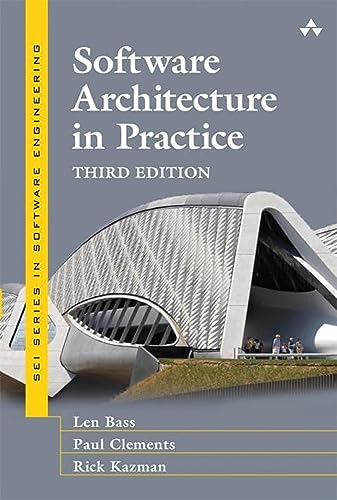
Inhaltsangabe
The core book in SEI's influential architecture curriculum, this book introduces software architecture both for practicing software engineers and for students pursuing careers in software design or management. It combines the authority of SEI's pioneering curriculum with the proven pedagogical effectiveness of a book that's been used for many years in countless training and college courses. The authors provide a comprehensive overview of the field of software architecture in a single, easy-to-digest package. This book will help readers understand: * Why software architecture is critical to development projects and the organization as a whole * Which technical and organizational factors influence architecture, and are in turn influenced by it * How architecture drives quality attributes such as performance and reliability * How to master and choose among today's best architectural tactics
Die Inhaltsangabe kann sich auf eine andere Ausgabe dieses Titels beziehen.
Über die Autorin bzw. den Autor
Len Bass is a Senior Principal Researcher at National ICT Australia Ltd (NICTA). He joined NICTA in 2011 after twenty-five years at the Software Engineering Institute (SEI) at Carnegie Mellon University. He is the coauthor of two award-winning books in software architecture, including Documenting Software Architectures: Views and Beyond, Second Edition (Addison-Wesley, 2011), as well as several other books and numerous papers in computer science and software engineering on a wide range of topics. Len has almost fifty years’ experience in software development and research in multiple domains, such as scientific analysis systems, embedded systems, and information systems.
Paul Clements is the Vice President of Customer Success at BigLever Software, Inc., where he works to spread the adoption of systems and software product line engineering. Prior to this position, he was Senior Member of the Technical Staff at the SEI, where, for 17 years, he lead or co-lead projects in software product line engineering and software architecture documentation and analysis. Other books Paul has coauthored include Documenting Software Architectures: Views and Beyond, Second Edition (Addison-Wesley, 2011) and Evaluating Software Architectures: Methods and Case Studies, (Addison-Wesley, 2002), and Software Product Lines: Practices and Patterns (Addison-Wesley, 2002). In addition, he has also published dozens of papers in software engineering reflecting his long-standing interest in the design and specification of challenging software systems. Paul was a founding member of the IFIP WG2.10 Working Group on Software Architecture.
Rick Kazman is a Professor at the University of Hawaii and a Visiting Scientist (and former Senior Member of the Technical Staff) at the SEI. He is a coauthor of Evaluating Software Architectures: Methods and Case Studies, (Addison-Wesley, 2002). Rick’s primary research interests are software architecture, design and analysis tools, software visualization, and software engineering economics. He is also interested in human-computer interaction and information retrieval. Rick was one of the creators of several highly influential methods and tools for architecture analysis, including the SAAM (Software Architecture Analysis Method), the ATAM (Architecture Tradeoff Analysis Method), the CBAM (Cost-Benefit Analysis Method), and the Dali architecture reverse engineering tool.
„Über diesen Titel“ kann sich auf eine andere Ausgabe dieses Titels beziehen.
Weitere beliebte Ausgaben desselben Titels

Suchergebnisse für Software Architecture in Practice (SEI Series in Software...

Beispielbild für diese ISBN
Software Architecture in Practice
Verlag:
Addison-Wesley Professional, 2012
ISBN 10: 0321815734
ISBN 13: 9780321815736
Gebraucht
Hardcover
Anbieter: medimops, Berlin, Deutschland
Verkäuferbewertung 5 von 5 Sternen

Zustand: very good. Gut/Very good: Buch bzw. Schutzumschlag mit wenigen Gebrauchsspuren an Einband, Schutzumschlag oder Seiten. / Describes a book or dust jacket that does show some signs of wear on either the binding, dust jacket or pages. Artikel-Nr. M00321815734-V
Gebraucht kaufen
EUR 19,94
EUR 10,00 Versand
Versand von Deutschland nach USA
Versand von Deutschland nach USA
Anzahl: 1 verfügbar
Foto des Verkäufers
Software architecture in practice
Anbieter: Bookbot, Prague, Tschechien
Verkäuferbewertung 5 von 5 Sternen
Hardcover. Zustand: Fair. Spuren von Feuchtigkeit / Nasse; Leichte Rillen / Abschurfungen / Risse / Knicke. The award-winning Software Architecture in Practice, Third Edition, has been revised to reflect the latest developments in the field. It introduces key concepts and best practices of software architecture, focusing on system structure and element interactions. Architecture is essential for achieving system quality, serves as a reusable asset for future systems, and plays a critical role in a software organization's business strategy. This edition is organized around architecture influence cycles, illustrating how architecture impacts and is shaped by various contexts, including technical environments, project life cycles, business profiles, and professional practices. The authors have expanded their discussion on quality attributes, dedicating a chapter to each, and have broadened their exploration of architectural patterns. This resource is invaluable for anyone involved in designing, developing, or managing large software systems. New material covers contexts of software architecture, architecture competence for individuals and organizations, the relationship between business goals and architecture, architecturally significant requirements, and the role of architecture throughout the life cycle. Additionally, it addresses architecture in relation to current technologies like cloud computing, social networks, and end-user devices. Artikel-Nr. 55b757de-76d8-4595-81a0-dcf47d197c20
Gebraucht kaufen
EUR 14,07
EUR 20,99 Versand
Versand von Tschechien nach USA
Versand von Tschechien nach USA
Anzahl: 1 verfügbar
Beispielbild für diese ISBN
Software Architecture in Practice (SEI Series in Software Engineering)
Verlag:
Addison-Wesley Professional, 2012
ISBN 10: 0321815734
ISBN 13: 9780321815736
Gebraucht
Paperback
Anbieter: WorldofBooks, Goring-By-Sea, WS, Vereinigtes Königreich
Verkäuferbewertung 5 von 5 Sternen
Paperback. Zustand: Very Good. The book has been read, but is in excellent condition. Pages are intact and not marred by notes or highlighting. The spine remains undamaged. Artikel-Nr. GOR007387274
Gebraucht kaufen
EUR 60,16
EUR 6,47 Versand
Versand von Vereinigtes Königreich nach USA
Versand von Vereinigtes Königreich nach USA
Anzahl: 1 verfügbar
Beispielbild für diese ISBN
Software Architecture in Practice (SEI Series in Software Engineering)
Verlag:
Addison-Wesley Professional, 2012
ISBN 10: 0321815734
ISBN 13: 9780321815736
Gebraucht
Hardcover
Anbieter: Mooney's bookstore, Den Helder, Niederlande
Verkäuferbewertung 4 von 5 Sternen

Zustand: Very good. Artikel-Nr. E-9780321815736-6-2
Gebraucht kaufen
EUR 92,34
EUR 14,95 Versand
Versand von Niederlande nach USA
Versand von Niederlande nach USA
Anzahl: 1 verfügbar
Beispielbild für diese ISBN
Software Architecture in Practice
Anbieter: Revaluation Books, Exeter, Vereinigtes Königreich
Verkäuferbewertung 5 von 5 Sternen
Hardcover. Zustand: Brand New. 3rd edition. 600 pages. 9.30x1.50x6.40 inches. In Stock. Artikel-Nr. 0321815734
Neu kaufen
EUR 98,49
EUR 17,32 Versand
Versand von Vereinigtes Königreich nach USA
Versand von Vereinigtes Königreich nach USA
Anzahl: 1 verfügbar