
Verwandte Artikel zu Last Dance: Behind the Scenes at the Final Four
Inhaltsangabe
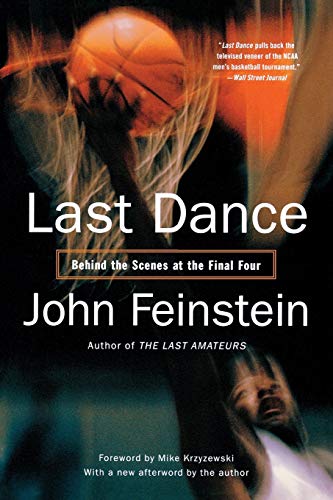
Exploring what it means to be a school, a coach, and a player in college basketball's Final Four, Feinstein exposes the driving forces behind one of the most revered events in American sports. Readers will also find dramatic stories from the officials and referees to the scouts and ticket-scalpers.
Die Inhaltsangabe kann sich auf eine andere Ausgabe dieses Titels beziehen.
Über die Autorin bzw. den Autor
John Feinstein is the author of many widely acclaimed and bestselling books on sports, including One on One, Moment of Glory, Are You Kidding Me?, Living on the Black, Tales from Q School, Last Dance, Next Man Up, Let Me Tell You a Story (with Red Auerbach), Caddy for Life, Open, The Punch, The Last Amateurs, The Majors, A Good Walk Spoiled, A Civil War, A Season on the Brink, Play Ball, and Hard Courts. He is also the author of five sports mystery novels for young readers. He writes for the Washington Post, Washingtonpost.com, and Golf Digest, and is a regular commentator on The Golf Channel.
Auszug. © Genehmigter Nachdruck. Alle Rechte vorbehalten.
Last Dance
By John FeinsteinLittle, Brown
Copyright © 2006 John FeinsteinAll right reserved.
ISBN: 978-0-316-01425-0
Introduction
Mike KrzyzewskiTHERE WAS A TIME, a few years back, when it was very difficult for me to go to the Final Four when my team didn't make it there. Part of it, no doubt, was the disappointment I felt because we weren't still playing. I'm probably spoiled because we've made the Final Four on ten occasions since 1986, although I can honestly tell you that I have never taken getting there for granted. Each trip is special.
This past year, after we lost in the round of sixteen to Michigan State, I decided to make the trip to St. Louis. There were some meetings I felt I should attend and some people I wanted to see. As it turned out, making the trip was one of the best things I've done in a long time.
On Sunday morning I attended a new event that the National Association of Basketball Coaches started recently called the Past Presidents Brunch. It is, as you might have guessed, a brunch for all past presidents of the NABC. I was president in 1992, so I was invited.
When I sat down, I found myself next to Bill Foster. I have been given a lot of credit through the years for the success of Duke basketball. What a lot of people don't realize is that the foundation our program is built on was put in place by Bill Foster. In 1974 he became Duke's coach after the worst season in school history. The program was in shambles and Bill had to rebuild in what was, without question, the toughest basketball conference in America. North Carolina State had just won the national championship, North Carolina was coached by Dean Smith, Maryland was strong under Lefty Driesell, and Terry Holland was just arriving to build Virginia into a power. Within four years, Bill turned the program completely around. He recruited players such as Jim Spanarkel, Mike Gminski, Gene Banks, and Kenny Dennard. In 1978 Duke won the ACC Tournament and, with no seniors in the starting lineup (back then, that actually meant something), went all the way to the national championship game before losing to Kentucky.
My first truly great recruiting class included Johnny Dawkins, Mark Alarie, Jay Bilas, and David Henderson. All of them have told me they have memories of that '78 team, that they admired guys like Spanarkel and Gminski and Banks and Dennard, and that those players and that team first put Duke on their radar. If I don't recruit those four players, I'm probably not the coach at Duke today. If Bill Foster hadn't built the team and the program he did, I probably would not have gotten those four players. At that brunch I had a chance to sit and really talk to Bill about what he had to overcome and to tell him how much I appreciated what he had built. I got to look him in the eye and tell him that I honestly believed he deserved at least some of the credit for all that Duke has accomplished in the past twenty years. I think-I hope-that meant something to him.
As I was leaving the brunch, I ran into Marv Harshman. Like Bill Foster, Harshman is retired now, but years ago he was a great coach at the University of Washington. In fact, the first NCAA Tournament game I coached was against a Marv Harshman-coached Washington team in 1984. We lost. Marv and I joked about the fact that he had started me on the road to having the most NCAA Tournament wins of any coach-with a loss.
I walked out of the brunch with a big smile on my face. Being in that room with so many of my colleagues from so many years and so many games was great. But to run into Foster and Harshman, two men who played a role in my life and were great coaches long before anyone thought to ask me to do a commercial for anything, was a great reminder to me of what the Final Four is all about. It is much bigger than the four teams and coaches who have the honor of playing in it in a given year. It has far more scope than three basketball games. It is about much more than wins and losses-although the wins and losses that occur will be remembered forever by the participants.
The Final Four is about understanding how lucky we all are to be part of college basketball. It is about people like me remembering how important Bill Foster and Marv Harshman are, not to mention John Wooden and Big House Gaines and Bill Russell and Bill Bradley and Dean Smith and John Thompson. And so many others. There's a tendency during the course of a basketball season for a coach to crawl into the cocoon of his team and the day-to-day, game-to-game pressures. Sometimes in April I feel a little bit like someone who has been locked in a cave all winter and I find myself blinking at the glare of Life Beyond Basketball. When I'm not still coaching at the Final Four-and, believe me, I prefer the years when I am still coaching-being there is a bridge back to reality. I'm reminded there's more to basketball than our practices, our games, and our rivalries. In spite of what some people might believe, Duke-Carolina is not the game's only great rivalry, although it is a pretty damn good one.
My first memories of the Final Four go back to listening to games on the radio as a kid growing up in Chicago. I always watched the Big Ten game of the week on television when I was young and I often went to games in the old Chicago Stadium. For some reason, a game I saw there between Duke and Notre Dame sticks out in my memory. Maybe there was some fate involved in that.
The first team I really remember well, though, is the Loyola of Chicago team that won the national championship in 1963. Those games, particularly the championship game against Cincinnati, stand out. I remember having the sense that what Loyola had done was a big deal even though I couldn't actually watch the games.
When I played at Army for Bob Knight in the late '60s, the National Invitation Tournament was as big a deal in our minds as the NCAAs were. My three years as a college player coincided with Lew Alcindor's three years at UCLA. (Alcindor, of course, later became Kareem Abdul-Jabbar.) I remember it sort of being accepted that no one was going to beat UCLA. We had very good teams at Army and we badly wanted to win a championship. In 1968 we were 20-4 and invited to the NCAAs. We knew we weren't going to beat UCLA and Alcindor, but we honestly thought we could win the NIT. So, Coach Knight decided to take the NIT bid. Unfortunately, we lost to Notre Dame (on St. Patrick's Day, as I am constantly reminded even now). The next year we went back to the NIT and shocked South Carolina, which had been ranked number two in the national polls for a lot of the season, in the quarterfinals before losing in the semis to Boston College.
My first Final Four was in 1973. I was still in the army but back home on leave in March. I had already talked to Coach Knight about joining his staff when I got out of the army the following year and I flew to St. Louis to watch Indiana play UCLA in the semifinals. I remember thinking then how big the event was and how amazing it was to stand in the lobby of the coaches' hotel and watch the parade of famous coaches as they came and went during the weekend. I didn't get to see Bill Walton shoot 21 of 22 for UCLA because I had to report back to my unit soon after the semifinals. I'm not sure if I'm right about this, but I don't think I would have been able to stay even if Indiana had won on Saturday.
A little more than a year later, I went to work for Coach Knight as a graduate assistant. That was the first year [1975] that he coached a team that went undefeated in the regular season. Unfortunately, Scott...
„Über diesen Titel“ kann sich auf eine andere Ausgabe dieses Titels beziehen.
Suchergebnisse für Last Dance: Behind the Scenes at the Final Four

Beispielbild für diese ISBN
Last Dance: Behind the Scenes at the Final Four
Verlag:
Little, Brown Paperbacks, 2007
ISBN 10: 0316014257
ISBN 13: 9780316014250
Gebraucht
Paperback
Anbieter: World of Books (was SecondSale), Montgomery, IL, USA
Verkäuferbewertung 5 von 5 Sternen

Paperback. Zustand: Good. There is no event in sports quite like the Final Four. John Feinstein will explore what it means to a school, a coach and a player to be in the Final Four or even at The Final. There are moving stories of players and coaches who thought they'd never make it to college basketball's final weekend, spectacular triumphs of the winning teams and heartbreaking defeat of those who missed the cut. He also brings us inspiring and dramatic stories from people behind the scenes: from officials and referees to scouts and ticket-scalpers. With the unflinching eye of a seasoned reporter and the remarkable skill of a true storyteller, Feinstein exposes the driving force behind one of the most revered events in American sports. Artikel-Nr. 00087781562
Gebraucht kaufen
EUR 4,53
Versand gratis
Versand innerhalb von USA
Versand innerhalb von USA
Anzahl: 7 verfügbar
Beispielbild für diese ISBN
Last Dance: Behind the Scenes at the Final Four
Verlag:
Little, Brown Paperbacks, 2007
ISBN 10: 0316014257
ISBN 13: 9780316014250
Gebraucht
Paperback
Anbieter: World of Books (was SecondSale), Montgomery, IL, USA
Verkäuferbewertung 5 von 5 Sternen
Paperback. Zustand: Fair. There is no event in sports quite like the Final Four. John Feinstein will explore what it means to a school, a coach and a player to be in the Final Four or even at The Final. There are moving stories of players and coaches who thought they'd never make it to college basketball's final weekend, spectacular triumphs of the winning teams and heartbreaking defeat of those who missed the cut. He also brings us inspiring and dramatic stories from people behind the scenes: from officials and referees to scouts and ticket-scalpers. With the unflinching eye of a seasoned reporter and the remarkable skill of a true storyteller, Feinstein exposes the driving force behind one of the most revered events in American sports. Artikel-Nr. 00050896070
Gebraucht kaufen
EUR 4,53
Versand gratis
Versand innerhalb von USA
Versand innerhalb von USA
Anzahl: 3 verfügbar
Beispielbild für diese ISBN
Last Dance
Verlag:
Back Bay Books (edition Reprint), 2007
ISBN 10: 0316014257
ISBN 13: 9780316014250
Gebraucht
Paperback
Anbieter: BooksRun, Philadelphia, PA, USA
Verkäuferbewertung 5 von 5 Sternen
Paperback. Zustand: Very Good. Reprint. It's a well-cared-for item that has seen limited use. The item may show minor signs of wear. All the text is legible, with all pages included. It may have slight markings and/or highlighting. Artikel-Nr. 0316014257-11-1
Gebraucht kaufen
EUR 4,59
Versand gratis
Versand innerhalb von USA
Versand innerhalb von USA
Anzahl: 1 verfügbar
Beispielbild für diese ISBN
Last Dance
Verlag:
Little, Brown Paperbacks (edition Reprint), 2007
ISBN 10: 0316014257
ISBN 13: 9780316014250
Gebraucht
Paperback
Anbieter: BooksRun, Philadelphia, PA, USA
Verkäuferbewertung 5 von 5 Sternen
Paperback. Zustand: Very Good. Reprint. It's a well-cared-for item that has seen limited use. The item may show minor signs of wear. All the text is legible, with all pages included. It may have slight markings and/or highlighting. Artikel-Nr. 0316014257-8-1
Gebraucht kaufen
EUR 4,89
Versand gratis
Versand innerhalb von USA
Versand innerhalb von USA
Anzahl: 1 verfügbar
Beispielbild für diese ISBN
Last Dance : Behind the Scenes at the Final Four
Anbieter: Better World Books: West, Reno, NV, USA
Verkäuferbewertung 5 von 5 Sternen
Zustand: Good. Reprint. Former library copy. Pages intact with minimal writing/highlighting. The binding may be loose and creased. Dust jackets/supplements are not included. Includes library markings. Stock photo provided. Product includes identifying sticker. Better World Books: Buy Books. Do Good. Artikel-Nr. 39820169-75
Gebraucht kaufen
EUR 6,21
Versand gratis
Versand innerhalb von USA
Versand innerhalb von USA
Anzahl: 1 verfügbar
Beispielbild für diese ISBN
Last Dance : Behind the Scenes at the Final Four
Anbieter: Better World Books, Mishawaka, IN, USA
Verkäuferbewertung 5 von 5 Sternen
Zustand: Very Good. Reprint. Pages intact with possible writing/highlighting. Binding strong with minor wear. Dust jackets/supplements may not be included. Stock photo provided. Product includes identifying sticker. Better World Books: Buy Books. Do Good. Artikel-Nr. GRP76410171
Gebraucht kaufen
EUR 6,21
Versand gratis
Versand innerhalb von USA
Versand innerhalb von USA
Anzahl: 1 verfügbar
Beispielbild für diese ISBN
Last Dance
Anbieter: Wonder Book, Frederick, MD, USA
Verkäuferbewertung 5 von 5 Sternen
Zustand: Very Good. Very Good condition. A copy that may have a few cosmetic defects. May also contain light spine creasing or a few markings such as an owner's name, short gifter's inscription or light stamp. Artikel-Nr. Z07A-03194
Gebraucht kaufen
EUR 6,45
Versand gratis
Versand innerhalb von USA
Versand innerhalb von USA
Anzahl: 1 verfügbar
Beispielbild für diese ISBN
Last Dance
Anbieter: Wonder Book, Frederick, MD, USA
Verkäuferbewertung 5 von 5 Sternen
Zustand: Good. Good condition. A copy that has been read but remains intact. May contain markings such as bookplates, stamps, limited notes and highlighting, or a few light stains. Artikel-Nr. E21A-11366
Gebraucht kaufen
EUR 6,45
Versand gratis
Versand innerhalb von USA
Versand innerhalb von USA
Anzahl: 1 verfügbar
Beispielbild für diese ISBN
Last Dance
Anbieter: ThriftBooks-Dallas, Dallas, TX, USA
Verkäuferbewertung 5 von 5 Sternen
Paperback. Zustand: Fair. No Jacket. Readable copy. Pages may have considerable notes/highlighting. ~ ThriftBooks: Read More, Spend Less. Artikel-Nr. G0316014257I5N00
Gebraucht kaufen
EUR 6,58
Versand gratis
Versand innerhalb von USA
Versand innerhalb von USA
Anzahl: 1 verfügbar
Beispielbild für diese ISBN
Last Dance
Anbieter: ThriftBooks-Dallas, Dallas, TX, USA
Verkäuferbewertung 5 von 5 Sternen
Paperback. Zustand: As New. No Jacket. Pages are clean and are not marred by notes or folds of any kind. ~ ThriftBooks: Read More, Spend Less. Artikel-Nr. G0316014257I2N00
Gebraucht kaufen
EUR 6,58
Versand gratis
Versand innerhalb von USA
Versand innerhalb von USA
Anzahl: 1 verfügbar