
Verwandte Artikel zu Afterburn
Inhaltsangabe
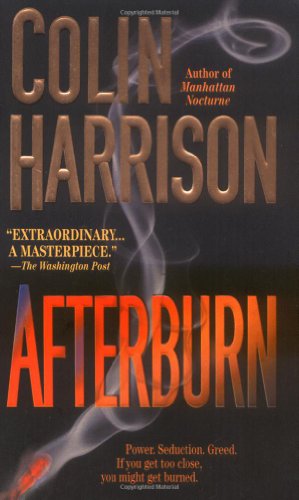
In a thriller set on Manhattan's Upper East Side, a former Vietnam POW-turned-wealthy international executive, whose family is beset by life-threatening illnesses, meets a beautiful but troubled female ex-con, and their lives are turned upside down. Reprint.
Die Inhaltsangabe kann sich auf eine andere Ausgabe dieses Titels beziehen.
Über die Autorin bzw. den Autor
Colin Harrison is the deputy editor of Harper's and the author of Bodies Electric, Break and Enter, and Manhattan Nocturne. He lives with his wife, novelist Kathryn Harrison, in Brooklyn.
^Colin Harrison is the deputy editor of Harper's Magazine.^
COLLIN HARRISON is the deputy editor of Harper's and the author of Bodies Electric, Break and Enter, and Manhattan Nocturne. He lives with his wife, novelist Kathryn Harrison, in Brooklyn.
Auszug. © Genehmigter Nachdruck. Alle Rechte vorbehalten.
Afterburn
CHINA CLUB, HONG KONG
SEPTEMBER 7, 1999
HE WOULD SURVIVE. Oh shit, yes, Charlie promised himself, he'd survive this, too--his ninth formal Chinese banquet in as many evenings, yet another bowl of shark-fin soup being passed to him by the endless waiters in red uniforms, who stood obsequiously against the silk wallpaper pretending not to hear the self-satisfied ravings of those they served. Except for his fellow gweilos--British Petroleum's Asia man, a mischievous German from Lufthansa, and two young American executives from Kodak and Citigroup--the other dozen men at the huge circular mahogany table were all Chinese. Mostly in their fifties, the men represented the big corporate players--Bank of Asia, Hong Kong Telecom, Hang Seng Bank, China Motors--and each, Charlie noted, had arrived at the age of cleverness. Of course, at fifty-eight he himself was old enough that no one should be able to guess what he was thinking unless he wanted them to, even Ellie. In his call to her that morning--it being evening in New York City--he'd tried not to sound too worried about Julia. "It's all going to be fine, sweetie," he'd promised, gazing out at the choppy haze of Hong Kong's harbor, where the heavy traffic of tankers and freighters and barges pressed China's claim--everything from photocopiers to baseball caps flowing out into the world, everything from oil refineries to contact lenses flowing in. "She'll get pregnant, I'm sure," he'd told Ellie. But he wasn't sure. No, not at all. In fact, it looked as if it was going to be easier for him to build his electronics factory in Shanghai than for his daughter to hatch a baby.
"We gather in friendship," announced the Chinese host, Mr. Ming, the vice-chairman of the Bank of Asia. Havingagreed to lend Charlie fifty-two million U.S. dollars to build his Shanghai factory, Mr. Ming in no way could be described as a friend; the relationship was one of overlord and indentured. But this was to be expected, and Charlie smiled along with the others as the banker stood and presented in high British English an analysis of southeastern China's economy that was so shallow, optimistic, and full of euphemism that no one, especially the central ministries in Beijing, might object. The Chinese executives nodded politely as Mr. Ming spoke, touching their napkins to their lips, smiling vaguely. Of course, they nursed secret worries--worries that corresponded to whether they were entrepreneurs (who had built shipping lines or real-estate empires or garment factories) or the managers of institutional power (who controlled billions of dollars not their own). Privately the entrepreneurs disdained the tedious, risk-adverse probity of the managers, who, in turn, stood burdened by the institutional reputations of the dead. True, the managers had not made something from nothing, but they had carried bucket upon bucket of obeisance to nurture a gigantus. As with the distinction between a sapling and an ancient tree, their spreading, limb-heavy corporations had known fierce political winds, diseases of managerial orthodoxy, the insect-hollowing of internal bureaucracy. And yet, Charlie decided, the men were finally more like one another than unlike; each long ago had learned to sell high (1997) and buy low (1998), and had passed the threshold of unspendable wealth, such riches conforming them in their behaviors; each owned more houses or paintings or Rolls-Royces than could be admired or used at once. Each played golf or tennis passably well; each had purchased a Canadian or British passport; each possessed a forty-million-dollar yacht, or a forty-million-dollar home atop Victoria's Peak, or a forty-million-dollar wife. Like the wealthy businessmen on New York's East Side, the Chinese executives hired more or less the same doctors and antique dealers and feng shui mystics to advise them. Each had a slender young Filipino or Russian or Czech mistresstucked away in one of Hong Kong's luxury apartment buildings--ticking her lips if requested--or had a secure phone line to one of the ministry buildings in Beijing, or was betting against the Hong Kong dollar while insisting on its firmness--any of the costly mischief in which rich men indulge.
The men at the table, in fact, as much as any men, sat as money incarnate, particularly the American dollar, the euro, and the Japanese yen--all simultaneously, and all hedged against fluctuations of the others. But although the men were money, money was not them; money assumed any shape or color or politics, it could be fire or stone or dream, it could summon armies or bind atoms, and, indifferent to the sufferings of the mortal soul, it could leave or arrive at any time. And on this exact night, Charlie thought, setting his ivory chopsticks neatly upon the lacquered plate while nodding to the uniformed boy to take it away--on this very night he could see that although money had assumed the shapes of the men in the room (including him, of course--his shoes, his dental work, his very shit), it existed in differing densities and volumes and brightnesses. Whereas Charlie was a man of perhaps thirty or thirty-three million dollars of wealth, that sum amounted to shoe-shine change in the present company. No sir, money, in that room, in that moment, was understood as inconsequential in sums less than one hundred million dollars, and of political importance only when five times more. Money, in fact, found its greatest compression and gravity in the form of the tiny man sitting silently across from Charlie--Sir Henry Lai, the Oxford-educated Chinese gambling mogul, owner of a fleet of jet-foil ferries, a dozen hotels, and most of the casinos of Macao and Vietnam. Worth billions--and billions more.
But, Charlie wondered, perhaps he was wrong. He could think of one shape that money had not yet assumed, although quite a bit of it had been spent, perhaps a hundred thousand dollars in all. Money animated the dapper Chinese businessman across from him, but could it arrive in theworld as Charlie's own grandchild? This was the question he feared most, this was the question that had eaten at him and at Ellie for years now, and which would soon be answered: In a few hours, Julia would tell them once and forever if she was capable of having a baby.
She had suffered through cycle upon cycle of disappointment--hundreds of shots of fertility drugs followed by the needle-recovery of the eggs, the inspection of the eggs, the selection of the eggs, the insemination of the eggs (recorded on videotape--another needle squirting into a dish), the implantation of the eggs (also recorded on tape with an ultrasound screen), the anticipation of the eggs. My eggs, my eggs--Julia's sad mantra. She'd been trying for seven years. The blockage of her fallopian tubes might be due, she'd said, to her use of an IUD years prior. Abortion, Charlie knew, could also cause the problem, but he'd never asked and his daughter had never told. Now Julia, a woman of only thirty-five, a little gray already salting her hair, was due to get the final word. At 11:00 a.m. Manhattan time, she'd sit in her law office and be told the results of this, the last in vitro attempt. Her ninth. Three more than the doctor preferred to do. Seven more than the insurance company would pay for. Almost as if she was trying for all of them, after what had happened to Ben, trying to bring new life to the family. Good news would be that one of the reinserted fertilized eggs had decided to cling to the wall of Julia's uterus. Bad news: There was no chance of conception; egg donorship or adoption must now be considered. And if that was the news, well then, that was really goddamn something. It would mean not just that his only daughter was heartbroken, but that, genetically speaking, he, Charlie Ravich, was finished, that his...
„Über diesen Titel“ kann sich auf eine andere Ausgabe dieses Titels beziehen.
Suchergebnisse für Afterburn

Beispielbild für diese ISBN
Afterburn
Anbieter: World of Books (was SecondSale), Montgomery, IL, USA
Verkäuferbewertung 5 von 5 Sternen

Zustand: Good. Charlie Ravich is an international corporate tycoon, a husband and father on the hard side of fifty, and a restless soul in search of immortality. When Christina Welles, a prison parolee, well-schooled in the art of manipulation, walks into his life, Charlie thinks he just might have found what he's looking for. As she tries to outrun her past, and he to understand his future, two obsessions are about to be indulged. Artikel-Nr. 00087387220
Gebraucht kaufen
EUR 3,22
Versand gratis
Versand innerhalb von USA
Versand innerhalb von USA
Anzahl: 2 verfügbar
Beispielbild für diese ISBN
Afterburn
Anbieter: Better World Books, Mishawaka, IN, USA
Verkäuferbewertung 5 von 5 Sternen
Zustand: Good. Pages intact with minimal writing/highlighting. The binding may be loose and creased. Dust jackets/supplements are not included. Stock photo provided. Product includes identifying sticker. Better World Books: Buy Books. Do Good. Artikel-Nr. 39509910-6
Gebraucht kaufen
EUR 6,18
Versand gratis
Versand innerhalb von USA
Versand innerhalb von USA
Anzahl: 2 verfügbar
Beispielbild für diese ISBN
Afterburn: A Novel
Anbieter: ThriftBooks-Atlanta, AUSTELL, GA, USA
Verkäuferbewertung 5 von 5 Sternen
Unknown. Zustand: Fair. No Jacket. Readable copy. Pages may have considerable notes/highlighting. ~ ThriftBooks: Read More, Spend Less. Artikel-Nr. G0312978707I5N00
Gebraucht kaufen
EUR 6,41
Versand gratis
Versand innerhalb von USA
Versand innerhalb von USA
Anzahl: 1 verfügbar
Beispielbild für diese ISBN
Afterburn
Verlag:
St Martins Pr, New York, New York, U.S.A., 2001
ISBN 10: 0312978707
ISBN 13: 9780312978709
Gebraucht
Paperback
Anbieter: The Yard Sale Store, Narrowsburg, NY, USA
Verkäuferbewertung 5 von 5 Sternen
Paperback. Zustand: Good. RELIABLE Pocketbook style paperback in very nice condition. TIGHT!! Some shelf wear and a bit of crease at the spine. A useful edition. PRESENTABLE! Artikel-Nr. 200751700000030
Gebraucht kaufen
EUR 2,76
EUR 5,32 Versand
Versand innerhalb von USA
Versand innerhalb von USA
Anzahl: 1 verfügbar