
Verwandte Artikel zu Afterimage
Inhaltsangabe
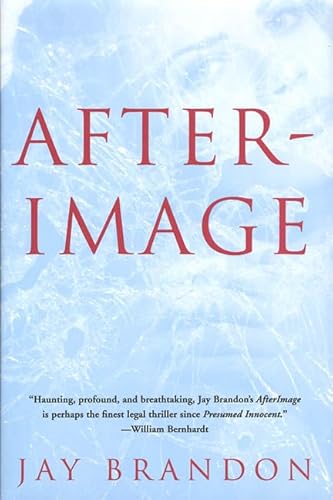
A body unearthed from a shallow grave outside of San Antonio looks suspiciously like a woman District Attorney Chris Sinclair knew in college and turns out to be, in fact, the woman's daughter.
Die Inhaltsangabe kann sich auf eine andere Ausgabe dieses Titels beziehen.
Über die Autorin bzw. den Autor
Jay Brandon is the author of twelve critically acclaimed novels, including the Edgar Award-nominated Fade the Heat. As an attorney, Brandon has practiced at the highest criminal court in Texas, the Court of Criminal Appeals. He continues to practice family and criminal law. Brandon lives in San Antonio with his wife and three children.
Auszug. © Genehmigter Nachdruck. Alle Rechte vorbehalten.
Afterimage
1
She was more beautiful than thy first love, But now lies under boards.
--from "A Dream of Death," by W. B. Yeats
One
Some days justice nods off. Certainly there are times when the Bexar County Justice Center hibernates. Sometimes one could set off a shrapnel grenade in a hallway and not injure anyone. On such days, usually late afternoons, judges are hard to find, prosecutors have drifted back to their offices or out of the building altogether, and lawyers who do happen to meet in the echoing corridors look at each other shamefacedly, as if to say, What are we doing here? It is a failure of sorts just to be in the building.
The Justice Center had recently experienced a series of such days: Thanksgiving week, Christmas week, the dead end of the year. But now January had arrived, forcing the building unwillingly back to life. Jurors had been called, the courts resumed business, lawyers, defendants, and cops lined the halls. Still, justice hadn't entirely climbed back up to speed. The plea-bargaining between prosecutors and defense lawyers exhibited a desultory, let's-put-this-off-until-I-feel-more-up-to-it quality, and hardly any trials had actually got off the ground yet. So when the District Attorney of Bexar County appeared in a courtroom, people took notice.
The District Attorney, Chris Sinclair, not only entered the courtroom, he walked straight to the front and took his place at the prosecution's table. A few minutes later when the judge ofthe court, Betty Willis, called a case name, Chris stood and announced, "The State is ready."
At thirty-five, Christian Sinclair looked too young to be the District Attorney, but he had been for two years. He was of medium height, but looked taller standing at the front of the courtroom, where the lights caught his blond hair and strong forehead. His mouth, usually quick to twitch toward a smile, locked in a grim line as he gazed steadily across the space inside the bar, to where a defendant and his lawyer slowly made their way to the defense table.
A reporter who had spotted the District Attorney in the hall and followed him into the courtroom frowned and hurried to the front of the spectator seats to get a look at the defendant and his lawyer. The reporter knew of no big cases going to trial during this half-speed week. But if the District Attorney himself was prosecuting, it must be a big one.
However, the case didn't immediately demonstrate its largeness, and in a moment it became clear that it wouldn't even be going to trial today. "Ready on the motion to suppress," said the defendant's tall, distinguished-looking lawyer. Lowell Burke, the veteran defense lawyer, projected confidence, an appearance that sprang from his habitual air of detachment, as if he had more important business elsewhere. Some defense lawyers appear indistinguishable from their clients, huddling together as they plot a defense. Burke disdained that school of behavior. His steady gaze at the trial judge said that he had come here on a matter of law, and oh yes, that crook at his side? He was only an essential tool of the legal trade--not, certainly, a friend of Burke's.
The reporter who had come forward to watch the action became more curious. Lowell Burke didn't take appointed cases and he didn't come cheap. This defendant obviously had money--or had had money before he'd walked into Burke's office. But he didn't look it. The reporter hadn't recognized the defendant's name when the judge called it: something Belasco. The defendant was a young man in his mid-twenties with very pale skin, ragged fingernails, and slicked-back hair. His dark suit fit him well and gave him elegant lines. Trust Lowell Burke tohave his client well turned out. The young defendant wore the expensive clothing as if accustomed to it, but there was still something relentlessly late-night about his appearance. He didn't look like old money and he didn't look like earned money. The reporter waited to hear what he'd been charged with.
Judge Willis, in her mid-sixties, made a formidable impression on the bench, with her plump cheeks and bright lips. "Call your first witness," she said.
Chris Sinclair demonstrated a Bexar County oddity by saying to the bailiff, "Officer Reynolds, please." This hearing sprang out of a motion to suppress evidence, which was a defense motion, so the defense bore the burden of proof, and should have gone first in putting on evidence. But in Bexar County the prosecution had an easier time producing police witnesses, through its liaisons with the police department, and so for years had assumed the responsibility of bringing police officers to such hearings. Somehow with that burden the prosecution had also assumed the right to go forward first with evidence.
The young uniformed officer marched swiftly up the aisle of the courtroom, creaking with leather and authority, his chin lifted with all the confidence of twenty-four years of life and a year and a half of police experience. He responded with a clipped, "I do," to the judge's giving him the oath, and took his seat in the witness stand. He looked straight at the District Attorney as he'd been instructed to do.
Holding his witness's gaze, Chris said, "State your name and occupation."
"Josh Reynolds, police officer, Terrell Hills Police Department."
After another couple of preliminary questions, Chris asked, "Officer, where were you on the evening of November 8 of last year?"
"I was outside a home on Tuttle Road in Terrell Hills."
"Were you on duty?"
"I was on duty and in uniform, but in an unmarked car, parked several houses down the street from the house we were surveilling."
Hearing the word "surveillance" used as a verb tended to make Chris Sinclair flinch, even as often as he'd heard cops do it. He let it pass, unsurprised at hearing young Officer Reynolds spout jargon.
"Was anyone with you, Officer?"
"Yes sir, there were a team of us, led by a detective from San Antonio PD Narcotics Unit."
"Was this a narcotics operation?"
"Yes sir, but they needed local support since the suspects had turned up in Terrell Hills. That's why I was there."
Terrell Hills, a very small incorporated suburb completely surrounded by the city of San Antonio, had an average income level that rose much higher than San Antonio's did. The suburb also had a small police force with more experience at keeping the peace than at drug stings.
Chris asked, "Why did you have this one particular house under surveillance, Officer?"
"We had information that some suspects--"
Lowell Burke stirred himself for the first time and rose to his feet with no appearance of haste. "Objection, Your Honor. This sounds like hearsay."
"Sustained," Judge Willis ruled. In the courtroom Betty Willis displayed an absolutely blank demeanor. She strove so hard to appear impartial that she'd developed the habit of not looking at anyone. The judge stared off at the back wall of the courthouse, like Lady Justice unblindfolded but unseeing nevertheless. Young prosecutors had expressed the urge to jump up and wave their hands through her line of sight to see if she'd react.
Chris continued unperturbed. "As you sat in your car with the narcotics detective and other officers, what were you waiting for?"
"We were waiting for a signal from inside the house, sir. We had a man inside."
In Officer Reynolds's recounting of the tale, the operation had become his. Chris continued, "How were you to receive a signal?"
The officer answered with exaggerated care, as if the District Attorney were venturing onto dangerous ground. "The person inside was wearing a hidden mike,...
„Über diesen Titel“ kann sich auf eine andere Ausgabe dieses Titels beziehen.
Suchergebnisse für Afterimage

Beispielbild für diese ISBN
Afterimage
Verlag:
Tor Publishing Group, 2000
ISBN 10: 0312865422
ISBN 13: 9780312865429
Gebraucht
Hardcover
Erstausgabe
Anbieter: Better World Books, Mishawaka, IN, USA
Verkäuferbewertung 5 von 5 Sternen

Zustand: Good. 1st. Former library copy. Pages intact with minimal writing/highlighting. The binding may be loose and creased. Dust jackets/supplements are not included. Includes library markings. Stock photo provided. Product includes identifying sticker. Better World Books: Buy Books. Do Good. Artikel-Nr. 9158548-6
Gebraucht kaufen
EUR 6,36
Versand gratis
Versand innerhalb von USA
Versand innerhalb von USA
Anzahl: 2 verfügbar
Beispielbild für diese ISBN
Afterimage (Chris Sinclair)
Anbieter: Wonder Book, Frederick, MD, USA
Verkäuferbewertung 5 von 5 Sternen
Zustand: Good. Good condition. Good dust jacket. A copy that has been read but remains intact. May contain markings such as bookplates, stamps, limited notes and highlighting, or a few light stains. Artikel-Nr. J11F-01768
Gebraucht kaufen
EUR 6,43
Versand gratis
Versand innerhalb von USA
Versand innerhalb von USA
Anzahl: 1 verfügbar
Beispielbild für diese ISBN
Afterimage (Chris Sinclair)
Anbieter: ThriftBooks-Atlanta, AUSTELL, GA, USA
Verkäuferbewertung 5 von 5 Sternen
Hardcover. Zustand: Fair. No Jacket. Former library book; Readable copy. Pages may have considerable notes/highlighting. ~ ThriftBooks: Read More, Spend Less. Artikel-Nr. G0312865422I5N10
Gebraucht kaufen
EUR 7,34
Versand gratis
Versand innerhalb von USA
Versand innerhalb von USA
Anzahl: 1 verfügbar
Beispielbild für diese ISBN
Afterimage
Verlag:
Forge, New York, New York, U.S.A., 2000
ISBN 10: 0312865422
ISBN 13: 9780312865429
Gebraucht
Hardcover
Anbieter: The Yard Sale Store, Narrowsburg, NY, USA
Verkäuferbewertung 5 von 5 Sternen
Hard Cover. Zustand: Good. Cover has a forward lean. RELIABLE library withdrawal in the plastic, protective covers. Stamped at the page edge with a card pocket removed from the last inside cover page leaving a mark. Some scuff to the covers and the page edge. Spot of soil on the last inside cover page. Artikel-Nr. AUERNov17VI9
Gebraucht kaufen
EUR 2,11
EUR 5,33 Versand
Versand innerhalb von USA
Versand innerhalb von USA
Anzahl: 1 verfügbar