
Verwandte Artikel zu Substitute Teaching: A Handbook for Hassle-Free Subbing
Inhaltsangabe
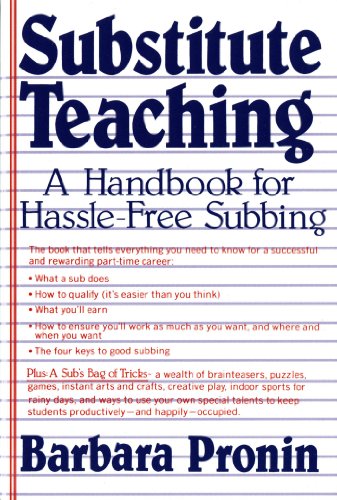
The book that tells everything you need to know for a successful and rewarding part-time career:
What a sub does
How to qualify (it's easier than you think)
What you'll earn
How to ensure you'll work as much as you want, and where and when you want
The four keys to good subbing
Plus: A sub's bag of tricks-a wealth of brainteasers, puzzles, games, instant arts and crafts, creative play, indoor sports for rainy days, and ways to use your own special talents to keep students productively-and happily-occupied.
Die Inhaltsangabe kann sich auf eine andere Ausgabe dieses Titels beziehen.
Über die Autorin bzw. den Autor
Barbara Pronin is the author of seven mystery novels, including three as Barbara Nickolae, and two non-fiction books. When a short article about women of the Dutch resistance in WW II caught her eye, the character of Evi Strobel moved into her head and refused to leave until she told her story. A former Brooklynite who loves dark chocolate, Greek sunsets, and the L.A. (nee Brooklyn) Dodgers, Barbara lives and works in Orange County, California, where, when she isn't writing fiction, she struggles at her spinet piano and writes about real estate.
Auszug. © Genehmigter Nachdruck. Alle Rechte vorbehalten.
Substitute Teaching
A Handbook for Hassle-Free Subbing
By Barbara ProninSt. Martin's Press
Copyright © 1983 Barbara Pronin
All rights reserved.
ISBN: 978-0-312-77484-4All rights reserved.
Contents
Title Page,
INTRODUCTION,
PART ONE - The ABCs of Subbing,
1. - What Does a Sub Do?,
2. - Can I Qualify?,
3. - How Much Can I Earn?,
4. - Where Do I Begin?,
5. - A Look at Today's Classroom,
6. - Choosing the Grade Level for Me,
7. - Learning Basic Procedures,
PART TWO - In the Classroom on Your Own,
8. - Four Keys to Good Subbing,
9. - On a Typical Day,
10. - Your Day from Start to Finish (K-6),
11. - The Junior and Senior High School Day,
PART THREE - A Bag of Tricks,
12. - Timefillers in the Bag,
13. - Brainteasers,
14. - Instant Arts and Crafts,
15. - Creative Play,
16. - Indoor Sports for Rainy Days,
17. - Using Your Own Special Talents,
PART FOUR - Where Do I Go from Here?,
18. - A Chart for Self-Evaluation,
19. - Ideas for Growth and Sharing,
20. - On Subbing,
Epilogue,
APPENDIX A - SOURCES FOR MORE BRIGHT IDEAS,
APPENDIX B - GOOD READING,
INDEX,
Copyright Page,
CHAPTER 1
What Does a Sub Do?
Let me go on record as saying here and now that substitute teaching is fun. It is necessary to like children, of course, and to be open-minded and flexible enough to face new classes daily. But if you are a reasonably friendly, outgoing person with a general knowledge of the basic subject areas, you have the attributes.
As you might expect from the term "substitute teacher," the sub is a stand-in for the regular teacher in any given classroom on any given day.
Whether the regular teacher is out sick, attending a conference, or stuck in a snowstorm on the slopes of Aspen, every school district must have at hand a roster of people — familiarly dubbed as "subs" — who can, at very short notice, step into the classroom and take over the duties of the teacher.
It comes as no news to most of us that the American population is shrinking. The high cost of living and our concern for the welfare of future generations is resulting in smaller families. Schools are closing here and there because of lower student enrollment, and newly certified teachers sometimes have difficulty finding jobs.
Yet, in a recent questionnaire sent at random to more than a hundred school districts nationwide, one hundred percent responded overwhelmingly that they have an ongoing need for substitutes! Someone must stand at the head of each class when the regular teacher is out.
But what does the sub do?
Since the primary obligation of every teacher is to teach, you are correct in assuming that you, as a sub, will be expected to instruct students in all of the basic subject areas from first grade penmanship to high school algebra depending upon the grade level of the teacher you are replacing.
Does this mean that you must be a whiz in every subject? That the intricacies of trigonometry must be as easy for you as simple addition? Of course not. What it does mean is that you should be aware of the kinds of subject matter taught at the various grade levels and have a passing acquaintance with them.
You must also be aware of the differences in attitude and behavior at various grade levels so that you can determine which age groups you will be most comfortable with as a sub.
In a later chapter we will discuss these academic and behavioral differences in detail so that you can make an intelligent decision about where you would most like to be. For now, suffice it to say that, yes, you will be expected to teach.
You will be expected, too, to maintain control of the class. While quiet times are still necessary and desirable — as during the taking of tests, for example, or when all students are working on a simultaneous assignment — the days of silent classrooms many of us remember from our youths have more or less gone the way of white buck shoes and poodle skirts.
Today's classrooms, as we shall see, are often active and multilevel. That is, more than one grade level may be represented in a room or the children may be grouped according to their skill. While this is efficient in terms of learning, it can also mean that you must have eyes in the back of your head (remember the way your mother did?).
When you are not accustomed to dealing with thirty children at once it takes a keen eye and a cool head to develop firm organization. You need to know what's going on in all corners of the classroom for the day to progress in a smooth and orderly fashion.
As one sub recently told me, "The first time I worked with a special reading group I told the rest of the class to read silently to themselves and I assumed they would do just that. By the time I looked up to call the second group forward, there was bedlam — and I hadn't even realized!"
Before long, you will discover that the surest way to keep "bedlam" from your door is to keep students busy and happily occupied, especially when you need to work with individual groups. Timefillers (Chapter 12) and a little common sense will help.
You must become familiar with standard school procedures such as fire drills, playground rules, and the like, for you will be expected to supervise and enforce them. A later chapter will steer you toward learning these basic procedures before you enter the classroom. When the appropriate bell sounds, you should instruct the children about its meaning, not the other way around.
You will perform whatever extra duties the regular teacher was scheduled to perform on a given day. The task of supervising children during recesses and lunch hour, and in the lunchroom itself, is often divided among staff members who may give up a portion of their own free time on a rotating basis in order to do it. While it may seem that teachers are absent only on rainy days when they have bus duty, rest assured this minor inconvenience comes with the territory.
If the teacher was scheduled to attend a staff meeting you may be required to attend in his or her place, taking adequate notes.
In kindergarten through sixth grade classrooms (K-6), particularly where students are in the same room all day, you may find yourself with blocks of unscheduled time, which you will be expected to fill with choices of your own.
Every absentee teacher leaves a lesson plan of some sort for the substitute's use. This may be in the form of a note to you or on a schedule listed in the plan book. Needless to say, some lesson plans are far more complete and detailed than others.
At those times when the daily lesson plan is skimpy or is altered for some reason — for example, band practice is canceled or a scheduled film does not arrive — you may have free time on your hands. Subs are encouraged to use this time to introduce their own projects and activities.
Part Three of this book is filled with hundreds of indoor and outdoor ideas to help you use free time happily and creatively and to get you started using your own special talents and skills to fill your bag of tricks.
Last but not least you will be expected to behave in an ethical and professional manner. You will arrive on time and stay until your tasks are complete. You will dress in a manner befitting a teacher, uphold the district rules for health and safety, and use school property and materials with care.
You will treat each school, each class, each...
„Über diesen Titel“ kann sich auf eine andere Ausgabe dieses Titels beziehen.
Suchergebnisse für Substitute Teaching: A Handbook for Hassle-Free Subbing

Beispielbild für diese ISBN
Substitute Teaching: A Handbook for Hassle-Free Subbing
Verlag:
St. Martin's Griffin (edition 6th ed.), 1983
ISBN 10: 0312774842
ISBN 13: 9780312774844
Gebraucht
Paperback
Anbieter: BooksRun, Philadelphia, PA, USA
Verkäuferbewertung 5 von 5 Sternen

Paperback. Zustand: Very Good. 6th ed. It's a well-cared-for item that has seen limited use. The item may show minor signs of wear. All the text is legible, with all pages included. It may have slight markings and/or highlighting. Artikel-Nr. 0312774842-11-22
Gebraucht kaufen
EUR 5,13
Versand gratis
Versand innerhalb von USA
Versand innerhalb von USA
Anzahl: 1 verfügbar
Beispielbild für diese ISBN
Substitute Teaching A Handbook
Anbieter: World of Books (was SecondSale), Montgomery, IL, USA
Verkäuferbewertung 5 von 5 Sternen
Zustand: Very Good. Item in very good condition! Textbooks may not include supplemental items i.e. CDs, access codes etc. Artikel-Nr. 00110090840
Gebraucht kaufen
EUR 5,48
Versand gratis
Versand innerhalb von USA
Versand innerhalb von USA
Anzahl: 3 verfügbar
Beispielbild für diese ISBN
Substitute Teaching: A Handbook for Hassle-Free Subbing
Anbieter: ThriftBooks-Atlanta, AUSTELL, GA, USA
Verkäuferbewertung 5 von 5 Sternen
Paperback. Zustand: Very Good. No Jacket. May have limited writing in cover pages. Pages are unmarked. ~ ThriftBooks: Read More, Spend Less. Artikel-Nr. G0312774842I4N00
Gebraucht kaufen
EUR 6,09
Versand gratis
Versand innerhalb von USA
Versand innerhalb von USA
Anzahl: 1 verfügbar
Beispielbild für diese ISBN
Substitute Teaching: A Handbook for Hassle-Free Subbing
Anbieter: ThriftBooks-Dallas, Dallas, TX, USA
Verkäuferbewertung 5 von 5 Sternen
Paperback. Zustand: Good. No Jacket. Pages can have notes/highlighting. Spine may show signs of wear. ~ ThriftBooks: Read More, Spend Less. Artikel-Nr. G0312774842I3N00
Gebraucht kaufen
EUR 6,09
Versand gratis
Versand innerhalb von USA
Versand innerhalb von USA
Anzahl: 1 verfügbar
Beispielbild für diese ISBN
Substitute Teaching
Anbieter: Wonder Book, Frederick, MD, USA
Verkäuferbewertung 5 von 5 Sternen
Zustand: Very Good. Very Good condition. A copy that may have a few cosmetic defects. May also contain light spine creasing or a few markings such as an owner's name, short gifter's inscription or light stamp. Artikel-Nr. I06D-01155
Gebraucht kaufen
EUR 6,40
Versand gratis
Versand innerhalb von USA
Versand innerhalb von USA
Anzahl: 2 verfügbar
Beispielbild für diese ISBN
Substitute Teaching
Anbieter: Wonder Book, Frederick, MD, USA
Verkäuferbewertung 5 von 5 Sternen
Zustand: Good. Good condition. A copy that has been read but remains intact. May contain markings such as bookplates, stamps, limited notes and highlighting, or a few light stains. Artikel-Nr. V07B-04617
Gebraucht kaufen
EUR 6,40
Versand gratis
Versand innerhalb von USA
Versand innerhalb von USA
Anzahl: 1 verfügbar
Beispielbild für diese ISBN
Substitute Teaching : A Handbook for Hassle-Free Subbing
Anbieter: Better World Books, Mishawaka, IN, USA
Verkäuferbewertung 5 von 5 Sternen
Zustand: Good. Pages intact with minimal writing/highlighting. The binding may be loose and creased. Dust jackets/supplements are not included. Stock photo provided. Product includes identifying sticker. Better World Books: Buy Books. Do Good. Artikel-Nr. GRP98618783
Gebraucht kaufen
EUR 6,54
Versand gratis
Versand innerhalb von USA
Versand innerhalb von USA
Anzahl: 2 verfügbar
Beispielbild für diese ISBN
Substitute Teaching : A Handbook for Hassle-Free Subbing
Anbieter: Better World Books, Mishawaka, IN, USA
Verkäuferbewertung 5 von 5 Sternen
Zustand: Fine. Used book that is in almost brand-new condition. May contain a remainder mark. Better World Books: Buy Books. Do Good. Artikel-Nr. 54608899-6
Gebraucht kaufen
EUR 6,54
Versand gratis
Versand innerhalb von USA
Versand innerhalb von USA
Anzahl: 1 verfügbar
Beispielbild für diese ISBN
Substitute Teaching : A Handbook for Hassle-Free Subbing
Anbieter: Better World Books Ltd, Dunfermline, Vereinigtes Königreich
Verkäuferbewertung 5 von 5 Sternen
Zustand: Very Good. Pages intact with possible writing/highlighting. Binding strong with minor wear. Dust jackets/supplements may not be included. Stock photo provided. Product includes identifying sticker. Better World Books: Buy Books. Do Good. Artikel-Nr. 2266559-6
Gebraucht kaufen
EUR 8,30
EUR 5,88 Versand
Versand von Vereinigtes Königreich nach USA
Versand von Vereinigtes Königreich nach USA
Anzahl: 1 verfügbar