
Verwandte Artikel zu Common Sense Economics: What Everyone Should Know About...
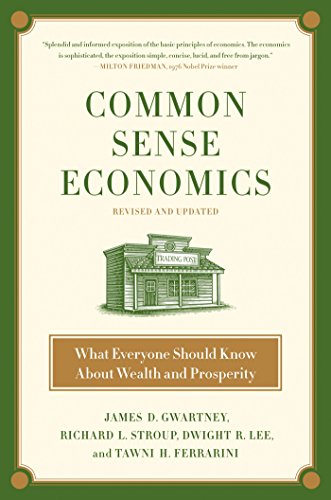
Inhaltsangabe
"The authors tell us what everyone should know about economics in language we can all understand. It's refreshing when four of the best in the profession avoid the all-too-common practice of writing in a code that only other economists can comprehend." ---Robert McTeer, former president of the Federal Reserve Bank of Dallas
With the global economy recovering from a steep recession, those who fail to grasp basic economic principles such as gains from trade, the role of profit and loss, and the secondary effects of government spending, taxes, and borrowing risk falling behind in their professional careers--even their personal lives. Common Sense Economics discusses key principles and uses them to show how to make wise personal and policy choices.
This new edition of a classic from James D. Gwartney, Richard L. Stroup, Dwight R. Lee, and Tawni H. Ferrarini, with reflections on the recent recession and the policy response to it, illuminates our world and what might be done to make it better.
Die Inhaltsangabe kann sich auf eine andere Ausgabe dieses Titels beziehen.
Über die Autorin bzw. den Autor
James D. Gwartney holds the Gus A. Stavros Eminent Scholar Chair at Florida State University and is the director of the Stavros Center for the Advancement of Free Enterprise and Economic Education.
Richard L. Stroup is the author of Eco-Nomics and an adjunct professor of economics at North Carolina State University.
Dwight R. Lee is coauthor of Getting Rich in America and holds the William J. O'Neil Chair of Global Markets and Freedom at Southern Methodist University.
Tawni H. Ferrarini is the Sam M. Cohodas Professor of Economics and the Director of the Center for Economic Education and Entrepreneurship at Northern Michigan University.
Auszug. © Genehmigter Nachdruck. Alle Rechte vorbehalten.
Common Sense Economics
What Everyone Should Know About Wealth and ProsperityBy James D. GwartneySt. Martin's Press
Copyright © 2010 James D. GwartneyAll right reserved.
ISBN: 9780312644895
Introduction
Life is about choices, and economics is about how incentives affect those choices and shape our lives. Choices about education, how we spend and invest, what we do in the workplace, and many other personal decisions will influence our well-being and quality of life. Moreover, the choices we make as voters and citizens affect the laws or “rules of the game,” and these rules exert an enormous impact on our freedom and prosperity. To choose intelligently, both for ourselves and for society generally, we must understand some basic principles about how people choose, what motivates their actions, and how their actions influence their personal welfare and that of others. Thus, economics is about human decision making, the analysis of the forces underlying choice, and the implications with regard to how societies work.
The following section introduces twelve key concepts that are crucial to the understanding of how our economy works. The reader will learn such things as the true meaning of costs, why prices matter, how trade furthers prosperity, and why production of things people value underpins our standard of living. In a fraction of the time devoted to Economics 101, you can pick up most of its important lessons. In subsequent sections you will use these concepts to address other vitally important topics.
1. Incentives Matter.
All of economics rests on one simple principle: Changes in incentives influence human behavior in predictable ways. Both monetary and non-monetary factors influence incentives. If something becomes more costly, people will be less likely to choose it. Correspondingly, when an option becomes more attractive, people will be more likely to choose it. This simple idea, sometimes called the basic postulate of economics, is a powerful tool because it applies to almost everything that we do.
People will be less likely to choose an option as it becomes more costly. Think about the implications of this proposition. When late for an appointment, a person will be less likely to take time to stop and visit with a friend. Fewer people will go picnicking on a cold and rainy day. Higher prices will reduce the number of units sold. Attendance in college classes will be below normal the day before spring break. In each case, the explanation is the same: As the option becomes more costly, less is chosen.
Similarly, when the payoff derived from a choice increases, people will be more likely to choose it. A person will be more likely to bend over and pick up a quarter than a penny. Students will attend and pay more attention in class when the material is covered extensively on exams. Customers will buy more from stores that offer low prices, high quality service, and a convenient location. Employees will work harder and more efficiently when they are rewarded for doing so. All of these outcomes are highly predictable and they merely reflect the “incentives matter” postulate of economics.
This basic postulate explains how changes in market prices alter incentives in a manner that works to coordinate the actions of buyers and sellers. If buyers want to purchase more of an item than producers are willing (or able) to sell, its price will soon rise. As the price increases, sellers will be more willing to provide the item while buyers purchase fewer, until the higher price brings the amount demanded and the amount supplied into balance. At that point the price stabilizes.
What happens if it starts out the other way? If an item’s price is too high, suppliers will have to lower the price in order to sell it. The lower price will encourage people to buy more—but it will also discourage producers from producing as much, since at the new, lower price it will be less profitable to supply the product. Again, the price change works to bring the amount demanded by consumers into balance with the amount produced by suppliers. At that point there is no further pressure for a price change.
Remember the record high nominal gas prices in the summer of 2008? While a lot of people felt the pain of higher prices at the pump, there was no panic in the streets or lines at the gas pumps. Why? When the higher prices made it more costly to purchase gasoline, most consumers eliminated some less important trips. Others arranged more carpooling. With time, consumers also shifted to smaller, more fuel-efficient cars in order to reduce their gasoline bills. As buyers reacted to higher gas prices, so did sellers. The oil companies supplying gasoline increased their drilling, adopted new techniques to recover more oil from existing wells, and intensified their search for new oil fields. The higher price helped to keep the quantity supplied in line with the quantity demanded. Eventually, the prices of both crude oil and gasoline fell as supply expanded over time.
Incentives also influence political choices. There is little reason to believe that a person making choices in the voting booth will behave much differently than when making choices in the shopping mall. In most cases voters are more likely to support political candidates and policies that they believe will provide them with the most personal benefits, net of their costs. They will tend to oppose political options when the personal costs are high compared to the benefits they expect to receive. For example, polls indicated that nonunion members were overwhelmingly opposed to exempting union members from health care taxes that non-members and others were required to pay. Similarly, senior citizens have voted numerous times against candidates and proposals that would reduce their Medicare benefits.
There’s no way to get around the importance of incentives. It’s a part of human nature. Interestingly, incentives matter just as much under socialism as under capitalism. In the former Soviet Union, managers and employees of glass plants were at one time rewarded according to the tons of sheet glass they produced. Because their revenues depended on the weight of the glass, most factories produced sheet glass so thick that you could hardly see through it. The rules were changed so that the managers were compensated according to the number of square meters of glass they could produce. Under these rules, Soviet firms made glass so thin that it broke easily.
Some people think that incentives matter only when people are greedy and selfish. That’s not true. People act for a variety of reasons, some selfish and some charitable. The choices of both the self-centered and altruistic will be influenced by changes in personal costs and benefits. For example, both the selfish and the altruistic will be more likely to attempt to rescue a child in a shallow swimming pool than in the rapid currents approaching Niagara Falls. And both are more likely to give a needy person their hand-me-downs rather than their best clothes.
Even though no one would have accused the late Mother Teresa of greediness, her self-interest caused her to respond to incentives, too. When Mother Teresa’s organization, the Missionaries of Charity, attempted to open a shelter for the homeless in New York City, the city required expensive (but unneeded) alterations to its building. The organization abandoned the project. This decision did not reflect any change in Mother Teresa’s commitment to the poor. Instead, it reflected a change in incentives. When the cost of...
Life is about choices, and economics is about how incentives affect those choices and shape our lives. Choices about education, how we spend and invest, what we do in the workplace, and many other personal decisions will influence our well-being and quality of life. Moreover, the choices we make as voters and citizens affect the laws or “rules of the game,” and these rules exert an enormous impact on our freedom and prosperity. To choose intelligently, both for ourselves and for society generally, we must understand some basic principles about how people choose, what motivates their actions, and how their actions influence their personal welfare and that of others. Thus, economics is about human decision making, the analysis of the forces underlying choice, and the implications with regard to how societies work.
The following section introduces twelve key concepts that are crucial to the understanding of how our economy works. The reader will learn such things as the true meaning of costs, why prices matter, how trade furthers prosperity, and why production of things people value underpins our standard of living. In a fraction of the time devoted to Economics 101, you can pick up most of its important lessons. In subsequent sections you will use these concepts to address other vitally important topics.
1. Incentives Matter.
All of economics rests on one simple principle: Changes in incentives influence human behavior in predictable ways. Both monetary and non-monetary factors influence incentives. If something becomes more costly, people will be less likely to choose it. Correspondingly, when an option becomes more attractive, people will be more likely to choose it. This simple idea, sometimes called the basic postulate of economics, is a powerful tool because it applies to almost everything that we do.
People will be less likely to choose an option as it becomes more costly. Think about the implications of this proposition. When late for an appointment, a person will be less likely to take time to stop and visit with a friend. Fewer people will go picnicking on a cold and rainy day. Higher prices will reduce the number of units sold. Attendance in college classes will be below normal the day before spring break. In each case, the explanation is the same: As the option becomes more costly, less is chosen.
Similarly, when the payoff derived from a choice increases, people will be more likely to choose it. A person will be more likely to bend over and pick up a quarter than a penny. Students will attend and pay more attention in class when the material is covered extensively on exams. Customers will buy more from stores that offer low prices, high quality service, and a convenient location. Employees will work harder and more efficiently when they are rewarded for doing so. All of these outcomes are highly predictable and they merely reflect the “incentives matter” postulate of economics.
This basic postulate explains how changes in market prices alter incentives in a manner that works to coordinate the actions of buyers and sellers. If buyers want to purchase more of an item than producers are willing (or able) to sell, its price will soon rise. As the price increases, sellers will be more willing to provide the item while buyers purchase fewer, until the higher price brings the amount demanded and the amount supplied into balance. At that point the price stabilizes.
What happens if it starts out the other way? If an item’s price is too high, suppliers will have to lower the price in order to sell it. The lower price will encourage people to buy more—but it will also discourage producers from producing as much, since at the new, lower price it will be less profitable to supply the product. Again, the price change works to bring the amount demanded by consumers into balance with the amount produced by suppliers. At that point there is no further pressure for a price change.
Remember the record high nominal gas prices in the summer of 2008? While a lot of people felt the pain of higher prices at the pump, there was no panic in the streets or lines at the gas pumps. Why? When the higher prices made it more costly to purchase gasoline, most consumers eliminated some less important trips. Others arranged more carpooling. With time, consumers also shifted to smaller, more fuel-efficient cars in order to reduce their gasoline bills. As buyers reacted to higher gas prices, so did sellers. The oil companies supplying gasoline increased their drilling, adopted new techniques to recover more oil from existing wells, and intensified their search for new oil fields. The higher price helped to keep the quantity supplied in line with the quantity demanded. Eventually, the prices of both crude oil and gasoline fell as supply expanded over time.
Incentives also influence political choices. There is little reason to believe that a person making choices in the voting booth will behave much differently than when making choices in the shopping mall. In most cases voters are more likely to support political candidates and policies that they believe will provide them with the most personal benefits, net of their costs. They will tend to oppose political options when the personal costs are high compared to the benefits they expect to receive. For example, polls indicated that nonunion members were overwhelmingly opposed to exempting union members from health care taxes that non-members and others were required to pay. Similarly, senior citizens have voted numerous times against candidates and proposals that would reduce their Medicare benefits.
There’s no way to get around the importance of incentives. It’s a part of human nature. Interestingly, incentives matter just as much under socialism as under capitalism. In the former Soviet Union, managers and employees of glass plants were at one time rewarded according to the tons of sheet glass they produced. Because their revenues depended on the weight of the glass, most factories produced sheet glass so thick that you could hardly see through it. The rules were changed so that the managers were compensated according to the number of square meters of glass they could produce. Under these rules, Soviet firms made glass so thin that it broke easily.
Some people think that incentives matter only when people are greedy and selfish. That’s not true. People act for a variety of reasons, some selfish and some charitable. The choices of both the self-centered and altruistic will be influenced by changes in personal costs and benefits. For example, both the selfish and the altruistic will be more likely to attempt to rescue a child in a shallow swimming pool than in the rapid currents approaching Niagara Falls. And both are more likely to give a needy person their hand-me-downs rather than their best clothes.
Even though no one would have accused the late Mother Teresa of greediness, her self-interest caused her to respond to incentives, too. When Mother Teresa’s organization, the Missionaries of Charity, attempted to open a shelter for the homeless in New York City, the city required expensive (but unneeded) alterations to its building. The organization abandoned the project. This decision did not reflect any change in Mother Teresa’s commitment to the poor. Instead, it reflected a change in incentives. When the cost of...
„Über diesen Titel“ kann sich auf eine andere Ausgabe dieses Titels beziehen.
Suchergebnisse für Common Sense Economics: What Everyone Should Know About...

Beispielbild für diese ISBN
Common Sense Economics: What Everyone Should Know about Wealth and Prosperity
Anbieter: World of Books (was SecondSale), Montgomery, IL, USA
Verkäuferbewertung 5 von 5 Sternen

Hardback. Zustand: Good. With the global economy recovering from a steep recession, and with that recovery challenging our long-held ideas about what careers and the market can be, learning the basics of economics has never been more essential. Principles such as gains from trade, the role of profit and loss, and the secondary effects of government spending, taxes, and borrowing risk continue to be critically important to the way America's economy functions, and critically important to understand for those hoping to further their professional lives - even their personal lives. Common Sense Economics discusses key points and theories, using them to show how any reader can make wiser personal choices and form more informed positions on policy. Now in its third edition, this fully updated classic from James D. Gwartney, Richard L. Stroup, Dwight R. Lee, and Tawni H. Ferrarini reflects on the recession and the progress that's been made since the crash; it offers insight into political processes and the many ways in which economics informs policy, illuminating our world and what might be done to make it better. Artikel-Nr. 00109641314
Gebraucht kaufen
EUR 4,53
Versand gratis
Versand innerhalb von USA
Versand innerhalb von USA
Anzahl: 5 verfügbar
Beispielbild für diese ISBN
Common Sense Economics: What Everyone Should Know About Wealth and Prosperity
Anbieter: World of Books (was SecondSale), Montgomery, IL, USA
Verkäuferbewertung 5 von 5 Sternen
Zustand: Very Good. Item in very good condition! Textbooks may not include supplemental items i.e. CDs, access codes etc. Artikel-Nr. 00109421492
Gebraucht kaufen
EUR 4,53
Versand gratis
Versand innerhalb von USA
Versand innerhalb von USA
Anzahl: 2 verfügbar
Beispielbild für diese ISBN
Common Sense Economics: What Everyone Should Know about Wealth and Prosperity
Anbieter: World of Books (was SecondSale), Montgomery, IL, USA
Verkäuferbewertung 5 von 5 Sternen
Hardback. Zustand: Fair. With the global economy recovering from a steep recession, and with that recovery challenging our long-held ideas about what careers and the market can be, learning the basics of economics has never been more essential. Principles such as gains from trade, the role of profit and loss, and the secondary effects of government spending, taxes, and borrowing risk continue to be critically important to the way America's economy functions, and critically important to understand for those hoping to further their professional lives - even their personal lives. Common Sense Economics discusses key points and theories, using them to show how any reader can make wiser personal choices and form more informed positions on policy. Now in its third edition, this fully updated classic from James D. Gwartney, Richard L. Stroup, Dwight R. Lee, and Tawni H. Ferrarini reflects on the recession and the progress that's been made since the crash; it offers insight into political processes and the many ways in which economics informs policy, illuminating our world and what might be done to make it better. Artikel-Nr. 00106950409
Gebraucht kaufen
EUR 4,53
Versand gratis
Versand innerhalb von USA
Versand innerhalb von USA
Anzahl: 3 verfügbar
Beispielbild für diese ISBN
Common Sense Economics: What Everyone Should Know About Wealth and Prosperity
ISBN 10: 0312644892
ISBN 13: 9780312644895
Gebraucht
Hardcover
Anbieter: BooksRun, Philadelphia, PA, USA
Verkäuferbewertung 5 von 5 Sternen
Hardcover. Zustand: Fair. Second Edition, Revised, Updated. With dust jacket. The item might be beaten up but readable. May contain markings or highlighting, as well as stains, bent corners, or any other major defect, but the text is not obscured in any way. Artikel-Nr. 0312644892-7-1-29
Gebraucht kaufen
EUR 4,62
Versand gratis
Versand innerhalb von USA
Versand innerhalb von USA
Anzahl: 1 verfügbar
Beispielbild für diese ISBN
Common Sense Economics : What Everyone Should Know about Wealth and Prosperity
Anbieter: Better World Books: West, Reno, NV, USA
Verkäuferbewertung 5 von 5 Sternen
Zustand: Very Good. Former library copy. Pages intact with possible writing/highlighting. Binding strong with minor wear. Dust jackets/supplements may not be included. Includes library markings. Stock photo provided. Product includes identifying sticker. Better World Books: Buy Books. Do Good. Artikel-Nr. GRP104736906
Gebraucht kaufen
EUR 6,20
Versand gratis
Versand innerhalb von USA
Versand innerhalb von USA
Anzahl: 2 verfügbar
Beispielbild für diese ISBN
Common Sense Economics : What Everyone Should Know about Wealth and Prosperity
Anbieter: Better World Books: West, Reno, NV, USA
Verkäuferbewertung 5 von 5 Sternen
Zustand: Good. Former library copy. Pages intact with minimal writing/highlighting. The binding may be loose and creased. Dust jackets/supplements are not included. Includes library markings. Stock photo provided. Product includes identifying sticker. Better World Books: Buy Books. Do Good. Artikel-Nr. 405768-20
Gebraucht kaufen
EUR 6,20
Versand gratis
Versand innerhalb von USA
Versand innerhalb von USA
Anzahl: 3 verfügbar
Beispielbild für diese ISBN
Common Sense Economics : What Everyone Should Know about Wealth and Prosperity
Anbieter: Better World Books: West, Reno, NV, USA
Verkäuferbewertung 5 von 5 Sternen
Zustand: Good. Pages intact with minimal writing/highlighting. The binding may be loose and creased. Dust jackets/supplements are not included. Stock photo provided. Product includes identifying sticker. Better World Books: Buy Books. Do Good. Artikel-Nr. 4047716-6
Gebraucht kaufen
EUR 6,20
Versand gratis
Versand innerhalb von USA
Versand innerhalb von USA
Anzahl: 1 verfügbar
Beispielbild für diese ISBN
Common Sense Economics : What Everyone Should Know about Wealth and Prosperity
Anbieter: Better World Books, Mishawaka, IN, USA
Verkäuferbewertung 5 von 5 Sternen
Zustand: Very Good. Former library copy. Pages intact with possible writing/highlighting. Binding strong with minor wear. Dust jackets/supplements may not be included. Includes library markings. Stock photo provided. Product includes identifying sticker. Better World Books: Buy Books. Do Good. Artikel-Nr. GRP104736906
Gebraucht kaufen
EUR 6,20
Versand gratis
Versand innerhalb von USA
Versand innerhalb von USA
Anzahl: 1 verfügbar
Beispielbild für diese ISBN
Common Sense Economics : What Everyone Should Know about Wealth and Prosperity
Anbieter: Better World Books, Mishawaka, IN, USA
Verkäuferbewertung 5 von 5 Sternen
Zustand: Good. Pages intact with minimal writing/highlighting. The binding may be loose and creased. Dust jackets/supplements are not included. Stock photo provided. Product includes identifying sticker. Better World Books: Buy Books. Do Good. Artikel-Nr. 4047716-6
Gebraucht kaufen
EUR 6,20
Versand gratis
Versand innerhalb von USA
Versand innerhalb von USA
Anzahl: 1 verfügbar
Beispielbild für diese ISBN
Common Sense Economics : What Everyone Should Know about Wealth and Prosperity
Anbieter: Better World Books, Mishawaka, IN, USA
Verkäuferbewertung 5 von 5 Sternen
Zustand: Good. Former library copy. Pages intact with minimal writing/highlighting. The binding may be loose and creased. Dust jackets/supplements are not included. Includes library markings. Stock photo provided. Product includes identifying sticker. Better World Books: Buy Books. Do Good. Artikel-Nr. 405768-20
Gebraucht kaufen
EUR 6,20
Versand gratis
Versand innerhalb von USA
Versand innerhalb von USA
Anzahl: 4 verfügbar