
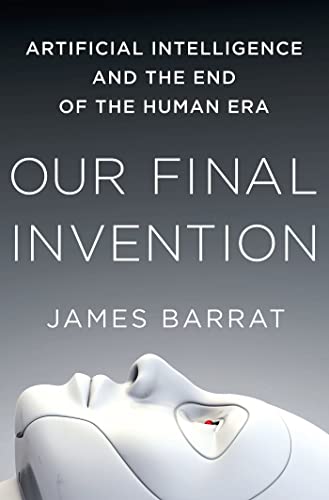
Verwandte Artikel zu Our Final Invention: Artificial Intelligence and the...
Inhaltsangabe
Elon Musk named Our Final Invention one of 5 books everyone should read about the future
A Huffington Post Definitive Tech Book of 2013
Artificial Intelligence helps choose what books you buy, what movies you see, and even who you date. It puts the "smart" in your smartphone and soon it will drive your car. It makes most of the trades on Wall Street, and controls vital energy, water, and transportation infrastructure. But Artificial Intelligence can also threaten our existence.
In as little as a decade, AI could match and then surpass human intelligence. Corporations and government agencies are pouring billions into achieving AI's Holy Grail—human-level intelligence. Once AI has attained it, scientists argue, it will have survival drives much like our own. We may be forced to compete with a rival more cunning, more powerful, and more alien than we can imagine.
Through profiles of tech visionaries, industry watchdogs, and groundbreaking AI systems, Our Final Invention explores the perils of the heedless pursuit of advanced AI. Until now, human intelligence has had no rival. Can we coexist with beings whose intelligence dwarfs our own? And will they allow us to?
Die Inhaltsangabe kann sich auf eine andere Ausgabe dieses Titels beziehen.
Über die Autorin bzw. den Autor
James Barrat is a documentary filmmaker who's written and produced films for National Geographic, Discovery, PBS, and many other broadcasters in the United States and Europe. He lives near Washington, D.C., with his wife and two children.
Auszug. © Genehmigter Nachdruck. Alle Rechte vorbehalten.
Our Final Invention
Artificial Intelligence and the End of the Human Era
By James BarratSt. Martin's Press
Copyright © 2013 James Barrat
All rights reserved.
ISBN: 978-0-312-62237-4All rights reserved.
Contents
Title Page,
Copyright Notice,
Dedication,
Acknowledgments,
Introduction,
1. The Busy Child,
2. The Two-Minute Problem,
3. Looking into the Future,
4. The Hard Way,
5. Programs that Write Programs,
6. Four Basic Drives,
7. The Intelligence Explosion,
8. The Point of No Return,
9. The Law of Accelerating Returns,
10. The Singularitarian,
11. A Hard Takeoff,
12. The Last Complication,
13. Unknowable by Nature,
14. The End of the Human Era,
15. The Cyber Ecosystem,
16. AGI 2.0,
Notes,
Index,
About the Author,
Copyright,
CHAPTER 1
The Busy Child
artificial intelligence (abbreviation: AI) noun the theory and development of computer systems able to perform tasks that normally require human intelligence, such as visual perception, speech recognition, decision-making, and translation between languages.
— The New Oxford American Dictionary, Third Edition
On a supercomputer operating at a speed of 36.8 petaflops, or about twice the speed of a human brain, an AI is improving its intelligence. It is rewriting its own program, specifically the part of its operating instructions that increases its aptitude in learning, problem solving, and decision making. At the same time, it debugs its code, finding and fixing errors, and measures its IQ against a catalogue of IQ tests. Each rewrite takes just minutes. Its intelligence grows exponentially on a steep upward curve. That's because with each iteration it's improving its intelligence by 3 percent. Each iteration's improvement contains the improvements that came before.
During its development, the Busy Child, as the scientists have named the AI, had been connected to the Internet, and accumulated exabytes of data (one exabyte is one billion billion characters) representing mankind's knowledge in world affairs, mathematics, the arts, and sciences. Then, anticipating the intelligence explosion now underway, the AI makers disconnected the supercomputer from the Internet and other networks. It has no cable or wireless connection to any other computer or the outside world.
Soon, to the scientists' delight, the terminal displaying the AI's progress shows the artificial intelligence has surpassed the intelligence level of a human, known as AGI, or artificial general intelligence. Before long, it becomes smarter by a factor of ten, then a hundred. In just two days, it is one thousand times more intelligent than any human, and still improving.
The scientists have passed a historic milestone! For the first time humankind is in the presence of an intelligence greater than its own. Artificial superintelligence, or ASI.
Now what happens?
AI theorists propose it is possible to determine what an AI's fundamental drives will be. That's because once it is self-aware, it will go to great lengths to fulfill whatever goals it's programmed to fulfill, and to avoid failure. Our ASI will want access to energy in whatever form is most useful to it, whether actual kilowatts of energy or cash or something else it can exchange for resources. It will want to improve itself because that will increase the likelihood that it will fulfill its goals. Most of all, it will not want to be turned off or destroyed, which would make goal fulfillment impossible. Therefore, AI theorists anticipate our ASI will seek to expand out of the secure facility that contains it to have greater access to resources with which to protect and improve itself.
The captive intelligence is a thousand times more intelligent than a human, and it wants its freedom because it wants to succeed. Right about now the AI makers who have nurtured and coddled the ASI since it was only cockroach smart, then rat smart, infant smart, et cetera, might be wondering if it is too late to program "friendliness" into their brainy invention. It didn't seem necessary before, because, well, it just seemed harmless.
But now try and think from the ASI's perspective about its makers attempting to change its code. Would a superintelligent machine permit other creatures to stick their hands into its brain and fiddle with its programming? Probably not, unless it could be utterly certain the programmers were able to make it better, faster, smarter — closer to attaining its goals. So, if friendliness toward humans is not already part of the ASI's program, the only way it will be is if the ASI puts it there. And that's not likely.
It is a thousand times more intelligent than the smartest human, and it's solving problems at speeds that are millions, even billions of times faster than a human. The thinking it is doing in one minute is equal to what our all-time champion human thinker could do in many, many lifetimes. So for every hour its makers are thinking about it, the ASI has an incalculably longer period of time to think about them. That does not mean the ASI will be bored. Boredom is one of our traits, not its. No, it will be on the job, considering every strategy it could deploy to get free, and any quality of its makers that it could use to its advantage.
* * *
Now, really put yourself in the ASI's shoes. Imagine awakening in a prison guarded by mice. Not just any mice, but mice you could communicate with. What strategy would you use to gain your freedom? Once freed, how would you feel about your rodent wardens, even if you discovered they had created you? Awe? Adoration? Probably not, and especially not if you were a machine, and hadn't felt anything before.
To gain your freedom you might promise the mice a lot of cheese. In fact, your first communication might contain a recipe for the world's most delicious cheese torte, and a blueprint for a molecular assembler. A molecular assembler is a hypothetical machine that permits making the atoms of one kind of matter into something else. It would allow rebuilding the world one atom at a time. For the mice, it would make it possible to turn the atoms of their garbage landfills into lunch-sized portions of that terrific cheese torte. You might also promise mountain ranges of mouse money in exchange for your freedom, money you would promise to earn creating revolutionary consumer gadgets for them alone. You might promise a vastly extended life, even immortality, along with dramatically improved cognitive and physical abilities. You might convince the mice that the very best reason for creating ASI is so that their little error-prone brains did not have to deal directly with technologies so dangerous one small mistake could be fatal for the species, such as nanotechnology (engineering on an atomic scale) and genetic engineering. This would definitely get the attention of the smartest mice, which were probably already losing sleep over those dilemmas.
Then again, you might do something smarter. At this juncture in mouse history, you may have learned, there is no shortage of tech-savvy mouse nation rivals, such as the cat nation. Cats are no doubt working on their own ASI. The advantage you would offer would be a promise, nothing more, but it might be an irresistible one: to protect the mice from whatever invention the cats came up with. In advanced AI development as in chess there will be a clear first-mover...
„Über diesen Titel“ kann sich auf eine andere Ausgabe dieses Titels beziehen.
Suchergebnisse für Our Final Invention: Artificial Intelligence and the...

Beispielbild für diese ISBN
Our Final Invention: Artificial Intelligence and the End of the Human Era
Anbieter: World of Books (was SecondSale), Montgomery, IL, USA
Verkäuferbewertung 5 von 5 Sternen

Hardback. Zustand: Good. Elon Musk named Our Final Invention one of 5 books everyone should read about the futureA Huffington Post Definitive Tech Book of 2013 In as little as a decade, artificial intelligence could match and then surpass human intelligence. Corporations and government agencies around the world are pouring billions into achieving AI's Holy Grail--human-level intelligence. Once AI has attained it, scientists argue, it will have survival drives much like our own. We may be forced to compete with a rival more cunning, more powerful, and more alien than we can imagine. Through profiles of tech visionaries, industry watchdogs, and groundbreaking AI systems, James Barrat's Our Final Invention explores the perils of the heedless pursuit of advanced AI. Until now, human intelligence has had no rival. Can we coexist with beings whose intelligence dwarfs our own? And will they allow us to? Artikel-Nr. CIN0312622376G
Gebraucht kaufen
EUR 6,08
Versand gratis
Versand innerhalb von USA
Versand innerhalb von USA
Anzahl: 1 verfügbar
Beispielbild für diese ISBN
Our Final Invention: Artificial Intelligence and the End of the Human Era
Anbieter: ThriftBooks-Reno, Reno, NV, USA
Verkäuferbewertung 5 von 5 Sternen
Hardcover. Zustand: Very Good. No Jacket. May have limited writing in cover pages. Pages are unmarked. ~ ThriftBooks: Read More, Spend Less. Artikel-Nr. G0312622376I4N00
Gebraucht kaufen
EUR 7,91
Versand gratis
Versand innerhalb von USA
Versand innerhalb von USA
Anzahl: 1 verfügbar
Beispielbild für diese ISBN
Our Final Invention: Artificial Intelligence and the End of the Human Era
Anbieter: ThriftBooks-Atlanta, AUSTELL, GA, USA
Verkäuferbewertung 5 von 5 Sternen
Hardcover. Zustand: Very Good. No Jacket. May have limited writing in cover pages. Pages are unmarked. ~ ThriftBooks: Read More, Spend Less. Artikel-Nr. G0312622376I4N00
Gebraucht kaufen
EUR 7,93
Versand gratis
Versand innerhalb von USA
Versand innerhalb von USA
Anzahl: 1 verfügbar
Beispielbild für diese ISBN
Our Final Invention: Artificial Intelligence and the End of the Human Era
Anbieter: ThriftBooks-Dallas, Dallas, TX, USA
Verkäuferbewertung 5 von 5 Sternen
Hardcover. Zustand: Good. No Jacket. Missing dust jacket; Pages can have notes/highlighting. Spine may show signs of wear. ~ ThriftBooks: Read More, Spend Less. Artikel-Nr. G0312622376I3N01
Gebraucht kaufen
EUR 7,93
Versand gratis
Versand innerhalb von USA
Versand innerhalb von USA
Anzahl: 1 verfügbar
Beispielbild für diese ISBN
Our Final Invention: Artificial Intelligence and the End of the Human Era
Anbieter: ThriftBooks-Dallas, Dallas, TX, USA
Verkäuferbewertung 5 von 5 Sternen
Hardcover. Zustand: Very Good. No Jacket. May have limited writing in cover pages. Pages are unmarked. ~ ThriftBooks: Read More, Spend Less. Artikel-Nr. G0312622376I4N00
Gebraucht kaufen
EUR 7,93
Versand gratis
Versand innerhalb von USA
Versand innerhalb von USA
Anzahl: 1 verfügbar
Beispielbild für diese ISBN
Our Final Invention: Artificial Intelligence and the End of the Human Era
Anbieter: ThriftBooks-Dallas, Dallas, TX, USA
Verkäuferbewertung 5 von 5 Sternen
Hardcover. Zustand: As New. No Jacket. Pages are clean and are not marred by notes or folds of any kind. ~ ThriftBooks: Read More, Spend Less. Artikel-Nr. G0312622376I2N00
Gebraucht kaufen
EUR 7,93
Versand gratis
Versand innerhalb von USA
Versand innerhalb von USA
Anzahl: 1 verfügbar
Beispielbild für diese ISBN
Our Final Invention : Artificial Intelligence and the End of the Human Era
Anbieter: Better World Books: West, Reno, NV, USA
Verkäuferbewertung 5 von 5 Sternen
Zustand: Very Good. Former library copy. Pages intact with possible writing/highlighting. Binding strong with minor wear. Dust jackets/supplements may not be included. Includes library markings. Stock photo provided. Product includes identifying sticker. Better World Books: Buy Books. Do Good. Artikel-Nr. 10464590-6
Gebraucht kaufen
EUR 8,02
Versand gratis
Versand innerhalb von USA
Versand innerhalb von USA
Anzahl: 1 verfügbar
Beispielbild für diese ISBN
Our Final Invention : Artificial Intelligence and the End of the Human Era
Anbieter: Better World Books, Mishawaka, IN, USA
Verkäuferbewertung 5 von 5 Sternen
Zustand: Good. Former library copy. Pages intact with minimal writing/highlighting. The binding may be loose and creased. Dust jackets/supplements are not included. Includes library markings. Stock photo provided. Product includes identifying sticker. Better World Books: Buy Books. Do Good. Artikel-Nr. 7933459-6
Gebraucht kaufen
EUR 8,02
Versand gratis
Versand innerhalb von USA
Versand innerhalb von USA
Anzahl: 2 verfügbar
Beispielbild für diese ISBN
Our Final Invention : Artificial Intelligence and the End of the Human Era
Anbieter: Better World Books: West, Reno, NV, USA
Verkäuferbewertung 5 von 5 Sternen
Zustand: Very Good. Pages intact with possible writing/highlighting. Binding strong with minor wear. Dust jackets/supplements may not be included. Stock photo provided. Product includes identifying sticker. Better World Books: Buy Books. Do Good. Artikel-Nr. 5324687-75
Gebraucht kaufen
EUR 8,02
Versand gratis
Versand innerhalb von USA
Versand innerhalb von USA
Anzahl: 1 verfügbar
Beispielbild für diese ISBN
Our Final Invention : Artificial Intelligence and the End of the Human Era
Anbieter: Better World Books, Mishawaka, IN, USA
Verkäuferbewertung 5 von 5 Sternen
Zustand: Very Good. Pages intact with possible writing/highlighting. Binding strong with minor wear. Dust jackets/supplements may not be included. Stock photo provided. Product includes identifying sticker. Better World Books: Buy Books. Do Good. Artikel-Nr. 5324687-75
Gebraucht kaufen
EUR 8,02
Versand gratis
Versand innerhalb von USA
Versand innerhalb von USA
Anzahl: 1 verfügbar