
Verwandte Artikel zu The Hour of Peril: The Secret Plot to Murder Lincoln...
Inhaltsangabe
"It's history that reads like a race-against-the-clock thriller." ―Harlan Coben
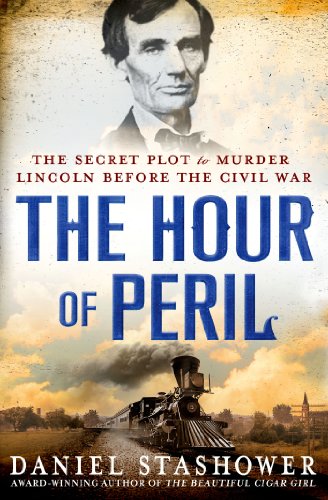
Daniel Stashower, the two-time Edgar award–winning author of The Beautiful Cigar Girl, uncovers the riveting true story of the "Baltimore Plot," an audacious conspiracy to assassinate Abraham Lincoln on the eve of the Civil War in THE HOUR OF PERIL.
In February of 1861, just days before he assumed the presidency, Abraham Lincoln faced a "clear and fully-matured" threat of assassination as he traveled by train from Springfield to Washington for his inauguration. Over a period of thirteen days the legendary detective Allan Pinkerton worked feverishly to detect and thwart the plot, assisted by a captivating young widow named Kate Warne, America's first female private eye.
As Lincoln's train rolled inexorably toward "the seat of danger," Pinkerton struggled to unravel the ever-changing details of the murder plot, even as he contended with the intractability of Lincoln and his advisors, who refused to believe that the danger was real. With time running out Pinkerton took a desperate gamble, staking Lincoln's life―and the future of the nation―on a "perilous feint" that seemed to offer the only chance that Lincoln would survive to become president. Shrouded in secrecy―and, later, mired in controversy―the story of the "Baltimore Plot" is one of the great untold tales of the Civil War era, and Stashower has crafted this spellbinding historical narrative with the pace and urgency of a race-against-the-clock thriller.
A Washington Post Notable Nonfiction Book of 2013
Winner of the 2014 Edgar Award for Best Fact Crime
Winner of the 2013 Agatha Award for Best Nonfiction
Winner of the 2014 Anthony Award for Best Critical or Non-fiction Work
Winner of the 2014 Macavity Award for Best Nonfiction
Die Inhaltsangabe kann sich auf eine andere Ausgabe dieses Titels beziehen.
Über die Autorin bzw. den Autor
DANIEL STASHOWER is an acclaimed biographer and narrative historian and winner of the Edgar, Agatha, and Anthony awards, and the Raymond Chandler Fulbright Fellowship in Detective Fiction. His work has appeared in The New York Times, The Washington Post, Smithsonian Magazine, AARP: The Magazine, and National Geographic Traveler as well as other publications.
Auszug. © Genehmigter Nachdruck. Alle Rechte vorbehalten.
CHAPTER ONE
THE APPRENTICE
Let none falter, who thinks he is right, and we may succeed.
—ABRAHAM LINCOLN, Springfield, Illinois, 1839
THE PECULIAR MARCH OF EVENTS that carried Allan Pinkerton to Baltimore had begun twenty-two years earlier—on the night of November 3, 1839—on a rain-soaked field in South Wales. At that time, Abraham Lincoln was still a young legislator in Illinois, voicing early concern over voting rights and the “injustice and bad policy” of slavery. An ocean away, Pinkerton was also throwing himself at what he called “the higher principles of liberty,” even at the risk of his own freedom.
Pinkerton had traveled hundreds of miles from his home in Glasgow to take his place amid a swelling band of protest marchers as they prepared to descend on the Welsh town of Newport. These “crazed and misguided zealots,” as one newspaper called them, were the vanguard of the Chartist agitation, a working-class labor movement struggling to make its voice heard in Britain. Pinkerton, though barely twenty years old, thought of himself as “the most ardent Chartist in Scotland.”
Ragged and footsore, Pinkerton moved among the demonstrators as they huddled beside campfires, listening to firebrand speeches and waiting for reinforcements that would never come. They were, as Pinkerton himself would admit, a sorry-looking group. A few had tattered blankets pulled tight around their shoulders for protection against a chilling rain; others went barefoot in the squelching mud.
The Chartists’ demands, as spelled out in the “People’s Charter” of 1838, included universal suffrage, equitable pay, and other democratic reforms for Britain’s “toiling class.” Lately, the movement had been split by internal conflict, with one faction espousing nonviolent “moral force” to achieve its goals, and another comprised of “physical force men,” who were prepared—perhaps even eager—to take up arms. Matters came to a crisis in July 1839, when the House of Commons rejected a national petition bearing over a million signatures. The following month saw the charismatic Chartist leader Henry Vincent convicted on conspiracy charges, spurring the physical-force wing of the movement toward a large-scale uprising.
Henry Vincent had been imprisoned at Monmouth Castle, outside of Newport, and it was thought that several other Chartist leaders were being held in the town’s Westgate Hotel. As thousands of marchers, many of them miners and mill workers, massed on the outskirts of town, it became clear that they intended to demonstrate their “fervid passions” to the country at large. Exactly how they intended to do so remains a subject of debate. Many believe that the marchers planned to storm the Westgate Hotel and free the prisoners they thought were inside. Others contend that a massive demonstration was planned to secure the release of Henry Vincent from his castle cell, perhaps signaling a nationwide uprising in support of the Chartist agenda. In any event, there were iron pikes and muskets in the hands of many of the marchers, suggesting that their intent could not have been entirely peaceful.
The original plan called for the marchers to advance on Newport under cover of darkness, but it was past nine o’clock in the morning before they finally descended on the town. The delay proved costly: Military forces from a nearby royal regiment had used the time to reinforce the hotel and surrounding buildings. As the rain-soaked, disorganized laborers massed in the village square, they found themselves facing off against a small but well-armed company of battle-trained soldiers.
The details of what followed are not entirely clear. According to some accounts, the Chartists surged forward and banged at the shuttered windows of the hotel to demand the release of the prisoners, only to be met with a withering volley of musket fire. Within minutes, the ranks broke and the marchers fell back in wild disorder, leaving their weapons scattered on the ground. The defending soldiers now turned their guns on a handful of Chartists who had managed to force their way inside the hotel. In moments, said a witness, “there was a scene dreadful beyond expression—the groans of the dying—the shrieks of the wounded, the pallid, ghostly countenances and the bloodshot eyes of the dead, in addition to the shattered windows, and the passages ankle-deep in gore.”
When the smoke cleared, some twenty-two men lay dead, and many others were grievously injured. Most had scattered as the first shots rained down on their heads, fleeing back to their homes, as one witness recorded, like “so many yelping dogs gone to ground.” In the aftermath, many of the Chartist marchers would be captured and their leaders condemned to be hung, drawn, and quartered.
“It was a bad day,” recalled Allan Pinkerton. “We returned to Glasgow by the back streets and lanes, more like thieves than honest working men.” The lessons of the Newport Rising, as the unhappy episode came to be known, would remain with Pinkerton to the end of his days. Within a few years, he would gain international fame as the leading figure of a new type of law enforcement, followed by no small measure of infamy as a strikebreaker, but Pinkerton never entirely fell out of step with the Newport marchers in his efforts for social justice. The tension between the ideals of his youth and the obligations of the career he created for himself—like the split between the moral-force and physical-force Chartists—created a strain in his character that he never entirely resolved. He understood the impulses of the poor and disenfranchised, whether they were criminals or enemy soldiers, but this only sharpened the edge of his ambition. Decades later, while commenting on labor unrest in America, Pinkerton offered a rare public glimpse of the beliefs he had forged in Scotland: “I believe that I of all others have earned the right to say plain things to the countless toilers who were engaged in these strikes. I say I have earned this right. I have been all my lifetime a working man.” Life in America, he insisted, presented common workingmen with opportunities he had been denied in his homeland, with a chance to “rise above their previous conditions, and reach a nobler and happier condition of life.”
If Pinkerton’s words sound naïve and self-serving to the modern ear, it was a sentiment Abraham Lincoln would have recognized. “Twenty-five years ago I was a hired laborer,” Lincoln once declared. “The hired laborer of yesterday labors on his own account today, and will hire others to labor for him tomorrow. Advancement—improvement in condition—is the order of things in a society of equals.”
* * *
ALLAN PINKERTON WAS BORN in a two-room tenement flat on Muirhead Street in Glasgow, Scotland, in the summer of 1819. His family lived in the area on the south bank of the River Clyde known as the Gorbals, infamous at that time for its crime, brothels, and “persons in narrow circumstances.” Named for his grandfather, a well-known blacksmith, Allan was one of eleven children, at least four of whom died in infancy. His father, William, a hand-loom weaver, died when Allan was barely ten years old, forcing him to leave school and take a job as an errand boy. He worked “from dawn to dusk for pennies,” as he later recalled, in the shop of a pattern maker named Neil Murphy, who had been a friend of his father. After work, the boy would stand on the street, waiting for his mother, Isabella, to return from her job at a spinning mill. A high point during this cheerless period—and a memory he would often recall in his old age—was the night she came home cradling a single fresh egg for their evening meal.
Pinkerton soon grew restless with what he called the “dreary existence” of an errand boy. At the age of twelve, he took the bold step of resigning in favor of an apprenticeship with a Glasgow cooper named William McAuley, learning the craft of making watertight casks, barrels, and kegs. By the age of eighteen, Pinkerton had earned his journeyman’s card and joined the Coopers’ Union, but by this time McAuley had no further work for him. Pinkerton took to the road and became a “tramp cooper,” traveling the country to pick up piecemeal work at breweries and distilleries. He sent whatever money he could spare back to his mother in Glasgow, but he often found himself living so close to the bone that he slept outdoors and went without food.
Friends from this period described Pinkerton as quiet and rather serious, with penetrating blue eyes beneath a coarse thatch of reddish hair. Most accounts refer to him as a short or “diminutive” man, though his height is sometimes listed as five eight—by no means small for the time. A famous photograph taken many years later shows Pinkerton standing with Abraham Lincoln at the Antietam battlefield. The image gives an initial impression of Pinkerton as undersized and somewhat hunched, though in fact he appears to be only half a head shorter than Lincoln, who was six four. In a second image taken at the same time, however, Lincoln has shifted his stance and Pinkerton appears to have lost several inches in stature. Pinkerton would likely have been pleased by the disparity; in later years, he made a point of masking his appearance by frequently changing his style of dress and facial hair, making it easier to go undercover. At a time when Lincoln cultivated a beard to make his appearance more distinctive, Pinkerton sought to go unnoticed.
As a young barrel maker, Pinkerton earned a reputation as a hard worker, but he was also known for his quick temper and aggressive manner. An avid reader, he grew passionate about social reform, and it was known that he would not back down from a fight over the political issues of the day. His years of work with heavy tools, including a ten-pound cooper’s hammer, gave him a thick torso and powerful arms. Friends sometimes remarked on his top-heavy gait; he tended to tilt forward, as if prepared at any moment to wade into a brawl.
After the Newport Rising, the youthful strain of radicalism in Pinkerton’s character hardened into something dark and implacable. He knew that he had been lucky to escape Newport with his liberty. The death sentences handed out at the time were later commuted, but dozens of his fellow Chartists would be transported to Australia. Still, Pinkerton was undaunted, and he threw himself back into the fight with even greater vigor. Within weeks, after some “rather disagreeable talk” at a gathering of the Glasgow Universal Suffrage Association, Pinkerton stalked out of the meeting hall and launched a group of his own, the Northern Democratic Association, for the purpose of ratifying the People’s Charter—“peaceably if we may, forcibly if we must.”
Pinkerton soon fell under the sway of a controversial activist named Julian Harney, later a friend and supporter of Karl Marx and Friedrich Engels, who was often described as the Chartist movement’s “enfant terrible.” In January of 1840, when Pinkerton invited Harney to address an overflow crowd at Glasgow’s Lyceum Theatre, there were loud jeers and catcalls from the rank and file, many of whom found the young firebrand’s views too extreme. Outraged, Pinkerton sprang to his feet—his face scarlet and his fists clenched—ready to take on all comers. After a few tense moments, cooler heads prevailed and the lecture went ahead as scheduled.
Not all of Pinkerton’s political meetings were so contentious. In the summer of 1841, he called on the choirmaster of a local Unitarian church to arrange a night of song at a neighborhood pub as a “whip round” fund-raiser for his Northern Democratic Association. Pinkerton attended the Thursday-night concert with his mother, and as the music began, he found himself unable to take his eyes off the choir’s young soprano. Though only fourteen years old at the time, she had the bearing and polish of a seasoned performer, and she soon brought the crowd to its feet with a spirited rendition of a forbidden Chartist song. Hopelessly smitten, Pinkerton took his friend Robbie Fergus aside to learn all he could about the young singer. She was a bookbinder’s apprentice from the nearby town of Paisley, Fergus told him, and her name was Joan Carfrae. At future concerts, Pinkerton made a point of sitting in the front row, wearing his best and perhaps only suit. He soon took it upon himself to escort Miss Carfrae home after each appearance. “I got to sort of hanging around her, clinging to her, so to speak,” Pinkerton later wrote, “and I knew I couldn’t live without her.”
Looking back on his courtship of Joan Carfrae in later years, Pinkerton recalled his distress, during the winter months of 1842, when a king’s warrant was issued for his arrest as a prominent leader of the Chartist movement. “I had become an outlaw with a price on my head,” he wrote. A number of his fellow Chartists were rounded up, but by the time the police sought out Pinkerton at his mother’s flat, the young cooper had fled. For several months, Pinkerton’s friends helped to hide him from the law, but he knew it was only a matter of time before he landed in jail, awaiting transportation to Australia. By this stage, many of his friends and Chartist colleagues had already decamped for America, including his friend Robbie Fergus, who had recently established himself in Chicago. Realizing that his options in Scotland were narrowing, Pinkerton resolved to follow Fergus and the others.
Joan Carfrae soon got wind of the plan. “When I had the price set on my head, she found me where I was hiding,” Pinkerton recalled, “and when I told her I was all set up to making American barrels for the rest of my life and ventured it would be a pretty lonesome business without my bonnie singing bird around the shop, she just sang me a Scotch song that meant she’d go too, and God bless her she did.”
In Pinkerton’s memory of the event, he and Joan were married secretly and then—after a hasty good-bye to his mother—smuggled aboard a ship bound for America, under the wing of the kindly Neil Murphy, the family friend who had given Pinkerton his start as a ten-year-old errand boy. “Within a few hours,” runs one early recounting of the drama, “he was both a married man and a wanted criminal fleeing to the New World.”
This is an agreeably dramatic story, but Pinkerton’s account would not have withstood the scrutiny of a sharp-eyed private detective. If the Glasgow police had truly been determined to arrest him, they would have had ample notice of his whereabouts. According to parish records, Pinkerton and Joan Carfrae were married in a public ceremony in a Glasgow church on March 13, 1842. No hint of secrecy or subterfuge is evident in the marriage register, and the Scottish tradition of the “proclamation of the banns”—a public announcement of the intent to marry, posted on three consecutive Sundays so as to allow any lawful impediments to come to light—was duly observed. In fact, the only unusual feature of the wedding appears to have been the bride’s age. Though she claimed to be eighteen, Joan Carfrae was, in fact, just two months past her fifteenth birthday.
If Pinkerton romanticized some of the details, his reasons for seeking a fresh start remained clear: “I know what it is to strive and grope along, with paltry remuneration and no encouragement save that of the hope and ambition planted in every human heart,” he wrote many years later. “I have been a poor lad in Scotland, buffeted and badgered by boorish masters. I have worked weary years through the ‘prentice period, until, by the hardest application, I conquered a trade. I know what it is, from personal experience, to be the tramp journeyman; to carry the stick and bundle; to seek work and not get it; and to get it, and receive but a pittance for it, or suddenly lose it altogether and be compelled to resume the weary search. In fact, I know every bitter experience that the most laborious of laboring men have been or ever will be required to undergo.”
Privately, his memories of his start in life were harsher still. In a letter written nearly twenty years later, at the start of the Civil War, Pinkerton expressed a sentiment that would color every aspect of his new life in America. “In my native country,” he declared, “I was free in name, but a slave in fact.”
Slave was not a word Pinkerton bandied about lightly. Within three years of his flight from Scotland, he would be running a station on the fabled Underground Railroad, helping runaway slaves make their way north to freedom.
Copyright © 2013 by Daniel Stashower
Hour of Peril
The Secret Plot to Murder Lincoln Before the Civil War
By Daniel StashowerSt. Martin's Press
Copyright © 2013 Daniel Stashower
All rights reserved.
ISBN: 978-0-312-60022-8All rights reserved.
CHAPTER ONE
THE APPRENTICE
Let none falter, who thinks he is right, and we may succeed.
—ABRAHAM LINCOLN, Springfield, Illinois, 1839
THE PECULIAR MARCH OF EVENTS that carried Allan Pinkerton to Baltimore had begun twenty-two years earlier—on the night of November 3, 1839—on a rain-soaked field in South Wales. At that time, Abraham Lincoln was still a young legislator in Illinois, voicing early concern over voting rights and the “injustice and bad policy” of slavery. An ocean away, Pinkerton was also throwing himself at what he called “the higher principles of liberty,” even at the risk of his own freedom.
Pinkerton had traveled hundreds of miles from his home in Glasgow to take his place amid a swelling band of protest marchers as they prepared to descend on the Welsh town of Newport. These “crazed and misguided zealots,” as one newspaper called them, were the vanguard of the Chartist agitation, a working-class labor movement struggling to make its voice heard in Britain. Pinkerton, though barely twenty years old, thought of himself as “the most ardent Chartist in Scotland.”
Ragged and footsore, Pinkerton moved among the demonstrators as they huddled beside campfires, listening to firebrand speeches and waiting for reinforcements that would never come. They were, as Pinkerton himself would admit, a sorry-looking group. A few had tattered blankets pulled tight around their shoulders for protection against a chilling rain; others went barefoot in the squelching mud.
The Chartists’ demands, as spelled out in the “People’s Charter” of 1838, included universal suffrage, equitable pay, and other democratic reforms for Britain’s “toiling class.” Lately, the movement had been split by internal conflict, with one faction espousing nonviolent “moral force” to achieve its goals, and another comprised of “physical force men,” who were prepared—perhaps even eager—to take up arms. Matters came to a crisis in July 1839, when the House of Commons rejected a national petition bearing over a million signatures. The following month saw the charismatic Chartist leader Henry Vincent convicted on conspiracy charges, spurring the physical-force wing of the movement toward a large-scale uprising.
Henry Vincent had been imprisoned at Monmouth Castle, outside of Newport, and it was thought that several other Chartist leaders were being held in the town’s Westgate Hotel. As thousands of marchers, many of them miners and mill workers, massed on the outskirts of town, it became clear that they intended to demonstrate their “fervid passions” to the country at large. Exactly how they intended to do so remains a subject of debate. Many believe that the marchers planned to storm the Westgate Hotel and free the prisoners they thought were inside. Others contend that a massive demonstration was planned to secure the release of Henry Vincent from his castle cell, perhaps signaling a nationwide uprising in support of the Chartist agenda. In any event, there were iron pikes and muskets in the hands of many of the marchers, suggesting that their intent could not have been entirely peaceful.
The original plan called for the marchers to advance on Newport under cover of darkness, but it was past nine o’clock in the morning before they finally descended on the town. The delay proved costly: Military forces from a nearby royal regiment had used the time to reinforce the hotel and surrounding buildings. As the rain-soaked, disorganized laborers massed in the village square, they found themselves facing off against a small but well-armed company of battle-trained soldiers.
The details of what followed are not entirely clear. According to some accounts, the Chartists surged forward and banged at the shuttered windows of the hotel to demand the release of the prisoners, only to be met with a withering volley of musket fire. Within minutes, the ranks broke and the marchers fell back in wild disorder, leaving their weapons scattered on the ground. The defending soldiers now turned their guns on a handful of Chartists who had managed to force their way inside the hotel. In moments, said a witness, “there was a scene dreadful beyond expression—the groans of the dying—the shrieks of the wounded, the pallid, ghostly countenances and the bloodshot eyes of the dead, in addition to the shattered windows, and the passages ankle-deep in gore.”
When the smoke cleared, some twenty-two men lay dead, and many others were grievously injured. Most had scattered as the first shots rained down on their heads, fleeing back to their homes, as one witness recorded, like “so many yelping dogs gone to ground.” In the aftermath, many of the Chartist marchers would be captured and their leaders condemned to be hung, drawn, and quartered.
“It was a bad day,” recalled Allan Pinkerton. “We returned to Glasgow by the back streets and lanes, more like thieves than honest working men.” The lessons of the Newport Rising, as the unhappy episode came to be known, would remain with Pinkerton to the end of his days. Within a few years, he would gain international fame as the leading figure of a new type of law enforcement, followed by no small measure of infamy as a strikebreaker, but Pinkerton never entirely fell out of step with the Newport marchers in his efforts for social justice. The tension between the ideals of his youth and the obligations of the career he created for himself—like the split between the moral-force and physical-force Chartists—created a strain in his character that he never entirely resolved. He understood the impulses of the poor and disenfranchised, whether they were criminals or enemy soldiers, but this only sharpened the edge of his ambition. Decades later, while commenting on labor unrest in America, Pinkerton offered a rare public glimpse of the beliefs he had forged in Scotland: “I believe that I of all others have earned the right to say plain things to the countless toilers who were engaged in these strikes. I say I have earned this right. I have been all my lifetime a working man.” Life in America, he insisted, presented common workingmen with opportunities he had been denied in his homeland, with a chance to “rise above their previous conditions, and reach a nobler and happier condition of life.”
If Pinkerton’s words sound naïve and self-serving to the modern ear, it was a sentiment Abraham Lincoln would have recognized. “Twenty-five years ago I was a hired laborer,” Lincoln once declared. “The hired laborer of yesterday labors on his own account today, and will hire others to labor for him tomorrow. Advancement—improvement in condition—is the order of things in a society of equals.”
* * *
ALLAN PINKERTON WAS BORN in a two-room tenement flat on Muirhead Street in Glasgow, Scotland, in the summer of 1819. His family lived in the area on the south bank of the River Clyde known as the Gorbals, infamous at that time for its crime, brothels, and “persons in narrow circumstances.” Named for his grandfather, a well-known blacksmith, Allan was one of eleven children, at least four of whom died in infancy. His father, William, a hand-loom weaver, died when Allan was barely ten years old, forcing him to leave school and take a job as an errand boy. He worked “from dawn to dusk for pennies,” as he later recalled, in the shop of a pattern maker named Neil Murphy, who had been a friend of his father. After work, the boy would stand on the street, waiting for his mother, Isabella, to return from her job at a spinning mill. A high point during this cheerless period—and a memory he would often recall in his old age—was the night she came home cradling a single fresh egg for their evening meal.
Pinkerton soon grew restless with what he called the “dreary existence” of an errand boy. At the age of twelve, he took the bold step of resigning in favor of an apprenticeship with a Glasgow cooper named William McAuley, learning the craft of making watertight casks, barrels, and kegs. By the age of eighteen, Pinkerton had earned his journeyman’s card and joined the Coopers’ Union, but by this time McAuley had no further work for him. Pinkerton took to the road and became a “tramp cooper,” traveling the country to pick up piecemeal work at breweries and distilleries. He sent whatever money he could spare back to his mother in Glasgow, but he often found himself living so close to the bone that he slept outdoors and went without food.
Friends from this period described Pinkerton as quiet and rather serious, with penetrating blue eyes beneath a coarse thatch of reddish hair. Most accounts refer to him as a short or “diminutive” man, though his height is sometimes listed as five eight—by no means small for the time. A famous photograph taken many years later shows Pinkerton standing with Abraham Lincoln at the Antietam battlefield. The image gives an initial impression of Pinkerton as undersized and somewhat hunched, though in fact he appears to be only half a head shorter than Lincoln, who was six four. In a second image taken at the same time, however, Lincoln has shifted his stance and Pinkerton appears to have lost several inches in stature. Pinkerton would likely have been pleased by the disparity; in later years, he made a point of masking his appearance by frequently changing his style of dress and facial hair, making it easier to go undercover. At a time when Lincoln cultivated a beard to make his appearance more distinctive, Pinkerton sought to go unnoticed.
As a young barrel maker, Pinkerton earned a reputation as a hard worker, but he was also known for his quick temper and aggressive manner. An avid reader, he grew passionate about social reform, and it was known that he would not back down from a fight over the political issues of the day. His years of work with heavy tools, including a ten-pound cooper’s hammer, gave him a thick torso and powerful arms. Friends sometimes remarked on his top-heavy gait; he tended to tilt forward, as if prepared at any moment to wade into a brawl.
After the Newport Rising, the youthful strain of radicalism in Pinkerton’s character hardened into something dark and implacable. He knew that he had been lucky to escape Newport with his liberty. The death sentences handed out at the time were later commuted, but dozens of his fellow Chartists would be transported to Australia. Still, Pinkerton was undaunted, and he threw himself back into the fight with even greater vigor. Within weeks, after some “rather disagreeable talk” at a gathering of the Glasgow Universal Suffrage Association, Pinkerton stalked out of the meeting hall and launched a group of his own, the Northern Democratic Association, for the purpose of ratifying the People’s Charter—“peaceably if we may, forcibly if we must.”
Pinkerton soon fell under the sway of a controversial activist named Julian Harney, later a friend and supporter of Karl Marx and Friedrich Engels, who was often described as the Chartist movement’s “enfant terrible.” In January of 1840, when Pinkerton invited Harney to address an overflow crowd at Glasgow’s Lyceum Theatre, there were loud jeers and catcalls from the rank and file, many of whom found the young firebrand’s views too extreme. Outraged, Pinkerton sprang to his feet—his face scarlet and his fists clenched—ready to take on all comers. After a few tense moments, cooler heads prevailed and the lecture went ahead as scheduled.
Not all of Pinkerton’s political meetings were so contentious. In the summer of 1841, he called on the choirmaster of a local Unitarian church to arrange a night of song at a neighborhood pub as a “whip round” fund-raiser for his Northern Democratic Association. Pinkerton attended the Thursday-night concert with his mother, and as the music began, he found himself unable to take his eyes off the choir’s young soprano. Though only fourteen years old at the time, she had the bearing and polish of a seasoned performer, and she soon brought the crowd to its feet with a spirited rendition of a forbidden Chartist song. Hopelessly smitten, Pinkerton took his friend Robbie Fergus aside to learn all he could about the young singer. She was a bookbinder’s apprentice from the nearby town of Paisley, Fergus told him, and her name was Joan Carfrae. At future concerts, Pinkerton made a point of sitting in the front row, wearing his best and perhaps only suit. He soon took it upon himself to escort Miss Carfrae home after each appearance. “I got to sort of hanging around her, clinging to her, so to speak,” Pinkerton later wrote, “and I knew I couldn’t live without her.”
Looking back on his courtship of Joan Carfrae in later years, Pinkerton recalled his distress, during the winter months of 1842, when a king’s warrant was issued for his arrest as a prominent leader of the Chartist movement. “I had become an outlaw with a price on my head,” he wrote. A number of his fellow Chartists were rounded up, but by the time the police sought out Pinkerton at his mother’s flat, the young cooper had fled. For several months, Pinkerton’s friends helped to hide him from the law, but he knew it was only a matter of time before he landed in jail, awaiting transportation to Australia. By this stage, many of his friends and Chartist colleagues had already decamped for America, including his friend Robbie Fergus, who had recently established himself in Chicago. Realizing that his options in Scotland were narrowing, Pinkerton resolved to follow Fergus and the others.
Joan Carfrae soon got wind of the plan. “When I had the price set on my head, she found me where I was hiding,” Pinkerton recalled, “and when I told her I was all set up to making American barrels for the rest of my life and ventured it would be a pretty lonesome business without my bonnie singing bird around the shop, she just sang me a Scotch song that meant she’d go too, and God bless her she did.”
In Pinkerton’s memory of the event, he and Joan were married secretly and then—after a hasty good-bye to his mother—smuggled aboard a ship bound for America, under the wing of the kindly Neil Murphy, the family friend who had given Pinkerton his start as a ten-year-old errand boy. “Within a few hours,” runs one early recounting of the drama, “he was both a married man and a wanted criminal fleeing to the New World.”
This is an agreeably dramatic story, but Pinkerton’s account would not have withstood the scrutiny of a sharp-eyed private detective. If the Glasgow police had truly been determined to arrest him, they would have had ample notice of his whereabouts. According to parish records, Pinkerton and Joan Carfrae were married in a public ceremony in a Glasgow church on March 13, 1842. No hint of secrecy or subterfuge is evident in the marriage register, and the Scottish tradition of the “proclamation of the banns”—a public announcement of the intent to marry, posted on three consecutive Sundays so as to allow any lawful impediments to come to light—was duly observed. In fact, the only unusual feature of the wedding appears to have been the bride’s age. Though she claimed to be eighteen, Joan Carfrae was, in fact, just two months past her fifteenth birthday.
If Pinkerton romanticized some of the details, his reasons for seeking a fresh start remained clear: “I know what it is to strive and grope along, with paltry remuneration and no encouragement save that of the hope and ambition planted in every human heart,” he wrote many years later. “I have been a poor lad in Scotland, buffeted and badgered by boorish masters. I have worked weary years through the ‘prentice period, until, by the hardest application, I conquered a trade. I know what it is, from personal experience, to be the tramp journeyman; to carry the stick and bundle; to seek work and not get it; and to get it, and receive but a pittance for it, or suddenly lose it altogether and be compelled to resume the weary search. In fact, I know every bitter experience that the most laborious of laboring men have been or ever will be required to undergo.”
Privately, his memories of his start in life were harsher still. In a letter written nearly twenty years later, at the start of the Civil War, Pinkerton expressed a sentiment that would color every aspect of his new life in America. “In my native country,” he declared, “I was free in name, but a slave in fact.”
Slave was not a word Pinkerton bandied about lightly. Within three years of his flight from Scotland, he would be running a station on the fabled Underground Railroad, helping runaway slaves make their way north to freedom.
Copyright © 2013 by Daniel Stashower
(Continues...)
Excerpted from Hour of Peril by Daniel Stashower. Copyright © 2013 Daniel Stashower. Excerpted by permission of St. Martin's Press.
All rights reserved. No part of this excerpt may be reproduced or reprinted without permission in writing from the publisher.
Excerpts are provided by Dial-A-Book Inc. solely for the personal use of visitors to this web site.
„Über diesen Titel“ kann sich auf eine andere Ausgabe dieses Titels beziehen.
Suchergebnisse für The Hour of Peril: The Secret Plot to Murder Lincoln...

Beispielbild für diese ISBN
The Hour of Peril: The Secret Plot to Murder Lincoln Before the Civil War
Anbieter: World of Books (was SecondSale), Montgomery, IL, USA
Verkäuferbewertung 5 von 5 Sternen

Hardback. Zustand: Very Good. It's history that reads like a race-against-the-clock thriller. --Harlan CobenDaniel Stashower, the two-time Edgar award-winning author of The Beautiful Cigar Girl, uncovers the riveting true story of the Baltimore Plot, an audacious conspiracy to assassinate Abraham Lincoln on the eve of the Civil War in THE HOUR OF PERIL.In February of 1861, just days before he assumed the presidency, Abraham Lincoln faced a clear and fully-matured threat of assassination as he traveled by train from Springfield to Washington for his inauguration. Over a period of thirteen days the legendary detective Allan Pinkerton worked feverishly to detect and thwart the plot, assisted by a captivating young widow named Kate Warne, America's first female private eye.As Lincoln's train rolled inexorably toward the seat of danger, Pinkerton struggled to unravel the ever-changing details of the murder plot, even as he contended with the intractability of Lincoln and his advisors, who refused to believe that the danger was real. With time running out Pinkerton took a desperate gamble, staking Lincoln's life--and the future of the nation--on a perilous feint that seemed to offer the only chance that Lincoln would survive to become president. Shrouded in secrecy--and, later, mired in controversy--the story of the Baltimore Plot is one of the great untold tales of the Civil War era, and Stashower has crafted this spellbinding historical narrative with the pace and urgency of a race-against-the-clock thriller. A Washington Post Notable Nonfiction Book of 2013 Winner of the 2014 Edgar Award for Best Fact Crime Winner of the 2013 Agatha Award for Best Nonfiction Winner of the 2014 Anthony Award for Best Critical or Non-fiction Work Winner of the 2014 Macavity Award for Best Nonfiction. Artikel-Nr. 00102254419
Gebraucht kaufen
EUR 3,83
Versand gratis
Versand innerhalb von USA
Versand innerhalb von USA
Anzahl: 3 verfügbar
Beispielbild für diese ISBN
The Hour of Peril: The Secret Plot to Murder Lincoln Before the Civil War
Anbieter: World of Books (was SecondSale), Montgomery, IL, USA
Verkäuferbewertung 5 von 5 Sternen
Hardback. Zustand: Good. It's history that reads like a race-against-the-clock thriller. --Harlan CobenDaniel Stashower, the two-time Edgar award-winning author of The Beautiful Cigar Girl, uncovers the riveting true story of the Baltimore Plot, an audacious conspiracy to assassinate Abraham Lincoln on the eve of the Civil War in THE HOUR OF PERIL.In February of 1861, just days before he assumed the presidency, Abraham Lincoln faced a clear and fully-matured threat of assassination as he traveled by train from Springfield to Washington for his inauguration. Over a period of thirteen days the legendary detective Allan Pinkerton worked feverishly to detect and thwart the plot, assisted by a captivating young widow named Kate Warne, America's first female private eye.As Lincoln's train rolled inexorably toward the seat of danger, Pinkerton struggled to unravel the ever-changing details of the murder plot, even as he contended with the intractability of Lincoln and his advisors, who refused to believe that the danger was real. With time running out Pinkerton took a desperate gamble, staking Lincoln's life--and the future of the nation--on a perilous feint that seemed to offer the only chance that Lincoln would survive to become president. Shrouded in secrecy--and, later, mired in controversy--the story of the Baltimore Plot is one of the great untold tales of the Civil War era, and Stashower has crafted this spellbinding historical narrative with the pace and urgency of a race-against-the-clock thriller. A Washington Post Notable Nonfiction Book of 2013 Winner of the 2014 Edgar Award for Best Fact Crime Winner of the 2013 Agatha Award for Best Nonfiction Winner of the 2014 Anthony Award for Best Critical or Non-fiction Work Winner of the 2014 Macavity Award for Best Nonfiction. Artikel-Nr. 00072342027
Gebraucht kaufen
EUR 3,83
Versand gratis
Versand innerhalb von USA
Versand innerhalb von USA
Anzahl: 12 verfügbar
Beispielbild für diese ISBN
The Hour of Peril: The Secret Plot to Murder Lincoln Before the Civil War
Anbieter: World of Books (was SecondSale), Montgomery, IL, USA
Verkäuferbewertung 5 von 5 Sternen
Hardback. Zustand: Fair. It's history that reads like a race-against-the-clock thriller. --Harlan CobenDaniel Stashower, the two-time Edgar award-winning author of The Beautiful Cigar Girl, uncovers the riveting true story of the Baltimore Plot, an audacious conspiracy to assassinate Abraham Lincoln on the eve of the Civil War in THE HOUR OF PERIL.In February of 1861, just days before he assumed the presidency, Abraham Lincoln faced a clear and fully-matured threat of assassination as he traveled by train from Springfield to Washington for his inauguration. Over a period of thirteen days the legendary detective Allan Pinkerton worked feverishly to detect and thwart the plot, assisted by a captivating young widow named Kate Warne, America's first female private eye.As Lincoln's train rolled inexorably toward the seat of danger, Pinkerton struggled to unravel the ever-changing details of the murder plot, even as he contended with the intractability of Lincoln and his advisors, who refused to believe that the danger was real. With time running out Pinkerton took a desperate gamble, staking Lincoln's life--and the future of the nation--on a perilous feint that seemed to offer the only chance that Lincoln would survive to become president. Shrouded in secrecy--and, later, mired in controversy--the story of the Baltimore Plot is one of the great untold tales of the Civil War era, and Stashower has crafted this spellbinding historical narrative with the pace and urgency of a race-against-the-clock thriller. A Washington Post Notable Nonfiction Book of 2013 Winner of the 2014 Edgar Award for Best Fact Crime Winner of the 2013 Agatha Award for Best Nonfiction Winner of the 2014 Anthony Award for Best Critical or Non-fiction Work Winner of the 2014 Macavity Award for Best Nonfiction. Artikel-Nr. 00102356226
Gebraucht kaufen
EUR 3,83
Versand gratis
Versand innerhalb von USA
Versand innerhalb von USA
Anzahl: 2 verfügbar
Beispielbild für diese ISBN
The Hour of Peril: The Secret Plot to Murder Lincoln Before the Civil War
Verlag:
Minotaur Books (edition First Edition), 2013
ISBN 10: 0312600224
ISBN 13: 9780312600228
Gebraucht
Hardcover
Erstausgabe
Anbieter: BooksRun, Philadelphia, PA, USA
Verkäuferbewertung 5 von 5 Sternen
Hardcover. Zustand: Very Good. First Edition. It's a well-cared-for item that has seen limited use. The item may show minor signs of wear. All the text is legible, with all pages included. It may have slight markings and/or highlighting. Artikel-Nr. 0312600224-11-1
Gebraucht kaufen
EUR 4,90
Versand gratis
Versand innerhalb von USA
Versand innerhalb von USA
Anzahl: 1 verfügbar
Beispielbild für diese ISBN
The Hour of Peril: The Secret Plot to Murder Lincoln Before the Civil War
Verlag:
Minotaur Books (edition First Edition), 2013
ISBN 10: 0312600224
ISBN 13: 9780312600228
Gebraucht
Hardcover
Erstausgabe
Anbieter: BooksRun, Philadelphia, PA, USA
Verkäuferbewertung 5 von 5 Sternen
Hardcover. Zustand: Very Good. First Edition. With dust jacket. It's a well-cared-for item that has seen limited use. The item may show minor signs of wear. All the text is legible, with all pages included. It may have slight markings and/or highlighting. Artikel-Nr. 0312600224-8-1-29
Gebraucht kaufen
EUR 5,32
Versand gratis
Versand innerhalb von USA
Versand innerhalb von USA
Anzahl: 1 verfügbar
Beispielbild für diese ISBN
The Hour of Peril: The Secret Plot to Murder Lincoln Before the Civil War
Anbieter: ThriftBooks-Dallas, Dallas, TX, USA
Verkäuferbewertung 5 von 5 Sternen
Hardcover. Zustand: Very Good. No Jacket. Former library book; May have limited writing in cover pages. Pages are unmarked. ~ ThriftBooks: Read More, Spend Less. Artikel-Nr. G0312600224I4N10
Gebraucht kaufen
EUR 6,13
Versand gratis
Versand innerhalb von USA
Versand innerhalb von USA
Anzahl: 1 verfügbar
Beispielbild für diese ISBN
The Hour of Peril: The Secret Plot to Murder Lincoln Before the Civil War
Anbieter: ThriftBooks-Atlanta, AUSTELL, GA, USA
Verkäuferbewertung 5 von 5 Sternen
Hardcover. Zustand: Very Good. No Jacket. May have limited writing in cover pages. Pages are unmarked. ~ ThriftBooks: Read More, Spend Less. Artikel-Nr. G0312600224I4N00
Gebraucht kaufen
EUR 6,13
Versand gratis
Versand innerhalb von USA
Versand innerhalb von USA
Anzahl: 1 verfügbar
Beispielbild für diese ISBN
The Hour of Peril: The Secret Plot to Murder Lincoln Before the Civil War
Anbieter: ThriftBooks-Atlanta, AUSTELL, GA, USA
Verkäuferbewertung 5 von 5 Sternen
Hardcover. Zustand: Very Good. No Jacket. Former library book; May have limited writing in cover pages. Pages are unmarked. ~ ThriftBooks: Read More, Spend Less. Artikel-Nr. G0312600224I4N10
Gebraucht kaufen
EUR 6,13
Versand gratis
Versand innerhalb von USA
Versand innerhalb von USA
Anzahl: 1 verfügbar
Beispielbild für diese ISBN
The Hour of Peril : The Secret Plot to Murder Lincoln Before the Civil War
Verlag:
St. Martin's Press, 2013
ISBN 10: 0312600224
ISBN 13: 9780312600228
Gebraucht
Hardcover
Erstausgabe
Anbieter: Better World Books, Mishawaka, IN, USA
Verkäuferbewertung 5 von 5 Sternen
Zustand: Very Good. First Edition. Pages intact with possible writing/highlighting. Binding strong with minor wear. Dust jackets/supplements may not be included. Stock photo provided. Product includes identifying sticker. Better World Books: Buy Books. Do Good. Artikel-Nr. GRP102244061
Gebraucht kaufen
EUR 6,35
Versand gratis
Versand innerhalb von USA
Versand innerhalb von USA
Anzahl: 1 verfügbar
Beispielbild für diese ISBN
The Hour of Peril : The Secret Plot to Murder Lincoln Before the Civil War
Verlag:
St. Martin's Press, 2013
ISBN 10: 0312600224
ISBN 13: 9780312600228
Gebraucht
Hardcover
Erstausgabe
Anbieter: Better World Books: West, Reno, NV, USA
Verkäuferbewertung 5 von 5 Sternen
Zustand: Good. First Edition. Pages intact with minimal writing/highlighting. The binding may be loose and creased. Dust jackets/supplements are not included. Stock photo provided. Product includes identifying sticker. Better World Books: Buy Books. Do Good. Artikel-Nr. 3186261-6
Gebraucht kaufen
EUR 6,35
Versand gratis
Versand innerhalb von USA
Versand innerhalb von USA
Anzahl: 1 verfügbar