
Verwandte Artikel zu On Borrowed Time
Inhaltsangabe
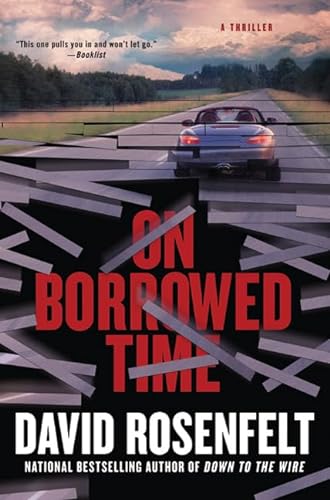
What if it were possible that your most cherished memories were lies… and that finding out the truth could cost you your life?
Richard Kilmer is head over heels in love with Jennifer Ryan, who takes him home to meet her parents, where she accepts his marriage proposal. While visiting, they set out on a nostalgic drive up to Kendrick Falls. On their way there, a freak storm rolls in, Richard loses control of his car, and it rolls. When the storm clears in a matter of seconds, Jen is gone. Richard can’t find her, and neither can the police who respond to the scene. More horrifying is that no one in Richard's life will even confirm Jen’s existence, and all traces of her have disappeared.
Where could she be? Has Richard lost his mind, or has something far worse happened?
David Rosenfelt’s On Borrowed Time is a stunning new thriller about an ordinary man who is trapped in a nightmare where he can’t be certain of anything—not even his own memories.
Die Inhaltsangabe kann sich auf eine andere Ausgabe dieses Titels beziehen.
Über die Autorin bzw. den Autor
David Rosenfelt is the Edgar and Shamus Award--nominated author of eight Andy Carpenter novels and two stand-alones, most recently Down to the Wire. He and his wife live in California with the twenty-seven golden retrievers they’ve rescued.
Auszug. © Genehmigter Nachdruck. Alle Rechte vorbehalten.
Chapter One
The moment we met is burned into my mind, and even now I replay it over and over. It’s somehow vaguely comforting, and thinking about Jennifer gives her a presence. I’ve wanted to give her a presence for so very long.
It’s not outright denial, but it’s almost as good.
It was at a political rally for a candidate Jen was supporting. It’s funny, but I can’t remember who the candidate was, and I can’t venture a guess, based on what I learned later about Jen’s politics. In that area, she was always a contradiction: a social liberal who was ?ercely in favor of the death penalty, and a ?scal conservative who never met a homeless shelter she didn’t want the government to support. But whatever it was she was advocating at that or any other moment, that advocacy was ?erce.
I’m a writer, so I had the political “get out of jail free” card; it was a violation of my alleged journalist credentials to even hint at my leanings. I wrote mainly magazine articles, most of them political or business- oriented, but I wasn’t there for anything having to do with work. The truth is, I had just been wandering by and stopped to see what was going on.
So on that day we were who we are, or at least as I have always seen us: Jen as a participant in life, and myself as an observer of it.
It didn’t take a particularly keen observer to notice her. She was light-up-the-room beautiful, even though she was wearing a New York Yankees cap. I hate the Yankees, always have, always will, but I quickly rationalized that I’d never really felt any animosity for their caps. So I went over to her and introduced myself.
“Hi. I’m Richard Kilmer. I’m a journalist.”
“How nice for you,” she deadpanned. Journalists were not necessarily her favorite people.
“Yes . . . I wanted to ask you a few questions. About the rally . . . the candidate . . .”
She smiled, and it was the ?rst time I had ever seen a smile that had nothing whatsoever to do with the mouth or lips. This smile was wholly in her eyes, and I later came to realize that this was part of her ability as a smile ventriloquist. Just by being in the vicinity, Jen could make everything and everyone smile, without letting on that she was doing so.
“I really don’t know that much about him,” she said. “But if you want your questions answered . . . Carl, come here a second?”
She called over a young man standing a few yards away. Carl was unshaven, balding, and maybe twenty pounds overweight. Not a horrible-looking guy, but not really my type.
“Hey,” Carl said, proving that if nothing else he was a charming conversationalist.
“This is Richard Kilmer . . . a journalist. He’s looking for some information.” She went on to tell me that Carl knew far more about this particular candidate than she did.
“What do you want to know?” Carl asked.
“Well, to be perfectly honest,” I said, “I was more interested in the female point of view.”
Carl frowned his disdain at me and walked away.
“You should have said so,” Jen said, scanning the crowd. “Then let’s see what we can ?nd for you.”
She was playing with me, no doubt looking for some female shot putter to stick me with. “I was interested in your point of view,” I said.
“Let me guess,” she said. “You’re particularly interested in my point of view coupled with coffee, drinks, or dinner.”
“That’s uncanny,” I said.
“Why didn’t you say so in the ?rst place?”
“I only use honesty as a last resort.”
She thought about it for a few moments, as if weighing it. Then, “Coffee.”
I hated that look.
It was a look that said, You’re full of shit, Richard. You know it and I know it, so let’s move on, shall we?
My problem with the look, and with Jen, for that matter, was that it and she were always right. In that case, I had just tried to tell her that we should drive to her parents’ house in upstate New York on Monday, rather than Sunday. I had lamely claimed that we’d hit less traf?c that way, but she knew it was really because I wanted to watch the pro football games. When it comes to football, I’m somewhere between a fanatic and a lunatic.
“You want to watch football tomorrow,” she said. It wasn’t a question, but rather a statement of fact.
“Football?” I asked. “Tomorrow? God, the week ?ew by; it never entered my mind. Where do the days go?”
She laughed, and asked, “What time are the Giants playing?”
“The Giants? The Giants? The name sounds familiar. . . .”
“Richard . . .”
“One o’clock. They’re playing the Redskins at home.”
She shook her head in amazement. “Redskins. How can a team have a name like that in the twenty-?rst century?”
I nodded vigorously. “Exactly. They are politically incorrect pigs. Which is the main reason I want them to be defeated tomorrow. Somebody has to take a stand on the side of decency, and they will leave Giants Stadium tomorrow having learned a moral lesson. And it’s about time.”
There was that look again. It was time to come clean.
“The winner makes the playoffs. The playoffs, Jen. That’s three wins from the Super Bowl. I really want to see it.”
“Then why didn’t you just say so in the ?rst place?”
I shrugged. “Honesty? Last resort? Remember?”
She smiled. “Tell me about it.” That was sort of a catchphrase she used whenever someone told her something she already knew, which was pretty often.
Jen agreed that the game was not to be missed, so she called her mother and told her we’d be there on Monday. It wasn’t a big deal, since we’d been invited for Christmas, which was Friday. Her parents lived in Ardmore, a small town about two hours from our apartment in Manhattan on the Upper West Side. We had a two-bedroom on the thirty-third ?oor of a building called the Montana, on Eighty-seventh and Broadway. If there is a piece of real estate in the world that should not be called Montana, it is that one.
Jen had told me a couple of weeks before that her parents were excited to meet me, that I was the ?rst boyfriend she had ever brought home. As always, it was jarring to hear her call me a “boyfriend”; we seemed to be so much more than that. I think on some level that’s why I bought a ring and planned to ask her to marry me the following week. If she accepted, and I anticipated that she would, I would instantly make the quantum leap from “boyfriend” to “?ancé.”
In a matter of hours after ?rst meeting Jen I had regressed from independent twenty-nine-year-old male, unwilling (or afraid, if some of my dates were to be believed) to make a commitment, to pathetic twenty-nine-year-old puppy, panicked that she wouldn’t like me. My amazement that she did, that in fact she grew to love me, was not modesty, false or otherwise. The simple truth was that Jen could have had absolutely anyone she wanted, and she chose me. It was the kind of situation for which the word “hallelujah!” was coined.
Jen moved into my apartment four months after we met. We chose mine because it was bigger, and because I owned it, while she was just renting. In a matter of hours, the apartment went from a place completely devoid of personality to a real home. When Jen got ?nished with it, my impersonal group of rooms had become the kind of home the Waltons would beg to spend Thanksgiving in.
Jen even liked my friends, few in number as they were. Don’t misunderstand, for the most part my friends are intelligent, successful people. They may have their faults, but there’s not a terrorist in the bunch, and the world would be a better place if their level of goodness prevailed everywhere. But as a group, we have one ?aw; we argue about everything. They are heated, sometimes stimulating, sometimes childish debates about a wide range of topics from sports to politics to people, and the truth is, most outsiders ?nd it a little off-putting.
Since I had only arrived in town three months before meeting Jen, I had only had time to develop two close friendships. I had met both John Sucich and Willie Citrin playing basketball at the Y, and discovered we all had a love of politics, sports, and women. Not necessarily in that order.
Jen was an insider from day one, and one particular night was a perfect example as to why. We went out to the Legends Sports Bar to have dinner and watch the Knicks-76ers game. John and Willie brought along dates, who in my mind were named Somebody and Whoever. For both John and Willie, two dates was a long-term relationship, so I didn’t spend too much time memorizing the women’s names. I knew it was dehumanizing, but I ?gured that if they didn’t want to be dehumanized, what the hell were they doing with John and Willie?
That night we were arguing about the death penalty, a frequent topic. John and Willie were for it; I am so strongly against it that I once wrote a series of articles advocating my position. As always, they told me that if my sister were murdered I’d feel differently. I don’t have a sister, but they’d probably killed her off ?fty times. Jen was on their side; this was a woman who quite literally wouldn’t harm a ?y, but would apparently toast a convicted murderer or rapist without thinking twice.
I neither won nor lost...
„Über diesen Titel“ kann sich auf eine andere Ausgabe dieses Titels beziehen.
Suchergebnisse für On Borrowed Time

Beispielbild für diese ISBN
On Borrowed Time
Anbieter: World of Books (was SecondSale), Montgomery, IL, USA
Verkäuferbewertung 5 von 5 Sternen

Hardback. Zustand: Good. Living the dreamEverything is going right for magazine writer Richard Kilmer. His girlfriend, the beautiful Jennifer Ryan, has agreed to marry him. The happy couple celebrates with a romantic drive up to Kendrick Falls. Even as dark clouds begin to gather, Jen and Richard press on.Heading for a fallThe freak storm sends Richard careening off the road and throws Jen from the vehicle. Richard seems to be fine, but he can't find Jen anywhere--neither can the town's police. The storm has disappeared and with it every trace of the future Mrs. Kilmer. No turning backRichard remembers her so vividly, but no one he knows can confirm that Jen ever existed. Could he be crazy? Did he dream her up? After weeks of nightmares, therapy, and unanswered questions, his life is still in pieces. But just as Richard begins to completely unravel, so do the secrets behind Jen's disappearance. Excellent. All will marvel at the way Rosenfelt builds suspense.--Publishers Weekly (Starred Review) Outstanding.Anyone who enjoyed Dennis Lehane's Shutter Island will love this thriller. --Library Journal (starred review). Artikel-Nr. 00106096265
Gebraucht kaufen
EUR 5,16
Versand gratis
Versand innerhalb von USA
Versand innerhalb von USA
Anzahl: 1 verfügbar
Beispielbild für diese ISBN
On Borrowed Time
Anbieter: ThriftBooks-Atlanta, AUSTELL, GA, USA
Verkäuferbewertung 5 von 5 Sternen
Hardcover. Zustand: Good. No Jacket. Former library book; Pages can have notes/highlighting. Spine may show signs of wear. ~ ThriftBooks: Read More, Spend Less. Artikel-Nr. G031259836XI3N10
Gebraucht kaufen
EUR 5,87
Versand gratis
Versand innerhalb von USA
Versand innerhalb von USA
Anzahl: 1 verfügbar
Beispielbild für diese ISBN
On Borrowed Time
Anbieter: ThriftBooks-Dallas, Dallas, TX, USA
Verkäuferbewertung 5 von 5 Sternen
Hardcover. Zustand: Fair. No Jacket. Former library book; Readable copy. Pages may have considerable notes/highlighting. ~ ThriftBooks: Read More, Spend Less. Artikel-Nr. G031259836XI5N10
Gebraucht kaufen
EUR 5,87
Versand gratis
Versand innerhalb von USA
Versand innerhalb von USA
Anzahl: 1 verfügbar
Beispielbild für diese ISBN
On Borrowed Time
Anbieter: ThriftBooks-Phoenix, Phoenix, AZ, USA
Verkäuferbewertung 5 von 5 Sternen
Hardcover. Zustand: Fair. No Jacket. Former library book; Readable copy. Pages may have considerable notes/highlighting. ~ ThriftBooks: Read More, Spend Less. Artikel-Nr. G031259836XI5N10
Gebraucht kaufen
EUR 5,87
Versand gratis
Versand innerhalb von USA
Versand innerhalb von USA
Anzahl: 1 verfügbar
Beispielbild für diese ISBN
On Borrowed Time
Anbieter: ThriftBooks-Dallas, Dallas, TX, USA
Verkäuferbewertung 5 von 5 Sternen
Hardcover. Zustand: Very Good. No Jacket. Former library book; May have limited writing in cover pages. Pages are unmarked. ~ ThriftBooks: Read More, Spend Less. Artikel-Nr. G031259836XI4N10
Gebraucht kaufen
EUR 5,87
Versand gratis
Versand innerhalb von USA
Versand innerhalb von USA
Anzahl: 1 verfügbar
Beispielbild für diese ISBN
On Borrowed Time
Anbieter: ThriftBooks-Phoenix, Phoenix, AZ, USA
Verkäuferbewertung 5 von 5 Sternen
Hardcover. Zustand: Good. No Jacket. Former library book; Pages can have notes/highlighting. Spine may show signs of wear. ~ ThriftBooks: Read More, Spend Less. Artikel-Nr. G031259836XI3N10
Gebraucht kaufen
EUR 5,87
Versand gratis
Versand innerhalb von USA
Versand innerhalb von USA
Anzahl: 1 verfügbar
Beispielbild für diese ISBN
On Borrowed Time
Anbieter: ThriftBooks-Atlanta, AUSTELL, GA, USA
Verkäuferbewertung 5 von 5 Sternen
Hardcover. Zustand: Fair. No Jacket. Former library book; Readable copy. Pages may have considerable notes/highlighting. ~ ThriftBooks: Read More, Spend Less. Artikel-Nr. G031259836XI5N10
Gebraucht kaufen
EUR 5,87
Versand gratis
Versand innerhalb von USA
Versand innerhalb von USA
Anzahl: 1 verfügbar
Beispielbild für diese ISBN
On Borrowed Time
Anbieter: ThriftBooks-Reno, Reno, NV, USA
Verkäuferbewertung 5 von 5 Sternen
Hardcover. Zustand: Good. No Jacket. Former library book; Pages can have notes/highlighting. Spine may show signs of wear. ~ ThriftBooks: Read More, Spend Less. Artikel-Nr. G031259836XI3N10
Gebraucht kaufen
EUR 5,87
Versand gratis
Versand innerhalb von USA
Versand innerhalb von USA
Anzahl: 1 verfügbar
Beispielbild für diese ISBN
On Borrowed Time
Anbieter: ThriftBooks-Reno, Reno, NV, USA
Verkäuferbewertung 5 von 5 Sternen
Hardcover. Zustand: Very Good. No Jacket. Former library book; May have limited writing in cover pages. Pages are unmarked. ~ ThriftBooks: Read More, Spend Less. Artikel-Nr. G031259836XI4N10
Gebraucht kaufen
EUR 5,87
Versand gratis
Versand innerhalb von USA
Versand innerhalb von USA
Anzahl: 1 verfügbar
Beispielbild für diese ISBN
On Borrowed Time
Anbieter: ThriftBooks-Dallas, Dallas, TX, USA
Verkäuferbewertung 5 von 5 Sternen
Hardcover. Zustand: Good. No Jacket. Former library book; Pages can have notes/highlighting. Spine may show signs of wear. ~ ThriftBooks: Read More, Spend Less. Artikel-Nr. G031259836XI3N10
Gebraucht kaufen
EUR 5,87
Versand gratis
Versand innerhalb von USA
Versand innerhalb von USA
Anzahl: 1 verfügbar