
Verwandte Artikel zu COLLECTED PROSE: Autobiographical Writings, True Stories,...
COLLECTED PROSE: Autobiographical Writings, True Stories, Critical Essays, Prefaces, and Collaborations With Artists, and Interviews - Softcover
Inhaltsangabe
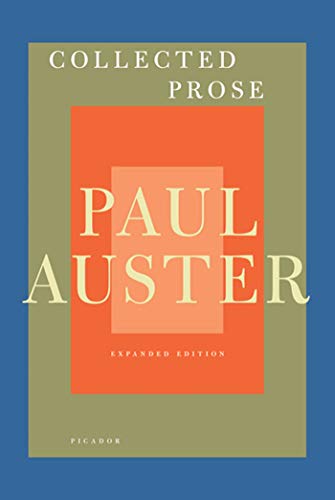
The expanded edition of an essential collection of writings, essays, and interviews from Paul Auster, one of the finest thinkers and stylists in contemporary letters.
The celebrated author of The New York Trilogy, The Book of Illusions, and 4 3 2 1 presents here a highly personal collection of essays, prefaces, true stories, autobiographical writings, and collaborations with artists, as well as occasional pieces written for magazines and newspapers, including his "breathtaking memoir" (Financial Times), The Invention of Solitude.
Ranging in subject from Sir Walter Raleigh to Kafka, Nathaniel Hawthorne to the high-wire artist Philippe Petit, conceptual artist Sophie Calle to Auster's own typewriter, the World Trade Center catastrophe to his beloved New York City itself, Collected Prose records the passions and insights of a writer who "will be remembered as one of the great writers of our time" (San Francisco Chronicle).
Die Inhaltsangabe kann sich auf eine andere Ausgabe dieses Titels beziehen.
Über die Autorin bzw. den Autor
Paul Auster was the bestselling author of 4 3 2 1, Bloodbath Nation, Baumgartner, The Book of Illusions, and The New York Trilogy, among many other works. In 2006 he was awarded the Prince of Asturias Prize for Literature. Among his other honors are the Prix Médicis Étranger for Leviathan, the Independent Spirit Award for the screenplay of Smoke, and the Premio Napoli for Sunset Park. In 2012, he was the first recipient of the NYC Literary Honors in the category of fiction. He was also a finalist for the International IMPAC Dublin Literary Award (The Book of Illusions), the PEN/Faulkner Award (The Music of Chance), the Edgar Award (City of Glass), and the Man Booker Prize (4 3 2 1). Auster was a member of the American Academy of Arts and Letters and a Commandeur de l'Ordre des Arts et des Lettres. His work has been translated into more than forty languages. He died at age seventy-seven in 2024.
Von der hinteren Coverseite
An essential collection from one of the finest thinkers and stylists in contemporary letters.
The celebrated author of The New York Trilogy, The Book of Illusions, and Oracle Night presents here a highly personal collection of essays, prefaces, true stories, autobiographical writings, and collaborations with artists, as well as occasional pieces written for magazines and newspapers, including The Invention of Solitude his "breathtaking memoir." (Financial Times Magazine London)
Ranging in subject from Sir Walter Raleigh to Kafka, Nathaniel Hawthorne to the high-wire artist Philippe Petit, conceptual artist Sophie Calle to Auster's own typewriter, the World Trade Center catastrophe to his beloved New York City itself, Collected Prose records the passions and insights of a writer who "will be remembered as one of the great writers of our time" (San Francisco Chronicle).
"Auster's Collected Prose provides a fascinating long-exposure snapshot of a writer's private and abiding obsessions and touchstones as he oscillates between the worlds of his life and art."--The Times (London)
"He is a remarkable writer whose work needs to be read in totality."--The Sunday Herald (Scotland)
"One of America's leading novelists...The literary essays and prefaces in this collection are elegant and accessible.... Much of what is offered here displays his warmth, democratic instincts, and human concerns."--The Daily Telegraph (London)
"Auster's informed enthusiasms, especially for European modernism and aspects of the avant-garde, make him a passionate, intelligent, and stimulating commentator. He writes acutely about the dilemmas which inform serious artistic decisions. The hospitable, generous pieces make one want to go immediately to the writers he discusses."--The Observer (London)
Paul Auster is the author of eleven novels, most recently Oracle Night. His previous two novels, The Book of Illusions and Timbuktu, were national bestsellers. He lives in Brooklyn, New York.
Aus dem Klappentext
An essential collection from one of the finest thinkers and stylists in contemporary letters.
The celebrated author of The New York Trilogy, The Book of Illusions, and Oracle Night presents here a highly personal collection of essays, prefaces, true stories, autobiographical writings, and collaborations with artists, as well as occasional pieces written for magazines and newspapers, including The Invention of Solitude his "breathtaking memoir." (Financial Times Magazine London)
Ranging in subject from Sir Walter Raleigh to Kafka, Nathaniel Hawthorne to the high-wire artist Philippe Petit, conceptual artist Sophie Calle to Auster's own typewriter, the World Trade Center catastrophe to his beloved New York City itself, Collected Prose records the passions and insights of a writer who "will be remembered as one of the great writers of our time" (San Francisco Chronicle).
"Auster's Collected Prose provides a fascinating long-exposure snapshot of a writer's private and abiding obsessions and touchstones as he oscillates between the worlds of his life and art."--The Times (London)
"He is a remarkable writer whose work needs to be read in totality."--The Sunday Herald (Scotland)
"One of America's leading novelists...The literary essays and prefaces in this collection are elegant and accessible.... Much of what is offered here displays his warmth, democratic instincts, and human concerns."--The Daily Telegraph (London)
"Auster's informed enthusiasms, especially for European modernism and aspects of the avant-garde, make him a passionate, intelligent, and stimulating commentator. He writes acutely about the dilemmas which inform serious artistic decisions. The hospitable, generous pieces make one want to go immediately to the writers he discusses."--The Observer (London)
Paul Auster is the author of eleven novels, most recently Oracle Night. His previous two novels, The Book of Illusions and Timbuktu, were national bestsellers. He lives in Brooklyn, New York.
Auszug. © Genehmigter Nachdruck. Alle Rechte vorbehalten.
Collected Prose
Autobiographical Writings, True Stories, Critical Essays, Prefaces, Collaborations with Artists, and Interviews
By Paul AusterPicador
Copyright © 2010 Paul Auster
All rights reserved.
ISBN: 978-0-312-42992-8All rights reserved.
Contents
THE INVENTION OF SOLITUDE,
HAND TO MOUTH,
TRUE STORIES,
GOTHAM HANDBOOK,
THE STORY OF MY TYPEWRITER,
NORTHERN LIGHTS,
CRITICAL ESSAYS,
PREFACES,
OCCASIONS,
NYC = USA,
TWO INTERVIEWS,
REFERENCES,
CHAPTER 1
THE INVENTION OF SOLITUDE
Portrait of an Invisible Man
In searching out the truth be ready for the unexpected, for it is difficult to find and puzzling when you find it.
Heraclitus
One day there is life. A man, for example, in the best of health, not even old, with no history of illness. Everything is as it was, as it will always be. He goes from one day to the next, minding his own business, dreaming only of the life that lies before him. And then, suddenly, it happens there is death. A man lets out a little sigh, he slumps down in his chair, and it is death. The suddenness of it leaves no room for thought, gives the mind no chance to seek out a word that might comfort it. We are left with nothing but death, the irreducible fact of our own mortality. Death after a long illness we can accept with resignation. Even accidental death we can ascribe to fate. But for a man to die of no apparent cause, for a man to die simply because he is a man, brings us so close to the invisible boundary between life and death that we no longer know which side we are on. Life becomes death, and it is as if this death has owned this life all along. Death without warning. Which is to say: life stops. And it can stop at any moment.
The news of my father's death came to me three weeks ago. It was Sunday morning, and I was in the kitchen preparing breakfast for my small son, Daniel. Upstairs my wife was still in bed, warm under the quilts, luxuriating in a few extra hours of sleep. Winter in the country: a world of silence, wood smoke, whiteness. My mind was filled with thoughts about the piece I had been writing the night before, and I was looking ahead to the afternoon when I would be able to get back to work. Then the phone rang. I knew instantly that there was trouble. No one calls at eight o'clock on a Sunday morning unless it is to give news that cannot wait. And news that cannot wait is always bad news.
I could not muster a single ennobling thought.
Even before we packed our bags and set out on the three-hour drive to New Jersey, I knew that I would have to write about my father. I had no plan, had no precise idea of what this meant. I cannot even remember making a decision about it. It was simply there, a certainty, an obligation that began to impose itself on me the moment I was given the news. I thought: my father is gone. If I do not act quickly, his entire life will vanish along with him.
Looking back on it now, even from so short a distance as three weeks, I find this a rather curious reaction. I had always imagined that death would numb me, immobilize me with grief. But now that it had happened, I did not shed any tears, I did not feel as though the world had collapsed around me. In some strange way, I was remarkably prepared to accept this death, in spite of its suddenness. What disturbed me was something else, something unrelated to death or my response to it: the realization that my father had left no traces.
He had no wife, no family that depended on him, no one whose life would be altered by his absence. A brief moment of shock, perhaps, on the part of scattered friends, sobered as much by the thought of capricious death as by the loss of their friend, followed by a short period of mourning, and then nothing. Eventually, it would be as though he had never lived at all.
Even before his death he had been absent, and long ago the people closest to him had learned to accept this absence, to treat it as the fundamental quality of his being. Now that he was gone, it would not be difficult for the world to absorb the fact that he was gone forever. The nature of his life had prepared the world for his death — had been a kind of death by anticipation — and if and when he was remembered, it would be dimly, no more than dimly.
Devoid of passion, either for a thing, a person, or an idea, incapable or unwilling to reveal himself under any circumstances, he had managed to keep himself at a distance from life, to avoid immersion in the quick of things. He ate, he went to work, he had friends, he played tennis, and yet for all that he was not there. In the deepest, most unalterable sense, he was an invisible man. Invisible to others, and most likely invisible to himself as well. If, while he was alive, I kept looking for him, kept trying to find the father who was not there, now that he is dead I still feel as though I must go on looking for him. Death has not changed anything. The only difference is that I have run out of time.
For fifteen years he had lived alone. Doggedly, opaquely, as if immune to the world. He did not seem to be a man occupying space, but rather a block of impenetrable space in the form of a man. The world bounced off him, shattered against him, at times adhered to him — but it never got through. For fifteen years he haunted an enormous house, all by himself, and it was in that house that he died.
For a short while we had lived there as a family — my father, my mother, my sister, and I. After my parents were divorced, everyone dispersed: my mother began a new life, I went off to college, and my sister stayed with my mother until she, too, went off to school. Only my father remained. Because of a clause in the divorce agreement which stipulated that my mother still owned a share of the house and would be given half the proceeds whenever it was sold (which made my father reluctant to sell), or from some secret refusal to change his life (so as not to show the world that the divorce had affected him in a way he could not control), or simply from inertia, an emotional lethargy that prevented him from taking any action, he stayed on, living alone in a house that could have accommodated six or seven people.
It was an impressive place: old, solidly built, in the Tudor style, with leaded windows, a slate roof, and rooms of royal proportions. Buying it had been a big step for my parents, a sign of growing wealth. This was the best neighborhood in town, and although it was not a pleasant place to live (especially for children), its prestige outweighed its deadliness. Given the fact that he wound up spending the rest of his life in that house, it is ironic that my father at first resisted moving there. He complained about the price (a constant theme), and when at last he relented, it was with grudging bad humor. Even so, he paid in cash. All in one go. No mortgage, no monthly payments. It was 1959, and business was going well for him.
Always a man of habit, he would leave for work early in the morning, work hard all day, and then, when he came home (on those days he did not work late), take a short nap before dinner. Sometime during our first week in the new house, before we had properly moved in, he made a curious kind of mistake. Instead of driving home to the new house after work, he went directly to the old one, as he had done for years, parked his car in the driveway, walked into the house through the back door, climbed the stairs, entered the bedroom, lay down on the bed, and went to sleep. He slept for about an hour....
„Über diesen Titel“ kann sich auf eine andere Ausgabe dieses Titels beziehen.
Suchergebnisse für COLLECTED PROSE: Autobiographical Writings, True Stories,...

Beispielbild für diese ISBN
Collected Prose: Autobiographical Writings, True Stories, Critical Essays, Prefaces, Collaborations with Artists, and Interviews: Expanded Edition
Anbieter: World of Books (was SecondSale), Montgomery, IL, USA
Verkäuferbewertung 5 von 5 Sternen

Paperback. Zustand: Very Good. The expanded edition of an essential collection of writings, essays, and interviews from Paul Auster, one of the finest thinkers and stylists in contemporary letters. The celebrated author of The New York Trilogy, The Book of Illusions, and 4 3 2 1 presents here a highly personal collection of essays, prefaces, true stories, autobiographical writings, and collaborations with artists, as well as occasional pieces written for magazines and newspapers, including his "breathtaking memoir" (Financial Times), The Invention of Solitude. Ranging in subject from Sir Walter Raleigh to Kafka, Nathaniel Hawthorne to the high-wire artist Philippe Petit, conceptual artist Sophie Calle to Auster's own typewriter, the World Trade Center catastrophe to his beloved New York City itself, Collected Prose records the passions and insights of a writer who "will be remembered as one of the great writers of our time" (San Francisco Chronicle). Artikel-Nr. 00092383991
Gebraucht kaufen
EUR 5,91
Versand gratis
Versand innerhalb von USA
Versand innerhalb von USA
Anzahl: 2 verfügbar
Beispielbild für diese ISBN
Collected Prose: Autobiographical Writings, True Stories, Critical Essays, Prefaces, Collaborations with Artists, and Interviews: Expanded Edition
Anbieter: ThriftBooks-Dallas, Dallas, TX, USA
Verkäuferbewertung 5 von 5 Sternen
Paperback. Zustand: Good. No Jacket. Former library book; Pages can have notes/highlighting. Spine may show signs of wear. ~ ThriftBooks: Read More, Spend Less. Artikel-Nr. G0312429924I3N10
Gebraucht kaufen
EUR 7,62
Versand gratis
Versand innerhalb von USA
Versand innerhalb von USA
Anzahl: 1 verfügbar
Beispielbild für diese ISBN
Collected Prose: Autobiographical Writings, True Stories, Critical Essays, Prefaces, Collaborations with Artists, and Interviews: Expanded Edition
Anbieter: ThriftBooks-Dallas, Dallas, TX, USA
Verkäuferbewertung 5 von 5 Sternen
Paperback. Zustand: Very Good. No Jacket. May have limited writing in cover pages. Pages are unmarked. ~ ThriftBooks: Read More, Spend Less. Artikel-Nr. G0312429924I4N00
Gebraucht kaufen
EUR 7,62
Versand gratis
Versand innerhalb von USA
Versand innerhalb von USA
Anzahl: 1 verfügbar
Beispielbild für diese ISBN
Collected Prose: Autobiographical Writings, True Stories, Critical Essays, Prefaces, Collaborations with Artists, and Interviews: Expanded Edition
Anbieter: ThriftBooks-Atlanta, AUSTELL, GA, USA
Verkäuferbewertung 5 von 5 Sternen
Paperback. Zustand: Good. No Jacket. Pages can have notes/highlighting. Spine may show signs of wear. ~ ThriftBooks: Read More, Spend Less. Artikel-Nr. G0312429924I3N00
Gebraucht kaufen
EUR 7,62
Versand gratis
Versand innerhalb von USA
Versand innerhalb von USA
Anzahl: 1 verfügbar
Beispielbild für diese ISBN
Collected Prose: Autobiographical Writings, True Stories, Critical Essays, Prefaces, Collaborations with Artists, and Interviews: Expanded Edition
Anbieter: ThriftBooks-Dallas, Dallas, TX, USA
Verkäuferbewertung 5 von 5 Sternen
Paperback. Zustand: Very Good. No Jacket. Former library book; May have limited writing in cover pages. Pages are unmarked. ~ ThriftBooks: Read More, Spend Less. Artikel-Nr. G0312429924I4N10
Gebraucht kaufen
EUR 7,62
Versand gratis
Versand innerhalb von USA
Versand innerhalb von USA
Anzahl: 1 verfügbar
Beispielbild für diese ISBN
Collected Prose: Autobiographical Writings, True Stories, Critical Essays, Prefaces, Collaborations with Artists, and Interviews: Expanded Edition
Anbieter: ThriftBooks-Atlanta, AUSTELL, GA, USA
Verkäuferbewertung 5 von 5 Sternen
Paperback. Zustand: Very Good. No Jacket. May have limited writing in cover pages. Pages are unmarked. ~ ThriftBooks: Read More, Spend Less. Artikel-Nr. G0312429924I4N00
Gebraucht kaufen
EUR 7,62
Versand gratis
Versand innerhalb von USA
Versand innerhalb von USA
Anzahl: 1 verfügbar
Beispielbild für diese ISBN
Collected Prose: Autobiographical Writings, True Stories, Critical Essays, Prefaces, Collaborations with Artists, and Interviews: Expanded Edition
Anbieter: Housing Works Online Bookstore, New York, NY, USA
Verkäuferbewertung 5 von 5 Sternen
Paperback. Zustand: Very Good. First Edition. Artikel-Nr. mon-uvg-0312429924
Gebraucht kaufen
EUR 5,24
EUR 3,56 Versand
Versand innerhalb von USA
Versand innerhalb von USA
Anzahl: 1 verfügbar
Beispielbild für diese ISBN
Collected Prose : Autobiographical Writings, True Stories, Critical Essays, Prefaces, Collaborations with Artists, and Interviews: Expanded Edition
Anbieter: Better World Books, Mishawaka, IN, USA
Verkäuferbewertung 5 von 5 Sternen
Zustand: Very Good. Expanded. Pages intact with possible writing/highlighting. Binding strong with minor wear. Dust jackets/supplements may not be included. Stock photo provided. Product includes identifying sticker. Better World Books: Buy Books. Do Good. Artikel-Nr. 404200-6
Gebraucht kaufen
EUR 10,39
Versand gratis
Versand innerhalb von USA
Versand innerhalb von USA
Anzahl: 1 verfügbar
Beispielbild für diese ISBN
Collected Prose Autobiographical Writings, True Stories, Critical Essays, Prefaces, Collaborations with Artists, and Interviews: Expanded Edition
Anbieter: Powell's Bookstores Chicago, ABAA, Chicago, IL, USA
Verkäuferbewertung 5 von 5 Sternen
Paperback. Zustand: Very Good. Minimal shelf wear, clean internals. May have remainder mark. Artikel-Nr. 2045889
Gebraucht kaufen
EUR 8,28
EUR 4,47 Versand
Versand innerhalb von USA
Versand innerhalb von USA
Anzahl: 4 verfügbar
Beispielbild für diese ISBN
Collected Prose Autobiographical Writings, True Stories, Critical Essays, Prefaces, Collaborations with Artists, and Interviews: Expanded Edition
Anbieter: Powell's Bookstores Chicago, ABAA, Chicago, IL, USA
Verkäuferbewertung 5 von 5 Sternen
Paperback. Zustand: Very Good. Minimal shelf wear, clean internals. Remainder mark. Artikel-Nr. 2048639
Gebraucht kaufen
EUR 8,28
EUR 4,47 Versand
Versand innerhalb von USA
Versand innerhalb von USA
Anzahl: 4 verfügbar