
Verwandte Artikel zu The Moor (Mary Russell Mystery)
Inhaltsangabe
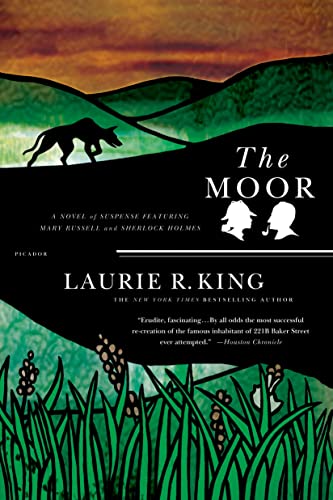
In the eerie wasteland of Dartmoor, Sherlock Holmes summons his devoted wife and partner, Mary Russell, from her studies at Oxford to aid the investigation of a death and some disturbing phenomena of a decidedly supernatural origin. Through the mists of the moor there have been sightings of a spectral coach made of bones carrying a woman long-ago accused of murdering her husband--and of a hound with a single glowing eye. Returning to the scene of one of his most celebrated cases, The Hound of the Baskervilles, Holmes and Russell investigate a mystery darker and more unforgiving than the moors themselves, in Laurie R. King's The Moor.
Die Inhaltsangabe kann sich auf eine andere Ausgabe dieses Titels beziehen.
Über die Autorin bzw. den Autor
Laurie R. King is the Edgar Award-winning author of the contemporary novels featuring Kate Martinelli, the acclaimed Mary Russell mysteries, and several stand-alone novels, including the highly praised A Darker Place. She lives in northern California.
Von der hinteren Coverseite
Though theirs is a marriage of true equals, when Sherlock Holmes summons his wife and partner Mary Russell to the eerie scene of his most celebrated case, she abandons her Oxford studies to aid his investigation. But this time, on Dartmoor, there is more to the matter than a phantom hound. Sightings of a spectral coach carrying a long-dead noblewoman over the moonlit moor have heralded a mysterious death, the corpse surrounded by oversize paw prints. Here on this wild and foreboding moor, Russell and Holmes embark on a quest with few clues save a fanatic anthropologist, an ancestral portrait, a moorland witch, and a lowly-but most revealing-hedgehog. As Holmes and Russell anticipate, a rational explanation lies beneath the supernatural events-but one darker than they could have imagined. And one that could end their lives in this harsh and desolate land.
Auszug. © Genehmigter Nachdruck. Alle Rechte vorbehalten.
The Moor
A Novel of Suspense Featuring Mary Russell and Sherlock HolmesBy Laurie R. KingPicador
Copyright © 2007 Laurie R. KingAll right reserved.
ISBN: 9780312427399
1
When I obtained a holiday from my books, I mounted
my pony and made for the moor.
my pony and made for the moor.
—A BOOK OF DARTMOOR
THE TELEGRAM IN my hand read:
RUSSELL NEED YOU IN DEVONSHIRE. IF FREE TAKE EARLIEST TRAIN CORYTON. IF NOT FREE COME ANYWAY. BRING COMPASS. HOLMES
To say I was irritated would be an understatement. We had only just pulled ourselves from the mire of a difficult and emotionally draining case and now, less than a month later, with my mind firmly turned to the work awaiting me in this, my spiritual home, Oxford, my husband and longtime partner Sherlock Holmes proposed with this peremptory telegram to haul me away into his world once more. With an effort, I gave my landlady’s housemaid a smile, told her there was no reply (Holmes had neglected to send the address for a response—no accident on his part), and shut the door. I refused to speculate on why he wanted me, what purpose a compass would serve, or indeed what he was doing in Devon at all, since when last I had heard he was setting off to look into an interesting little case of burglary from an impregnable vault in Berlin. I squelched all impulse to curiosity, and returned to my desk.
Two hours later the girl interrupted my reading again, with another flimsy envelope. This one read:
ALSO SIX INCH MAPS EXETER TAVISTOCK OKEHAMPTON,
CLOSE YOUR BOOKS. LEAVE NOW.
HOLMES
CLOSE YOUR BOOKS. LEAVE NOW.
HOLMES
Damn the man, he knew me far too well.
I found my heavy brass pocket compass in the back of a drawer. It had never been quite the same since being first cracked and then drenched in an aqueduct beneath Jerusalem some four years before, but it was an old friend and it seemed still to work reasonably well. I dropped it into a similarly well-travelled rucksack, packed on top of it a variety of clothing to cover the spectrum of possibilities that lay between arctic expedition and tiara-topped dinner with royalty (neither of which, admittedly, were beyond Holmes’ reach), added the book on Judaism in mediaeval Spain that I had been reading, and went out to buy the requested stack of highly detailed six-inch-to-the-mile Ordnance Survey maps of the southwestern portion of England.
AT CORYTON, IN Devon, many hours later, I found the station deserted and dusk fast closing in. I stood there with my rucksack over my shoulder, boots on feet, and hair in cap, listening to the train chuff away towards the next minuscule stop. An elderly married couple had also got off here, climbed laboriously into the sagging farm cart that awaited them, and been driven away. I was alone. It was raining. It was cold.
There was a certain inevitability to the situation, I reflected, and dropped my rucksack to the ground to remove my gloves, my waterproof, and a warmer hat. Straightening up, I happened to turn slightly and noticed a small, light-coloured square tacked up to the post by which I had walked. Had I not turned, or had it been half an hour darker, I should have missed it entirely.
Russell it said on the front. Unfolded, it proved to be a torn-off scrap of paper on which I could just make out the words, in Holmes’ writing:
Lew House is two miles north.
Do you know the words to “Onward Christian Soldiers”
or “Widdecombe Fair”?
Do you know the words to “Onward Christian Soldiers”
or “Widdecombe Fair”?
—H.
I dug back into the rucksack, this time for a torch. When I had confirmed that the words did indeed say what I had thought, I tucked the note away, excavated clear to the bottom of the rucksack for the compass to check which branch of the track fading into the murk was pointing north, and set out.
I hadn’t the faintest idea what he meant by that note. I had heard the two songs, one a thumping hymn and the other one of those overly precious folk songs, but I did not know their words other than one song’s decidedly ominous (to a Jew) introductory image of Christian soldiers marching behind their “cross of Jesus” and the other’s endless and drearily jolly chorus of “Uncle Tom Cobbley and all.” In the first place, when I took my infidel self into a Christian church it was not usually of the sort wherein such hymns were standard fare, and as for the second, well, thus far none of my friends had succumbed to the artsy allure of sandals, folk songs, and Morris dancing. I had not seen Holmes in nearly three weeks, and it did occur to me that perhaps in the interval my husband had lost his mind.
Two miles is no distance at all on a smooth road on a sunny morning, but in the wet and moonless dark in which I soon found myself, picking my way down a slick, rutted track, following the course of a small river which I could not see, but could hear, smell, and occasionally step in, two miles was a fair trek. And there was something else as well: I felt as if I were being followed, or watched. I am not normally of a nervous disposition, and when I have such feelings I tend to assume that they have some basis in reality, but I could hear nothing more solid than the rain and the wind, and when I stopped there were no echoing splashes of feet behind me. It was simply a sense of Presence in the night; I pushed on, trying to ignore it.
I stayed to the left when the track divided, and was grateful to find, when time came to cross the stream, that a bridge had been erected across it. Not that wading through the water would have made me much wetter, and admittedly it would have cleared my lower extremities of half a hundredweight of mud, but the bridge as a solid reminder of Civilisation in the form of county councils I found encouraging.
Having crossed the stream, I now left its burble behind me, exchanging the hiss of rain on water for the thicker noises of rain on mud and vegetation, and I was just telling myself that it couldn’t be more than another half mile when I heard a faint thread of sound. Another hundred yards and I could hear it above the suck and plop of my boots; fifty more and I was on top of it.
It was a violin, playing a sweet, plaintive melody, light and slow and shot through with a profound and permanent sadness. I had never, to my knowledge, heard the tune before, although it had the bone-deep familiarity possessed by all things that are very old. I did, however, know the hands that wielded the bow.
“Holmes?” I said into the dark.
He finished the verse, drawing out the long final note, before he allowed the instrument to fall silent.
“Hello, Russell. You took your time.”
“Holmes, I hope there is a good reason for this.”
He did not answer, but I heard the familiar sounds of violin and bow being put into a case. The latches snapped, followed by the vigorous rustle of a waterproof being donned. I turned on the torch in time to see Holmes stepping out of the small shelter of a roofed gate set into a stone wall. He paused, looking thoughtfully at the telltale inundation of mud up my right side to the elbow, the result of a misstep into a pothole.
“Why did you not use the torch, coming up the road?” he asked.
“I, er …” I was...
„Über diesen Titel“ kann sich auf eine andere Ausgabe dieses Titels beziehen.
Suchergebnisse für The Moor (Mary Russell Mystery)

Foto des Verkäufers
The Moor: A Novel of Suspense Featuring Mary Russell and Sherlock Holmes (A Mary Russell Mystery, 4)
Anbieter: Dream Books Co., Denver, CO, USA
Verkäuferbewertung 5 von 5 Sternen

Zustand: good. Gently used with minimal wear on the corners and cover. A few pages may contain light highlighting or writing, but the text remains fully legible. Dust jacket may be missing, and supplemental materials like CDs or codes may not be included. May be ex-library with library markings. Ships promptly! Artikel-Nr. DBV.0312427395.G
Gebraucht kaufen
EUR 3,95
Versand gratis
Versand innerhalb von USA
Versand innerhalb von USA
Anzahl: 2 verfügbar
Beispielbild für diese ISBN
The Moor
Anbieter: World of Books (was SecondSale), Montgomery, IL, USA
Verkäuferbewertung 5 von 5 Sternen
Paperback. Zustand: Good. Though theirs is a marriage of true equals, when Sherlock Holmes summons his wife and partner Mary Russell to the eerie scene of his most celebrated case, she abandons her Oxford studies to aid his investigation. But this time, on Dartmoor, there is more to the matter than a phantom hound. Sightings of a spectral coach carrying a long-dead noblewoman over the moonlit moor have heralded a mysterious death, the corpse surrounded by oversize paw prints. Here on this wild and foreboding moor, Russell and Holmes embark on a quest with few clues save a fanatic anthropologist, an ancestral portrait, a moorland witch, and a lowly-but most revealing-hedgehog. As Holmes and Russell anticipate, a rational explanation lies beneath the supernatural events-but one darker than they could have imagined. And one that could end their lives in this harsh and desolate land. Artikel-Nr. 00105530703
Gebraucht kaufen
EUR 4,02
Versand gratis
Versand innerhalb von USA
Versand innerhalb von USA
Anzahl: 10 verfügbar
Beispielbild für diese ISBN
The Moor
Anbieter: World of Books (was SecondSale), Montgomery, IL, USA
Verkäuferbewertung 5 von 5 Sternen
Paperback. Zustand: Very Good. Though theirs is a marriage of true equals, when Sherlock Holmes summons his wife and partner Mary Russell to the eerie scene of his most celebrated case, she abandons her Oxford studies to aid his investigation. But this time, on Dartmoor, there is more to the matter than a phantom hound. Sightings of a spectral coach carrying a long-dead noblewoman over the moonlit moor have heralded a mysterious death, the corpse surrounded by oversize paw prints. Here on this wild and foreboding moor, Russell and Holmes embark on a quest with few clues save a fanatic anthropologist, an ancestral portrait, a moorland witch, and a lowly-but most revealing-hedgehog. As Holmes and Russell anticipate, a rational explanation lies beneath the supernatural events-but one darker than they could have imagined. And one that could end their lives in this harsh and desolate land. Artikel-Nr. 00107417926
Gebraucht kaufen
EUR 4,02
Versand gratis
Versand innerhalb von USA
Versand innerhalb von USA
Anzahl: 2 verfügbar
Beispielbild für diese ISBN
The Moor
Anbieter: World of Books (was SecondSale), Montgomery, IL, USA
Verkäuferbewertung 5 von 5 Sternen
Paperback. Zustand: Fair. Though theirs is a marriage of true equals, when Sherlock Holmes summons his wife and partner Mary Russell to the eerie scene of his most celebrated case, she abandons her Oxford studies to aid his investigation. But this time, on Dartmoor, there is more to the matter than a phantom hound. Sightings of a spectral coach carrying a long-dead noblewoman over the moonlit moor have heralded a mysterious death, the corpse surrounded by oversize paw prints. Here on this wild and foreboding moor, Russell and Holmes embark on a quest with few clues save a fanatic anthropologist, an ancestral portrait, a moorland witch, and a lowly-but most revealing-hedgehog. As Holmes and Russell anticipate, a rational explanation lies beneath the supernatural events-but one darker than they could have imagined. And one that could end their lives in this harsh and desolate land. Artikel-Nr. 00108781176
Gebraucht kaufen
EUR 4,02
Versand gratis
Versand innerhalb von USA
Versand innerhalb von USA
Anzahl: 2 verfügbar
Beispielbild für diese ISBN
The Moor
Anbieter: ThriftBooks-Atlanta, AUSTELL, GA, USA
Verkäuferbewertung 5 von 5 Sternen
Paperback. Zustand: Very Good. No Jacket. Former library book; May have limited writing in cover pages. Pages are unmarked. ~ ThriftBooks: Read More, Spend Less. Artikel-Nr. G0312427395I4N10
Gebraucht kaufen
EUR 6,03
Versand gratis
Versand innerhalb von USA
Versand innerhalb von USA
Anzahl: 1 verfügbar
Beispielbild für diese ISBN
The Moor
Anbieter: ThriftBooks-Phoenix, Phoenix, AZ, USA
Verkäuferbewertung 5 von 5 Sternen
Paperback. Zustand: Very Good. No Jacket. May have limited writing in cover pages. Pages are unmarked. ~ ThriftBooks: Read More, Spend Less. Artikel-Nr. G0312427395I4N00
Gebraucht kaufen
EUR 6,03
Versand gratis
Versand innerhalb von USA
Versand innerhalb von USA
Anzahl: 2 verfügbar
Beispielbild für diese ISBN
The Moor
Anbieter: ThriftBooks-Phoenix, Phoenix, AZ, USA
Verkäuferbewertung 5 von 5 Sternen
Paperback. Zustand: Fair. No Jacket. Readable copy. Pages may have considerable notes/highlighting. ~ ThriftBooks: Read More, Spend Less. Artikel-Nr. G0312427395I5N00
Gebraucht kaufen
EUR 6,03
Versand gratis
Versand innerhalb von USA
Versand innerhalb von USA
Anzahl: 1 verfügbar
Beispielbild für diese ISBN
The Moor
Anbieter: ThriftBooks-Dallas, Dallas, TX, USA
Verkäuferbewertung 5 von 5 Sternen
Paperback. Zustand: Very Good. No Jacket. Former library book; May have limited writing in cover pages. Pages are unmarked. ~ ThriftBooks: Read More, Spend Less. Artikel-Nr. G0312427395I4N10
Gebraucht kaufen
EUR 6,03
Versand gratis
Versand innerhalb von USA
Versand innerhalb von USA
Anzahl: 1 verfügbar
Beispielbild für diese ISBN
The Moor
Anbieter: ThriftBooks-Reno, Reno, NV, USA
Verkäuferbewertung 5 von 5 Sternen
Paperback. Zustand: Very Good. No Jacket. May have limited writing in cover pages. Pages are unmarked. ~ ThriftBooks: Read More, Spend Less. Artikel-Nr. G0312427395I4N00
Gebraucht kaufen
EUR 6,03
Versand gratis
Versand innerhalb von USA
Versand innerhalb von USA
Anzahl: 2 verfügbar
Beispielbild für diese ISBN
The Moor
Anbieter: ThriftBooks-Dallas, Dallas, TX, USA
Verkäuferbewertung 5 von 5 Sternen
Paperback. Zustand: Good. No Jacket. Pages can have notes/highlighting. Spine may show signs of wear. ~ ThriftBooks: Read More, Spend Less. Artikel-Nr. G0312427395I3N00
Gebraucht kaufen
EUR 6,03
Versand gratis
Versand innerhalb von USA
Versand innerhalb von USA
Anzahl: 4 verfügbar