
Verwandte Artikel zu Aunt Julia and the Scriptwriter
Inhaltsangabe
WINNER OF THE NOBEL PRIZE IN LITERATURE
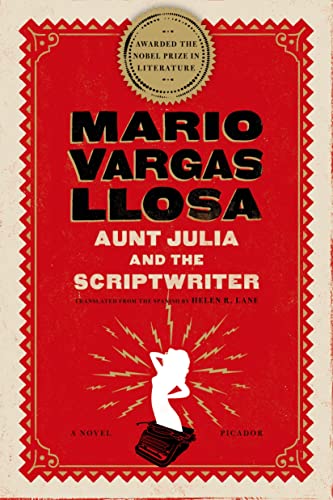
Mario Vargas Llosa's brilliant, multilayered novel is set in the Lima, Peru, of the author's youth, where a young student named Marito is toiling away in the news department of a local radio station. His young life is disrupted by two arrivals.
The first is his aunt Julia, recently divorced and thirteen years older, with whom he begins a secret affair. The second is a manic radio scriptwriter named Pedro Camacho, whose racy, vituperative soap operas are holding the city's listeners in thrall. Pedro chooses young Marito to be his confidant as he slowly goes insane.
Interweaving the story of Marito's life with the ever-more-fevered tales of Pedro Camacho, Vargas Llosa's novel is hilarious, mischievous, and masterful, a classic named one of the best books of the year by the New York Times Book Review.
Die Inhaltsangabe kann sich auf eine andere Ausgabe dieses Titels beziehen.
Über die Autorin bzw. den Autor
MARIO VARGAS LLOSA was awarded the Nobel Prize in Literature in 2010 "for his cartography of structures of power and his trenchant images of the individual's resistance, revolt, and defeat." Peru's foremost writer, he has been awarded the Cervantes Prize, the Spanish-speaking world's most distinguished literary honor, and the Jerusalem Prize. His many works include The Feast of the Goat, The Bad Girl, Aunt Julia and the Scriptwriter, The War of the End of the World, and The Storyteller. He lives in London.
Auszug. © Genehmigter Nachdruck. Alle Rechte vorbehalten.
Aunt Julia and the Scriptwriter
By Mario Vargas Llosa, Helen R. LanePicador
Copyright © 1977 Editorial Seix Barral, S.A., Spain
All rights reserved.
ISBN: 978-0-312-42724-5All rights reserved.
CHAPTER 1
In those long-ago days, I was very young and lived with my grandparents in a villa with white walls in the Calle Ocharán, in Miraflores. I was studying at the University of San Marcos, law, as I remember, resigned to earning myself a living later on by practicing a liberal profession, although deep down what I really wanted was to become a writer someday. I had a job with a pompous-sounding title, a modest salary, duties as a plagiarist, and flexible working hours: News Director of Radio Panamericana. It consisted of cutting out interesting news items that appeared in the daily papers and rewriting them slightly so that they could be read on the air during the newscasts. My editorial staff was limited to Pascual, a youngster who slicked down his hair with quantities of brilliantine and loved catastrophes. There were one-minute news bulletins every hour on the hour, except for those at noon and at 9 p.m., which were fifteen minutes long, but we were able to prepare several of the one-minute hourly ones ahead of time, so that I was often out of the office for long stretches at a time, drinking coffee in one of the cafés on La Colmena, going to class now and again, or dropping in at the offices of Radio Central, always much livelier than the ones where I worked.
The two radio stations belonged to the same owner and were next door to each other on the Calle Belén, just a few steps away from the Plaza San Martín. The two of them bore no resemblance whatsoever to each other. Or rather, like those sisters in tragic drama, one of whom has been born with every possible grace and the other with every possible defect, what was most noticeable was the contrast between them. Radio Panamericana occupied the third floor and the rooftop terrace of a brand-new building, and its personnel, its ambitions, and its programs all had about them a certain snobbish, cosmopolitan air, pretensions of being modern, youthful, aristocratic. Although its disc jockeys and m.c.'s weren't Argentines (as Pedro Camacho would have put it), they might just as well have been. The station broadcast lots of music, hours and hours of jazz and rock plus a bit of classical stuff now and again, it was always the first to put the latest hits from New York and Europe on the air in Lima, yet at the same time it did not disdain Latin American music so long as it had a modicum of sophistication; as for Peruvian selections, they were cautiously screened and allowed on the air only if they were waltzes. There were also programs calculated to appeal to intellectuals among the listening audience, such as "Portraits from the Past" or "Reports from Abroad," and even in frivolous mass-entertainment programs, such as "The Quiz Show" or "The Trampoline to Fame," there was a noticeable attempt to avoid excessive stupidity or vulgarity. One of the proofs of its cultural preoccupations was its News Section, consisting of Pascual and me, working out of a wooden shack on the rooftop terrace, from which we could see garbage dumps and the last remaining colonial windows let into the roofs of Lima. The one access to our hideaway was by way of an elevator whose doors had the disquieting habit of opening before it stopped.
Radio Central, by contrast, occupied cramped quarters in an old house with all sorts of odd corners and courtyards, and one needed only to listen to the relaxed, easygoing, slang-ridden voices of its announcers and m.c.'s to recognize its popular, plebeian, frankly parochial appeal. It broadcast very few news reports, and on its frequency Peruvian music, including popular Andean tunes, held sway, and often Indian singers from the music halls about town participated in these broadcasts, open to the public, which drew vast crowds to the doors of the studio many hours before they went on the air. It also flooded the airwaves with tropical music from Mexico and Argentina, and its programs were simple, unimaginative, attracting a wide audience: "Telephoned Requests," "Birthday Serenades," "Gossip from the World of Entertainment," "Celluloid and Cinema." But its plat de résistance, served up repeatedly and in great abundance, and the feature that, according to all the surveys, attracted its vast listenership, was the serials it sent out over the airwaves.
They broadcast at least half a dozen a day, and I greatly enjoyed spying on the casts when they were in front of the microphone: hungry, shabbily dressed actors and actresses on the decline, whose tender, crystal-clear, young voices were terribly different from their old-looking faces, their bitter mouths, and their tired eyes. "The day television comes to Peru, the only way out for them will be suicide," Genaro Jr. predicted, pointing to them through the big glass panels of the studio, where, as though in an enormous aquarium, you could see them grouped around the microphone, scripts in hand, ready to begin Chapter 24 of "The Alvear Family." And what a disappointment it would have been for those housewives who grew misty-eyed on hearing the voice of Luciano Pando if they could have seen his hunchbacked body and his squinty eyes, and what a disappointment for those pensioners to whom the musical murmur of Josefina Sánchez brought back memories if they had known that she had a double chin, a mustache, ears that stuck way out, and varicose veins. But the arrival of television in Peru was still a long way off, and for the moment the modest survival of the fauna of the world of soap operas seemed assured.
I had always been curious to know who the writers were who churned out these serials that kept my grandmother entertained in the afternoon, these stories that assailed my eardrums at my Aunt Laura's, my Aunt Olga's, my Aunt Gaby's, or at my countless girl cousins' when I went to visit them (our family was a Biblical one, from the Miraflores district, and we were all very close). I suspected that the serials were imported, but it surprised me to learn that the Genaros did not buy them in Mexico or in Argentina but in Cuba. They were produced by CMQ, a sort of radio-television empire ruled over by Goar Mestre, a gentleman with silvery hair whom I had occasionally seen, on one of his visits to Lima, walking down the corridors of Radio Panamericana, solicitously escorted by the owners and the object of the reverent gaze of the entire staff. I had heard so much about the Cuban CMQ from announcers, m.c.'s, and technicians at Radio Panamericana — for whom it represented something mythical, what Hollywood represented in those days for filmmakers — that as Javier and I drank coffee in the Bransa we had often spent considerable time fantasizing about that army of polygraphic scriptwriters who, there in the distant Havana of palm trees, paradisiac beaches, gangsters, and tourists, in the air-conditioned offices of Goar Mestre's citadel, were doubtless spending eight hours a day at noiseless typewriters turning out that torrent of adulteries, suicides, passionate love affairs, unexpected encounters, inheritances, devotions, coincidences, and crimes which, from that Caribbean island, were spreading throughout Latin America, crystallized in the voices of the continent's Luciano Pandos and Josefina Sánchezes to fill with dreams the afternoons of the grandmothers, aunts, cousins, and pensioners of each country.
Genaro Jr. bought (or, rather, CMQ sold) the serials by weight and by telegram. It was he himself who had told me so one afternoon, when to his great stupefaction I had...
„Über diesen Titel“ kann sich auf eine andere Ausgabe dieses Titels beziehen.
Suchergebnisse für Aunt Julia and the Scriptwriter

Foto des Verkäufers
Aunt Julia and the Scriptwriter
Anbieter: Dream Books Co., Denver, CO, USA
Verkäuferbewertung 5 von 5 Sternen

Zustand: acceptable. This copy has clearly been enjoyedâ"expect noticeable shelf wear and some minor creases to the cover. Binding is strong, and all pages are legible. May contain previous library markings or stamps. Artikel-Nr. DBV.0312427247.A
Gebraucht kaufen
EUR 3,90
Versand gratis
Versand innerhalb von USA
Versand innerhalb von USA
Anzahl: 1 verfügbar
Beispielbild für diese ISBN
Aunt Julia and the Scriptwriter
Anbieter: World of Books (was SecondSale), Montgomery, IL, USA
Verkäuferbewertung 5 von 5 Sternen
Paperback. Zustand: Good. WINNER OF THE NOBEL PRIZE IN LITERATURE Mario Vargas Llosa's brilliant, multilayered novel is set in the Lima, Peru, of the author's youth, where a young student named Marito is toiling away in the news department of a local radio station. His young life is disrupted by two arrivals. The first is his aunt Julia, recently divorced and thirteen years older, with whom he begins a secret affair. The second is a manic radio scriptwriter named Pedro Camacho, whose racy, vituperative soap operas are holding the city's listeners in thrall. Pedro chooses young Marito to be his confidant as he slowly goes insane. Interweaving the story of Marito's life with the ever-more-fevered tales of Pedro Camacho, Vargas Llosa's novel is hilarious, mischievous, and masterful, a classic named one of the best books of the year by the New York Times Book Review. Artikel-Nr. 00104269578
Gebraucht kaufen
EUR 3,96
Versand gratis
Versand innerhalb von USA
Versand innerhalb von USA
Anzahl: 8 verfügbar
Beispielbild für diese ISBN
Aunt Julia and the Scriptwrite
Anbieter: World of Books (was SecondSale), Montgomery, IL, USA
Verkäuferbewertung 5 von 5 Sternen
Zustand: Acceptable. Item in acceptable condition! Textbooks may not include supplemental items i.e. CDs, access codes etc. Artikel-Nr. 00094281448
Gebraucht kaufen
EUR 3,96
Versand gratis
Versand innerhalb von USA
Versand innerhalb von USA
Anzahl: 4 verfügbar
Beispielbild für diese ISBN
Aunt Julia and the Scriptwrite
Anbieter: World of Books (was SecondSale), Montgomery, IL, USA
Verkäuferbewertung 5 von 5 Sternen
Zustand: Very Good. Item in very good condition! Textbooks may not include supplemental items i.e. CDs, access codes etc. Artikel-Nr. 00109237261
Gebraucht kaufen
EUR 3,96
Versand gratis
Versand innerhalb von USA
Versand innerhalb von USA
Anzahl: 1 verfügbar
Beispielbild für diese ISBN
Aunt Julia and the Scriptwriter
Anbieter: ThriftBooks-Atlanta, AUSTELL, GA, USA
Verkäuferbewertung 5 von 5 Sternen
Paperback. Zustand: Fair. No Jacket. Readable copy. Pages may have considerable notes/highlighting. ~ ThriftBooks: Read More, Spend Less. Artikel-Nr. G0312427247I5N00
Gebraucht kaufen
EUR 5,96
Versand gratis
Versand innerhalb von USA
Versand innerhalb von USA
Anzahl: 1 verfügbar
Beispielbild für diese ISBN
Aunt Julia and the Scriptwriter: A Novel
Verlag:
Picador (edition First Edition), 2007
ISBN 10: 0312427247
ISBN 13: 9780312427245
Gebraucht
Paperback
Erstausgabe
Anbieter: BooksRun, Philadelphia, PA, USA
Verkäuferbewertung 5 von 5 Sternen
Paperback. Zustand: Fair. First Edition. The item might be beaten up but readable. May contain markings or highlighting, as well as stains, bent corners, or any other major defect, but the text is not obscured in any way. Artikel-Nr. 0312427247-7-1
Gebraucht kaufen
EUR 6,77
Versand gratis
Versand innerhalb von USA
Versand innerhalb von USA
Anzahl: 1 verfügbar
Beispielbild für diese ISBN
Aunt Julia and the Scriptwriter : A Novel
Anbieter: Better World Books, Mishawaka, IN, USA
Verkäuferbewertung 5 von 5 Sternen
Zustand: Good. 1 Edition. Former library copy. Pages intact with minimal writing/highlighting. The binding may be loose and creased. Dust jackets/supplements are not included. Includes library markings. Stock photo provided. Product includes identifying sticker. Better World Books: Buy Books. Do Good. Artikel-Nr. GRP97516151
Gebraucht kaufen
EUR 7,01
Versand gratis
Versand innerhalb von USA
Versand innerhalb von USA
Anzahl: 2 verfügbar
Beispielbild für diese ISBN
Aunt Julia and the Scriptwriter : A Novel
Anbieter: Better World Books, Mishawaka, IN, USA
Verkäuferbewertung 5 von 5 Sternen
Zustand: Good. 1 Edition. Pages intact with minimal writing/highlighting. The binding may be loose and creased. Dust jackets/supplements are not included. Stock photo provided. Product includes identifying sticker. Better World Books: Buy Books. Do Good. Artikel-Nr. 4072839-6
Gebraucht kaufen
EUR 7,01
Versand gratis
Versand innerhalb von USA
Versand innerhalb von USA
Anzahl: 8 verfügbar
Beispielbild für diese ISBN
Aunt Julia and the Scriptwriter: A Novel
Anbieter: Wonder Book, Frederick, MD, USA
Verkäuferbewertung 5 von 5 Sternen
Zustand: Very Good. Very Good condition. A copy that may have a few cosmetic defects. May also contain light spine creasing or a few markings such as an owner's name, short gifter's inscription or light stamp. Artikel-Nr. H10L-01209
Gebraucht kaufen
EUR 7,14
Versand gratis
Versand innerhalb von USA
Versand innerhalb von USA
Anzahl: 1 verfügbar
Beispielbild für diese ISBN
Aunt Julia and the Scriptwriter: A Novel
Anbieter: Wonder Book, Frederick, MD, USA
Verkäuferbewertung 5 von 5 Sternen
Zustand: Good. Good condition. A copy that has been read but remains intact. May contain markings such as bookplates, stamps, limited notes and highlighting, or a few light stains. Artikel-Nr. L06E-01674
Gebraucht kaufen
EUR 7,14
Versand gratis
Versand innerhalb von USA
Versand innerhalb von USA
Anzahl: 2 verfügbar