
Verwandte Artikel zu ONCE UPON A COUNTRY: A Palestinian Life
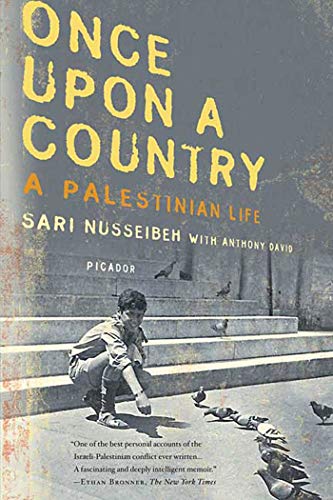
Inhaltsangabe
A New York Times Book Review Editors' Choice
A teacher, a scholar, a philosopher, and an eyewitness to history, Sari Nusseibeh is one of our most urgent and articulate authorities on the conflict in the Middle East. From his time teaching side by side with Israelis at the Hebrew University through his appointment by Yasir Arafat to administer the Arab Jerusalem, he has held fast to the principles of freedom and equality for all, and his story dramatizes the consequences of war, partition, and terrorism as few other books have done. Once Upon a Country brings rare depth and compassion to the story of his country.
Die Inhaltsangabe kann sich auf eine andere Ausgabe dieses Titels beziehen.
Über die Autorin bzw. den Autor
Sari Nusseibeh, a philosopher, was the Palestine Liberation Organization's chief representative in Jerusalem from 2001 to 2002, in which role he advocated a two-state solution to the Israel-Palestine conflict. He is the president of and a professor at Al-Quds University, the Arab University of Jerusalem. Nusseibeh was educated at Oxford and Harvard, and was a Radcliffe Institute Fellow at Harvard for 2004-05. He is the author of two previous books.
Auszug. © Genehmigter Nachdruck. Alle Rechte vorbehalten.
Once Upon a Country
A Palestinian LifeBy Nusseibeh, SariPicador
Copyright © 2008 Nusseibeh, SariAll right reserved.
ISBN: 9780312427108
Prologue
A Fairy Tale
Almost forty years ago the Israeli army conquered Jerusalem, a city my family had lived in since the days of Omar the Great, and soon afterward I fell in love with Lucy. Everyone agreed at the time, including the two of us, that it was an odd match. We were both students at Oxford, which at least on the surface was where our similarities ended. Lucy was the daughter of John Austin, one of England’s mightiest modern philosophers, and I was the nineteen-year-old son of a man who had spent the last twenty years serving a Jordanian-administered Palestine, an entity recently wiped off the map in six brief days. Lucy was expected to marry into the British intelligentsia and to pursue a dazzling academic career of her own. By contrast, I no longer had a country, and the old ruling class my father represented had been plunged into a crisis from which it would never recover. The children of the privileged and educated, including all five of my siblings, began heading for the exits.
Had I intended to stay in exile, the love that Lucy and I shared perhaps would have raised fewer eyebrows. But I wanted to return, and I wanted her to go with me. But how do you ask the daughter of a famous Oxford don to follow you to the war-scarred, embattled, poor, and occupied city of Jerusalem? How do you break the news that your fate will be tied to one of the most volatile corners on the planet, with two major wars in its recent history and the Arab leaders worldwide calling for another? It seemed too preposterous even to try, so I wrote a fairy tale instead.
It was second nature for me to use myth to get across something so important. At the time I was, as I remain, under the thrall of Lewis Carroll’s Alice’s Adventures in Wonderland, for in it I saw how a children’s yarn could say more than a dozen philosophical treatises.
Fairy tales are also in my blood, and how could it be otherwise, with my having been raised surrounded by such a timeless and magical landscape? When my ancestors arrived in Jerusalem from Arabia thirteen centuries ago, the city’s history was already so hallowed by time—and of course by the ancient Jewish prophets who once roamed its streets—that it left the newcomers from the desert in awe. That awe was so strong that as a child 1,300 years later, I couldn’t walk to the corner market without feeling it all the way to my fingertips. Sometimes, when I watched my uncle’s camels graze among ruins of Suq al-Khawajat, or Goldsmith’s Souk, which had belonged to the Nusseibehs from time immemorial, the sensation of being a character in an ancient story swept through me—as it did when I watched a different uncle, the doorkeeper of the Church of the Holy Sepulcher, take a foot-long skeleton key and, as in the story that my Christian friends told me of St. Peter and the Pearly Gates, unlock a door thick enough to withstand a battering ram. In a city whose lanes were too narrow and crooked for a tank, this massive oak door still gave off a sense of impenetrability.
After snatching the city away from the Byzantine Empire in the seventh century, Omar the Great made our family’s ancestor High Judge of Jerusalem, and from that point on my family has served the Holy City as judges, teachers, Sufi sages, politicians, and as doorkeepers to the Church of the Holy Sepulcher.
With all this in my background, my fairy tale’s first line was as truthful as it was unsubtle: “Oh how I wish I could go to the Holy Land.” The rest of the story is about an angel on a flying donkey who takes an English girl named Louise on a ride to Jerusalem. The model for my story was Mohammed’s Night Journey to Jerusalem, my favorite childhood fable. One evening the Prophet mounted a winged steed named al-Burak, Arabic for “lightning,” and took a magical trip that over time would inspire the tales of flying carpets. Apart from the revelation of the Koran, in the only miracle ever associated with the Muslim prophet, Mohammed flew on al-Burak’s back over the endless dunes and rock deserts of Arabia to a land described in the Koran as holy and blessed.
The destination of the Night Journey was the site of Solomon’s ancient temple in Jerusalem and the place, according to Jewish tradition, of Abraham’s sacrifice. To be more precise, he and his steed landed on the rock where some say Adam was created, and where he first set foot on earth after his expulsion from Paradise. (They’ll also tell you that if you look closely enough, you’ll see his footprints.) It is from that rock that the Prophet then ascended to heaven to receive instructions for the Abrahamic message of Islam, or faith in the one God.
In the yarn I wrote for Lucy, after an angel wearing a turban and riding the magical donkey whisks Louise away to Jerusalem, she meets a variety of characters, including Mr. Seems, who is never what he seems to be. Another figure she encounters stands guard at the Church of the Holy Sepulcher. Since the time of the Crusades, this knight of the Holy Sepulcher has been asleep at the same spot, as rigid as the tin man in The Wizard of Oz, and just as teary eyed, because a thousand years ago he vowed not to budge until there was peace in the Holy Land.
While at Oxford, I never finished the tale. I got Louise as far as Jerusalem, but I couldn’t figure out what to do with her once she arrived. Would she help awaken the Crusader knight outside the Holy Sepulcher? Would she help bring peace to the Holy Land? I was stumped.
Anyway, Lucy didn’t need a fairy tale to fall in love with Jerusalem: before I wrote the story she had already spent time in the Holy Land, while on tour with an Oxford choir, and had begun to identify with the landscape, history, language, and people with as much avidity as a native.
And so for more than thirty-five years my tale sat in a drawer, untitled and unfinished, and the knight remained very much asleep. More pressing matters—academic work, family life, and three decades of war and upheaval—got in the way. It was only last year, as I was preparing for my upcoming fellowship at the Radcliffe Institute at Harvard, that I picked up the tale again. I asked my twelve-year-old daughter, Nuzha, bedridden with the flu at the time, for her opinion on its merits. An avid and critical reader of stories and an aspiring writer herself, she gave me the thumbs-up, and I packed the tale along with the rest of my things to take to America. So as the institute’s distinguished mathematicians, historians, and biologists pursued their academic and scientific endeavors, I worked on my fairy tale.
The aim, of course, was no longer to persuade Lucy to run off with me to Jerusalem. Now other motives had surfaced. Lucy and I now had our own children, who had to make their own decision as to whether to stay in a land far more mired in tragedy and seething with resentment than it was after the Six-Day War. Could I so easily say to my children, as I said to Lucy back then, that a life in Palestine...
„Über diesen Titel“ kann sich auf eine andere Ausgabe dieses Titels beziehen.
Suchergebnisse für ONCE UPON A COUNTRY: A Palestinian Life

Beispielbild für diese ISBN
Once Upon a Country: A Palestinian Life
Anbieter: World of Books (was SecondSale), Montgomery, IL, USA
Verkäuferbewertung 5 von 5 Sternen

Paperback. Zustand: Fair. A New York Times Book Review Editors' Choice A teacher, a scholar, a philosopher, and an eyewitness to history, Sari Nusseibeh is one of our most urgent and articulate authorities on the conflict in the Middle East. From his time teaching side by side with Israelis at the Hebrew University through his appointment by Yasir Arafat to administer the Arab Jerusalem, he has held fast to the principles of freedom and equality for all, and his story dramatizes the consequences of war, partition, and terrorism as few other books have done. Once Upon a Country brings rare depth and compassion to the story of his country. Artikel-Nr. 00105751923
Gebraucht kaufen
EUR 6,45
Versand gratis
Versand innerhalb von USA
Versand innerhalb von USA
Anzahl: 1 verfügbar
Beispielbild für diese ISBN
Once upon a Country : A Palestinian Life
Anbieter: Better World Books: West, Reno, NV, USA
Verkäuferbewertung 5 von 5 Sternen
Zustand: Good. Pages intact with minimal writing/highlighting. The binding may be loose and creased. Dust jackets/supplements are not included. Stock photo provided. Product includes identifying sticker. Better World Books: Buy Books. Do Good. Artikel-Nr. 5761468-6
Gebraucht kaufen
EUR 6,46
Versand gratis
Versand innerhalb von USA
Versand innerhalb von USA
Anzahl: 2 verfügbar
Beispielbild für diese ISBN
Once upon a Country : A Palestinian Life
Anbieter: Better World Books, Mishawaka, IN, USA
Verkäuferbewertung 5 von 5 Sternen
Zustand: Good. Pages intact with minimal writing/highlighting. The binding may be loose and creased. Dust jackets/supplements are not included. Stock photo provided. Product includes identifying sticker. Better World Books: Buy Books. Do Good. Artikel-Nr. 5761468-6
Gebraucht kaufen
EUR 6,46
Versand gratis
Versand innerhalb von USA
Versand innerhalb von USA
Anzahl: 4 verfügbar
Beispielbild für diese ISBN
Once Upon a Country: A Palestinian Life
Verlag:
Picador (edition First Edition), 2008
ISBN 10: 0312427107
ISBN 13: 9780312427108
Gebraucht
Paperback
Erstausgabe
Anbieter: BooksRun, Philadelphia, PA, USA
Verkäuferbewertung 5 von 5 Sternen
Paperback. Zustand: Fair. First Edition. The item might be beaten up but readable. May contain markings or highlighting, as well as stains, bent corners, or any other major defect, but the text is not obscured in any way. Artikel-Nr. 0312427107-7-1
Gebraucht kaufen
EUR 6,49
Versand gratis
Versand innerhalb von USA
Versand innerhalb von USA
Anzahl: 1 verfügbar
Beispielbild für diese ISBN
Once Upon a Country: A Palestinian Life
Anbieter: ThriftBooks-Dallas, Dallas, TX, USA
Verkäuferbewertung 5 von 5 Sternen
Paperback. Zustand: Fair. No Jacket. Readable copy. Pages may have considerable notes/highlighting. ~ ThriftBooks: Read More, Spend Less. Artikel-Nr. G0312427107I5N00
Gebraucht kaufen
EUR 8,11
Versand gratis
Versand innerhalb von USA
Versand innerhalb von USA
Anzahl: 1 verfügbar
Beispielbild für diese ISBN
Once Upon a Country: A Palestinian Life
Anbieter: BookOutlet, Jefferson City, TN, USA
Verkäuferbewertung 5 von 5 Sternen
Paperback. Zustand: New. Paperback. Publisher overstock, may contain remainder mark on edge. Artikel-Nr. 9780312427108B
Beispielbild für diese ISBN
Once Upon a Country: A Palestinian Life
Anbieter: Revaluation Books, Exeter, Vereinigtes Königreich
Verkäuferbewertung 5 von 5 Sternen
Paperback. Zustand: Brand New. reprint edition. 562 pages. 8.25x5.50x1.50 inches. In Stock. Artikel-Nr. x-0312427107
Neu kaufen
EUR 43,59
EUR 14,53 Versand
Versand von Vereinigtes Königreich nach USA
Versand von Vereinigtes Königreich nach USA
Anzahl: 2 verfügbar
Beispielbild für diese ISBN
ONCE UPON A COUNTRY: A Palestinian Life
Anbieter: Studibuch, Stuttgart, Deutschland
Verkäuferbewertung 5 von 5 Sternen
paperback. Zustand: Sehr gut. 588 Seiten; 9780312427108.2 Gewicht in Gramm: 1. Artikel-Nr. 1200903
Gebraucht kaufen
EUR 8,65
EUR 62,30 Versand
Versand von Deutschland nach USA
Versand von Deutschland nach USA
Anzahl: 1 verfügbar
Foto des Verkäufers
ONCE UPON A COUNTRY: A Palestinian Life
Anbieter: Berliner Büchertisch eG, Berlin, Deutschland
Verkäuferbewertung 5 von 5 Sternen
Softcover/Paperback. Zustand: Gut. Reprint. 588 S. Gutes Exemplar, geringe Gebrauchsspuren, Cover/SU berieben/bestoßen, Lesefalze am Rücken des Buches, innen alles in Ordnung. B260105am67 ISBN: 9780312427108 Sprache: Englisch Gewicht in Gramm: 454. Artikel-Nr. 747358
Gebraucht kaufen
EUR 7,59
EUR 100,00 Versand
Versand von Deutschland nach USA
Versand von Deutschland nach USA
Anzahl: 1 verfügbar