
Verwandte Artikel zu Limitations (Picador) Rough Cut
Inhaltsangabe
A Picador Paperback Original
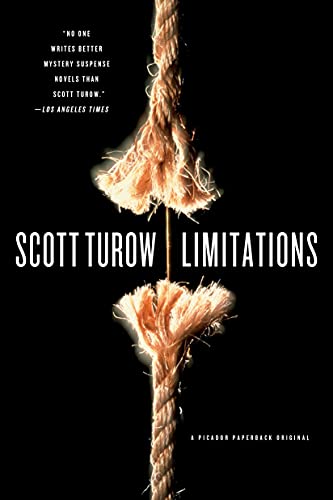
From the #1 New York Times bestselling author of Presumed Innocent comes a compelling new legal mystery featuring George Mason from Personal Injuries. Originally commissioned and published by The New York Times Magazine, this edition contains additional material.
Life would seem to have gone well for George Mason. His days as a criminal defense lawyer are long behind him. At fifty-nine, he has sat as a judge on the Court of Appeals in Kindle County for nearly a decade. Yet, when a disturbing rape case is brought before him, the judge begins to question the very nature of the law and his role within it. What is troubling George Mason so deeply? Is it his wife's recent diagnosis? Or the strange and threatening e-mails he has started to receive? And what is it about this horrific case of sexual assault, now on trial in his courtroom, that has led him to question his fitness to judge?
In Limitations, Scott Turow, the master of the legal thriller, returns to Kindle County with a page-turning entertainment that asks the biggest questions of all. Ingeniously, and with great economy of style, Turow probes the limitations not only of the law but of human understanding itself.
Die Inhaltsangabe kann sich auf eine andere Ausgabe dieses Titels beziehen.
Über die Autorin bzw. den Autor
Scott Turow is the author of worldwide bestselling novels including Presumed Innocent, Innocent, Ordinary Heroes, The Burden of Proof, Reversible Errors and Limitations. His works of nonfiction include One L, his journal from his first year at law school, and Ultimate Punishment, which he wrote after serving on the Illinois commission that investigated the administration of the death penalty and influenced Governor George Ryan's unprecedented commutation of the sentences of 164 death row inmates on his last day in office. Ultimate Punishment won the Robert F. Kennedy Book Award. He lives outside Chicago, where he is partner in the firm of SNR Denton (formerly Sonnenschein, Nath & Rosenthal).
Von der hinteren Coverseite
Praise for author Scott Turow:
"No one writes better mystery suspense novels than Scott Turow."--Los Angeles Times
"Scott Turow not only knows what his readers want, he delivers just about perfectly. . . . Turow is the closest we have to a Balzac of the fin de siècle professional class."--Chicago Tribune
"Turow has set new standards for the genre, most notably in the depth and subtlety of his characterizations. . . . The kind of reading pleasure that only the best novelists--genre or otherwise--can provide."--The New York Times
"Of all the lawyer-storytellers who have clambered onto the bestseller lists in recent years, Scott Turow is the champ. Not only are his plots absorbing and his characters persuasive, but his sentences flow with an artful cadence."--Dennis Drabelle, The Washington Post Book World
"Turow brings a literary sensibility to a grit-and-gravel genre: if he calls to mind any comparison, it's to John le Carré. His novels are shaped by [a] studied bleakness, an introspect's embrace of the gray-zone ambiguities of modern life."--Gail Caldwell, Boston Sunday Globe
"Turow is well established as one of the greater writers of modern legal thrillers. . . . Turow's prose is beautiful and his observations, particularly the perceptions of small-scale human vulnerabilities, can take your breath away."--The Times (London)
"One begins with admiration for Turow's skillful evocation of the thrill of detection; one finishes fascinated by his deft probing of the mysteries of character and family. Like John le Carré in the realm of spy novels and P. D. James in that of mysteries, Scott Turow has the goods to transcend the limitations of the genre."--Dan Cryer, Newsday
Aus dem Klappentext
Praise for author Scott Turow:
"No one writes better mystery suspense novels than Scott Turow."--Los Angeles Times
"Scott Turow not only knows what his readers want, he delivers just about perfectly. . . . Turow is the closest we have to a Balzac of the fin de siècle professional class."--Chicago Tribune
"Turow has set new standards for the genre, most notably in the depth and subtlety of his characterizations. . . . The kind of reading pleasure that only the best novelists--genre or otherwise--can provide."--The New York Times
"Of all the lawyer-storytellers who have clambered onto the bestseller lists in recent years, Scott Turow is the champ. Not only are his plots absorbing and his characters persuasive, but his sentences flow with an artful cadence."--Dennis Drabelle, The Washington Post Book World
"Turow brings a literary sensibility to a grit-and-gravel genre: if he calls to mind any comparison, it's to John le Carré. His novels are shaped by [a] studied bleakness, an introspect's embrace of the gray-zone ambiguities of modern life."--Gail Caldwell, Boston Sunday Globe
"Turow is well established as one of the greater writers of modern legal thrillers. . . . Turow's prose is beautiful and his observations, particularly the perceptions of small-scale human vulnerabilities, can take your breath away."--The Times (London)
"One begins with admiration for Turow's skillful evocation of the thrill of detection; one finishes fascinated by his deft probing of the mysteries of character and family. Like John le Carré in the realm of spy novels and P. D. James in that of mysteries, Scott Turow has the goods to transcend the limitations of the genre."--Dan Cryer, Newsday
Auszug. © Genehmigter Nachdruck. Alle Rechte vorbehalten.
Limitations
By Turow, ScottPicador
Copyright ©2006 Turow, ScottAll right reserved.
ISBN: 9780312426453
Chapter One
The Argument
“May it please the court,” booms Jordan Sapperstein from the podium. “This case must be reversed. Your Honors have no choice.”
Seated behind the elevated walnut bench a dozen feet away, Judge George Mason suppresses an impulsive wince at Sapperstein’s excesses. The judge is seldom reluctant to let lawyers know when their claims are unpersuasive, but making faces, as his father warned him when he was a boy in Virginia long ago, is simply rude.
The truth is that George Mason recoils even more from the case, People v. Jacob Warnovits et al., than from the celebrated attorney beginning his oral argument. Before he was elected to the bench, at age forty-seven, George was a criminal defense lawyer, perpetually engrossed in his warring feelings—loathing, amusement, intrigue, envy—about those who broke the rules. Yet from the instant the Court of Appeals’s docket department randomly placed him on Warnovits five weeks ago, he has been uneasy about the assignment. He has found it uncharacteristically difficult to read the briefs or view the record of the trial in the Kindle County Superior Court, where nineteen months ago, the four young defendants were convicted of criminal sexual assault and given the mandatory minimum sentence of six years. Now the judge thinks what he has every time the matter has come reluctantly to mind: hard cases make bad law.
As the senior member of the three-judge panel, Judge Mason, in his inky robe, occupies the center spot on the long bench between his two colleagues. Judge Summerset Purfoyle, with his time-engraved pecan face and a sponge of white hair, is perhaps more regally handsome now than in his days as a successful soul balladeer. The other judge, Nathan Koll, small and stout, his plump jowls like a croissant beneath his chin, eyes Sapperstein from his first words with a dark, merciless look.
Beyond the lawyers in the well of the court, the security officers have fit onto the walnut pews as many as possible of the spectators who lined up at the courtroom door, leaving the air close on a warm day at the start of June. In the front row, the reporters and sketch artists hastily record what they can. Behind them the onlookers—law students, court buffs, friends of the defendants, and supporters of the victim—are now intent, after having shifted through three civil cases argued before the same panel earlier in the morning. Even the stateliness of the appellate courtroom, with its oxblood pillars of marble rising two stories to the vaulted ceiling and the gilded rococo details on the furnishings, cannot fully dampen the high-wattage current of controversy that has long enlivened the Warnovits case, which has taken on complex meanings for thousands of people who know nothing about the legal principles at stake and not much more about the underlying facts.
The victim of the crime is Mindy DeBoyer, although her name, as an alleged rape victim, is never used in the frequent public accounts. More than seven years ago, in March 1999, Mindy was fifteen and a member of the rowdy throng at a house party for the Glen Brae High School boys’ ice hockey team. Earlier that day, Glen Brae had finished second in the state. The players were sore—from the pounding of six games in six days and from failing after coming so close to the state title—and the celebration in the home of the team co-captain, Jacob Warnovits, whose parents had flown off to a wedding in New York, was out of control from the start. Mindy DeBoyer, by her own testimony, ‘got hammered beyond belief’ on the combination of rum and a pill provided by Warnovits and somehow ended up passed out in his room.
Warnovits claimed he had discovered her there and took Mindy’s position, like Goldilocks in the bed of one of the three bears, as a proposition. The jury clearly rejected that explanation, probably because Warnovits also invited three other team members to join him in violating the young woman, who was unconscious and lifeless as a rag doll. Warnovits captured each assault on videotape, often employing the camera in a grotesque fashion that would startle even a pornographer. The soundtrack, a vile screed from Warnovits, ended after more than fifty minutes with his warnings to his friends to get Mindy out of there and ‘don’t say jack.’
When she awoke at about 5:00 a.m. amid the lingering reek from the empty cans and ashes in the Warnovitses’ living room, Mindy DeBoyer had no idea what had occurred. A sexual novice, although not uninitiated, she realized she’d had rough treatment, and she noticed that her skirt was on backward. Yet she had no memory of any of the night’s late events. After sneaking home, she phoned other kids she’d seen at the party, but no one could recall whom Mindy had gone off with. Speaking to her best friend, Vera Hartal, Mindy DeBoyer wondered if she might even have been raped. But she was fifteen and not eager to involve an adult, or admit where she had been. She healed in her own time and said nothing.
And so life marched on. The four boys graduated from high school and went to college, as did Mindy two and a half years later. Feeling safer with time, Jacob Warnovits could not resist occasionally entertaining his fraternity brothers with the tape. One freshman pledge, Michael Willets, turned out to be close to the DeBoyer family, and after a lengthy conversation with his sister, he tipped the police, who arrived at the fraternity house with a search warrant. Mindy DeBoyer reviewed the videotape in horror, and Warnovits and the three other young men were indicted in quick order on January 14, 2003.
As George Mason views the case, the principal legal question is the statute of limitations, which under state law would ordinarily bar bringing felony charges more than three years after the crime. But the grinding social issue is that Mindy DeBoyer is black. She is well-to-do, like the boys who assaulted her, but her parents, a lawyer and an MBA, could not keep from wondering publicly, in their initial agitation, whether a young white woman would have been treated the same way in Glen Brae, a suburban town to which integration came grudgingly.
The racial charges raised the volume in Glen Brae. Families close to the four boys proclaimed that their lives were being ruined long after the fact for a crime from which the victim had not really suffered. They implied that race alone was causing men to be punished for the misdeeds of children. The sharp disputes between neighbors boiled over into the press, where the DeBoyers’ views have clearly prevailed. Most accounts portray the defendants as spoiled rich boys who nearly escaped after a night of bestial fun in the slave cabin, even though not one of the many ugly terms the boys had applied to Mindy on the tape involved any mention of her race.
The substantial questions presented by the young men’s appeal have allowed them to remain free on bond, and all four, now in their midtwenties, are beside the journalists in the front spectators’ row. The fate of each is in the hands of Jordan Sapperstein, in a cream suit with heavy black pinstripes, who is gesticulating often and using his crinkled gray pageboy for emphasis. Judge Mason has never fully decoded whatever it is a human being is saying about himself when...
„Über diesen Titel“ kann sich auf eine andere Ausgabe dieses Titels beziehen.
Suchergebnisse für Limitations (Picador) Rough Cut

Beispielbild für diese ISBN
Limitations
Verlag:
Picador (edition First Edition), 2006
ISBN 10: 0312426453
ISBN 13: 9780312426453
Gebraucht
Paperback
Erstausgabe
Anbieter: BooksRun, Philadelphia, PA, USA
Verkäuferbewertung 5 von 5 Sternen

Paperback. Zustand: Fair. First Edition. The item might be beaten up but readable. May contain markings or highlighting, as well as stains, bent corners, or any other major defect, but the text is not obscured in any way. Artikel-Nr. 0312426453-7-18-13
Gebraucht kaufen
EUR 4,61
Versand gratis
Versand innerhalb von USA
Versand innerhalb von USA
Anzahl: 1 verfügbar
Beispielbild für diese ISBN
Limitations
Verlag:
Picador (edition First Edition), 2006
ISBN 10: 0312426453
ISBN 13: 9780312426453
Gebraucht
Paperback
Erstausgabe
Anbieter: BooksRun, Philadelphia, PA, USA
Verkäuferbewertung 5 von 5 Sternen
Paperback. Zustand: Very Good. First Edition. It's a well-cared-for item that has seen limited use. The item may show minor signs of wear. All the text is legible, with all pages included. It may have slight markings and/or highlighting. Artikel-Nr. 0312426453-11-1
Gebraucht kaufen
EUR 4,71
Versand gratis
Versand innerhalb von USA
Versand innerhalb von USA
Anzahl: 1 verfügbar
Beispielbild für diese ISBN
Limitations
Verlag:
Picador (edition First Edition), 2006
ISBN 10: 0312426453
ISBN 13: 9780312426453
Gebraucht
Paperback
Erstausgabe
Anbieter: BooksRun, Philadelphia, PA, USA
Verkäuferbewertung 5 von 5 Sternen
Paperback. Zustand: Fair. First Edition. The item might be beaten up but readable. May contain markings or highlighting, as well as stains, bent corners, or any other major defect, but the text is not obscured in any way. Artikel-Nr. 0312426453-7-1
Gebraucht kaufen
EUR 4,86
Versand gratis
Versand innerhalb von USA
Versand innerhalb von USA
Anzahl: 1 verfügbar
Beispielbild für diese ISBN
Limitations
Anbieter: ThriftBooks-Dallas, Dallas, TX, USA
Verkäuferbewertung 5 von 5 Sternen
Paperback. Zustand: Very Good. No Jacket. May have limited writing in cover pages. Pages are unmarked. ~ ThriftBooks: Read More, Spend Less. Artikel-Nr. G0312426453I4N00
Gebraucht kaufen
EUR 5,98
Versand gratis
Versand innerhalb von USA
Versand innerhalb von USA
Anzahl: 1 verfügbar
Beispielbild für diese ISBN
Limitations
Anbieter: ThriftBooks-Dallas, Dallas, TX, USA
Verkäuferbewertung 5 von 5 Sternen
Paperback. Zustand: Very Good. No Jacket. Former library book; May have limited writing in cover pages. Pages are unmarked. ~ ThriftBooks: Read More, Spend Less. Artikel-Nr. G0312426453I4N10
Gebraucht kaufen
EUR 5,98
Versand gratis
Versand innerhalb von USA
Versand innerhalb von USA
Anzahl: 1 verfügbar
Beispielbild für diese ISBN
Limitations
Anbieter: ThriftBooks-Atlanta, AUSTELL, GA, USA
Verkäuferbewertung 5 von 5 Sternen
Paperback. Zustand: Very Good. No Jacket. Former library book; May have limited writing in cover pages. Pages are unmarked. ~ ThriftBooks: Read More, Spend Less. Artikel-Nr. G0312426453I4N10
Gebraucht kaufen
EUR 6,01
Versand gratis
Versand innerhalb von USA
Versand innerhalb von USA
Anzahl: 1 verfügbar
Beispielbild für diese ISBN
Limitations
Anbieter: Better World Books, Mishawaka, IN, USA
Verkäuferbewertung 5 von 5 Sternen
Zustand: Very Good. Pages intact with possible writing/highlighting. Binding strong with minor wear. Dust jackets/supplements may not be included. Stock photo provided. Product includes identifying sticker. Better World Books: Buy Books. Do Good. Artikel-Nr. 12461656-75
Gebraucht kaufen
EUR 6,17
Versand gratis
Versand innerhalb von USA
Versand innerhalb von USA
Anzahl: 2 verfügbar
Beispielbild für diese ISBN
Limitations
Anbieter: Better World Books, Mishawaka, IN, USA
Verkäuferbewertung 5 von 5 Sternen
Zustand: Good. Former library copy. Pages intact with minimal writing/highlighting. The binding may be loose and creased. Dust jackets/supplements are not included. Includes library markings. Stock photo provided. Product includes identifying sticker. Better World Books: Buy Books. Do Good. Artikel-Nr. GRP71691180
Gebraucht kaufen
EUR 6,17
Versand gratis
Versand innerhalb von USA
Versand innerhalb von USA
Anzahl: 4 verfügbar
Beispielbild für diese ISBN
Limitations
Anbieter: Wonder Book, Frederick, MD, USA
Verkäuferbewertung 5 von 5 Sternen
Zustand: Very Good. Very Good condition. A copy that may have a few cosmetic defects. May also contain light spine creasing or a few markings such as an owner's name, short gifter's inscription or light stamp. Artikel-Nr. B10C-02255
Gebraucht kaufen
EUR 6,41
Versand gratis
Versand innerhalb von USA
Versand innerhalb von USA
Anzahl: 3 verfügbar
Beispielbild für diese ISBN
Limitations
Anbieter: Wonder Book, Frederick, MD, USA
Verkäuferbewertung 5 von 5 Sternen
Zustand: Good. Good condition. A copy that has been read but remains intact. May contain markings such as bookplates, stamps, limited notes and highlighting, or a few light stains. Artikel-Nr. L09C-05030
Gebraucht kaufen
EUR 6,41
Versand gratis
Versand innerhalb von USA
Versand innerhalb von USA
Anzahl: 1 verfügbar