
Verwandte Artikel zu Doomsday Men: The Real Dr. Strangelove and the Dream...
Inhaltsangabe
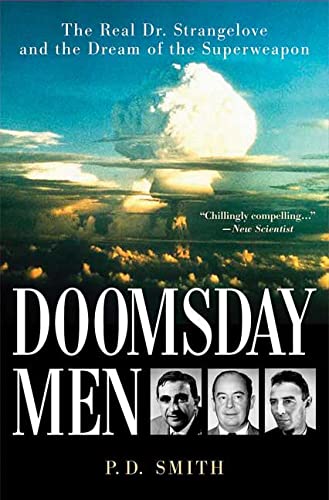
This is the gripping, untold story of the doomsday bomb—the ultimate weapon of mass destruction. In 1950, Hungarian-born scientist Leo Szilard made a dramatic announcement on American radio: science was on the verge of creating a doomsday bomb. For the first time in history, mankind realized that he had within his grasp a truly God-like power, the ability to destroy life itself. The shockwave from this statement reverberated across the following decade and beyond.
If detonated, Szilard's doomsday device—a huge cobalt-clad H-bomb—would pollute the atmosphere with radioactivity and end all life on earth. The scientific creators of such apocalyptic weapons had transformed the laws of nature into instruments of mass destruction and for many people in the Cold War there was little to distinguish real scientists from that “fictional master of megadeath,” Stanley Kubrick’s Dr. Strangelove. Indeed, as PD Smith’s chilling account shows, the dream of the superweapon begins in popular culture. This is a story that cannot be told without the iconic films and fictions that portray our deadly fascination with superweapons, from H.G. Wells’ The War of the Worlds to Nevil Shute’s On the Beach and Kubrick’s Dr. Strangelove or: How I Learned to Stop Worrying and Love the Bomb.
Although scientists admitted it was possible to build the cobalt bomb, no superpower would admit to having created one. However, it remained a terrifying possibility, striking fear into the hearts of people around the world. The story of the cobalt bomb is an unwritten chapter of the Cold War, but now PD Smith reveals the personalities behind this feared technology and shows how the scientists responsible for the twentieth century’s most terrible weapons grew up in a culture dreaming of superweapons and Wellsian utopias. He argues that, in the end, the doomsday machine became the ultimate symbol of humanity’s deepest fears about the science of destruction.
Die Inhaltsangabe kann sich auf eine andere Ausgabe dieses Titels beziehen.
Über die Autorin bzw. den Autor
P.D. Smith is an independent researcher and writer. He has taught at University College London where he is an Honorary Research Fellow in the Science and Technology Studies Department. He regularly reviews books for the Guardian, and has written for the Independent, the Financial Times and the Times Literary Supplement among other journals. His previous books are Metaphor and Materiality: German Literature and the World-View of Science 1780-1955 and a biography of Einstein. He lives in Hampshire.
Rezensionen
Starred Review. Weaving together biography, science and art, Smith has created a compelling history of physics in the 20th century, focusing on the long-lasting search for ever more destructive weapons-from the development of chemical warfare in World War I Germany through the arms race of the Cold War. Explaining "why some of the most gifted and idealistic men of the twentieth century spent so much effort trying to destroy the planet," Smith's dynamic, riveting narrative reveals details of people, places and events that are rarely covered in textbooks, bringing to life not just scientists like Robert Oppenheimer and Leo Szilard, but the horrors of chemical and atomic warfare. Time and again, "it seemed that a giant leap forward for science also meant a step backward for mankind," and contemporary film and fiction echoed this sentiment with "clear signs... of genuine resentment towards scientists for betraying the high ideals of their profession and, indeed, the best interests of humanity." Ironically, the goal of many of these scientists was peace, not war: "Many scientists were convinced that the terrible reality of atomic superweapons would force nations to resolve their disputes and work for world peace." Captivating and thoroughly referenced, this chronicle should interest a wide audience, from science and history buffs to armchair politicos.
Copyright © Reed Business Information, a division of Reed Elsevier Inc. All rights reserved.
„Über diesen Titel“ kann sich auf eine andere Ausgabe dieses Titels beziehen.
Suchergebnisse für Doomsday Men: The Real Dr. Strangelove and the Dream...

Beispielbild für diese ISBN
Doomsday Men: The Real Dr. Strangelove and the Dream of the Superweapon
Anbieter: ThriftBooks-Atlanta, AUSTELL, GA, USA
Verkäuferbewertung 5 von 5 Sternen

Hardcover. Zustand: Good. No Jacket. Former library book; Pages can have notes/highlighting. Spine may show signs of wear. ~ ThriftBooks: Read More, Spend Less. Artikel-Nr. G031237397XI3N10
Gebraucht kaufen
EUR 6,24
Versand gratis
Versand innerhalb von USA
Versand innerhalb von USA
Anzahl: 1 verfügbar
Beispielbild für diese ISBN
Doomsday Men: The Real Dr. Strangelove and the Dream of the Superweapon
Anbieter: ThriftBooks-Dallas, Dallas, TX, USA
Verkäuferbewertung 5 von 5 Sternen
Hardcover. Zustand: Very Good. No Jacket. Former library book; May have limited writing in cover pages. Pages are unmarked. ~ ThriftBooks: Read More, Spend Less. Artikel-Nr. G031237397XI4N10
Gebraucht kaufen
EUR 6,24
Versand gratis
Versand innerhalb von USA
Versand innerhalb von USA
Anzahl: 1 verfügbar
Beispielbild für diese ISBN
Doomsday Men: The Real Dr. Strangelove and the Dream of the Superweapon
Anbieter: ThriftBooks-Dallas, Dallas, TX, USA
Verkäuferbewertung 5 von 5 Sternen
Hardcover. Zustand: Good. No Jacket. Former library book; Pages can have notes/highlighting. Spine may show signs of wear. ~ ThriftBooks: Read More, Spend Less. Artikel-Nr. G031237397XI3N10
Gebraucht kaufen
EUR 6,24
Versand gratis
Versand innerhalb von USA
Versand innerhalb von USA
Anzahl: 1 verfügbar
Beispielbild für diese ISBN
Doomsday Men : The Real Dr. Strangelove and the Dream of the Superweapon
Verlag:
St. Martin's Press, 2007
ISBN 10: 031237397X
ISBN 13: 9780312373979
Gebraucht
Hardcover
Erstausgabe
Anbieter: Better World Books, Mishawaka, IN, USA
Verkäuferbewertung 5 von 5 Sternen
Zustand: Very Good. 1st. Former library copy. Pages intact with possible writing/highlighting. Binding strong with minor wear. Dust jackets/supplements may not be included. Includes library markings. Stock photo provided. Product includes identifying sticker. Better World Books: Buy Books. Do Good. Artikel-Nr. 3183797-6
Gebraucht kaufen
EUR 6,70
Versand gratis
Versand innerhalb von USA
Versand innerhalb von USA
Anzahl: 1 verfügbar
Beispielbild für diese ISBN
Doomsday Men : The Real Dr. Strangelove and the Dream of the Superweapon
Verlag:
St. Martin's Press, 2007
ISBN 10: 031237397X
ISBN 13: 9780312373979
Gebraucht
Hardcover
Erstausgabe
Anbieter: Better World Books: West, Reno, NV, USA
Verkäuferbewertung 5 von 5 Sternen
Zustand: Very Good. 1st. Former library copy. Pages intact with possible writing/highlighting. Binding strong with minor wear. Dust jackets/supplements may not be included. Includes library markings. Stock photo provided. Product includes identifying sticker. Better World Books: Buy Books. Do Good. Artikel-Nr. 3183797-6
Gebraucht kaufen
EUR 6,70
Versand gratis
Versand innerhalb von USA
Versand innerhalb von USA
Anzahl: 1 verfügbar
Beispielbild für diese ISBN
Doomsday Men : The Real Dr. Strangelove and the Dream of the Superweapon
Verlag:
St. Martin's Press, 2007
ISBN 10: 031237397X
ISBN 13: 9780312373979
Gebraucht
Hardcover
Erstausgabe
Anbieter: Better World Books, Mishawaka, IN, USA
Verkäuferbewertung 5 von 5 Sternen
Zustand: Good. 1st. Former library copy. Pages intact with minimal writing/highlighting. The binding may be loose and creased. Dust jackets/supplements are not included. Includes library markings. Stock photo provided. Product includes identifying sticker. Better World Books: Buy Books. Do Good. Artikel-Nr. 3940050-6
Gebraucht kaufen
EUR 6,70
Versand gratis
Versand innerhalb von USA
Versand innerhalb von USA
Anzahl: 1 verfügbar
Beispielbild für diese ISBN
Doomsday Men : The Real Dr. Strangelove and the Dream of the Superweapon
Verlag:
St. Martin's Press, 2007
ISBN 10: 031237397X
ISBN 13: 9780312373979
Gebraucht
Hardcover
Erstausgabe
Anbieter: Better World Books Ltd, Dunfermline, Vereinigtes Königreich
Verkäuferbewertung 5 von 5 Sternen
Zustand: Very Good. 1st. Former library copy. Pages intact with possible writing/highlighting. Binding strong with minor wear. Dust jackets/supplements may not be included. Includes library markings. Stock photo provided. Product includes identifying sticker. Better World Books: Buy Books. Do Good. Artikel-Nr. 3183797-6
Gebraucht kaufen
EUR 6,06
EUR 5,82 Versand
Versand von Vereinigtes Königreich nach USA
Versand von Vereinigtes Königreich nach USA
Anzahl: 1 verfügbar