
Verwandte Artikel zu You're Not You
Inhaltsangabe
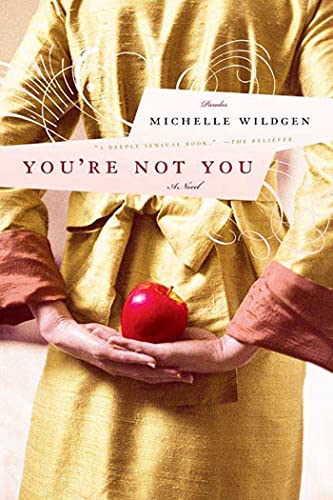
Michelle Wildgen's debut novel You're Not You is "a complex and satisfying dish: a story of intimate strangers and their impact on each other's lives" (O, The Oprah Magazine).
Now a major motion picture directed by George C. Wolfe, produced by Denise Di Novi and starring Hilary Swank, Josh Duhamel and Emmy Rossum.
Bec is adrift. It's the summer before her junior year in college. She's sleeping with a married professor, losing interest in her classes, and equivocating about her career. She takes a job caring for Kate, a thirty-six-year-old woman who has been immobilized by ALS.
As it turns out, before the disease Kate was a stylish and commanding woman, an advertising executive and an accomplished chef. Now, as she and Bec spend long days together, Bec begins to absorb Kate's sophistication and her sensuality, cooking for her, sharing her secrets, and gradually beginning to live her own life with a boldness informed by Kate's influence. The more intense her commitment to Kate, the further Bec strays from the complacency of her college life. And when Kate's marriage veers into dangerous territory, Bec will have to choose between the values of her old life and the allure of an entirely new one.
Die Inhaltsangabe kann sich auf eine andere Ausgabe dieses Titels beziehen.
Über die Autorin bzw. den Autor
Michelle Wildgen is a senior editor at Tin House. Her first novel, You're Not You, a New York Times Editor's Choice and one of People Magazine's Ten Best Books of 2006, and was made into a film starring Hilary Swank and Denise DiNovi. She is also the author of the acclaimed novel But Not for Long. Wildgen's work has appeared in O, The Oprah Magazine, The New York Times, and literary journals including Prairie Schooner and TriQuarterly.
Von der hinteren Coverseite
College student Bec is dangerously adrift. Self-conscious and increasingly uncertain about her long-term plans, she's studying a major that no longer interests her and is caught up in a bewildering affair with a married professor. In an impulsive attempt to redeem herself, she answers a want ad seeking a caregiver.
What she finds is a wealthy, cultivated woman in her midthirties. Once an advertising executive, accomplished chef, and skilled decorator, Kate is now in the advanced stages of ALS (Lou Gehrig's disease). She and her husband, Evan, handle their situation with mordant humor, careful planning, and a lot of determination. Yet while Bec perceives the couple as charmingly frank and good-humored, strains exist beneath the surface.
Bec is soon a vital part of her employer's household, and their increasing closeness transforms both women's lives and their relationships. The more she acts on Kate's behalf, the further Bec strays from her stringent comfort zone. She performs every task, from the most administrative to the most intimate, and she translates Kate's speech for strangers, friends, and even family. Sometimes enthusiastically, sometimes reluctantly, Bec advances further and further into Kate's world, surprised by her own increasing dedication and ease. But how closely can Bec intertwine her own life with Kate's?
The two confront their obstacles unsentimentally, with dark humor and unflinching candor, as their relationship is slowly stripped of pretense. Honesty becomes their touchstone: They may find humor in the most devastating moments, but they won't pretend to believe in silver linings that don't exist. With crystal clarity, debut author Michelle Wildgen hascrafted a deeply affecting novel about the singular relationship between two women, balancing humor and regret, sensuality and necessity, and testing the outer limits of friendship. Advance Praise for "You're Not You"
"Michelle Wildgen's novel" You Are Not You "is so skillfully rendered that it's hard to believe it is a first novel. The character of Bec, a twentysomething who has a habit of falling into things---jobs, love affairs---is funny, completely unsentimental, and really great for a reader to hang around with. Her worldview and how it changes when she goes to work for Kate, a refined woman in her thirties, is riveting. I simply couldn't put this book down."
---Whitney Otto, author of" How to Make an American Quilt"
"What an enjoyable and deeply satisfying novel. In" You're Not You, "Michelle Wildgen manages to capture, in some extraordinary way, what it's like to be a fairly ordinary college student, waiting for one's life to begin. Bec is a wonderfully complex heroine, and the nuances of her relations with the remarkable Kate are both vivid and suspenseful. This is an exhilarating debut."
---Margot Livesey, author of" Banishing Verona"
"With" You're Not You, "Michelle Wildgen has produced an artful and slyly seductive debut novel about a caregiver in full thrall to her charge's steely hold on sensuality, taste, and grace."
---Helen Schulman, author of" P.S."
"Michelle Wildgen writes with a lush, fierce clarity about the most private and complex of matters: the relationship between identity and intimacy, the body's pleasures and profound betrayals, the sharp impact of loss, and the gifts of deep attachment." You're Not You "is startling and smart, awise, beautiful novel."
---Nancy Reisman, author of" The First Desire"
Auszug. © Genehmigter Nachdruck. Alle Rechte vorbehalten.
You're Not You
By Michelle WildgenPicador USA
Copyright © 2007 Michelle WildgenAll right reserved.
ISBN: 9780312369521
Chapter One
I would begin on Thursday morning. The idea was for me to arrive early, by seven thirty, so Evan could show me what he did for his wife before he left for work, and afterward I’d follow him and Kate through a typical morning and afternoon. I had one day to observe and then training was over.
I began the morning by smacking the snooze button in a single well-aimed flail at six fifteen. I then lay immobile, arm outstretched and palm still .at against the warm grooves of the clock, enumerating my regrets over the switch from a night job to a morning one, until the alarm resumed.
After a pot of coffee, however, I began to change my mind. It turned out our living room windows faced east and sunlight flooded the room, something I had not had the opportunity to note in the nine months I had lived here. I settled myself before the television, coffee cup a pleasingly warm weight on my stomach, careful not to unbalance the couch (a green and gold yard-sale affair we had to treat gingerly, since Jill and I had hacked off one of the legs to get it in the front door, then propped it back on the splintered stump). I even opened a window to let in the breeze. You really could hear birds chirping in the morning—that wasn’t just in folk songs. I sipped my coffee and listened to the anchors’ chitchat. Things were happening in the world. For once I knew what some of them were.
By the time I arrived at the Norrises’ house, I felt downright hale. My lungs, I thought, breathing deeply as I rang the bell, seemed to be of genuinely admirable capacity.
Evan opened the front door. “Bec,” he said, smiling. “I guess this is the official welcome. Come on back to the bedroom.” He was wearing dark pants, a neatly ironed white shirt.
I watched his hands swing as we walked to the back of the house, liking him. Something in Evan’s gait seemed familiar, but then lately I had detected a bizarre habit of trying to associate every person I liked with Liam: If Jill made me laugh I listened to the tone of her voice to see if it was like Liam’s when he told a story; if a guy on the street gave me a certain kind of smile I searched his face for Liam’s thick eyebrows or his straight white teeth.
In the bedroom Kate was in her wheelchair, already dressed in a khaki skirt and blue T-shirt. Her damp hair left dark patches on the shoulders of her top. Her face was pale and bare, her eyes soft. Without makeup she seemed soft-fleshed, vulnerable as an open mollusk. When she spoke to me, her voice was low, the words slurred and indistinct
though it was clear she was trying to enunciate. Evan translated after each phrase, switching pronouns and glancing back and forth between us.
“So we let Evan . . . do everything today . . . and you watch, okay? Sometime I’ll have you dress me . . . just so you know how, but . . . we can do that later.”
When this last part was repeated, Kate gave me a sheepish smile. I said, “Oh, don’t worry. I’ll learn soon enough, right?” Maybe at the beginning she always gave herself a little grace period before she showed a total stranger everything. Frankly, I was grateful for the wait. I might not stay at this job beyond the summer. Perhaps I would never have to deal with dressing, period.
But I was resolved to put in the three months till September. Look at Jill—back in high school she’d stuck it out, for no money, volunteering at an ugly nursing home for almost a year. By contrast, I’d found a pretty easy deal (I allowed myself a moment of superiority), and presumably I had a bit more fortitude at twenty-one than Jill had had at seventeen.
“So,” said Evan, clasping his hands, “let’s get to it.”
The three of us went into the bathroom, which was palatial. There was room for three chairs, Kate and Evan facing each other next to the counter and me standing perpendicular to them, opposite the mirror. On the counter was a neatly divided compartment case of makeup and a few pricey hair products lined up near the sink: bottles of creams and mousse and a vial of something syrupy and clear.
Evan held up a bottle and said, “First you take a little of this and rub it on your hands and put it through her hair.”
She let her head tip back as he combed his fingers through her hair, which looked silky and heavy, and rubbed his palms over the crown of her skull. The cream smelled of limes and coconut. That was just fine. I knew how to do that. He combed her hair back from her face, parting it to one side. I made a mental note that it was the left side. Her skin was pale, flushed through the cheeks and dusted with freckles I hadn’t noticed the day before. Her eyes, a light, clear tortoiseshell amber, bore a burst of gold around the pupils. It was not a girlish face, but built of firm lines instead, her eyebrows slanted rather than blandly curving, her nose long and straight, the tip slightly angled toward her lips, her mouth wide but not especially full. It was the face maybe not of a model but of a tall woman, its scale too bold to be comfortable on a petite frame. How tall had she been? Five eight, five nine? Not just the chair but her thinness made it difficult to guess. The proportions were off.
When he finished she said through Evan, “How are you with makeup?”
My hand darted up to my face. Then I knew I should have put on a little, out of deference to the job. I hated makeup—my eyelashes felt stiff when I wore mascara, and I always forgot powder. I never understood how Jill could go out on a hot summer morning with her eyes smoky and dark and her mouth covered in a coat of burgundy lipstick. Yesterday at the interview Kate hadn’t seemed to be wearing much, but now I guessed it was the kind of expertly blended makeup that only looks like nothing.
“I can learn,” I hedged.
“Evan learned,” Kate said.
“Oh, then no problem,” I said. I took out some mints and offered the tin around. It was as though we were just girls hanging out. Except for the husband it felt like junior high. Of course, if I had paid better attention in junior high makeup sessions I might have known what I was doing by now. “This is going to be good for me,” I said, through a mouthful of mints. “My roommate’s been bugging me to wear some mascara since we were thirteen.”
Kate smiled as she lifted her face to Evan. He dotted her skin with foundation and smoothed the makeup out, covering the freckles across the bridge of her nose, which I thought was too bad. Then he dusted her cheeks with blush and held up two compacts of eye shadow. She looked them over for a moment and then nodded at one, saying in that low voice something that sounded like “just a little.” Evan went to work like a pro, whisking taupe shadow over her closed eyelids and feathering a stiff brush, tipped with brown powder, against the grain of her eyebrows and then brushing them back into place.
It was a brisk, impressive procedure, and as I watched I wondered if I would ever go through anything like it myself if I were her. She didn’t have to go out every day, yet she did her hair and put on a full face of makeup? It seemed silly, so precious, to go through all these motions for nothing. But perhaps she simply liked to feel...
I would begin on Thursday morning. The idea was for me to arrive early, by seven thirty, so Evan could show me what he did for his wife before he left for work, and afterward I’d follow him and Kate through a typical morning and afternoon. I had one day to observe and then training was over.
I began the morning by smacking the snooze button in a single well-aimed flail at six fifteen. I then lay immobile, arm outstretched and palm still .at against the warm grooves of the clock, enumerating my regrets over the switch from a night job to a morning one, until the alarm resumed.
After a pot of coffee, however, I began to change my mind. It turned out our living room windows faced east and sunlight flooded the room, something I had not had the opportunity to note in the nine months I had lived here. I settled myself before the television, coffee cup a pleasingly warm weight on my stomach, careful not to unbalance the couch (a green and gold yard-sale affair we had to treat gingerly, since Jill and I had hacked off one of the legs to get it in the front door, then propped it back on the splintered stump). I even opened a window to let in the breeze. You really could hear birds chirping in the morning—that wasn’t just in folk songs. I sipped my coffee and listened to the anchors’ chitchat. Things were happening in the world. For once I knew what some of them were.
By the time I arrived at the Norrises’ house, I felt downright hale. My lungs, I thought, breathing deeply as I rang the bell, seemed to be of genuinely admirable capacity.
Evan opened the front door. “Bec,” he said, smiling. “I guess this is the official welcome. Come on back to the bedroom.” He was wearing dark pants, a neatly ironed white shirt.
I watched his hands swing as we walked to the back of the house, liking him. Something in Evan’s gait seemed familiar, but then lately I had detected a bizarre habit of trying to associate every person I liked with Liam: If Jill made me laugh I listened to the tone of her voice to see if it was like Liam’s when he told a story; if a guy on the street gave me a certain kind of smile I searched his face for Liam’s thick eyebrows or his straight white teeth.
In the bedroom Kate was in her wheelchair, already dressed in a khaki skirt and blue T-shirt. Her damp hair left dark patches on the shoulders of her top. Her face was pale and bare, her eyes soft. Without makeup she seemed soft-fleshed, vulnerable as an open mollusk. When she spoke to me, her voice was low, the words slurred and indistinct
though it was clear she was trying to enunciate. Evan translated after each phrase, switching pronouns and glancing back and forth between us.
“So we let Evan . . . do everything today . . . and you watch, okay? Sometime I’ll have you dress me . . . just so you know how, but . . . we can do that later.”
When this last part was repeated, Kate gave me a sheepish smile. I said, “Oh, don’t worry. I’ll learn soon enough, right?” Maybe at the beginning she always gave herself a little grace period before she showed a total stranger everything. Frankly, I was grateful for the wait. I might not stay at this job beyond the summer. Perhaps I would never have to deal with dressing, period.
But I was resolved to put in the three months till September. Look at Jill—back in high school she’d stuck it out, for no money, volunteering at an ugly nursing home for almost a year. By contrast, I’d found a pretty easy deal (I allowed myself a moment of superiority), and presumably I had a bit more fortitude at twenty-one than Jill had had at seventeen.
“So,” said Evan, clasping his hands, “let’s get to it.”
The three of us went into the bathroom, which was palatial. There was room for three chairs, Kate and Evan facing each other next to the counter and me standing perpendicular to them, opposite the mirror. On the counter was a neatly divided compartment case of makeup and a few pricey hair products lined up near the sink: bottles of creams and mousse and a vial of something syrupy and clear.
Evan held up a bottle and said, “First you take a little of this and rub it on your hands and put it through her hair.”
She let her head tip back as he combed his fingers through her hair, which looked silky and heavy, and rubbed his palms over the crown of her skull. The cream smelled of limes and coconut. That was just fine. I knew how to do that. He combed her hair back from her face, parting it to one side. I made a mental note that it was the left side. Her skin was pale, flushed through the cheeks and dusted with freckles I hadn’t noticed the day before. Her eyes, a light, clear tortoiseshell amber, bore a burst of gold around the pupils. It was not a girlish face, but built of firm lines instead, her eyebrows slanted rather than blandly curving, her nose long and straight, the tip slightly angled toward her lips, her mouth wide but not especially full. It was the face maybe not of a model but of a tall woman, its scale too bold to be comfortable on a petite frame. How tall had she been? Five eight, five nine? Not just the chair but her thinness made it difficult to guess. The proportions were off.
When he finished she said through Evan, “How are you with makeup?”
My hand darted up to my face. Then I knew I should have put on a little, out of deference to the job. I hated makeup—my eyelashes felt stiff when I wore mascara, and I always forgot powder. I never understood how Jill could go out on a hot summer morning with her eyes smoky and dark and her mouth covered in a coat of burgundy lipstick. Yesterday at the interview Kate hadn’t seemed to be wearing much, but now I guessed it was the kind of expertly blended makeup that only looks like nothing.
“I can learn,” I hedged.
“Evan learned,” Kate said.
“Oh, then no problem,” I said. I took out some mints and offered the tin around. It was as though we were just girls hanging out. Except for the husband it felt like junior high. Of course, if I had paid better attention in junior high makeup sessions I might have known what I was doing by now. “This is going to be good for me,” I said, through a mouthful of mints. “My roommate’s been bugging me to wear some mascara since we were thirteen.”
Kate smiled as she lifted her face to Evan. He dotted her skin with foundation and smoothed the makeup out, covering the freckles across the bridge of her nose, which I thought was too bad. Then he dusted her cheeks with blush and held up two compacts of eye shadow. She looked them over for a moment and then nodded at one, saying in that low voice something that sounded like “just a little.” Evan went to work like a pro, whisking taupe shadow over her closed eyelids and feathering a stiff brush, tipped with brown powder, against the grain of her eyebrows and then brushing them back into place.
It was a brisk, impressive procedure, and as I watched I wondered if I would ever go through anything like it myself if I were her. She didn’t have to go out every day, yet she did her hair and put on a full face of makeup? It seemed silly, so precious, to go through all these motions for nothing. But perhaps she simply liked to feel...
„Über diesen Titel“ kann sich auf eine andere Ausgabe dieses Titels beziehen.
Suchergebnisse für You're Not You

Beispielbild für diese ISBN
You're Not You
Anbieter: World of Books (was SecondSale), Montgomery, IL, USA
Verkäuferbewertung 5 von 5 Sternen

Paperback. Zustand: Good. Michelle Wildgen's debut novel You're Not You is "a complex and satisfying dish: a story of intimate strangers and their impact on each other's lives" (O, The Oprah Magazine). Now a major motion picture directed by George C. Wolfe, produced by Denise Di Novi and starring Hilary Swank, Josh Duhamel and Emmy Rossum. Bec is adrift. It's the summer before her junior year in college. She's sleeping with a married professor, losing interest in her classes, and equivocating about her career. She takes a job caring for Kate, a thirty-six-year-old woman who has been immobilized by ALS. As it turns out, before the disease Kate was a stylish and commanding woman, an advertising executive and an accomplished chef. Now, as she and Bec spend long days together, Bec begins to absorb Kate's sophistication and her sensuality, cooking for her, sharing her secrets, and gradually beginning to live her own life with a boldness informed by Kate's influence. The more intense her commitment to Kate, the further Bec strays from the complacency of her college life. And when Kate's marriage veers into dangerous territory, Bec will have to choose between the values of her old life and the allure of an entirely new one. Artikel-Nr. 00101810522
Gebraucht kaufen
EUR 4,56
Versand gratis
Versand innerhalb von USA
Versand innerhalb von USA
Anzahl: 6 verfügbar
Beispielbild für diese ISBN
You're Not You: A Novel
Verlag:
Picador (edition First Edition), 2007
ISBN 10: 0312369522
ISBN 13: 9780312369521
Gebraucht
Paperback
Erstausgabe
Anbieter: BooksRun, Philadelphia, PA, USA
Verkäuferbewertung 5 von 5 Sternen
Paperback. Zustand: Fair. First Edition. The item might be beaten up but readable. May contain markings or highlighting, as well as stains, bent corners, or any other major defect, but the text is not obscured in any way. Artikel-Nr. 0312369522-7-1
Gebraucht kaufen
EUR 4,62
Versand gratis
Versand innerhalb von USA
Versand innerhalb von USA
Anzahl: 1 verfügbar
Beispielbild für diese ISBN
You're Not You
Anbieter: ThriftBooks-Atlanta, AUSTELL, GA, USA
Verkäuferbewertung 5 von 5 Sternen
Paperback. Zustand: Good. No Jacket. Missing dust jacket; Pages can have notes/highlighting. Spine may show signs of wear. ~ ThriftBooks: Read More, Spend Less. Artikel-Nr. G0312369522I3N01
Gebraucht kaufen
EUR 6,26
Versand gratis
Versand innerhalb von USA
Versand innerhalb von USA
Anzahl: 1 verfügbar
Beispielbild für diese ISBN
You're Not You
Anbieter: ThriftBooks-Dallas, Dallas, TX, USA
Verkäuferbewertung 5 von 5 Sternen
Paperback. Zustand: Good. No Jacket. Pages can have notes/highlighting. Spine may show signs of wear. ~ ThriftBooks: Read More, Spend Less. Artikel-Nr. G0312369522I3N00
Gebraucht kaufen
EUR 6,26
Versand gratis
Versand innerhalb von USA
Versand innerhalb von USA
Anzahl: 1 verfügbar
Beispielbild für diese ISBN
You're Not You
Anbieter: ThriftBooks-Reno, Reno, NV, USA
Verkäuferbewertung 5 von 5 Sternen
Paperback. Zustand: Good. No Jacket. Pages can have notes/highlighting. Spine may show signs of wear. ~ ThriftBooks: Read More, Spend Less. Artikel-Nr. G0312369522I3N00
Gebraucht kaufen
EUR 6,26
Versand gratis
Versand innerhalb von USA
Versand innerhalb von USA
Anzahl: 1 verfügbar
Beispielbild für diese ISBN
You're Not You
Anbieter: ThriftBooks-Atlanta, AUSTELL, GA, USA
Verkäuferbewertung 5 von 5 Sternen
Paperback. Zustand: Good. No Jacket. Pages can have notes/highlighting. Spine may show signs of wear. ~ ThriftBooks: Read More, Spend Less. Artikel-Nr. G0312369522I3N00
Gebraucht kaufen
EUR 6,26
Versand gratis
Versand innerhalb von USA
Versand innerhalb von USA
Anzahl: 1 verfügbar
Beispielbild für diese ISBN
You're Not You
Anbieter: ThriftBooks-Atlanta, AUSTELL, GA, USA
Verkäuferbewertung 5 von 5 Sternen
Paperback. Zustand: Very Good. No Jacket. May have limited writing in cover pages. Pages are unmarked. ~ ThriftBooks: Read More, Spend Less. Artikel-Nr. G0312369522I4N00
Gebraucht kaufen
EUR 6,26
Versand gratis
Versand innerhalb von USA
Versand innerhalb von USA
Anzahl: 1 verfügbar
Beispielbild für diese ISBN
You're Not You: A Novel
Anbieter: Wonder Book, Frederick, MD, USA
Verkäuferbewertung 5 von 5 Sternen
Zustand: Very Good. Very Good condition. A copy that may have a few cosmetic defects. May also contain light spine creasing or a few markings such as an owner's name, short gifter's inscription or light stamp. Artikel-Nr. X12C-01616
Gebraucht kaufen
EUR 6,42
Versand gratis
Versand innerhalb von USA
Versand innerhalb von USA
Anzahl: 1 verfügbar
Beispielbild für diese ISBN
You're Not You : A Novel
Anbieter: Better World Books, Mishawaka, IN, USA
Verkäuferbewertung 5 von 5 Sternen
Zustand: Fine. 1 Edition. Used book that is in almost brand-new condition. May contain a remainder mark. Better World Books: Buy Books. Do Good. Artikel-Nr. 13697919-75
Gebraucht kaufen
EUR 8,34
Versand gratis
Versand innerhalb von USA
Versand innerhalb von USA
Anzahl: 1 verfügbar
Beispielbild für diese ISBN
You're Not You: A Novel
Anbieter: Robinson Street Books, IOBA, Binghamton, NY, USA
Verkäuferbewertung 4 von 5 Sternen

Paperback. Zustand: good. Prompt Shipment, shipped in Boxes, Tracking PROVIDEDComing of Age - Fiction; Good trade paperback with creasing, nicked, dog-eared, and prompt shipping with tracking. Artikel-Nr. Bing699psd009
Gebraucht kaufen
EUR 13,77
EUR 8,47 Versand
Versand innerhalb von USA
Versand innerhalb von USA
Anzahl: 1 verfügbar