
Verwandte Artikel zu Happy at Last: The Thinking Person's Guide to Finding...
Inhaltsangabe
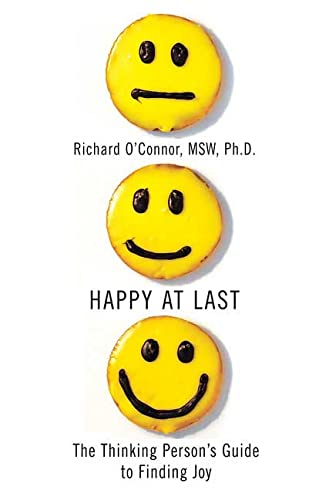
Draws on the latest scientific and psychological research to discuss how the brain responds to happy stimuli and can be trained for greater receptivity to happiness, in a guide that shares practical advice and exercises on how to develop core skills for managing sadness and experiencing happiness in today's world. 35,000 first printing.
Die Inhaltsangabe kann sich auf eine andere Ausgabe dieses Titels beziehen.
Über die Autorin bzw. den Autor
Richard O’Connor, MSW, Ph.D. is the author of Undoing Depression and Undoing Perpetual Stress. For fourteen years he was executive director of the Northwest Center for Family Service and Mental Health, a private, nonprofit mental health clinic serving Litchfield County, Connecticut, overseeing the work of twenty mental health professionals in treating almost a thousand patients per year. He is currently a practicing psychotherapist with offices in Connecticut and New York.
Auszug. © Genehmigter Nachdruck. Alle Rechte vorbehalten.
From the Introduction to Happy At Last
Conventional happiness reached a dead end well before our current economic meltdown. For centuries, one of the basic operating principles of Western society has been the belief that increasing prosperity will lead automatically to greater happiness. But now for the first time we have the data to prove that’s just not so. In the USA and Europe, over the last fifty years since scientists started measuring personal happiness reliably, people continue to report that they are less and less happy every year—although personal wealth continues to increase. As other nations become more Westernized, and prosperity spreads around the globe, happiness declines as well. This theory that most of us unconsciously buy into, if I get rich, then I’ll be happy, doesn’t work. In fact, what seems to work is the opposite—if I get rich I’ll get depressed and anxious. Rates of depression and anxiety disorders are zooming into the stratosphere in Western countries. Other social indicators we can assume are linked with unhappiness are climbing as well—divorce, illegal drug use, incarceration rates, poor educational performance, violence, obesity.
So wealth is not the answer. Maybe it’s a good thing to face that now, because those of us in the West are probably past the very pinnacle of wealth, looking downhill from here on. In fact, it’s likely that the U.S. passed the peak of personal wealth without much fanfare in the 1980’s, because ever since then we’ve been working longer and longer hours to maintain the same standard of living. Still, whether the peak is in the recent past or the near future, the long-term outlook is tough simply because the global economy means there’s a great leveling coming. All the billions of people in China, India, and Africa want our standard of living too; and because energy and other resources are finite, as their slices of pie get larger, ours will get smaller. Look at the cost of gasoline in the US over the past five years; sure, some of the increase comes from profit taking and price gouging, but most of it is due to the fact that there’s some newly wealthy guy in Shanghai who wants gas too.
It’s not bad enough that wealth doesn’t bring happiness; wealth itself is going to be harder and harder to get. It’s time for a revolution.
This is going to be a small revolution, however. Although government could do a much better job than it does, government can’t provide the solution to happiness. The revolution in happiness has to come at a personal level; mostly at an individual level, although our relationships with others can help too.
If you’ve read any of my previous books you know that I’ve identified myself as someone with a history of clinical depression. While someone with depression might seem to be the last person qualified to write a guide to happiness, it’s not the case. Here’s why—me, and my patients, my fellow depression sufferers, are your canaries in the coal mine. We suffer from what’s known as depressive realism—the tendency to see things just as they are, without comforting illusions. We’ve been facing the realities of life for a long time, and we can help you as those realities become sharper and tougher, as they are going to do. Besides that, depressed people know that the ability to experience happiness again is the very last symptom of depression to lift, and we’ve had to work hard to get there. I’ve done my share of that hard work, and at this point I feel more joyful and content with my lot than I ever have. I’ve learned a lot along the way, and I want to share it with you. If I can make it, with one metaphorical hand tied behind my back, so can you.
I’ve also helped some very unhappy people. I’ve been a therapist for almost thirty years, and I’ve seen a lot. People who were raised by, or married to, sadists or sons of bitches. People who’ve been raped, abused, bullied, discriminated against, and tortured. People who were there at 9/11. People who’ve had cancer, stroke, heart attack, chronic pain. People who live in a permanent state of fear. People who seem to have never felt good—for no reason that we could ever find. I’m not saying that working with me has turned them all into dancing little forest sprites, but most of them have felt a lot better. In the process I’ve learned a lot from them as well.
SO—there are some unpleasant new realities that interfere with happiness (there are plenty of old ones too, which we’ll discuss). Fortunately, there have been some truly revolutionary developments in psychology and brain science in the past few years—and more on the way—that can help us immensely. Psychology is moving from simply alleviating distress to helping people live richer and more satisfying lives. We know now that focused attention and practice, such as accomplished musicians experience, changes the brain; the neural circuits that correspond to the motions of Eric Clapton’s fingers or Pavarotti’s discrimination of tone become enlarged and enriched with time. However, Western psychology is only beginning to investigate whether that kind of intentional, focused practice can change something like feelings of happiness, relatedness, or empathy. We’ve operated on the—largely untested—assumption that those are fixed traits, determined by our genes and perhaps influenced by childhood experience, certainly not changeable by any kind of adult experiences other than, perhaps, severe trauma. Now there’s evidence to suggest that practicing happiness skills can change your brain circuits as well. If you can learn to type, you can learn to be happy.
It may surprise you that achieving happiness takes effort, at least for most of us. It doesn’t come naturally. We can—hopefully—feel good when a good thing happens, but the feeling doesn’t last. Eventually we go back to our normal state, which for most people is one of vague discontent. In this book we’re going to talk about achieving a deeper and more sustained kind of happiness.
Maybe you’re not surprised that happiness is in big trouble. Maybe you already suspect that society is headed in the wrong direction. After all, why else would we be such suckers for exotic Martinis, Lotto, fashion, plastic surgery, and all the other nostrums that promise ecstasy and fulfillment? Our culture has promised us that the secret to happiness is making enough money so that you can buy the right things, with the right labels, so you can belong to the elite and feel really good about yourself. The fact that it just doesn’t work that way is not an expression of values, like me wagging my finger at you to say you should be above worldly things; it’s a scientific fact. Psychologists and economists have known for twenty years about the hedonic treadmill—a fancy way of saying that no matter how much you have right now, you want more; and when you get more, you will want more still. It’s...
„Über diesen Titel“ kann sich auf eine andere Ausgabe dieses Titels beziehen.
Suchergebnisse für Happy at Last: The Thinking Person's Guide to Finding...

Beispielbild für diese ISBN
Happy at Last : The Thinking Person's Guide to Finding Joy
Anbieter: Better World Books, Mishawaka, IN, USA
Verkäuferbewertung 5 von 5 Sternen

Zustand: Good. Pages intact with minimal writing/highlighting. The binding may be loose and creased. Dust jackets/supplements are not included. Stock photo provided. Product includes identifying sticker. Better World Books: Buy Books. Do Good. Artikel-Nr. 8335942-6
Gebraucht kaufen
EUR 7,40
Versand gratis
Versand innerhalb von USA
Versand innerhalb von USA
Anzahl: 1 verfügbar
Beispielbild für diese ISBN
Happy at Last : The Thinking Person's Guide to Finding Joy
Anbieter: Better World Books, Mishawaka, IN, USA
Verkäuferbewertung 5 von 5 Sternen
Zustand: Good. Former library copy. Pages intact with minimal writing/highlighting. The binding may be loose and creased. Dust jackets/supplements are not included. Includes library markings. Stock photo provided. Product includes identifying sticker. Better World Books: Buy Books. Do Good. Artikel-Nr. 4224294-6
Gebraucht kaufen
EUR 7,40
Versand gratis
Versand innerhalb von USA
Versand innerhalb von USA
Anzahl: 2 verfügbar
Beispielbild für diese ISBN
Happy at Last: The Thinking Person's Guide to Finding Joy
Anbieter: ThriftBooks-Dallas, Dallas, TX, USA
Verkäuferbewertung 5 von 5 Sternen
Hardcover. Zustand: Very Good. No Jacket. May have limited writing in cover pages. Pages are unmarked. ~ ThriftBooks: Read More, Spend Less. Artikel-Nr. G0312369069I4N00
Gebraucht kaufen
EUR 9,00
Versand gratis
Versand innerhalb von USA
Versand innerhalb von USA
Anzahl: 1 verfügbar
Beispielbild für diese ISBN
Happy at Last: The Thinking Person's Guide to Finding Joy
Anbieter: ThriftBooks-Atlanta, AUSTELL, GA, USA
Verkäuferbewertung 5 von 5 Sternen
Hardcover. Zustand: Good. No Jacket. Pages can have notes/highlighting. Spine may show signs of wear. ~ ThriftBooks: Read More, Spend Less. Artikel-Nr. G0312369069I3N00
Gebraucht kaufen
EUR 9,00
Versand gratis
Versand innerhalb von USA
Versand innerhalb von USA
Anzahl: 1 verfügbar
Beispielbild für diese ISBN
Happy at Last: The Thinking Person's Guide to Finding Joy
Anbieter: ThriftBooks-Dallas, Dallas, TX, USA
Verkäuferbewertung 5 von 5 Sternen
Hardcover. Zustand: Very Good. No Jacket. Former library book; May have limited writing in cover pages. Pages are unmarked. ~ ThriftBooks: Read More, Spend Less. Artikel-Nr. G0312369069I4N10
Gebraucht kaufen
EUR 9,00
Versand gratis
Versand innerhalb von USA
Versand innerhalb von USA
Anzahl: 1 verfügbar
Beispielbild für diese ISBN
Happy at Last : The Thinking Person's Guide to Finding Joy
Anbieter: Better World Books Ltd, Dunfermline, Vereinigtes Königreich
Verkäuferbewertung 5 von 5 Sternen
Zustand: Very Good. Former library copy. Pages intact with possible writing/highlighting. Binding strong with minor wear. Dust jackets/supplements may not be included. Includes library markings. Stock photo provided. Product includes identifying sticker. Better World Books: Buy Books. Do Good. Artikel-Nr. 4003803-6
Gebraucht kaufen
EUR 10,52
EUR 5,99 Versand
Versand von Vereinigtes Königreich nach USA
Versand von Vereinigtes Königreich nach USA
Anzahl: 1 verfügbar