
Verwandte Artikel zu Simple Prosperity: Finding Real Wealth in a Sustainable...
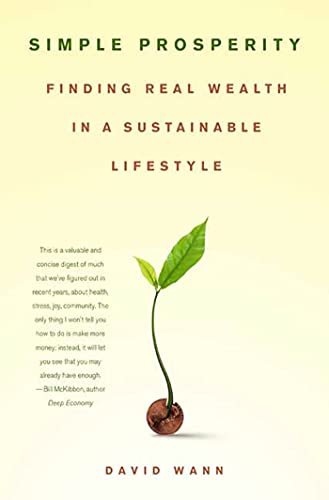
Inhaltsangabe
The co-author of the best-selling Affluenza explains how to profit by abandoning a consumer-driven lifestyle for amore sustainable existence, putting real financial benefits on developing a healthier lifestyle, increasing social networking opportunities, lowering energy costs, managing time, and promoting the natural environment.
Die Inhaltsangabe kann sich auf eine andere Ausgabe dieses Titels beziehen.
Über die Autorin bzw. den Autor
David Wann is an author, filmmaker, and speaker on the topic of sustainable lifestyles - the creation of a joyfully moderate way of life that requires half the resources to deliver twice the satisfaction. His nine non-fiction books and five award-winning TV documentaries advocate for community-based, resource-conscious, equitable changes in American politics and values. In this first novel, Tickling the Bear: How to Stay Safe in the Universe, he also draws upon his experience as an organic gardener, founder of a co-housing community, proud husband and father, and amateur musician to create credible characters that navigate a world threatened by environmental and social collapse. David has produced 20 videos and TV programs, including the award-winning TV documentary "Designing a Great Neighborhood," and "Building Livable Communities," for Vice President Al Gore. David is the father of two adult children, president of the Sustainable Futures Society, and a Fellow of the national Simplicity Forum. He co-designed the cohousing neighborhood where he lives, has taught at the college level, and worked more than a decade as a policy analyst for U.S. EPA. Visit www.DaveWann.net
Auszug. © Genehmigter Nachdruck. Alle Rechte vorbehalten.
Simple Prosperity
Finding Real Wealth in a Sustainable Lifestyle
By David WannSt. Martin's Press
Copyright © 2007 David Wann
All rights reserved.
ISBN: 978-0-312-36141-9All rights reserved.
Contents
Title Page,
Acknowledgments,
Preface: - A Generation's Journey Back to Health,
Introduction,
1 - Taking Stock,
2 - Evolutionary Income,
3 - Personal Growth,
4 - Mindful Money,
5 - The Bonds of Social Capital,
6 - Time Affluence,
7 - The Stocks of Wellness,
8 - The Currency of Nature,
9 - Precious Work and Play,
10 - The Real Wealth of Neighborhoods,
11 - Higher Returns on Investment,
12 - Energy Savings,
13 - The Benefits of Right-Sizing,
14 - Trimming the Fat,
15 - Infinite Information,
16 - Historical Dividends,
17 - Cultural Prosperity,
Notes,
Suggested Reading List,
Index,
Copyright Page,
CHAPTER 1
Taking Stock
How Foresight Can Cut Our Losses
Currently, more money is being spent on breast implants and Viagra than on Alzheimer's research. So in the very near future there should be a large elderly population with impressive breasts and magnificent erections, but no recollection of what to do with them.
— Sally Feldman
We've been born into a cult that has made a god of numbers. We worship rankings, quantities, statistics, profit margins, and polls ... We want to know first, last, biggest, best, most, least, latest, and how much the baby weighs. We've mapped the genome. We've captured the quark. By God or by Newton we will know.
— Marilyn Ferguson
It would be possible to describe everything scientifically, but it would make no sense, as if you described a Beethoven symphony as a variation of wave pressure.
— Albert Einstein
We must make the rescue of the environment the central organizing principle for civilization.
— Al Gore
I have an embarrassing confession to make, right up front: I'm not a "confident consumer." This morning's New York Times may report that consumer confidence has risen to its highest level in more than three years, but as I begin writing this first chapter, I'm not any more confident than I was back then that our mainstream lifestyle can take us where we need to go. I'm confident enough in general, I guess, but I'm very un comfortable being labeled a "consumer." We're far more than consumers, aren't we? We're a brilliant species that creates human-scaled tools and art, works cooperatively, takes care of natural assets, and uses its awesome brainpower to solve both small and large challenges. But we aren't giving ourselves the time, permission, or focus to do these things well.
What's up? We aren't eating like humans who need energy and vitality to feel great. We're not taking care of the children the way humans have always done. We're not designing products that last. And we're overriding many of our most tried and tested instincts, taking direction mostly from the relatively "new," rational side of the human brain that creates assembly lines, profit-and-loss statements, and missiles. We're suppressing the more playful, empathetic, and intuitive side, missing great opportunities for fun and fulfillment.
I have a proposal. Rather than settle for a passive/aggressive, dysfunctional American Dream, let's just recycle it. The people who track "consumer confidence" have their metrics on backward, in my humble opinion. Overconsumption is clearly a fundamental problem, not solution, in the maintenance of a healthy economy and planet. I believe it's not just oil production that's about to peak, but also human satisfaction. If we picture our position on a graph called "The Benefits of Consumption," it appears we're on a slope of diminishing returns. We're consuming more now but enjoying it less, to paraphrase an old cigarette commercial.
Here are what I consider to be the two most critical economic screw-ups: First, our economy is out of alignment with the values that make us feel grateful to be alive. Values such as health, relationships with people, connection with nature, satisfying work, a sense of purpose, abundance of personal time, and freedom of expression are the real wealth, far more valuable than money and mountains of manufactured stuff. If we obtain these values directly, without money as a constant, meddling middleman, we don't need as much money, and we don't need to tear things apart to get it. The whole industrial metabolism of civilization — what some call "throughput" — can slow down to match the rhythms of nature.
Second, although we're trained to think of the environment as a subset of the economy, when we think about it, we see it's just the opposite. Everything is inside the environment. The economy is really just an opportunistic system of ideas and rules we made up, but the environment is reality itself — a wonderful place for our homes, farms, schools, and businesses to locate — as long as we're trustworthy tenants. But without a more grounded, respectful ethic, we'll never get back our damage deposit. In this era of overconsumption, production is allowed to be careless, and, as a result, the faster we produce and consume, the faster natural and cultural assets get trashed. For example, of the roughly five thousand languages now spoken in the world, fewer than 20 percent will still be spoken by the year 2100. The disappearing languages, though rich in tradition, ties to the land, and loyalties to people, simply don't translate in the global economy.
It's important to remember that the economy was invented when world population was ten times smaller but the planet seemed infinitely large and filled to the brim with resources. It seemed foolish not to produce and consume all we wanted, especially since this seemed to liberate the downtrodden individual. But in the guardian economy now being born — that acknowledges how small the world really is and how fragile its web of life — only the interest provided by nature will be consumed, never the principle. In the new "mindful money" lifestyle, there will be more sensible boundaries and constraints, just as there is when an architect begins to design a house on a new site. The lot is only so big, with a certain type of soil, certain solar exposure, and so on. We can be as creative as we want within sustainable parameters, but the limits of the Earth are as tangible and finite as the characteristics of a building lot.
Changing just one idea can change the whole world: the accumulation of money and consumption of manufactured stuff is not why we're here. There are other ways to meet human needs, many of which are not currently being met. When we change the way we think about value, the world will begin to regenerate, almost overnight. We're ready! One piece of evidence is that, according to the World Values Survey, a near majority of Americans (61 percent) believe that protecting the environment should be a higher priority than economic growth; that we should prevent the natural world from coming unraveled even if that were to mean some loss of jobs and a slower-growing economy. The good news is, saving our civilization from collapse will create jobs and help the economy, which can't flourish in a battered, depleted environment.
» Cutting Our Losses and Reinventing the Economy
In the book Affluenza: The All-Consuming Epidemic, my coauthors...
„Über diesen Titel“ kann sich auf eine andere Ausgabe dieses Titels beziehen.
Suchergebnisse für Simple Prosperity: Finding Real Wealth in a Sustainable...

Beispielbild für diese ISBN
Simple Prosperity: Finding Real Wealth in a Sustainable Lifestyle
Anbieter: World of Books (was SecondSale), Montgomery, IL, USA
Verkäuferbewertung 5 von 5 Sternen

Paperback. Zustand: Fair. In his bestseller Affluenza, David Wann and his co-authors diagnosed the debilitating disease of over-consumption. In Simple Prosperity he shows readers how we can overcome this disease by investing in a variety of real wealth sources. To recapture a more abundant and sustainable lifestyle, try: - Creating a richer life story through personal growth incentives - Forming higher-yield friendships and stronger bonds through social capital - Taking preventive healthcare measures to build up wellness reserves - Balancing the biological budget through "greener" currency - Caring for people, not just cars, to improve your neighborhood wealth index - Resolving that pesky carbon conundrum through energy savings - Celebrating instead of desecrating! Cultural prosperity futures value the earth as a sacred place In our age of hedge fund hysteria, Simple Prosperity is a new way of investing that will save our sanity and the planet. Artikel-Nr. 00096462753
Gebraucht kaufen
EUR 4,63
Versand gratis
Versand innerhalb von USA
Versand innerhalb von USA
Anzahl: 1 verfügbar
Beispielbild für diese ISBN
Simple Prosperity: Finding Real Wealth in a Sustainable Lifestyle
Anbieter: World of Books (was SecondSale), Montgomery, IL, USA
Verkäuferbewertung 5 von 5 Sternen
Paperback. Zustand: Very Good. In his bestseller Affluenza, David Wann and his co-authors diagnosed the debilitating disease of over-consumption. In Simple Prosperity he shows readers how we can overcome this disease by investing in a variety of real wealth sources. To recapture a more abundant and sustainable lifestyle, try: - Creating a richer life story through personal growth incentives - Forming higher-yield friendships and stronger bonds through social capital - Taking preventive healthcare measures to build up wellness reserves - Balancing the biological budget through "greener" currency - Caring for people, not just cars, to improve your neighborhood wealth index - Resolving that pesky carbon conundrum through energy savings - Celebrating instead of desecrating! Cultural prosperity futures value the earth as a sacred place In our age of hedge fund hysteria, Simple Prosperity is a new way of investing that will save our sanity and the planet. Artikel-Nr. 00096693238
Gebraucht kaufen
EUR 4,63
Versand gratis
Versand innerhalb von USA
Versand innerhalb von USA
Anzahl: 1 verfügbar
Beispielbild für diese ISBN
Simple Prosperity: Finding Real Wealth in a Sustainable Lifestyle
Verlag:
St. Martin's Griffin (edition First Edition), 2007
ISBN 10: 0312361416
ISBN 13: 9780312361419
Gebraucht
Paperback
Erstausgabe
Anbieter: BooksRun, Philadelphia, PA, USA
Verkäuferbewertung 5 von 5 Sternen
Paperback. Zustand: Very Good. First Edition. It's a well-cared-for item that has seen limited use. The item may show minor signs of wear. All the text is legible, with all pages included. It may have slight markings and/or highlighting. Artikel-Nr. 0312361416-11-18
Gebraucht kaufen
EUR 4,74
Versand gratis
Versand innerhalb von USA
Versand innerhalb von USA
Anzahl: 1 verfügbar
Beispielbild für diese ISBN
Simple Prosperity: Finding Real Wealth in a Sustainable Lifestyle
Verlag:
St. Martin's Griffin (edition First Edition), 2007
ISBN 10: 0312361416
ISBN 13: 9780312361419
Gebraucht
Paperback
Erstausgabe
Anbieter: BooksRun, Philadelphia, PA, USA
Verkäuferbewertung 5 von 5 Sternen
Paperback. Zustand: Very Good. First Edition. It's a well-cared-for item that has seen limited use. The item may show minor signs of wear. All the text is legible, with all pages included. It may have slight markings and/or highlighting. Artikel-Nr. 0312361416-11-1
Gebraucht kaufen
EUR 4,79
Versand gratis
Versand innerhalb von USA
Versand innerhalb von USA
Anzahl: 1 verfügbar
Beispielbild für diese ISBN
Simple Prosperity: Finding Real Wealth in a Sustainable Lifestyle
Verlag:
St. Martin's Griffin (edition First Edition), 2007
ISBN 10: 0312361416
ISBN 13: 9780312361419
Gebraucht
Paperback
Erstausgabe
Anbieter: BooksRun, Philadelphia, PA, USA
Verkäuferbewertung 5 von 5 Sternen
Paperback. Zustand: Very Good. First Edition. It's a well-cared-for item that has seen limited use. The item may show minor signs of wear. All the text is legible, with all pages included. It may have slight markings and/or highlighting. Artikel-Nr. 0312361416-11-6
Gebraucht kaufen
EUR 4,96
Versand gratis
Versand innerhalb von USA
Versand innerhalb von USA
Anzahl: 1 verfügbar
Beispielbild für diese ISBN
Simple Prosperity : Finding Real Wealth in a Sustainable Lifestyle
Verlag:
St. Martin's Press, 2007
ISBN 10: 0312361416
ISBN 13: 9780312361419
Gebraucht
Softcover
Erstausgabe
Anbieter: Better World Books, Mishawaka, IN, USA
Verkäuferbewertung 5 von 5 Sternen
Zustand: Good. 1st. Pages intact with minimal writing/highlighting. The binding may be loose and creased. Dust jackets/supplements are not included. Stock photo provided. Product includes identifying sticker. Better World Books: Buy Books. Do Good. Artikel-Nr. 8462635-6
Gebraucht kaufen
EUR 6,16
Versand gratis
Versand innerhalb von USA
Versand innerhalb von USA
Anzahl: 1 verfügbar
Beispielbild für diese ISBN
Simple Prosperity : Finding Real Wealth in a Sustainable Lifestyle
Verlag:
St. Martin's Press, 2007
ISBN 10: 0312361416
ISBN 13: 9780312361419
Gebraucht
Softcover
Erstausgabe
Anbieter: Better World Books, Mishawaka, IN, USA
Verkäuferbewertung 5 von 5 Sternen
Zustand: Good. 1st. Former library copy. Pages intact with minimal writing/highlighting. The binding may be loose and creased. Dust jackets/supplements are not included. Includes library markings. Stock photo provided. Product includes identifying sticker. Better World Books: Buy Books. Do Good. Artikel-Nr. 6059971-6
Gebraucht kaufen
EUR 6,16
Versand gratis
Versand innerhalb von USA
Versand innerhalb von USA
Anzahl: 1 verfügbar
Beispielbild für diese ISBN
Simple Prosperity: Finding Real Wealth in a Sustainable Lifestyle
Anbieter: ThriftBooks-Dallas, Dallas, TX, USA
Verkäuferbewertung 5 von 5 Sternen
Paperback. Zustand: Very Good. No Jacket. May have limited writing in cover pages. Pages are unmarked. ~ ThriftBooks: Read More, Spend Less. Artikel-Nr. G0312361416I4N00
Gebraucht kaufen
EUR 6,19
Versand gratis
Versand innerhalb von USA
Versand innerhalb von USA
Anzahl: 1 verfügbar
Beispielbild für diese ISBN
Simple Prosperity: Finding Real Wealth in a Sustainable Lifestyle
Anbieter: ThriftBooks-Phoenix, Phoenix, AZ, USA
Verkäuferbewertung 5 von 5 Sternen
Paperback. Zustand: Very Good. No Jacket. May have limited writing in cover pages. Pages are unmarked. ~ ThriftBooks: Read More, Spend Less. Artikel-Nr. G0312361416I4N00
Gebraucht kaufen
EUR 6,19
Versand gratis
Versand innerhalb von USA
Versand innerhalb von USA
Anzahl: 1 verfügbar
Beispielbild für diese ISBN
Simple Prosperity: Finding Real Wealth in a Sustainable Lifestyle
Anbieter: ThriftBooks-Atlanta, AUSTELL, GA, USA
Verkäuferbewertung 5 von 5 Sternen
Paperback. Zustand: Very Good. No Jacket. Former library book; May have limited writing in cover pages. Pages are unmarked. ~ ThriftBooks: Read More, Spend Less. Artikel-Nr. G0312361416I4N10
Gebraucht kaufen
EUR 6,19
Versand gratis
Versand innerhalb von USA
Versand innerhalb von USA
Anzahl: 1 verfügbar