
Verwandte Artikel zu State of Emergency: The Third World Invasion and Conquest...
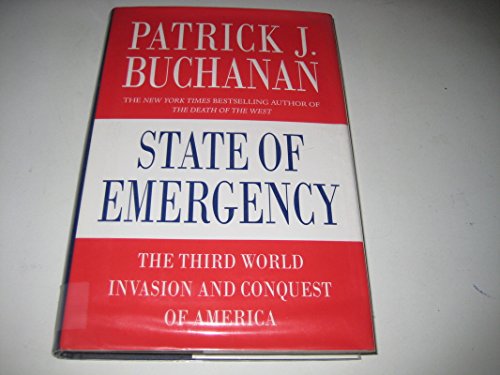
State of Emergency: The Third World Invasion and Conquest of America: How Illegal Immigration is Destroying America - Hardcover
Inhaltsangabe
The conservative spokesman sounds the alarm about the influx of illegal immigrants into the United States, discussing the effects of such immigration on the U.S. economy and society and arguing that it is causing a deconstruction of America, along the lines of culture, values, faith, language, and allegiance. 300,000 first printing.
Die Inhaltsangabe kann sich auf eine andere Ausgabe dieses Titels beziehen.
Über die Autorin bzw. den Autor
Patrick J. Buchanan, America's leading populist conservative, was a senior adviser to three American presidents, ran twice for the Republican presidential nomination, in 1992 and 1996, and was the Reform Party candidate in 2000. In his 1992 challenge to President George H. W. Bush, Buchanan was the first national leader to put the issue of America's broken and bleeding Mexican border and the Third World invasion of the United States onto the national agenda. No figure in politics or journalism has done more to alert the nation to this existential crisis. The author of seven other books, including the bestsellers Right from the Beginning; A Republic, Not an Empire; The Death of the West (Thomas Dunne Books 2002); and Where the Right Went Wrong (Thomas Dunne Books 2004), Buchanan is a syndicated columnist and a founding member of three of America's foremost public affairs shows, NBC's The McLaughlin Group, and CNN's The Capitol Gang and Crossfire. He lives in McLean, Virginia.
Auszug. © Genehmigter Nachdruck. Alle Rechte vorbehalten.
State of Emergency
1
How Civilizations Perish
Why was the border guard so thin? Did the Romans not notice ... that their way of life was changing forever?1
--THOMAS CAHILL, 1995
Civilizations die from suicide, not by murder.2
--ARNOLD TOYNBEE
Civilizations, Arnold Toynbee believed, arose when "creative minorities" devised solutions to the great crisis of the age. They perished when they failed to resolve that crisis.
After the collapse of the Roman Empire and the barbarian invasions, Toynbee concluded, the Catholic Church had solved the crisis of the age: disunity and chaos. It had done so by creating a new religious community out of which grew a new civilization and culture.
Thus began the history of Christendom.
From the fifteenth to the twentieth centuries, the West wrote the history of the world. Out of the Christian countries of Europe came the explorers, the missionaries, the conquerors, the colonizers, who, by the twentieth century, ruled virtually the entire world. But the passing of the West had begun.
Spain's empire was the first to fall. America delivered the coup de grâce in 1898. But it was the Thirty Years' War of 1914-1945, the Civil War of Western Civilization, that inflicted the mortal wounds.
By 1918, the German, Austro-Hungarian, and Russian empires had collapsed. World War II bled and broke the British and French. One by one, after war's end, the strategic outposts of empire--Suez, the Canal Zone, Rhodesia, South Africa, Hong Kong--began to fall. Within three decades, Europe's headlong retreat from Asia and Africa was complete.
From 1989 to 1991, the Soviet Empire fell and the Soviet Union split into fifteen pieces, half a dozen of them Muslim nations that had never before existed. Now, the African, Asian, Islamic, and Hispanic peoples that the West once ruled are coming to repopulate the mother countries.
By the Toynbeean concept of challenge and response, the crisis of Western civilization consists of three imminent and mortal perils: dying populations, disintegrating cultures, and invasions unresisted.
History repeats itself. After the Roman republic spread out from the town on the Tiber to rule Italy and "the Middle Sea of Earth" from Spain to Jerusalem, from Carthage to Hadrian's Wall, the conquered peoples made their way to the imperial capital. Rome became a polyglot city of all the creeds and cultures of the empire. But these alien peoples brought with them no reverence for Roman gods, no respect for Roman tradition, no love of Roman culture. And so, as Rome had conquered the barbarians, the barbarians conquered Rome. In the fifth century, beginning with Alaric and the Visigoths in 410, the northern tribes, one after another, invaded and sacked the Eternal City. And the Dark Ages descended.
And as Rome passed away, so, the West is passing away, from the same causes and in much the same way. What the Danube and Rhine were to Rome, the Rio Grande and Mediterranean are to America and Europe, the frontiers of a civilization no longer defended.
In How the Irish Saved Civilization, Thomas Cahill writes: "To the Romans, the German tribes were riffraff; to the Germans, the Roman side of the river was the place to be. The nearest we can cometo understanding this divide may be the southern border of the United States. There the spit-and-polish troops are immigration police; the hordes, the Mexicans, Haitians, and other dispossessed people seeking illegal entry."3
In his Fall of the Roman Empire: A New History of Rome and the Barbarians, Oxford's Peter Heather challenges previous historians and attributes the fall of the empire to Rome's refusal to block a great horde of refugees that arrived at its border late in the fourth century:
"In 376 a large band of Gothic refugees arrived at the Empire's Danube frontier, asking for asylum. In a complete break with established Roman policy, they were allowed in, unsubdued. They revolted, and within two years had defeated and killed the emperor Valens--the one who had received them--along with two-thirds of his army, at the battle of Hadrianople."4
At first, "this sudden surge of would-be Gothic immigrants wasn't seen as a problem at all," writes Heather. "On the contrary, Valens happily admitted them because he saw in this flood of displaced humanity a great opportunity."5 The Roman historian Ammianus wrote of how warmly the Goths were welcomed: "The affair caused more joy than fear and educated flatterers immoderately praised the good fortune of the prince, which unexpectedly brought him so many young recruits from the ends of the earth ... ."6
What Valens had done was the Christian thing to do, but it had never been the Roman thing to do. Valens has his modern counterpart in George W. Bush. For in May 2006, Republican senators at Bush's urging joined Democrats to offer a blanket amnesty to 12 million illegal aliens and permit U.S. businesses to go abroad and bring in foreign workers. Senators had been shocked by the millions of Hispanics marching in America's cities under Mexican flags. And as was the emperor Valens, President Bush was hailed for his compassion and vision.
Just as Rome's time came, so today comes the time of the West. From Algeria, Tunisia, Morocco, Mauritania, and the old French colonies of the sub-Sahara, they cross the Mediterranean. From the mandated lands Europe tore from the Ottomans, an Islamic invasion is mounted that is changing the character of the Old Continent. And the future the militant imams have in mind for Europe is not the same as that dreamed of by the bureaucrats of Brussels.
In 2005, there came a fire bell in the night. Children of Arab and African peoples France once ruled burned and looted the suburbs of Paris and three hundred cities. Prophets without honor had warned of what was coming.
In 2005, 750,000 more Russians disappeared from the face of the earth, bringing Russia's population down to 143 million. Due to an anemic birth rate and early deaths, another 10 million will vanish in the next ten years. Meanwhile, Chinese workers and traders in the thousands annually cross the Amur and Ussuri rivers to work and live, slowly repossessing the lands lost to the czars and the world's last great storehouse of natural resources: Siberia and the Russian Far East. In the Caucasus and Central Asia, holy warriors take up arms to drive Mother Russia back whence the Cossacks came centuries ago.
And, above all, it is happening here. In the eighteenth century, America began her restless, relentless drive to dominance from the Atlantic seaboard over the mountains to the great river. In the age of Jackson and Polk, the United States tore Florida away from Spain, and Texas, the Southwest, and California away from young Mexico. By century's end, we had annexed Hawaii, Guam, Puerto Rico, and the Philippines. In 1900, U.S. Marines marched beside British imperial troops to Peking to crush the Boxer Rebellion. In the first half of the twentieth century, America invaded Mexico, built the Panama Canal, intervened in the Caribbean and Central America, smashed Japan's empire, and conquered the Pacific and East Asia.
Now the tape has begun to run in reverse. In 1960, there were perhaps 5 million Asians and Hispanics in the United States. Today, there are 57 million. Between 10 percent and 20 percent of all Mexican, Central American, and Caribbean peoples have moved into the United States. One to 2 million enter every year and stay, half of them in defiance of America's laws and disdain for America's borders. No one knows how many illegal aliens are here. The estimates run from 12 to 20...
„Über diesen Titel“ kann sich auf eine andere Ausgabe dieses Titels beziehen.
Suchergebnisse für State of Emergency: The Third World Invasion and Conquest...

Beispielbild für diese ISBN
State of Emergency: How Illegal Immigration is Destroying America
Anbieter: World of Books (was SecondSale), Montgomery, IL, USA
Verkäuferbewertung 5 von 5 Sternen

Hardback. Zustand: Good. Pat Buchanan is sounding the alarm. Since 9/11, over three million immigrants have illegally crossed our borders. Our government, paralyzed by its own inept bureaucracy and beholden to monied corporate interests, has done nothing to stop the problem. Illegal immigration has become a calamitous national concern and is the hot button issue from the midterm elections in the southwest states to talk radio to Fox News. And the effect of this tidal wave of illegal immigrants has created serious sea changes to our economy and our society. The United States of 1960 was a First World nation, ninety percent of whose people traced their ancestry to Europe, ninety-seven percent of whom spoke English. We studied the same history and literature in school, went to the same movies, read the same books, listened to the same radio and television, cherished the same heroes. We were one nation and one people, Buchanan asserts. That America is dead and gone. The deconstruction of America-along the lines of culture and values, language and faith, allegiance and loyalty - has begun. By 2050, Americans of European descent will be a minority in the United States. Artikel-Nr. 00084695739
Gebraucht kaufen
EUR 4,05
Versand gratis
Versand innerhalb von USA
Versand innerhalb von USA
Anzahl: Mehr als 20 verfügbar
Beispielbild für diese ISBN
State of Emergency: How Illegal Immigration is Destroying America
Anbieter: World of Books (was SecondSale), Montgomery, IL, USA
Verkäuferbewertung 5 von 5 Sternen
Hardback. Zustand: Fair. Pat Buchanan is sounding the alarm. Since 9/11, over three million immigrants have illegally crossed our borders. Our government, paralyzed by its own inept bureaucracy and beholden to monied corporate interests, has done nothing to stop the problem. Illegal immigration has become a calamitous national concern and is the hot button issue from the midterm elections in the southwest states to talk radio to Fox News. And the effect of this tidal wave of illegal immigrants has created serious sea changes to our economy and our society. The United States of 1960 was a First World nation, ninety percent of whose people traced their ancestry to Europe, ninety-seven percent of whom spoke English. We studied the same history and literature in school, went to the same movies, read the same books, listened to the same radio and television, cherished the same heroes. We were one nation and one people, Buchanan asserts. That America is dead and gone. The deconstruction of America-along the lines of culture and values, language and faith, allegiance and loyalty - has begun. By 2050, Americans of European descent will be a minority in the United States. Artikel-Nr. 00084419242
Gebraucht kaufen
EUR 4,05
Versand gratis
Versand innerhalb von USA
Versand innerhalb von USA
Anzahl: 4 verfügbar
Foto des Verkäufers
State of Emergency: The Third World Invasion and Conquest of America
Anbieter: Dream Books Co., Denver, CO, USA
Verkäuferbewertung 5 von 5 Sternen
Zustand: acceptable. This copy has clearly been enjoyedâ"expect noticeable shelf wear and some minor creases to the cover. Binding is strong, and all pages are legible. May contain previous library markings or stamps. Artikel-Nr. DBV.0312360037.A
Gebraucht kaufen
EUR 4,07
Versand gratis
Versand innerhalb von USA
Versand innerhalb von USA
Anzahl: 1 verfügbar
Beispielbild für diese ISBN
State of Emergency: The Third World Invasion and Conquest of America
Verlag:
Thomas Dunne Books (edition First Edition), 2006
ISBN 10: 0312360037
ISBN 13: 9780312360030
Gebraucht
Hardcover
Erstausgabe
Anbieter: BooksRun, Philadelphia, PA, USA
Verkäuferbewertung 5 von 5 Sternen
Hardcover. Zustand: Fair. First Edition. With dust jacket. The item might be beaten up but readable. May contain markings or highlighting, as well as stains, bent corners, or any other major defect, but the text is not obscured in any way. Artikel-Nr. 0312360037-7-1-29
Gebraucht kaufen
EUR 5,37
Versand gratis
Versand innerhalb von USA
Versand innerhalb von USA
Anzahl: 1 verfügbar
Beispielbild für diese ISBN
State of Emergency: The Third World Invasion and Conquest of America
Verlag:
Thomas Dunne Books (edition First Edition), 2006
ISBN 10: 0312360037
ISBN 13: 9780312360030
Gebraucht
Hardcover
Erstausgabe
Anbieter: BooksRun, Philadelphia, PA, USA
Verkäuferbewertung 5 von 5 Sternen
Hardcover. Zustand: Very Good. First Edition. With dust jacket. It's a well-cared-for item that has seen limited use. The item may show minor signs of wear. All the text is legible, with all pages included. It may have slight markings and/or highlighting. Artikel-Nr. 0312360037-8-18-29
Gebraucht kaufen
EUR 5,64
Versand gratis
Versand innerhalb von USA
Versand innerhalb von USA
Anzahl: 1 verfügbar
Beispielbild für diese ISBN
State of Emergency: The Third World Invasion and Conquest of America
Anbieter: ThriftBooks-Reno, Reno, NV, USA
Verkäuferbewertung 5 von 5 Sternen
Hardcover. Zustand: Very Good. No Jacket. May have limited writing in cover pages. Pages are unmarked. ~ ThriftBooks: Read More, Spend Less. Artikel-Nr. G0312360037I4N00
Gebraucht kaufen
EUR 6,12
Versand gratis
Versand innerhalb von USA
Versand innerhalb von USA
Anzahl: 3 verfügbar
Beispielbild für diese ISBN
State of Emergency: The Third World Invasion and Conquest of America
Anbieter: ThriftBooks-Phoenix, Phoenix, AZ, USA
Verkäuferbewertung 5 von 5 Sternen
Hardcover. Zustand: Very Good. No Jacket. May have limited writing in cover pages. Pages are unmarked. ~ ThriftBooks: Read More, Spend Less. Artikel-Nr. G0312360037I4N00
Gebraucht kaufen
EUR 6,12
Versand gratis
Versand innerhalb von USA
Versand innerhalb von USA
Anzahl: 3 verfügbar
Beispielbild für diese ISBN
State of Emergency: The Third World Invasion and Conquest of America
Anbieter: ThriftBooks-Reno, Reno, NV, USA
Verkäuferbewertung 5 von 5 Sternen
Hardcover. Zustand: Very Good. No Jacket. Missing dust jacket; May have limited writing in cover pages. Pages are unmarked. ~ ThriftBooks: Read More, Spend Less. Artikel-Nr. G0312360037I4N01
Gebraucht kaufen
EUR 6,12
Versand gratis
Versand innerhalb von USA
Versand innerhalb von USA
Anzahl: 1 verfügbar
Beispielbild für diese ISBN
State of Emergency: The Third World Invasion and Conquest of America
Anbieter: ThriftBooks-Dallas, Dallas, TX, USA
Verkäuferbewertung 5 von 5 Sternen
Hardcover. Zustand: Very Good. No Jacket. May have limited writing in cover pages. Pages are unmarked. ~ ThriftBooks: Read More, Spend Less. Artikel-Nr. G0312360037I4N00
Gebraucht kaufen
EUR 6,13
Versand gratis
Versand innerhalb von USA
Versand innerhalb von USA
Anzahl: 3 verfügbar
Beispielbild für diese ISBN
State of Emergency: The Third World Invasion and Conquest of America
Anbieter: ThriftBooks-Atlanta, AUSTELL, GA, USA
Verkäuferbewertung 5 von 5 Sternen
Hardcover. Zustand: Very Good. No Jacket. May have limited writing in cover pages. Pages are unmarked. ~ ThriftBooks: Read More, Spend Less. Artikel-Nr. G0312360037I4N00
Gebraucht kaufen
EUR 6,13
Versand gratis
Versand innerhalb von USA
Versand innerhalb von USA
Anzahl: 3 verfügbar