
Verwandte Artikel zu Into My Own: The Remarkable People and Events that...
Inhaltsangabe
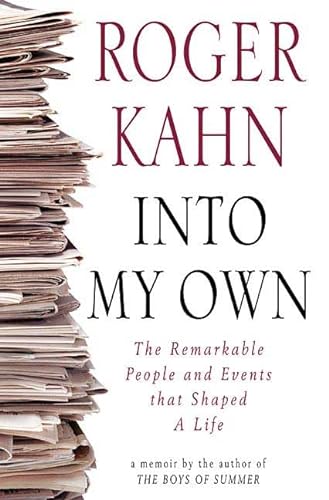
An inspirational memoir by the author of The Boys of Summer remembers eight people who shaped his identity as a father, writer, and friend, from Jackie Robinson and Robert Frost to his athletic scholar son, who died at the age of twenty-three. 75,000 first printing.
Die Inhaltsangabe kann sich auf eine andere Ausgabe dieses Titels beziehen.
Über die Autorinnen und Autoren
Roger Kahn is the author of nineteen books and hundreds of articles in national magazines such as Esquire, Sports Illustrated, Time, and The Saturday Evening Post. He has taught writing at various colleges and lectured at Yale, Princeton, and Columbia. Mr. Kahn held the distinguished position of Ottaway Professor of Journalism at SUNY New Paltz in the spring of 2004. He lives in Stone Ridge, New York, with his wife, the psychotherapist Katharine Johnson.
Roger Kahn is the author of nineteen books and hundreds of articles in national magazines such as Esquire, Sports Illustrated, Time, and The Saturday Evening Post. He has taught writing at various colleges and lectured at Yale, Princeton, and Columbia. Mr. Kahn held the distinguished position of Ottaway Professor of Journalism at SUNY New Paltz in the spring of 2004. He lives in Stone Ridge, New York, with his wife, the psychotherapist Katharine Johnson.
Aus dem Klappentext
Roger Kahn is one of America s foremost sportswriters. After successful seasons as a newspaperman and magazine writer, he burst onto the national scene in 1972 with his memorable bestseller, The Boys of Summer, a work that went beyond sports and captured the minds and hearts of millions across the country. Now in his eighth decade, Kahn has again written a book for the hearts and minds of his readers. Chronicling his own life, Into My Own is Kahn s reflection on the eight people who shaped him as a man, a father, and a writer.
In this poignant self-portrait, Kahn begins with his childhood in Brooklyn, reared on the verses of Homer, Shakespeare, Housman, and Millay---a curriculum set by his mother, and one that would influence his career with words. He combined his intellectual upbringing with his inherent passion for baseball, and began his sportswriting career under the legendary Stanley Woodward at the New York Herald Tribune. This lent Kahn the opportunity to interview and develop friendships with Pee Wee Reese and Jackie Robinson men he knew and admired for reasons far beyond their baseball abilities.
Kahn s writing is by no means limited to his sports coverage, and on the political front he devotes chapters to Eugene McCarthy and Barry Goldwater, whom he interviewed for the Saturday Evening Post---two diverse men in a turbulent era who championed their distinct versions of idealism. The Post had earlier sent Kahn to interview poet Robert Frost at his home in Vermont, a rare opportunity for any journalist, and one that resulted in the development of a marked friendship between two men of words. Perhaps most touching is his account, straightforward but abrim with love, of the life and death---at twenty-three---of his scholar-athlete son, Roger Laurence Kahn.
Into My Own is the touching memoir of an unassuming man, whose great love of baseball and literature led him into extraordinary experiences, opportunities, and friendships. Even amidst great family tragedy and personal difficulty, Kahn has prevailed---amongst poets, writers, politicians, and most of all, ballplayers.
In this poignant self-portrait, Kahn begins with his childhood in Brooklyn, reared on the verses of Homer, Shakespeare, Housman, and Millay---a curriculum set by his mother, and one that would influence his career with words. He combined his intellectual upbringing with his inherent passion for baseball, and began his sportswriting career under the legendary Stanley Woodward at the New York Herald Tribune. This lent Kahn the opportunity to interview and develop friendships with Pee Wee Reese and Jackie Robinson men he knew and admired for reasons far beyond their baseball abilities.
Kahn s writing is by no means limited to his sports coverage, and on the political front he devotes chapters to Eugene McCarthy and Barry Goldwater, whom he interviewed for the Saturday Evening Post---two diverse men in a turbulent era who championed their distinct versions of idealism. The Post had earlier sent Kahn to interview poet Robert Frost at his home in Vermont, a rare opportunity for any journalist, and one that resulted in the development of a marked friendship between two men of words. Perhaps most touching is his account, straightforward but abrim with love, of the life and death---at twenty-three---of his scholar-athlete son, Roger Laurence Kahn.
Into My Own is the touching memoir of an unassuming man, whose great love of baseball and literature led him into extraordinary experiences, opportunities, and friendships. Even amidst great family tragedy and personal difficulty, Kahn has prevailed---amongst poets, writers, politicians, and most of all, ballplayers.
Praise for Roger Kahn:
As a kid, I loved sports first and writing second, and loved everything Roger Kahn wrote. As an adult, I love writing first and sports second, and love Roger Kahn even more.
---Pulitzer Prize winner, David Maraniss
He can epitomize a player with a single swing of the pen.
---Time magazine
Roger Kahn is the best baseball writer in the business.
---Stephen Jay Gould, New York Review of Books
A work of high moral purpose and great poetic accomplishment. The finest American book on sports.
---James Michener on The Boys of Summer
Kahn has the almost unfair gift of easy, graceful writing.
---Boston Herald
---Pulitzer Prize winner, David Maraniss
He can epitomize a player with a single swing of the pen.
---Time magazine
Roger Kahn is the best baseball writer in the business.
---Stephen Jay Gould, New York Review of Books
A work of high moral purpose and great poetic accomplishment. The finest American book on sports.
---James Michener on The Boys of Summer
Kahn has the almost unfair gift of easy, graceful writing.
---Boston Herald
Roger Kahn is one of America s foremost sportswriters. After successful seasons as a newspaperman and magazine writer, he burst onto the national scene in 1972 with his memorable bestseller, The Boys of Summer, a work that went beyond sports and captured the minds and hearts of millions across the country. Now in his eighth decade, Kahn has again written a book for the hearts and minds of his readers. Chronicling his own life, Into My Own is Kahn s reflection on the eight people who shaped him as a man, a father, and a writer.
In this poignant self-portrait, Kahn begins with his childhood in Brooklyn, reared on the verses of Homer, Shakespeare, Housman, and Millay---a curriculum set by his mother, and one that would influence his career with words. He combined his intellectual upbringing with his inherent passion for baseball, and began his sportswriting career under the legendary Stanley Woodward at the New York Herald Tribune. This lent Kahn the opportunity to interview and develop friendships with Pee Wee Reese and Jackie Robinson?men he knew and admired for reasons far beyond their baseball abilities.
Kahn s writing is by no means limited to his sports coverage, and on the political front he devotes chapters to Eugene McCarthy and Barry Goldwater, whom he interviewed for the Saturday Evening Post---two diverse men in a turbulent era who championed their distinct versions of idealism. The Post had earlier sent Kahn to interview poet Robert Frost at his home in Vermont, a rare opportunity for any journalist, and one that resulted in the development of a marked friendship between two men of words. Perhaps most touching is his account, straightforward but abrim with love, of the life and death---at twenty-three---of his scholar-athlete son, Roger Laurence Kahn.
Into My Own is the touching memoir of an unassuming man, whose great love of baseball and literature led him into extraordinary experiences, opportunities, and friendships. Even amidst great family tragedy and personal difficulty, Kahn has prevailed---amongst poets, writers, politicians, and most of all, ballplayers.
In this poignant self-portrait, Kahn begins with his childhood in Brooklyn, reared on the verses of Homer, Shakespeare, Housman, and Millay---a curriculum set by his mother, and one that would influence his career with words. He combined his intellectual upbringing with his inherent passion for baseball, and began his sportswriting career under the legendary Stanley Woodward at the New York Herald Tribune. This lent Kahn the opportunity to interview and develop friendships with Pee Wee Reese and Jackie Robinson?men he knew and admired for reasons far beyond their baseball abilities.
Kahn s writing is by no means limited to his sports coverage, and on the political front he devotes chapters to Eugene McCarthy and Barry Goldwater, whom he interviewed for the Saturday Evening Post---two diverse men in a turbulent era who championed their distinct versions of idealism. The Post had earlier sent Kahn to interview poet Robert Frost at his home in Vermont, a rare opportunity for any journalist, and one that resulted in the development of a marked friendship between two men of words. Perhaps most touching is his account, straightforward but abrim with love, of the life and death---at twenty-three---of his scholar-athlete son, Roger Laurence Kahn.
Into My Own is the touching memoir of an unassuming man, whose great love of baseball and literature led him into extraordinary experiences, opportunities, and friendships. Even amidst great family tragedy and personal difficulty, Kahn has prevailed---amongst poets, writers, politicians, and most of all, ballplayers.
Praise for Roger Kahn:
?As a kid, I loved sports first and writing second, and loved everything Roger Kahn wrote. As an adult, I love writing first and sports second, and love Roger Kahn even more.
---Pulitzer Prize winner, David Maraniss
?He can epitomize a player with a single swing of the pen.
---Time magazine
?Roger Kahn is the best baseball writer in the business.
---Stephen Jay Gould, New York Review of Books
?A work of high moral purpose and great poetic accomplishment. The finest American book on sports.
---James Michener on The Boys of Summer
?Kahn has the almost unfair gift of easy, graceful writing.
---Boston Herald
---Pulitzer Prize winner, David Maraniss
?He can epitomize a player with a single swing of the pen.
---Time magazine
?Roger Kahn is the best baseball writer in the business.
---Stephen Jay Gould, New York Review of Books
?A work of high moral purpose and great poetic accomplishment. The finest American book on sports.
---James Michener on The Boys of Summer
?Kahn has the almost unfair gift of easy, graceful writing.
---Boston Herald
Auszug. © Genehmigter Nachdruck. Alle Rechte vorbehalten.
Chapter One
The Coach
Reality brightens my dream, to become a writer.
I
It may seem curious, at least it does to me, that an old Herald Tribune hand tapping a keyboard would so soon cite a primal dictum of The New York Times, as quoted by Arthur Gelb in the 662-page memoir he called City Room. Early in the book, along about page 136, Gelb quotes Adolph Ochs, paterfamilias of the family that runs the Times, as saying, "The most useful man on a newspaper is one who can edit. . . . Writers are galore."
Quoting Ochs around the Times may not be precisely like spouting Luke in a Southern Baptist church, but it comes close. The old man burst out of Chattanooga and took control of The New York Times in 1896, a publisher of ferocious ambition, an astounding work ethic, and a brilliant head for business. Even in the twenty-first century, six decades after his death, he remains the principal architect of what is probably the most successful newspaper on earth. There is a nice ring to his surprising phrase "writers are galore," but in this instance, as in a few others, Baron Ochs was wrong.
The greatest newspaperman I have known was R. (for Rufus) Stanley Woodward, a huge, myopic former Amherst lineman whose glory days came when he was sports editor of the New York Herald Tribune. During that stretch, from the 1930s into the 1960s, "Coach" Woodward pitched batting practice for the Yankees in a uniform borrowed from Lou Gehrig, discovered Red Smith, saved the baseball career of Jackie Robinson, and invented the modern sports page. He also took time out to cover World War II and, in 1944, armed with a Boy Scout knife and a sheaf of pencils, landed behind Nazi lines in a glider, the better to observe the horrific Battle of Arnhem. He did all these high deeds, and, on another level, he managed to convince me in my youth that if I worked hard, double-spaced my copy, read Paradise Lost, and learned to remain vertical after drinking four martinis, there was no reason, no reason at all, why I could not become a writer. Woodward was the man Ernest Hemingway wanted to be.
Woodward's credo, which he learned as a cub reporter at the Worcester Evening Gazette from an editor named Nicholas J. Skerrett, went like this: "The American newspaper is the greatest institution in the world." I think all of us who have worked for American newspapers feel that way, at least some of the time, which is why we get so upset when we see the art and craft of newspapering abused. Within Woodward's mighty frame--six feet two, 230 pounds--beat the sensitive and vulnerable heart of an idealist. He was a classicist, a humanist, and a liberal, who loved farming and played the violin. But above all he was an idealist.
Ogden Mills Reid, who had inherited great wealth, ran the Trib for four decades, until his death in 1947. In a staunch Republican way, old Ogden was an idealist, even as Woodward, and he championed the sometimes combative Coach. But Reid's will left the paper in the hands of his widow, Helen Rogers Reid, who had started her career as an impecunious social secretary. Helen was slight, strong-willed, jut-jawed, and tightfisted. She appointed herself publisher and designated her son "Whitie" editor in chief. Both these people were kind to me. Each took a personal interest in my work. But neither had old Ogden's overall tolerance for nonconformists, rebels, or, for that matter, martinis. After some clashes, which I'll get to presently, Helen and Whitie fired the best sports editor in the country and replaced him with a onetime college hockey star named Bob Cooke, formerly Whitie's Old Blue classmate at Yale.
Jolted, his adrenaline pumping wildly, Woodward immediately dictated, not wrote but dictated, a remarkable, forgotten book called Sports Page, which could be used as a primer today by every publication covering sports, although, Woodward being Woodward, it is livelier and better written than standard texts. In Sports Page, Woodward warned of "the unholy jargon, the tendency to call things by names other than their own." Typically that would be describing a shortstop's error as a "miscue." The shortstop, of course, does not carry a cue stick. Woodward ruled that "horrendous clashes of fearsome Tigers and snarling Wolverines, usually concluded in purple sunsets, are taboo." Copyreaders, whom he called "the comma police," sometimes may cut a good writer to dullness, "but they are essential if the vehicle [sports section] is not to be smeared with wild and indiscriminate pigments." Good copy editors were rare and valuable, but the lifeblood of a great sports section and a great newspaper flowed from its writers, or at least it should. "The giants of our craft," Woodward asserted, "Grantland Rice, W. O. McGeehan, and Westbrook Pegler, each gave something to today's school of writing. Rice contributed rhythm and euphony; Pegler a grumpy and grudging curiosity for fact; and McGeehan a certain twist, in the likeness of Anatole France, which could make an ordinary sentence interesting."
Rice is best remembered for creating the most remarkable lead ever written on a football game. Covering Army-Notre Dame in November 1924--Notre Dame, 13; Army, 7--Rice began:
Outlined against a blue-gray sky, The Four Horsemen rode again. In dramatic lore they are known as Famine, Pestilence, Destruction and Death. These are only aliases. Their real names are Stuhldreyer, Miller, Crowley and Layden. They formed the crest of the South Bend cyclone before which another fighting Army football team was swept over the precipice at the Polo Grounds yesterday afternoon as 55,000 spectators peered down on a bewildering panorama spread on the green plain below.
A cyclone can't be snared. It may be surrounded but somewhere it breaks through to keep on going. When the cyclone starts from South Bend, where the candle lights still gleam through the Indiana sycamores, those in the way must take to their storm cellars at top speed . . .
Over drinks Red Smith liked to ask archly, "From what angle was Granny watching the game if he saw the Notre Dame backfield outlined against a blue-gray sky?" Further, there was no precipice below the Polo Grounds; the old ball park actually sat under the precipice called Coogan's Bluff. But such specifics are piffle. Rice's lead itself was a cyclone that swept away all before it. Or so I believe. (So did Woodward, and so did Red Smith when he wasn't being arch.)
William O'Connell "Bill" McGeehan, called Sheriff, had his golden years in the 1920s, which used to be called the Golden Age of Sport. When Luis Angel Firpo, nicknamed the Wild Bull of the Pampas, fought Jack Dempsey, the Manassa Mauler, for the heavyweight championship in 1923, Firpo knocked Dempsey through the ropes in round one. Sportswriters shoved Dempsey back into the ring and, although dazed, he continued to fight fiercely. Dempsey won by a knockout in round two, the ninth knockdown in about four minutes of championship boxing. Ring Lardner commented that Dempsey had turned big Luis Firpo into "the Tame Cow of the Pampas." More seriously Sheriff McGeehan wrote in the New York Tribune: "A pair of wolves battling in the pines of the Northern Woods, a pair of cougars in the wastes of the Southwest, might have staged a faster and more savage bout, but no two human beings."
Pegler is remembered, if at all today, for his venomous old age, when he moved into the western desert and wrote column after column attacking Franklin and Eleanor Roosevelt. But the earlier Pegler had been a superb and salty journalist who wrote that only two varieties of sportswriter existed on earth, "the ones who go 'gee whiz' and the one who say, 'aw nuts.'"
Why is it that none of these worthies worked for Ochs's New York...
„Über diesen Titel“ kann sich auf eine andere Ausgabe dieses Titels beziehen.
Suchergebnisse für Into My Own: The Remarkable People and Events that...

Beispielbild für diese ISBN
Into My Own: The Remarkable People and Events That Shaped a Life
Anbieter: World of Books (was SecondSale), Montgomery, IL, USA
Verkäuferbewertung 5 von 5 Sternen

Hardback. Zustand: Very Good. Artikel-Nr. 00084472627
Gebraucht kaufen
EUR 5,93
Versand gratis
Versand innerhalb von USA
Versand innerhalb von USA
Anzahl: 1 verfügbar
Beispielbild für diese ISBN
Into My Own: The Remarkable People and Events That Shaped a Life
Anbieter: World of Books (was SecondSale), Montgomery, IL, USA
Verkäuferbewertung 5 von 5 Sternen
Hardback. Zustand: Good. Artikel-Nr. 00084319311
Gebraucht kaufen
EUR 5,93
Versand gratis
Versand innerhalb von USA
Versand innerhalb von USA
Anzahl: 2 verfügbar
Beispielbild für diese ISBN
Into My Own: The Remarkable People and Events That Shaped a Life
Verlag:
Thomas Dunne Books (edition First Edition), 2006
ISBN 10: 0312338139
ISBN 13: 9780312338138
Gebraucht
Hardcover
Erstausgabe
Anbieter: BooksRun, Philadelphia, PA, USA
Verkäuferbewertung 5 von 5 Sternen
Hardcover. Zustand: Very Good. First Edition. With dust jacket. It's a well-cared-for item that has seen limited use. The item may show minor signs of wear. All the text is legible, with all pages included. It may have slight markings and/or highlighting. Artikel-Nr. 0312338139-11-1-29
Gebraucht kaufen
EUR 6,17
Versand gratis
Versand innerhalb von USA
Versand innerhalb von USA
Anzahl: 1 verfügbar
Beispielbild für diese ISBN
Into My Own : The Remarkable People and Events That Shaped a Life
Verlag:
St. Martin's Press, 2006
ISBN 10: 0312338139
ISBN 13: 9780312338138
Gebraucht
Hardcover
Erstausgabe
Anbieter: Better World Books, Mishawaka, IN, USA
Verkäuferbewertung 5 von 5 Sternen
Zustand: Good. First Edition. Former library copy. Pages intact with minimal writing/highlighting. The binding may be loose and creased. Dust jackets/supplements are not included. Includes library markings. Stock photo provided. Product includes identifying sticker. Better World Books: Buy Books. Do Good. Artikel-Nr. 14956912-6
Gebraucht kaufen
EUR 6,38
Versand gratis
Versand innerhalb von USA
Versand innerhalb von USA
Anzahl: 1 verfügbar
Beispielbild für diese ISBN
Into My Own : The Remarkable People and Events That Shaped a Life
Verlag:
St. Martin's Press, 2006
ISBN 10: 0312338139
ISBN 13: 9780312338138
Gebraucht
Hardcover
Erstausgabe
Anbieter: Better World Books, Mishawaka, IN, USA
Verkäuferbewertung 5 von 5 Sternen
Zustand: Good. First Edition. Pages intact with minimal writing/highlighting. The binding may be loose and creased. Dust jackets/supplements are not included. Stock photo provided. Product includes identifying sticker. Better World Books: Buy Books. Do Good. Artikel-Nr. 401813-6
Gebraucht kaufen
EUR 6,38
Versand gratis
Versand innerhalb von USA
Versand innerhalb von USA
Anzahl: 1 verfügbar
Beispielbild für diese ISBN
Into My Own : The Remarkable People and Events That Shaped a Life
Verlag:
St. Martin's Press, 2006
ISBN 10: 0312338139
ISBN 13: 9780312338138
Gebraucht
Hardcover
Erstausgabe
Anbieter: Better World Books, Mishawaka, IN, USA
Verkäuferbewertung 5 von 5 Sternen
Zustand: Very Good. First Edition. Pages intact with possible writing/highlighting. Binding strong with minor wear. Dust jackets/supplements may not be included. Stock photo provided. Product includes identifying sticker. Better World Books: Buy Books. Do Good. Artikel-Nr. 401814-6
Gebraucht kaufen
EUR 6,38
Versand gratis
Versand innerhalb von USA
Versand innerhalb von USA
Anzahl: 1 verfügbar
Beispielbild für diese ISBN
Into My Own: The Remarkable People and Events That Shaped a Life
Anbieter: Wonder Book, Frederick, MD, USA
Verkäuferbewertung 5 von 5 Sternen
Zustand: Very Good. Very Good condition. Very Good dust jacket. A copy that may have a few cosmetic defects. May also contain light spine creasing or a few markings such as an owner's name, short gifter's inscription or light stamp. Artikel-Nr. K09R-00198
Gebraucht kaufen
EUR 6,45
Versand gratis
Versand innerhalb von USA
Versand innerhalb von USA
Anzahl: 1 verfügbar
Beispielbild für diese ISBN
Into My Own: The Remarkable People and Events That Shaped a Life
Anbieter: Wonder Book, Frederick, MD, USA
Verkäuferbewertung 5 von 5 Sternen
Zustand: Good. Good condition. Very Good dust jacket. A copy that has been read but remains intact. May contain markings such as bookplates, stamps, limited notes and highlighting, or a few light stains. Artikel-Nr. B02C-00569
Gebraucht kaufen
EUR 6,45
Versand gratis
Versand innerhalb von USA
Versand innerhalb von USA
Anzahl: 1 verfügbar
Beispielbild für diese ISBN
Into My Own: The Remarkable People and Events That Shaped a Life
Anbieter: ThriftBooks-Atlanta, AUSTELL, GA, USA
Verkäuferbewertung 5 von 5 Sternen
Hardcover. Zustand: Very Good. No Jacket. Missing dust jacket; May have limited writing in cover pages. Pages are unmarked. ~ ThriftBooks: Read More, Spend Less. Artikel-Nr. G0312338139I4N01
Gebraucht kaufen
EUR 7,58
Versand gratis
Versand innerhalb von USA
Versand innerhalb von USA
Anzahl: 1 verfügbar
Beispielbild für diese ISBN
Into My Own: The Remarkable People and Events That Shaped a Life
Anbieter: ThriftBooks-Atlanta, AUSTELL, GA, USA
Verkäuferbewertung 5 von 5 Sternen
Hardcover. Zustand: Very Good. No Jacket. May have limited writing in cover pages. Pages are unmarked. ~ ThriftBooks: Read More, Spend Less. Artikel-Nr. G0312338139I4N00
Gebraucht kaufen
EUR 7,58
Versand gratis
Versand innerhalb von USA
Versand innerhalb von USA
Anzahl: 1 verfügbar