
Inhaltsangabe
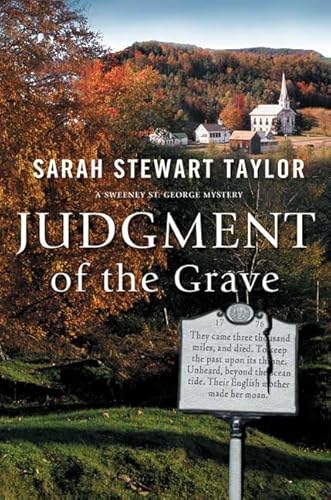
As gravestone expert Sweeney St. George tours burial sites of the Civil War, she stops to watch a battlefield reenactment in Massachusetts. There, she meets Pres Whiting, a boy whose family is in the gravestone business. When Pres discovers a dead man in a Revolutionary War-era British soldier's uniform, Sweeney and Cambridge homicide detective Tim Quinn jump on the case.
While they search for clues regarding the dead body, Sweeney and Quinn investigate other strange events. While Sweeney looks into the 1775 disappearance of militiaman, Quinn looks into a current missing persons case with alarming ties to the past. As they try to uncover how their own investigations are related to the body found in the woods, Sweeney and Quinn get a little too close for comfort -- to each other and to murder.
While they search for clues regarding the dead body, Sweeney and Quinn investigate other strange events. While Sweeney looks into the 1775 disappearance of militiaman, Quinn looks into a current missing persons case with alarming ties to the past. As they try to uncover how their own investigations are related to the body found in the woods, Sweeney and Quinn get a little too close for comfort -- to each other and to murder.
Die Inhaltsangabe kann sich auf eine andere Ausgabe dieses Titels beziehen.
Über die Autorinnen und Autoren
Sarah Stewart Taylor is the author of two previous mysteries that feature Sweeney St. George, including the Agatha-Award-finalist, O'artful Death. She lives with her husband in Vermont.
Sarah Stewart Taylor is the author of two previous mysteries that feature Sweeney St. George, including the Agatha-Award-finalist, O'artful Death. She lives with her husband in Vermont.
Auszug. © Genehmigter Nachdruck. Alle Rechte vorbehalten.
Chapter One
Sunday, October 10
Sweeney St. George had just found another example of a gravestone by the elusive round-skull carver when the late-afternoon peace of the cemetery was broken by the sound of gunfire.
Crack! Crack! Crack!
Without looking to see where it was coming from, she hit the ground, her arms covering her head, her heart slamming against her rib cage, all of her nerves going nuts as she heard another series of shots come quick and fast.
Crack! Crack! Crack!
“Don’t worry. It’s just pretend,” said a voice behind her, and Sweeney got to her feet and turned to find herself looking down at someone who at first appeared to be a short man with a high, girlish voice. His bald head glinted in the sun and he looked up at her with huge eyes in a pale face.
But he wasn’t a man. He was a boy, a completely bald boy of about eleven or twelve and as Sweeney looked into his intense brown eyes, which gave him the look of a young Ben Kingsley, the boy flushed and looked away. He reached down quickly for a baseball hat lying on the ground and put it on his head. “It’s a demonstration. Up at the Old North Bridge.”
“You mean, like Civil War reenactors and all that?”
“Yeah. Except it’s not the Civil War. It’s the Revolutionary War.” She almost expected him to finish up with a “duh.”
“Oh yeah, we’re in Concord, aren’t we?”
She had come out to Concord in order to find some more examples of the work of the eighteenth-century stonecutter Sweeney had come to think of as the round-skull carver. Sweeney, who studied gravestones and other funerary art, had been after the round-skull carver for months now, ever since she’d seen one of his stones in a Lexington cemetery and been intrigued by his unusual border designs and his oddly shaped death’s-heads. They were very human death’s-heads, she thought. That was the best way to describe them, with their round skulls and almost cheery expressions. She had found five stones she was positive had been made by the same carver and, after a doing a bit of asking around, discovered that no one knew who he was. So she had done what she normally did when looking for a carver’s identity and checked the Middlesex County probate records for the names of the people buried beneath the round-skull carver’s stones. The records often stipulated payment to this or that gravestone carver for the deceased’s stone and it was one of the only ways of finding a particularly elusive carver. She hadn’t had any luck yet, but now that she had found one of the stones in Concord, she could try again. And Edward Martin’s stone boded well because it was a large one, with elaborate carving on the side borders. It had cost a nice sum when it had been made in 1740, and since Edward Martin seemed to be a man of means, there was a good likelihood that he would have a probate record stipulating where his worldly possessions would go after death.
And here, in the South Burying Ground in Concord, it hadn’t taken her long to find another one. It was all there, the distinctive shape of the skull, the delicate wings at its side, the odd, unnaturally twining plants in the border design, the cramped lettering the carver had used to write, “Here Lyes the Body of Edward Martin.”
The boy looked down at her notes. “What are you doing?”
“I’m taking notes on this gravestone. I’m trying to figure out who made it.”
The boy sat down next to her and looked at the stone. “You don’t know who made it?”
“No, it’s not signed, but I’ve found a whole bunch of stones around here that I’m almost positive he made, and now that I have Edward Martin’s name, I can see if his estate paid the person who made his stone. It’s kind of like being a detective.” Another shot sounded and Sweeney started. “That didn’t sound pretend,” she said.
“Well, they don’t put any bullets in the guns,” the boy said. “They’re not allowed to. And the ones up at the Old North Bridge, they’re not even allowed to point the guns at each other. So it’s kind of stupid. They just, like, shoot them up in the air. My grandfather has reenactments up in his field, though, and up there they can pretend they’re really fighting because it’s not National Park property. They did Battle Road at the last one, which is also stupid because it’s not even the right time of year.”
Sweeney didn’t say anything, but clearly more explanation was needed and he went on.
“Well, you know, the Old North Bridge and the shot heard round the world, that whole thing, that was in April.” He looked around at the orange, red, and yellow trees and, as though he were breaking something to her, said gently, “This is October.”
“That was when we finally shot back at the British, right? I kind of forget my Revolutionary War history.”
He looked up at her, his face swollen and puffy, then said condescendingly, “The British regulars were on their way out to Concord because they were going to take all the guns and stuff from the provincials. So the Minutemen and everybody stood on the green in Lexington and the British shot at them and killed a bunch of them. No one thought they would actually do it. Then they came to Concord and we thought they were burning houses down. So the provincials decided they’d had enough and they went up to the North Bridge. No one really knows who fired the first shot, but we got a bunch of them. The Redcoats had to run away back to Charlestown, and the Minutemen hid in the fields and behind walls. They never knew what hit ’em. That was called Battle Road.”
Sweeney remembered a bit of Longfellow, something her father used to recite. She quoted, “ ‘You know the rest. In the books you have read, / How the British Regulars fired and fled . . .’ Do you know that one?”
The boy picked it up. “ ‘How the farmers gave them ball for ball, / From behind each fence and farm-yard wall, / Chasing the red-coats down the lane, / Then crossing the field to emerge again.’ ” Here Sweeney remembered the rest and she joined in again. “ ‘Under the trees at the turn of the road, / And only pausing to fire and load.’ ”
He smiled up at her. “Of course, Longfellow kind of added stuff. You know, like, to make it sound better. But that’s how we won the war,” the boy said in an authoritative way. “The British liked to fight in the open field and we knew how to fight guerrilla-style.”
“So, what, did you write a book or something?” Sweeney sat down on the ground and leaned her back against the gravestone, wrapping her arms around her knees. The boy had been right. It was October, and though they’d had a few nice days the week before, there was no denying it was getting cold.
“No. I just read a lot. My mom is director of the Minuteman Museum, so she knows about all this stuff. And my dad knows about it too.”
“Yeah? What does he do?”
“Oh,” he said uninterestedly, reaching up to scratch his scalp under the baseball hat. “He makes gravestones.”
Sweeney studied him for a moment. The puffiness of his face made him seem younger than he must be. Studying his eyes, she decided he...
„Über diesen Titel“ kann sich auf eine andere Ausgabe dieses Titels beziehen.
Weitere beliebte Ausgaben desselben Titels

Suchergebnisse für Judgment Of The Grave (Sweeney St. George, Band 3)

Beispielbild für diese ISBN
Judgment of the Grave (Sweeney St. George Mysteries)
Verlag:
Minotaur Books (edition First Edition), 2005
ISBN 10: 0312337396
ISBN 13: 9780312337391
Gebraucht
Hardcover
Erstausgabe
Anbieter: BooksRun, Philadelphia, PA, USA
Verkäuferbewertung 5 von 5 Sternen

Hardcover. Zustand: Very Good. First Edition. With dust jacket. It's a well-cared-for item that has seen limited use. The item may show minor signs of wear. All the text is legible, with all pages included. It may have slight markings and/or highlighting. Artikel-Nr. 0312337396-8-1-29
Gebraucht kaufen
EUR 5,35
Versand gratis
Versand innerhalb von USA
Versand innerhalb von USA
Anzahl: 1 verfügbar
Beispielbild für diese ISBN
Judgment of the Grave (Sweeney St. George Mysteries)
Anbieter: ThriftBooks-Atlanta, AUSTELL, GA, USA
Verkäuferbewertung 5 von 5 Sternen
Hardcover. Zustand: Very Good. No Jacket. Former library book; May have limited writing in cover pages. Pages are unmarked. ~ ThriftBooks: Read More, Spend Less. Artikel-Nr. G0312337396I4N10
Gebraucht kaufen
EUR 5,74
Versand gratis
Versand innerhalb von USA
Versand innerhalb von USA
Anzahl: 1 verfügbar
Beispielbild für diese ISBN
Judgment of the Grave (Sweeney St. George Mysteries)
Anbieter: ThriftBooks-Atlanta, AUSTELL, GA, USA
Verkäuferbewertung 5 von 5 Sternen
Hardcover. Zustand: Good. No Jacket. Pages can have notes/highlighting. Spine may show signs of wear. ~ ThriftBooks: Read More, Spend Less. Artikel-Nr. G0312337396I3N00
Gebraucht kaufen
EUR 5,74
Versand gratis
Versand innerhalb von USA
Versand innerhalb von USA
Anzahl: 1 verfügbar
Beispielbild für diese ISBN
Judgment of the Grave (Sweeney St. George Mysteries)
Anbieter: ThriftBooks-Dallas, Dallas, TX, USA
Verkäuferbewertung 5 von 5 Sternen
Hardcover. Zustand: Good. No Jacket. Former library book; Pages can have notes/highlighting. Spine may show signs of wear. ~ ThriftBooks: Read More, Spend Less. Artikel-Nr. G0312337396I3N10
Gebraucht kaufen
EUR 5,75
Versand gratis
Versand innerhalb von USA
Versand innerhalb von USA
Anzahl: 1 verfügbar
Beispielbild für diese ISBN
Judgment of the Grave (Sweeney St. George Mysteries)
Anbieter: ThriftBooks-Dallas, Dallas, TX, USA
Verkäuferbewertung 5 von 5 Sternen
Hardcover. Zustand: Good. No Jacket. Missing dust jacket; Pages can have notes/highlighting. Spine may show signs of wear. ~ ThriftBooks: Read More, Spend Less. Artikel-Nr. G0312337396I3N01
Gebraucht kaufen
EUR 5,75
Versand gratis
Versand innerhalb von USA
Versand innerhalb von USA
Anzahl: 1 verfügbar
Beispielbild für diese ISBN
Judgment of the Grave (Sweeney St. George Mysteries)
Anbieter: Wonder Book, Frederick, MD, USA
Verkäuferbewertung 5 von 5 Sternen
Zustand: Good. Good condition. Very Good dust jacket. A copy that has been read but remains intact. May contain markings such as bookplates, stamps, limited notes and highlighting, or a few light stains. Artikel-Nr. I29A-03027
Gebraucht kaufen
EUR 7,18
Versand gratis
Versand innerhalb von USA
Versand innerhalb von USA
Anzahl: 1 verfügbar
Beispielbild für diese ISBN
Judgment of the Grave (Sweeney St. George Mysteries)
Anbieter: ThriftBooks-Phoenix, Phoenix, AZ, USA
Verkäuferbewertung 5 von 5 Sternen
Hardcover. Zustand: Good. No Jacket. Former library book; Pages can have notes/highlighting. Spine may show signs of wear. ~ ThriftBooks: Read More, Spend Less. Artikel-Nr. G0312337396I3N10
Gebraucht kaufen
EUR 7,30
Versand gratis
Versand innerhalb von USA
Versand innerhalb von USA
Anzahl: 1 verfügbar
Beispielbild für diese ISBN
Judgment of the Grave (Sweeney St. George Mysteries)
Anbieter: ThriftBooks-Phoenix, Phoenix, AZ, USA
Verkäuferbewertung 5 von 5 Sternen
Hardcover. Zustand: Good. No Jacket. Pages can have notes/highlighting. Spine may show signs of wear. ~ ThriftBooks: Read More, Spend Less. Artikel-Nr. G0312337396I3N00
Gebraucht kaufen
EUR 7,30
Versand gratis
Versand innerhalb von USA
Versand innerhalb von USA
Anzahl: 1 verfügbar
Beispielbild für diese ISBN
Judgment of the Grave (Sweeney St. George)
Anbieter: Revaluation Books, Exeter, Vereinigtes Königreich
Verkäuferbewertung 5 von 5 Sternen
Hardcover. Zustand: Brand New. 316 pages. 8.50x5.75x1.25 inches. In Stock. Artikel-Nr. 0312337396
Neu kaufen
EUR 77,29
EUR 11,52 Versand
Versand von Vereinigtes Königreich nach USA
Versand von Vereinigtes Königreich nach USA
Anzahl: 1 verfügbar