
Verwandte Artikel zu The Year's Best Fantasy and Horror: Seventeenth Annual...
The Year's Best Fantasy and Horror: Seventeenth Annual Collection (Year's Best Fantasy & Horror) - Softcover
Inhaltsangabe
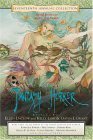
A new seventeenth collection of the finest short fantasy and horror fiction published during the previous year features an ecclectic assortment of works by Ursula K. Le Guin, Karen Joy Fowler, Richard Butner, Alex Irvine, Kim Newman, Ramsey Campbell, and Glen Hirshberg, among others, as well as a year-end wrap-up in publishing, film, comics, and manga. Simultaneous. 25,000 first printing.
Die Inhaltsangabe kann sich auf eine andere Ausgabe dieses Titels beziehen.
Über die Autorin bzw. den Autor
Ellen Datlow is the acclaimed editor of such anthologies as Sirens and Other Daemon Lovers (with Terri Windling), Lethal Kisses, Off Limits, and Endangered Species, and has won the World Fantasy Award six times. She has won and been nominated for the Stolker Award. She lives in New York City and currently edits fiction for SCIFI.COM
Kelly Link and Gavin J. Grant started Small Beer Press in 2000. They have published the zine Lady Churchill's Rosebud Wristlet ("tiny, but celebrated"-Washington Post) for seven years. They live in an old farmhouse in Northampton, Massachusetts.
Kelly Link's first collection of short stories, Stranger Things Happen, was selected as a Best Book of the Year by Salon, Locus, and The Village Voice. Stories from the collection have won the Nebula, Tiptree, and World Fantasy Awards. Her most recent short stories have appeared in Conjunctions and McSweeney's Mammoth Treasury of Thrilling Tales. She is the editor of the anthology Trampoline and is currently working on more short stories.
Originally from Scotland, Gavin J. Grant worked in bookshops in Los Angeles and Boston and BookSense.com a website for independent bookshops. He regularly reviews fantasy and science fiction. Publications where his work has appeared include Scifiction, Strange Horizons, The Third Alternative, Singularity, and The Year's Best Fantasy & Horror.
Kelly Link and Gavin J. Grant started Small Beer Press in 2000. They have published the zine Lady Churchill's Rosebud Wristlet ("tiny, but celebrated"-Washington Post) for seven years. They live in an old farmhouse in Northampton, Massachusetts.
Kelly Link's first collection of short stories, Stranger Things Happen, was selected as a Best Book of the Year by Salon, Locus, and The Village Voice. Stories from the collection have won the Nebula, Tiptree, and World Fantasy Awards. Her most recent short stories have appeared in Conjunctions and McSweeney's Mammoth Treasury of Thrilling Tales. She is the editor of the anthology Trampoline and is currently working on more short stories.
Originally from Scotland, Gavin J. Grant worked in bookshops in Los Angeles and Boston and BookSense.com a website for independent bookshops. He regularly reviews fantasy and science fiction. Publications where his work has appeared include Scifiction, Strange Horizons, The Third Alternative, Singularity, and The Year's Best Fantasy & Horror.
Auszug. © Genehmigter Nachdruck. Alle Rechte vorbehalten.
The Year's Best Fantasy and Horror: Seventeenth Annual Collection
Summation 2003: Fantasy
Kelly Link and Gavin J. Grant
Welcome to the summation and celebration of the year in fantasy fiction for the seventeenth annual edition of The Year's Best Fantasy and Horror.
That the field of fantastic fiction is alive and flourishing today is due in no small part to the work of our predecessor, Terri Windling. To those readers who will miss her editorial vision, we reply that we are also going to miss reading her version of The Year's Best Fantasy. We look forward, on the other hand, to reading more of Windling's own writing, to her ongoing work as an anthologist, and to seeing more of her paintings and art. As we read and choose stories for The Year's Best, we continue to be inspired by the work of anthologists like Windling, Datlow, Gardner Dozois, Stephen Jones, Judith Merril, Damon Knight, Robert Silverberg, Lin Carter, Arthur Saha, and Terry Carr. Especially in this transitional year, we are in no doubt that we missed some wonderful fantasy stories, collections, and novels. Recommendations are always welcome.
For readers dreading a radical departure with a set of new editors, we acknowledge that our tastes and editorial direction can't possibly match up, in all aspects, with Windling's. For that matter, Gavin's taste is different from Kelly's taste. We also acknowledge that our introduction may not be as thorough or as informed as Windling's introductions. We begin this year with a summation somewhere between a survey of the field and a commentary. We suggest that readers interested in discovering further in-depth essays, lists, and informed opinions on the year in genre fiction, that they consult Web sites like www.locusmag.com, and www.fantasticmetropolis.com, which point out notable books. There are also Web sites like www.endicott-studio.com and www.artistswithoutborders.org, on which Terri Windling and others continue to discuss and recommend and seek out stories, novels, music, performances, and other noteworthy examples of the fantastic in the arts.
We hope that readers of every category of the fantastic will find something here to delight them. As in previous volumes of The Year's Best, we have tried to include a broad spectrum of works and styles: epic fantasy, fairy tales, surrealism, dark fantasy, and all stops in between. We recognize that the fantasy field isbroader than our tastes. While each The Year's Best anthology is representative of a particular editor's preferences and biases, we have attempted in our half of this anthology to collect in one place those stories that delighted and surprised and moved us, as well as to produce a survey of the best in a field whose strength comes from its rich and varied traditions.
That there continues to be such a wealth of fantastic fiction, some of it appearing in mainstream publications, shelved in mainstream categories, while genre publishers and small-press publishers and various small-magazines of all descriptions continue to produce outstanding and notable works, seems to us a sign of the good health of the genre. The fact that much vigorous cross-pollination seems to be going on, while specialization continues to thrive, seems like a good thing for both readers and writers.
In 2003 the National Book Foundation awarded Stephen King the Distinguished Contributions to American Letters Medal; Alice Sebold's The Lovely Bones and J. R. R. Tolkien continued to find new readers; Peter Jackson's The Return of the King won eleven Oscars; Pulitzer Prize-winner Michael Chabon edited an issue of McSweeney's magazine devoted to pulp-style fiction; and J. K. Rowling became the U.K.'s richest woman. The borders between genre and mainstream began to seem extremely thin (even uncomfortably thin to some writers and readers).
Closer to home, while genre magazine subscriptions continue to fall (and we encourage every reader to subscribe to at least one of the major genre magazines), the field has seen growth (for better and for worse) from small press, online, 'zine, and print-on-demand publishers.
For better: The work of more writers and artists is accessible to readers. Night Shade, PS Publishing, Subterranean, Prime, Wheatland Press, and other small presses published some of our favorite books of the year: K. J. Bishop's novel, The Etched City (Prime); M. John Harrison's collection, Things That Never Happen (Night Shade); Jay Lake and Deborah Layne's anthology series Polyphony (Wheatland); Jeff VanderMeer and Mark Roberts's The Thackeray T. Lambshead Pocket Guide to Eccentric & Discredited Diseases (Night Shade); Elizabeth Hand's collection Bibliomancy (PS Publishing); Steve Rasnic Tem's Book of Days (Subterranean).
For worse: In the rush to make more work and more writers available, the editing at some small-press venues seems to consist of accepting stories rather than working with authors (and designers, copy editors, and proofreaders). This seems unfortunate when there are excellent online and print resources to help nascent editors and publishers with design, distribution, and art. Much of the small-press and 'zine publishing is a labor of love rather than a career, but one might as well learn to love design and copyediting.
Mainstream publishing, of course, has its own pitfalls: The midlist continues to shrink as do midlist advances, editors have far less time for actual editing, and publishing houses continue to be bought up, or merged, or streamlined.
A happier problem is that we found there were far too many excellent novellas and longer stories, a plethora, a richness, a more-than-we-can-collectness of exceptionallong work. We could easily have filled half of this volume with a handful of stories like Greer Gilman's "A Crowd of Bone," or on the other hand, half a dozen stories by Lucius Shepard. (It seemed to be a year for long novels, as well, although there is a trend toward publishing some of these novels in two installments, since chain bookstores are leery of stocking hardcovers priced over $25.) Since there are now at least three annual Year's Best anthologies--plus Jonathan Strahan's upcoming Best Short Novels: 2004 (Science Fiction Book Club)--here should be more opportunities to find reprints of some of these longer stories.
We have noted and will continue to note reprints of special interest. Whenever possible, we attempt to cover English-language novels and collections published outside the United States. Again, we have undoubtedly missed many excellent books. In future volumes, we hope to become more thorough at locating work of interest.
Where to find good books: There seems to us to be no shortage of review outlets available online or in libraries. We suggest starting with Locus Online, which offers links to various review sites, magazines, and publishers. For those who prefer reading on paper we recommend Locus, Chronicle, The New York Review of Science Fiction, Publishers Weekly, The Women's Review of Books, The New York Times Book Review, and Mark Ziesing Bookseller's catalogs. And when you can't find obscure or out-of-rint books at local independent stores, we recommend www.bookfinder.com.
Looking at trends in fantasy, the New Weird (a mostly U.K. movement that includes writers M. John Harrison, China Miéville, Justina Robson, and K. J. Bishop) staked out a piece of territory that rejected Tolkien-flavored epic fantasy in favor of Mervyn Peake and quirkier fare. In the United States, 2003 saw the launch of two nonprofits whose stated missions are to support artists and...
„Über diesen Titel“ kann sich auf eine andere Ausgabe dieses Titels beziehen.
Suchergebnisse für The Year's Best Fantasy and Horror: Seventeenth Annual...

Beispielbild für diese ISBN
Year's Best Fantasy and Horror
Anbieter: Better World Books, Mishawaka, IN, USA
Verkäuferbewertung 5 von 5 Sternen

Zustand: Good. 17th Edition. Pages intact with minimal writing/highlighting. The binding may be loose and creased. Dust jackets/supplements are not included. Stock photo provided. Product includes identifying sticker. Better World Books: Buy Books. Do Good. Artikel-Nr. 4765899-6
Gebraucht kaufen
EUR 10,19
Versand gratis
Versand innerhalb von USA
Versand innerhalb von USA
Anzahl: 1 verfügbar
Beispielbild für diese ISBN
Year's Best Fantasy and Horror
Anbieter: Better World Books: West, Reno, NV, USA
Verkäuferbewertung 5 von 5 Sternen
Zustand: Very Good. 17th Edition. Pages intact with possible writing/highlighting. Binding strong with minor wear. Dust jackets/supplements may not be included. Stock photo provided. Product includes identifying sticker. Better World Books: Buy Books. Do Good. Artikel-Nr. 6018683-6
Gebraucht kaufen
EUR 10,19
Versand gratis
Versand innerhalb von USA
Versand innerhalb von USA
Anzahl: 1 verfügbar
Beispielbild für diese ISBN
The Year's Best Fantasy and Horror: Seventeenth Annual Collection
Anbieter: Books From California, Simi Valley, CA, USA
Verkäuferbewertung 4 von 5 Sternen

paperback. Zustand: Very Good. Artikel-Nr. mon0004214383
Gebraucht kaufen
EUR 9,21
EUR 4,30 Versand
Versand innerhalb von USA
Versand innerhalb von USA
Anzahl: 1 verfügbar
Foto des Verkäufers
The Year's Best Fantasy and Horror: Seventeenth Annual Collection
Verlag:
St. Martin's Griffin, 2004
ISBN 10: 0312329288
ISBN 13: 9780312329280
Gebraucht
Paperback
Erstausgabe
Anbieter: Southampton Books, Sag Harbor, NY, USA
Verkäuferbewertung 5 von 5 Sternen
Paperback. Zustand: Like New. First Edition. First Edition, First Printing. Not price-clipped. Published by St. Martins Griffin, 2004. Octavo. Paperback. Book is like new with a spine lean.100% positive feedback. 30 day money back guarantee. NEXT DAY SHIPPING! Excellent customer service. Please email with any questions. All books packed carefully and ship with free delivery confirmation/tracking. All books come with free bookmarks. Ships from Sag Harbor, New York. Artikel-Nr. 389318
Gebraucht kaufen
EUR 17,74
EUR 4,30 Versand
Versand innerhalb von USA
Versand innerhalb von USA
Anzahl: 1 verfügbar
Foto des Verkäufers
The Year's Best Fantasy and Horror Seventeenth Annual Collection
Verlag:
St. Martin's Griffin, New York, 2004
ISBN 10: 0312329288
ISBN 13: 9780312329280
Gebraucht
Paperback
Erstausgabe
Anbieter: The Deva Bookshop, Holt, Vereinigtes Königreich
Verkäuferbewertung 5 von 5 Sternen
Paperback. Zustand: Very Good. No Jacket. 2004, First Edition, first impression, complete number line. Very Good condition used paperback, no inscriptions or other markings, very light edgewear, no creasing to spine. This volume is also available as part of a discounted set of 16 editions in this series dated 1989-2006, please contact me for details. This book is part of The Coetmor Collection which comes from a local book collector in North Wales. His particular area of interest is modern fiction. All his books are 1st Edition, 1st Impression, hardback, bought new by himself, and all in Fine or Near Fine condition. All were covered in archival quality dustjacket protectors at the time of purchase. Artikel-Nr. 205683
Gebraucht kaufen
EUR 23,98
EUR 21,53 Versand
Versand von Vereinigtes Königreich nach USA
Versand von Vereinigtes Königreich nach USA
Anzahl: 1 verfügbar