
Verwandte Artikel zu When Good People Write Bad Sentences: 12 Steps to Better...
Inhaltsangabe
A smart, practical and clever guide to improving writing skills (on the job and anywhere else)--ingeniously couched in a self-help parody to entertain as it instructs.
Die Inhaltsangabe kann sich auf eine andere Ausgabe dieses Titels beziehen.
Über die Autorin bzw. den Autor
Robert W. Harris has worked as a technical and business writer for the past 20 years. He is the author of ten books, including Fun with Phone Solicitors and Understanding Desktop Publishing.
Auszug. © Genehmigter Nachdruck. Alle Rechte vorbehalten.
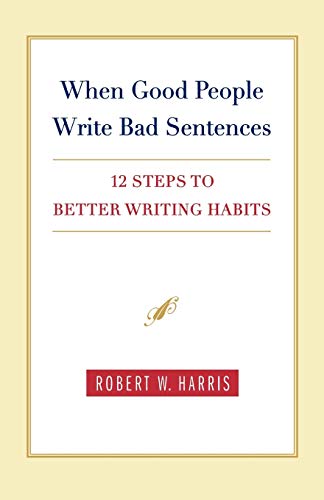
When Good People Write Bad Sentences
12 Steps to Better Writing Habits
By Robert W. HarrisSt. Martin's Press
Copyright © 2003 Robert W. Harris
All rights reserved.
ISBN: 978-0-312-32804-7All rights reserved.
Contents
TITLE PAGE,
COPYRIGHT NOTICE,
ACKNOWLEDGMENTS,
THE TWELVE STEPS TO VERBAL ENLIGHTENMENT,
INTRODUCTION,
STEP 1. Accept the Fact That Bad Writing Happens (by Overcoming Denial),
STEP 2. Admit You've Willingly Made Writing Mistakes (by Overcoming Pride),
STEP 3. Believe That Standard English Can Heal You (by Overcoming Suspicion),
STEP 4. Stop Writing Weak Sentences (by Overcoming Insecurity),
STEP 5. Stop Writing Formal Sentences (by Overcoming Worry),
STEP 6. Stop Writing Overweight Sentences (by Overcoming Shame),
STEP 7. Stop Writing Unclear Sentences (by Overcoming Indifference),
STEP 8. Stop Writing Careless Sentences (by Overcoming Regret),
STEP 9. Stop Writing Unpersuasive Sentences (by Overcoming Doubt),
STEP 10. Stop Writing Incongruous Sentences (by Overcoming Anger),
STEP 11. Stop Writing Unstructured Sentences (by Overcoming Rebelliousness),
STEP 12. Stop Writing Unsightly Sentences (by Overcoming Stubbornness),
NOTES,
AFTERWORD,
RECOVERING MALESCRIBE'S BILL OF RIGHTS,
INDEX,
ABOUT THE AUTHOR,
COPYRIGHT,
CHAPTER 1
STEP 1
ACCEPT THE FACT THAT BAD WRITING HAPPENS
(by Overcoming Denial)
Janet H., Fred S., and Pat C. are three happy individuals. Janet's a nuclear engineer who enjoys Scrabble, Italian cooking, and walks on the beach. Fred teaches high school history and spends his spare time restoring an old Chevy pickup and watching C-SPAN. And Pat's a twenty-something executive assistant with a desire to travel and a knack for origami. They're just three hard-working people with different backgrounds and different interests. But until recently they had something in common: they all suffered from malescribism, an uncontrollable urge to write badly. It was apparent to everyone around them, but they didn't have a clue.
Janet Expected Others to Be Good Readers
"Oh, I might omit a comma now and then," Janet often would say. "But it's not a problem." Janet was a nice person and a valued employee, but her writing was sloppy. As with most intuitive punctuators, she was well-intentioned in her writing but careless with the details. "They'll know what I mean," she said whenever someone would point out a missing comma or misplaced apostrophe.
But her readers didn't always know what she meant. By relying on her own quirky punctuation guidelines, Janet was unwittingly confusing her readers. It was often a challenge to figure out what she was trying to say. Said one coworker, "When it came from Janet, you just knew you would be doing a lot of rereading to understand what she meant."
Janet felt that good reading could make up for bad writing. But was it really fair to expect others to clean up her mess?
Fred Tried to Fit In
"Look, I'm just a social misspeller." That's what Fred had to say when asked if he might need to pay a little more attention to his writing. His attitude was that if everyone spells poorly, why worry about it? He didn't want to be seen as an intellectual snob or a stickler for details. As with all rule-bending justifiers, Fred tried to hide among other offenders.
"I'm no different from anyone else," he would say. He would even make jokes to avoid dealing directly with his problem. "If I don't know how to spell a word, how can I look it up?" he often would quip. Fred's colleagues would just shake their heads in frustration.
Fred thought "close is good enough" was the best guideline when it came to spelling. But is it?
Pat Felt Restricted by Rules
"Hey, the syntax I use is my own D ----- business!" That was Pat's response whenever anyone would question her arrangement of words. To her, writing was all about feelings and individuality. "I'm trying to communicate in my own voice, not please a bunch of picky readers," she would explain impatiently.
Pat was convinced that the accepted rules of writing were designed solely to stifle her creativity. But by exercising her "freedom" of expression, she was creating problems for others. Like most syntax abusers, she continually confused and frustrated her readers. And the impact was felt at home as well. "It wasn't so bad when we got married," said her husband, "but it seemed to get worse as time went by."
Pat thought that her readers would be so involved with her ideas that they would overlook the way she arranged words. But would they?
* * *
As you can see, addiction to bad writing can manifest itself in many ways. It can cloud judgment. It can hurt relationships. It can lead to anxiety, guilt, self-loathing, and, yes, even malaise. And the central theme is always denial. Oh, our three friends saw the problem in others but not in themselves. They convinced themselves there was no cause for concern. They couldn't see the damage their writing was doing. And the worse their writing got, the better their rationalizations became.
Fortunately, Janet, Fred, and Pat are now in recovery. As survivors of malescribism, they now see each day as an opportunity to write clear, correct, well-organized prose. How did they do it? How did they pull themselves up from the depths of verbal suffering and despair? They did it by admitting that they had a problem and that the problem had become unmanageable by their own efforts. With determination, they each learned and embraced Standard English, followed the twelve-step recovery program, and ultimately regained control of their lives.
What about you, friend? Do you think that you, or someone you know, might suffer from malescribism? Do you know enough about the disorder to come to an informed decision? You've probably got lots of questions, so let's learn a little more about this all-too-common affliction.
Understanding the Problem
"What is malescribism"?
Malescribism is the tendency to write badly. It is a set of dysfunctional responses to the demands of communicating in print. Instead of carefully and thoughtfully conveying a clear, confident message, malescribes string words together in an intuitive way, disregarding many of the accepted conventions of grammar, syntax, and style.
In the past, we thought that bad writing was simply the result of making individual mistakes, such as misspelling a word or dangling a participle. Malescribes were seen as "weak" or lacking in willpower. They simply weren't trying hard enough.
But today, we have a better understanding of the problem. We now know that the tendency to write badly is a human condition, and its seed is in all of us. Individual sins of omission (such as leaving out a needed comma) or commission (such as pointless redundancy) are merely reflections of that condition. For some people the disorder is mild, creating only minor communication problems. But for others it can be a life-draining malady.
The Roots of Bad Writing
"Why does bad-writing happen?"
Bad writing has to have a cause. Is it poor teaching? Dysfunctional family experiences? Unresolved psychosexual tensions? Or is it genetic? Sure, it's all of these, and we'll explore the roots of malescribism in detail during the course of the twelve steps. Regardless of the cause, the effects of the affliction can be...
„Über diesen Titel“ kann sich auf eine andere Ausgabe dieses Titels beziehen.
Suchergebnisse für When Good People Write Bad Sentences: 12 Steps to Better...

Beispielbild für diese ISBN
When Good People Write Bad Sentences: 12 Steps to Better Writing Habits
Anbieter: World of Books (was SecondSale), Montgomery, IL, USA
Verkäuferbewertung 5 von 5 Sternen

Zustand: Good. Item in good condition. Textbooks may not include supplemental items i.e. CDs, access codes etc. Artikel-Nr. 00093662971
Gebraucht kaufen
EUR 4,19
Versand gratis
Versand innerhalb von USA
Versand innerhalb von USA
Anzahl: 1 verfügbar
Beispielbild für diese ISBN
When Good People Write Bad Sentences: 12 Steps to Better Writing Habits
Anbieter: World of Books (was SecondSale), Montgomery, IL, USA
Verkäuferbewertung 5 von 5 Sternen
Zustand: Very Good. Item in very good condition! Textbooks may not include supplemental items i.e. CDs, access codes etc. Artikel-Nr. 00096689820
Gebraucht kaufen
EUR 4,19
Versand gratis
Versand innerhalb von USA
Versand innerhalb von USA
Anzahl: 2 verfügbar
Beispielbild für diese ISBN
When Good People Write Bad Sentences: 12 Steps to Better Writing Habits
Verlag:
St. Martin's Griffin (edition New title), 2004
ISBN 10: 0312328044
ISBN 13: 9780312328047
Gebraucht
Paperback
Anbieter: BooksRun, Philadelphia, PA, USA
Verkäuferbewertung 5 von 5 Sternen
Paperback. Zustand: Very Good. New title. It's a well-cared-for item that has seen limited use. The item may show minor signs of wear. All the text is legible, with all pages included. It may have slight markings and/or highlighting. Artikel-Nr. 0312328044-11-18
Gebraucht kaufen
EUR 4,29
Versand gratis
Versand innerhalb von USA
Versand innerhalb von USA
Anzahl: 1 verfügbar
Beispielbild für diese ISBN
When Good People Write Bad Sentences: 12 Steps to Better Writing Habits
Anbieter: ThriftBooks-Atlanta, AUSTELL, GA, USA
Verkäuferbewertung 5 von 5 Sternen
Paperback. Zustand: As New. No Jacket. Pages are clean and are not marred by notes or folds of any kind. ~ ThriftBooks: Read More, Spend Less. Artikel-Nr. G0312328044I2N00
Gebraucht kaufen
EUR 5,86
Versand gratis
Versand innerhalb von USA
Versand innerhalb von USA
Anzahl: 1 verfügbar
Beispielbild für diese ISBN
When Good People Write Bad Sentences: 12 Steps to Better Writing Habits
Anbieter: Wonder Book, Frederick, MD, USA
Verkäuferbewertung 5 von 5 Sternen
Zustand: Very Good. Very Good condition. A copy that may have a few cosmetic defects. May also contain light spine creasing or a few markings such as an owner's name, short gifter's inscription or light stamp. Artikel-Nr. K12B-03197
Gebraucht kaufen
EUR 6,27
Versand gratis
Versand innerhalb von USA
Versand innerhalb von USA
Anzahl: 2 verfügbar
Beispielbild für diese ISBN
When Good People Write Bad Sentences : 12 Steps to Better Writing Habits
Anbieter: Better World Books, Mishawaka, IN, USA
Verkäuferbewertung 5 von 5 Sternen
Zustand: Good. Pages intact with minimal writing/highlighting. The binding may be loose and creased. Dust jackets/supplements are not included. Stock photo provided. Product includes identifying sticker. Better World Books: Buy Books. Do Good. Artikel-Nr. GRP73091066
Gebraucht kaufen
EUR 6,41
Versand gratis
Versand innerhalb von USA
Versand innerhalb von USA
Anzahl: 2 verfügbar