
Verwandte Artikel zu WE JUST WANT TO LIVE HERE: A Palestinian Teenager,...
WE JUST WANT TO LIVE HERE: A Palestinian Teenager, an Israeli Teenager, an Unlikely Friendship - Softcover
Inhaltsangabe
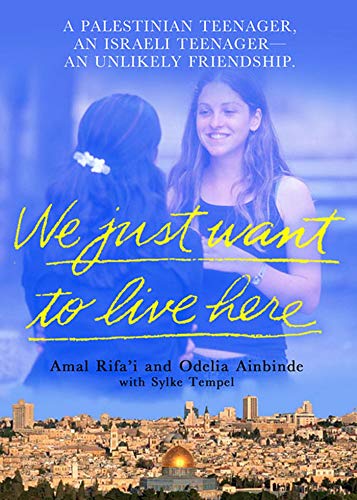
Palestinian Amal Rifa'i and Israeli Odelia Ainbinder are two teenage girls who live in the same city, yet worlds apart. They met on a student exchange program to Switzerland. Weeks after they returned, the latest, violent Intifada broke out in the fall of 2000.
But two years later, Middle East correspondent Sylke Tempel encouraged Amal and Odelia to develop their friendship by facilitating an exchange of their deepest feelings through letters. In their letters, Amal and Odelia discuss the Intifada, their families, traditions, suicide bombers, and military service. They write frankly of their anger, frustrations, and fear, but also of their hopes and dreams for a brighter future.
Together, Amal and Odelia give us a renewed sense of hope for peace in the Middle East, in We Just Want To Live Here.
Die Inhaltsangabe kann sich auf eine andere Ausgabe dieses Titels beziehen.
Über die Autorin bzw. den Autor
Amal Rifa'i and Odelia Ainbinder with Sylke Tempel
Von der hinteren Coverseite
"Profoundly moving....The conflict between Jews and Arabs has been described in countless books and argued in unending polemics, but here, in the letters between these two eighteen-year-old women, an Arab and a Jew, is the heartbreaking essence of the quarrel.... In these letters (an idea brilliantly conceived and carried through by Sylke Tempel) Amal and Odelia educate each other..... This is the book for anyone who wants to feel and understand the emotions on both sides. It will become a classic."
-Arthur Hertzberg, author of A Jew in America: My Life and a People's Struggle for Identity
Auszug. © Genehmigter Nachdruck. Alle Rechte vorbehalten.
We Just Want to Live Here
A Palestinian Teenager, An Israeli Teenager — Unlikely Friendship
By Amal Rifa'i, Odelia Ainbinder, Sylke TempelSt. Martin's Press
Copyright © 2003 Amal Rifa'i and Odelia Ainbinder with Sylke Tempel
All rights reserved.
ISBN: 978-0-312-31894-9All rights reserved.
Contents
Introduction,
1. Talking About Myself, Thinking About the Other,
2. Meeting the Other in Switzerland,
3. Intifada,
4. Travel,
5. Discussion Between Amal and Odelia,
6. Jerusalem,
7. School,
8. The Army,
9. How I Became What I Am,
10. Afterword,
Chronology: Middle East Conflict,
Maps,
Glossary,
Acknowledgments,
CHAPTER 1
TALKING ABOUT MYSELF, THINKING ABOUT THE OTHER
Odelia
Jewish New Year, Kfar Saba, September 7, 2002
Dear Amal,
I am sitting in my new room in Kfar Saba, a little town located some ten kilometers northeast of Tel Aviv. It's in the middle of the night and I am very tired but I am also very happy because this is the beginning of my new life. I finished school. I moved out of my parents' home in Jerusalem where I grew up and I am beginning a year of "community service." This is a voluntary year of doing social work before being drafted for the obligatory army service. My choice was to do community service in my youth movement Shomer HaZair. This is a socialist-Zionist youth movement that has existed in Israel and Europe and all over the world for ninety years already. Like most of these youth movements, it really doesn't play that big a role anymore in present-day Israel because youth movements are not cool, I suppose. You have to be an idealist to work for a youth movement. You have to think about your life, and the situation we are in. Most kids don't want to do that. They want instant answers. Like some-body who prefers to heat something up in a microwave instead of taking the effort to cook. Our youth movement is in bad shape. We haven't gotten a lot of kids who come to our activities; we have to work really hard on recruiting more.
This year I am going to be a kommunar, which means that I am in charge of a facility in Petach Tikva together with two other girls and a guy. We are responsible for the activities there and for the kids who look at us like "big bosses," turning to us when there's a problem. I am really excited that I chose to do that. I know it might sound somewhat strange and lots of people don't believe in it because it doesn't seem to be very realistic, but I believe in the chance that we can make the world a better place. In my youth movement, we want to teach the kids we are working with values like tolerance and freedom of thought. We want to motivate them not to look for easy answers.
Shomer HaZair owns an apartment in Kfar Saba for the people doing community service; fifteen of us will live on a commune. Of course, with a unique living situation we will have troubles and problems from time to time, but we will overcome them. We have already had long and often very intense discussions. It is so extraordinary that I am experiencing a socialist lifestyle, as in earlier days. During this year we have a shared economy and are supposed to share everything.
My long-term ambition is to become an actress. Actually, I am already an actress. I played leading roles in some performances staged by our school, but I want to become a professional actress. And when I say I am an actress, I mean one is born with the calling, in my opinion at least. That has nothing to do with what I am doing right now. My dream is just to be on stage every night, even if I might only get the minimum wage. I don't care. It is also my goal to become a well-known actress who reaches a wide audience.
What I wonder: Do you, Amal, have all of the opportunities I have or do you find it more difficult, because you are kind of a stranger in your own country?
Thinking about future plans involves the simple question: Do I have a future in this country? Or what is the future of this country? And I can't think of living somewhere else, at least not forever. Israel is my home. Which once again makes me think of you and how you feel about living in a place where you, at the same time, might feel so out of place in a country called Israel under a flag with the Star of David on it, which is a totally foreign symbol to you. I, of course, feel at home here. We practice my religion (I am Jewish). Hebrew is my language, and everybody around me speaks Hebrew. Would you feel better being in another place, or if you were living in a Palestinian state? I guess you would. How do you feel about this place? How would I feel if somebody took over Israel and told me: "OK, from now on this is a Christian country, we have changed the flag, our national symbol is the cross and the official language is — let's say — English." I guess that's what the Palestinians might feel. I wonder if you would prefer to stay here under such circumstances. Suppose the situation goes on forever — and I feel it might go on for some more years — perhaps you might go somewhere else?
I would like to go all over the world and live in other places, such as London. I always would come back and I always would feel at home here. Do you feel at home or do you feel a little bit out of place? On the one hand it is, or it was, your land and your home, at least in my opinion. But it is definitely also my country, a country that has changed completely for you. We have a language spoken that is not yours and a flag foreign to you, even though you live only five minutes from where I grew up. Could you distance yourself from everything Israeli and ask: "Am I only a Palestinian?" But you would still live only five minutes from where I, an Israeli, grew up.
For the moment, I want to make this the best year of my life. I would love to conclude it with great results by recruiting lots of new kids into the movement to make it stronger, to learn how we can live together in a socialist way as much as possible. Then, to finish with my army service and hopefully to do something meaningful there, like participate in an educational program. There are language-training programs for Russianspeaking soldiers, for example. And then to travel as all Israelis do after the army. I would like to go to South America, come back to Israel, and try to get into one of the best acting schools, preferably in London or New York. New York sounds a bit too scary, too big, too American. I only "know" it from the movies and therefore I think of New York as a Hollywood cliché right out of Batman — a crime-ridden, capitalistic "Gotham City." But London sounds wonderful. I have been there twice already, alone, and it's really a great place. If neither school works out, I will just go to Tel Aviv and hopefully keep on living my life without having to think about whether I should take a stupid bus or not because I could die in a suicide attack.
I would love to live in a world where I would not have to answer my little six-year-old brother's questions about this political situation. I don't have the slightest clue how to answer him when he asks me, "Are all Arabs bad?" I tell him, "Well, Oded, our parents sent you to a mixed Arab-Jewish kindergarten, and now to a mixed Arab-Jewish school. Do you think that all the Arabs in your class are bad?" Thank God, my mother has to put up with my brother's questions most of the time. If I have kids one day — and I suppose I will, and I suppose the situation will not have...
„Über diesen Titel“ kann sich auf eine andere Ausgabe dieses Titels beziehen.
Suchergebnisse für WE JUST WANT TO LIVE HERE: A Palestinian Teenager,...

Beispielbild für diese ISBN
We Just Want to Live Here: A Palestinian Teenager, an Israli Teenager -- an Unlikely Friendship
Anbieter: World of Books (was SecondSale), Montgomery, IL, USA
Verkäuferbewertung 5 von 5 Sternen

Zustand: Good. Item in good condition. Textbooks may not include supplemental items i.e. CDs, access codes etc. Artikel-Nr. 00063873285
Gebraucht kaufen
EUR 4,16
Versand gratis
Versand innerhalb von USA
Versand innerhalb von USA
Anzahl: 6 verfügbar
Beispielbild für diese ISBN
We Just Want to Live Here: A Palestinian Teenager, an Israli Teenager -- an Unlikely Friendship
Anbieter: World of Books (was SecondSale), Montgomery, IL, USA
Verkäuferbewertung 5 von 5 Sternen
Zustand: Very Good. Item in very good condition! Textbooks may not include supplemental items i.e. CDs, access codes etc. Artikel-Nr. 00107261345
Gebraucht kaufen
EUR 4,16
Versand gratis
Versand innerhalb von USA
Versand innerhalb von USA
Anzahl: 2 verfügbar
Beispielbild für diese ISBN
We Just Want to Live Here: A Palestinian Teenager, an Israli Teenager -- an Unlikely Friendship
ISBN 10: 0312318944
ISBN 13: 9780312318949
Gebraucht
Paperback
Anbieter: BooksRun, Philadelphia, PA, USA
Verkäuferbewertung 5 von 5 Sternen
Paperback. Zustand: Very Good. First U. S. Edition First Printing. It's a well-cared-for item that has seen limited use. The item may show minor signs of wear. All the text is legible, with all pages included. It may have slight markings and/or highlighting. Artikel-Nr. 0312318944-8-1
Gebraucht kaufen
EUR 5,43
Versand gratis
Versand innerhalb von USA
Versand innerhalb von USA
Anzahl: 1 verfügbar
Beispielbild für diese ISBN
We Just Want to Live Here : A Palestinian Teenager, an Israeli Teenager, an Unlikely Friendship
Anbieter: Better World Books, Mishawaka, IN, USA
Verkäuferbewertung 5 von 5 Sternen
Zustand: Very Good. 1 Edition. Pages intact with possible writing/highlighting. Binding strong with minor wear. Dust jackets/supplements may not be included. Stock photo provided. Product includes identifying sticker. Better World Books: Buy Books. Do Good. Artikel-Nr. 13333941-6
Gebraucht kaufen
EUR 6,04
Versand gratis
Versand innerhalb von USA
Versand innerhalb von USA
Anzahl: 1 verfügbar
Beispielbild für diese ISBN
We Just Want to Live Here: A Palestinian Teenager, an Israeli Teenager, an Unlikely Friendship
Anbieter: ThriftBooks-Atlanta, AUSTELL, GA, USA
Verkäuferbewertung 5 von 5 Sternen
Paperback. Zustand: Good. No Jacket. Pages can have notes/highlighting. Spine may show signs of wear. ~ ThriftBooks: Read More, Spend Less. Artikel-Nr. G0312318944I3N00
Gebraucht kaufen
EUR 6,81
Versand gratis
Versand innerhalb von USA
Versand innerhalb von USA
Anzahl: 1 verfügbar
Beispielbild für diese ISBN
We Just Want to Live Here: A Palestinian Teenager, an Israeli Teenager, an Unlikely Friendship
Anbieter: WorldofBooks, Goring-By-Sea, WS, Vereinigtes Königreich
Verkäuferbewertung 5 von 5 Sternen
Paperback. Zustand: Very Good. The book has been read, but is in excellent condition. Pages are intact and not marred by notes or highlighting. The spine remains undamaged. Artikel-Nr. GOR008273146
Gebraucht kaufen
EUR 6,99
EUR 6,53 Versand
Versand von Vereinigtes Königreich nach USA
Versand von Vereinigtes Königreich nach USA
Anzahl: 1 verfügbar
Beispielbild für diese ISBN
We Just Want to Live Here: A Palestinian Teenager, an Israli Teenager -- an Unlikely Friendship
Anbieter: Ria Christie Collections, Uxbridge, Vereinigtes Königreich
Verkäuferbewertung 5 von 5 Sternen
Zustand: New. In English. Artikel-Nr. ria9780312318949_new
Neu kaufen
EUR 14,07
EUR 10,93 Versand
Versand von Vereinigtes Königreich nach USA
Versand von Vereinigtes Königreich nach USA
Anzahl: Mehr als 20 verfügbar
Foto des Verkäufers
We Just Want To Live Here: A Palestinian Teenager, An Israli Teenager -- An Unlikely Friendship
Anbieter: SZ Global, Toronto, ON, Kanada
Verkäuferbewertung 5 von 5 Sternen
Paperback. Zustand: Collectible-Very Good. Palestinian Amal Rifa'i and Israeli Odelia Ainbinder are two teenage girls who live in the same city, yet worlds apart. They met on a student exchange program to Switzerland. Weeks after they returned, the latest, violent Intifada broke out in the fall of 2000.But two years later, Middle East correspondent Sylke Tempel encouraged Amal and Odelia to develop their friendship by facilitating an exchange of their deepest feelings through letters. In their letters, Amal and Odelia discuss the Intifada, their families, traditions, suicide bombers, and military service. They write frankly of their anger, frustrations, and fear, but also of their hopes and dreams for a brighter future.Together, Amal and Odelia give us a renewed sense of hope for peace in the Middle East. Amal Rifa'i, an eighteen-year-old Palestinian, plans to study special education in an Israeli college.Odelia Ainbinder, an eighteen-year-old Israeli, has started a year of community service with a socialist-Zionist movement. She will soon begin her mandatory military service.Sylke Tempel, is a Middle East correspondent reporting from Israel. She teaches at the Berlin branch of Stanford University Palestinian Amal Rifa'i and Israeli Odelia Ainbinder are two teenage girls who live in the same city yet are worlds apart. They met on a student-exchange program to Switzerland. Weeks after they returned, the latest violent Intifada broke out in the fall of 2000. But two years later, Middle East correspondent Sylke Temple encouraged Amal and Odelia to develop their friendship by facilitating an exchange of their deepest feelings through letters. In their letters, Amal and Odelia discuss the Intifada, their families, traditions, suicide bombers, and military service. They write frankly of their anger, frustration, and fear but also of their hopes and dreams for a brighter future.Together, Amal and Odelia give us a renewed sense of hope for peace in the Middle East. 'The letters exchanged between Amal and Odelia are profoundly moving. The conflict between Jews and Arabs has been described in countless books and argued in unending polemics, but here, in the letters between these two eighteen-year-old women, an Arab and a Jew, is the heartbreaking essence of the quarrel. It is the battle of two rights; the Palestinians who have been made into semi-strangers in their homeland and the Jews who have no other place which is central to their history, and which is always ready to receive Jews in flights from persecution. In these letters (an idea brilliantly conceived and carried through by Sylke Tempel) Amal and Odelia educate each other. The conclude together that their two peoples cannot continue to make war. They must agree that the are destined, perhaps even condemned, to live together in the land, as first in two separate states and ultimately, in growing comradeship. This is the book for anyone who wants to feel and understand the emotions on both sides. It will become a classic.'?Arthur Hertzberg, author of A Jew in America: My Life and a People's Struggle for Identity 'The openness of these young women, and their families, made it possible for me to delve more deeply into different world views than had ever been possible before.'?Sylke Tempel, from her Introduction to the book 'The letters exchanged between Amal and Odelia are profoundly moving. The conflict between Jews and Arabs has been described in countless books and argued in unending polemics, but here, in the letters between these two eighteen-year-old women, an Arab and a Jew, is the heartbreaking essence of the quarrel. It is the battle of two rights; the Palestinians who have been made into semi-strangers in their homeland and the Jews who have no other place which is central to their history, and which is always ready to receive Jews in flights from persecution. In these letters (an idea brilliantly conceived and carried through by Sylke Tempel) Amal and Odelia educate each other. The conclude together that their t. Artikel-Nr. 9780312318949
Gebraucht kaufen
EUR 27,93
EUR 32,44 Versand
Versand von Kanada nach USA
Versand von Kanada nach USA
Anzahl: 7 verfügbar