
Verwandte Artikel zu Love Signals: A Practical Field Guide To The Body Language...
Inhaltsangabe
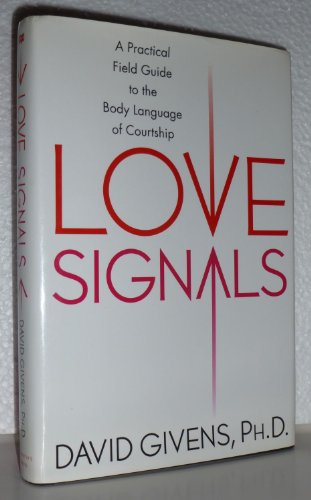
Identifying five phases of courtship including attracting attention, recognition, conversation, touching, and lovemaking, an anthropological guide explores the ways in which non-verbal communication impacts relationships while suggesting how to use body language strategically. 25,000 first printing.
Die Inhaltsangabe kann sich auf eine andere Ausgabe dieses Titels beziehen.
Über die Autorin bzw. den Autor
David Givens began studying body language at the University of Washington in Seattle. He served as Resident Anthropologist and Director of information services and programs at the American Anthropological Association in Washington, D.C. for more than a decade. He is currently Director of the Center for Non-Verbal Studies in Spokane, Washington. He teaches in the Department of Communication Arts at Gonzaga University. He offers seminars on nonverbal communication to diverse audiences, including lawyers, judges, social workers, salespeople, physicians. He works with law enforcement agencies and the U.S. Intelligence community.
Aus dem Klappentext
Praise for Dr. Givens' on-line Nonverbal Dictionary:
"A masterful piece of work."
- American Library Association
"Highly recommended."
- New Scientist
"It's contents will enlighten you."
- Discover Magazine's "Pick of the Web"
"Site of the Day."
- Good Housekeeping
"Tells all you need to know--and much, much, much more."
- San Francisco Examiner "Website of the Week"
"Very interesting reading."
- Houston Chronicle
"A masterful piece of work."
- American Library Association
"Highly recommended."
- New Scientist
"It's contents will enlighten you."
- Discover Magazine's "Pick of the Web"
"Site of the Day."
- Good Housekeeping
"Tells all you need to know--and much, much, much more."
- San Francisco Examiner "Website of the Week"
"Very interesting reading."
- Houston Chronicle
Auszug. © Genehmigter Nachdruck. Alle Rechte vorbehalten.
Love Signals
1. THE FIVE PHASES OF COURTSHIP
Once I’m done with kindergarten, I’m going to find me a wife.
—TOM(AGE 5 )
It’s better to be looked over than overlooked.
—MAE WEST
LOVE SIGNALS IS a practical field guide to the body language of courtship. It explores the nonverbal signs, signals, and cues human beings exchange to attract and keep their mates. As a medium of communication, love’s silent language predates speech by millions of years. Indeed, humans wooed in a nonverbal idiom well before they could speak. And today, despite the world’s estimated six thousand spoken languages, we still express emotions and feelings largely apart from words.
The first scientific study of courtship in our species, Homo sapiens, took place in the 1960s. Using a camera with mirror lenses to film couples without disturbing them, biologist Irenäus Eibl-Eibesfeldt of Germany’s Max Planck Institute documented many of the common flirting rituals seen around the world. A student of Konrad Lorenz, Eibl-Eibesfeldt wrote his doctorate, “Breeding Biology of the Common Toad,” before turning his lenses on human beings. From research in Brazil, Samoa, Paris, and other exotic field sites, Eibl-Eibesfeldt discovered a universal vocabulary of nonverbal signs used in seduction, flirtation, and courtship.
Since the 1960s, thousands of research projects in archaeology, biology, anthropology, linguistics, primatology, psychology, and psychiatry have been completed, establishing a virtual dictionary of courting cues. In the 1990s, we learned a great deal more about how the body speaks its mind apart from words. Progress made in neuroscience during the 1990–2000 Decade of the Brain and afterward has provided a clearer picture of what the unspoken signs in courtship’s lexicon mean.
We now know more about how the brain processes nonverbal cues. Just as the brain’s newer speech centers, for example, Broca’s and Wernicke’s areas, control language, older brain areas oversee communication apart from words. Specialized circuits of the central nervous system send, receive, and process speechless signs apart from our conscious awareness.
We now know more about how the brain processes nonverbal cues.
For the 90 percent of us who are right-handed, areas of the right-brain cerebral hemisphere process nonverbal cues. Our right brain is more holistic, visuospatial, and intuitive than our left brain, which is more verbal, analytic, and rational than the right. A section in the middle of our brain called the cingulate gyrus produces nonverbal signs of emotion. We detect facial cues and hand gestures through dedicated layers of cerebral cortex located at the sides of our brain. Thanks to brain-and-behavior research, body language has come of age in the twenty-first century as a science to help us understand the hidden meanings of attraction, courtship, and love.
The Nonverbal Language of Love
Our unspoken language of love is universal. The postures, gestures, and facial cues of attraction are everywhere the same, in all societies and cultures. A case in point is the en face gaze. En face is an intimate form of eye-to-eye contact between mothers and newborns. An affectionate mother moves her face to within inches of her baby’s face and positions her eyes in parallel alignment with her baby’s eyes for optimal eye contact. Her en face gaze completely captivates the newborn, stops its crying, and nurtures a strong mother-child bond. Pediatricians view en face communication as a sort of “mating dance.” Mother and child gaze in seeming rapture, synchronize their body movements, and imitate each other’s facial expressions to enhance compatibility and build rapport.
En face is a worldwide courting ritual as well. Affectionate couples move their faces within inches of each other’s face, lock eyes, and gaze deeply to show their love. Figuratively, they become each other’s baby. A potent love signal, en face is as romantic and compelling in Alabama as it is in Zululand.
Since the body language of courtship is universal, you needn’t speak the native tongue to attract a mate. One of the most exotic courtships I know of, between a tall, white, middle-aged New Jersey man and a short, teenage, African Pygmy, took place entirely apart from speaking. Before their engagement, neither she nor he uttered a mutually intelligible word. Gestures accomplished what conversation could not.
If the language of love is universal, you might wonder why we need a field guide to decipher its cues. One reason is that people postpone marriage in favor of careers today. As a result, they have problems attracting partners who are older, wiser, busier—and choosier. Thirty-somethings are less automatically smitten than they were as youths in high school. Another reason is that divorced men and women feel out of practice. They have trouble decoding the love signals they received earlier in their teens and twenties. Many, who avoided flirting after marriage, find it hard to shift gears and flirt again. In large metropolitan areas like Los Angeles, Chicago, and New York, thousands of eligible partners await the attention of complete strangers. In the past—in rural areas—people were more likely to court familiar folk who were known to be “safe.” Unacquainted couples often had matchmakers to ease them through the psychological barrier of stranger anxiety.
The dating scene is different today. Urban singles find themselves surrounded by strangers. Some use video dating services, go on cruises, run personal ads in newspapers, or search the Internet. Many find that interacting with people who are unfamiliar can be uncomfortable, unpredictable, even unsafe. Is that woman sincere? Is she telling the truth? Can I trust this man? Is he genuine? Is he dangerous? What clues should I look for?
Answers to these questions lie not in words, which can be deceptively manipulated, but in more candid, unedited signs from our faces, bodies, and hands. Silent messages emitted from shoulder shrugs, eyeblinks, aftershaves, eyebrows, tattoos, and toe cleavage fill the nonverbal landscape Love Signals explores. Used as a field guide to the natural history of courtship, Love Signals shows how to read beneath and between a partner’s spoken lines.
Silent messages emitted from shoulder shrugs, eyeblinks, aftershaves, eyebrows, tattoos, and toe cleavage fill the nonverbal landscape Love Signals explores.
As you will see, the body’s unspoken script reveals volumes about hidden agendas, feelings, and fears. Estimates of what percentage of our total communication is nonverbal range from 60 to 93 percent. In courtship, the percentage of emotional communication that is nonverbal exceeds 99 percent. When it comes to emotions, instead of verbalizing how we feel, our bodies do the talking.
What Do Hands Say?
A case in point is hands, which attract special notice in courtship. We find fingers, palms, and wrists incredibly appealing to look at. Dedicated centers in our temporal lobes, the cerebral lobes located just above our ears on either side of the brain, respond exclusively to hand shapes (Kandel, 1991). Both men and women are unconsciously alert to the physical appearance of each other’s hands and digits as well as to their expressive shapes and gestures.
Showing an upraised open palm is universally friendly....
„Über diesen Titel“ kann sich auf eine andere Ausgabe dieses Titels beziehen.
Suchergebnisse für Love Signals: A Practical Field Guide To The Body Language...

Beispielbild für diese ISBN
Love Signals: A Practical Field Guide to the Body Language of Courtship
Anbieter: World of Books (was SecondSale), Montgomery, IL, USA
Verkäuferbewertung 5 von 5 Sternen

Zustand: Good. Item in good condition. Textbooks may not include supplemental items i.e. CDs, access codes etc. Artikel-Nr. 00097717145
Gebraucht kaufen
EUR 7,71
Versand gratis
Versand innerhalb von USA
Versand innerhalb von USA
Anzahl: 1 verfügbar
Beispielbild für diese ISBN
Love Signals : A Practical Field Guide to the Body Language of Courtship
Anbieter: Better World Books, Mishawaka, IN, USA
Verkäuferbewertung 5 von 5 Sternen
Zustand: Good. Former library copy. Pages intact with minimal writing/highlighting. The binding may be loose and creased. Dust jackets/supplements are not included. Includes library markings. Stock photo provided. Product includes identifying sticker. Better World Books: Buy Books. Do Good. Artikel-Nr. 2263839-75
Gebraucht kaufen
EUR 13,72
Versand gratis
Versand innerhalb von USA
Versand innerhalb von USA
Anzahl: 1 verfügbar
Foto des Verkäufers
Love Signals: A Practical Field Guide to the Body Language of Courtship
Verlag:
St. Martin's Press, 2005
ISBN 10: 0312315058
ISBN 13: 9780312315054
Gebraucht
Hardcover
Erstausgabe
Anbieter: Sekkes Consultants, North Dighton, MA, USA
Verkäuferbewertung 5 von 5 Sternen
Hardcover. Zustand: Fine. Dust Jacket Included. 1st Edition. A world renowned anthropologist explores the non-verbal signs, signals, and cues human beings exchange to attract and keep their mates. Looks new, unread with just light top of the jacket fraying only. Size: 6" - 8¾" First Printing. book. Artikel-Nr. 272549
Gebraucht kaufen
EUR 19,55
Versand gratis
Versand innerhalb von USA
Versand innerhalb von USA
Anzahl: 1 verfügbar