
Verwandte Artikel zu Briarpatch
Inhaltsangabe
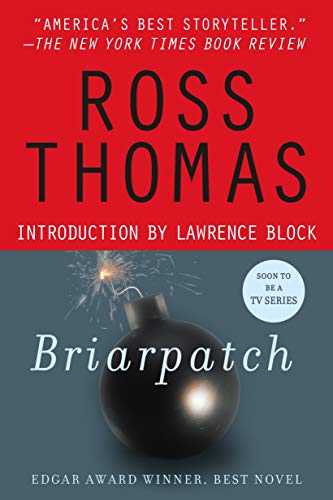
"America's best storyteller." -The New York Times Book Review
From Edgar Award-winning author Ross Thomas comes Briarpatch, a thrilling mystery of one man's personal mission to find justice for his family. Now, the basis for the USA Network television series executive produced by Sam Esmail, creator of Mr. Robot, starring Rosario Dawson.
A long-distance call from his small Texas hometown on his birthday gives Benjamin Dill the news that his sister Felicity-born on the same day exactly ten years apart-has died in a car bomb explosion. She was a homicide detective who had perhaps made one enemy too many over the course of her career.
Unwilling to let local law enforcement handle the investigation, Dill arrives in town that night to begin his dogged search for his sister's killer. What he finds is no surprise to him as he begins to unravel town secrets, because Benjamin Dill is never surprised at what awful things people will do.
Featuring an Introduction by New York Times bestselling author Lawrence Block
Edgar Award Winner for Best Novel
Die Inhaltsangabe kann sich auf eine andere Ausgabe dieses Titels beziehen.
Über die Autorin bzw. den Autor
ROSS THOMAS is the author of over twenty-five critically acclaimed novels. His debut, The Cold War Swap, was written in under six weeks and won an Edgar Award for Best First Novel, and Briarpatch won an Edgar Award for Best Novel. He's also written under the name Oliver Bleeck.
Thomas died in 1995 at the age of 69 in Santa Monica, California.
Auszug. © Genehmigter Nachdruck. Alle Rechte vorbehalten.
Briarpatch
By Ross ThomasSt. Martin's Griffin
Copyright © 2003 Ross ThomasAll right reserved.
ISBN: 9780312290313
CHAPTER 1
The long-distance call from the fifty-three-year-old chief of detectives reached Benjamin Dill three hours later. By then, because of different time zones, it was almost half-past eleven in Washington, D.C. When the phone rang, Dill was still in bed, alone and awake, in his one-bedroom apartment three blocks south of Dupont Circle on N Street. He had awakened at five that morning and discovered he was unable to go back to sleep. At 8:30 A.M. he had called his office and, pleading a summer cold, informed Betty Mae Marker he wouldn’t be in that day, Thursday, and probably not even Friday. Betty Mae Marker had counseled rest, aspirin, and plenty of liquids.
Dill had decided to forsake work that morning, not because he was sick, but because it was his thirty-eighth birthday. For some inexplicable reason he had come to regard thirty-eight as the watershed year in which youth ran down one side, old age the other. He had spent the morning in bed wondering, with only mild curiosity, how he had managed to accomplish so little in his more than three dozen years.
True, he told himself, you did manage to get married once and divorced twice—no mean feat. A year after his ex-wife had slipped quietly out of his life on that rainy June night in 1978, Dill had filed for divorce in the District of Columbia, charging desertion. Apparently convinced that Dill would never do anything right, she had filed in California, charging irreconcilable differences. Neither divorce was contested and both were granted. The two things Dill now remembered best about his former wife were her long and extremely beautiful blond hair and her unforgivable habit of sprinkling sugar on her sliced tomatoes. As for her face, well, it was fading into something of a blur—albeit a heart-shaped one.
During that long morning of reevaluation, which turned out to be both depressing and boring, Dill wisely ignored his financial balance sheet because it was, as usual, ridiculous. He owned no insurance, no stocks or bonds, no vested pension, no real property. His principal assets consisted of $5,123.82 in a non-interest-bearing checking account at the Dupont Circle branch of the Riggs National Bank and a recently paid for 1982 Volkswagen convertible (an unfortunate yellow) that was parked in the apartment building’s basement garage and whose sporty demeanor Dill now found disconcerting. He assumed this new attitude was yet another symptom of galloping maturity.
Dill gave up on his morning of pointless introspection when the long distance call from the fifty-three-year-old chief of detectives began its seventh ring. It was then that he picked up the phone and said hello.
“Mr. Dill?” the voice said. It was a stern voice, even harsh, full of bark and bite, gravel and authority.
“Yes.”
“Have you got a sister named Feticity—Felicity Dill?”
“Why?”
“My name’s Strucker. John Strucker. I’m chief of detectives down here and if your sister’s name is Felicity, she works for me. That’s why I’m calling.”
Dill took a deep breath, let some of it out, and said, “Is she dead or just hurt?”
There was no pause before the answer came—only a long sigh, which was an answer in itself. “She’s dead, Mr. Dill. I’m sorry.”
“Dead.” Dill didn’t make it a question.
“Yes.”
“I see.”
And then, because Dill knew he had to say something else to keep grief away for at least a few more moments, he said, “It’s her birthday.”
“Her birthday,” Strucker said patiently. “Well, I didn’t know that.”
“Mine, too,” Dill said in an almost musing tone. “We have the same birthday. We were born ten years apart, but on the same day—August fourth. Today.”
“Today, huh?” Strucker said, his harsh voice interested, overly reasonable, and almost kind. “Well, I’m sorry.”
“She’s twenty-eight.”
“Twenty-eight.”
“I’m thirty-eight.” There was a long silence until Dill said, “How did—” but broke off to make a noise that could have been either a cough or a sob. “How did it happen?” he said finally.
Again, the chief of detectives sighed. Even over the phone it had a sad and mournful sound. “Car bomb,” Strucker said.
“Car bomb,” Dill said.
“She came out of her house this morning at her regular time, got into her car—one of those all-tin Honda Accords—threw out the clutch, and that’s what activated the bomb—the clutch. They used C4—plastic.”
“They,” Dill said. “Who the hell are they?”
“Well, it might not’ve been a they, Mr. Dill. I just said that. It could’ve been only one guy, but one or a dozen, we’re gonna get who did it. It’s what we do—what we’re good at.”
“How quickly did she—” Dill paused and took a deep breath. “I mean, did she—”
Strucker interrupted to answer the incomplete question. “No, sir, she didn’t. It was instantaneous.”
“I read somewhere that it’s never instantaneous.”
Strucker apparently knew better than to argue with the recently bereaved. “It was quick, Mr. Dill. Very quick. She didn’t suffer.” He paused again, cleared his throat, and said, “We’d like to bury her. I mean the department would, if it’s okay with you.”
“When?”
“Is it all right with you?”
“Yes, it’s all right with me. When?”
“Saturday,” Strucker said. “We’ll have a big turnout from all over. It’s a nice ceremony, real nice, and I’m sure you’ll want to be here so if there’s anything we can do for you, make you a hotel reservation or something like that, well, just let—”
Dill interrupted. “The Hawkins. Is the Hawkins Hotel still in business?”
“Yes, sir, it is.”
“Make me a reservation there, will you?”
“For when?”
“For tonight,” Dill said. “I’ll be there tonight.”
Copyright © 1984 by Ross E. Thomas, Inc. Introduction copyright © 2003 by Lawrence Block.
Continues...
Excerpted from Briarpatch by Ross Thomas Copyright © 2003 by Ross Thomas. Excerpted by permission.
All rights reserved. No part of this excerpt may be reproduced or reprinted without permission in writing from the publisher.
Excerpts are provided by Dial-A-Book Inc. solely for the personal use of visitors to this web site.
„Über diesen Titel“ kann sich auf eine andere Ausgabe dieses Titels beziehen.
Suchergebnisse für Briarpatch

Beispielbild für diese ISBN
Briarpatch
Anbieter: World of Books (was SecondSale), Montgomery, IL, USA
Verkäuferbewertung 5 von 5 Sternen

Paperback. Zustand: Good. "America's best storyteller." --The New York Times Book Review From Edgar Award-winning author Ross Thomas comes Briarpatch, a thrilling mystery of one man's personal mission to find justice for his family. Now, the basis for the USA Network television series executive produced by Sam Esmail, creator of Mr. Robot, starring Rosario Dawson. A long-distance call from his small Texas hometown on his birthday gives Benjamin Dill the news that his sister Felicity--born on the same day exactly ten years apart--has died in a car bomb explosion. She was a homicide detective who had perhaps made one enemy too many over the course of her career. Unwilling to let local law enforcement handle the investigation, Dill arrives in town that night to begin his dogged search for his sister's killer. What he finds is no surprise to him as he begins to unravel town secrets, because Benjamin Dill is never surprised at what awful things people will do. Featuring an Introduction by New York Times bestselling author Lawrence Block Edgar Award Winner for Best Novel. Artikel-Nr. 00105847582
Gebraucht kaufen
EUR 4,05
Versand gratis
Versand innerhalb von USA
Versand innerhalb von USA
Anzahl: 2 verfügbar
Beispielbild für diese ISBN
Briarpatch: A Novel
Anbieter: Wonder Book, Frederick, MD, USA
Verkäuferbewertung 5 von 5 Sternen
Zustand: Good. Good condition. A copy that has been read but remains intact. May contain markings such as bookplates, stamps, limited notes and highlighting, or a few light stains. Bundled media such as CDs, DVDs, floppy disks or access codes may not be included. Artikel-Nr. I02M-02661
Gebraucht kaufen
EUR 6,42
Versand gratis
Versand innerhalb von USA
Versand innerhalb von USA
Anzahl: 1 verfügbar
Beispielbild für diese ISBN
Briarpatch : A Novel
Anbieter: Better World Books: West, Reno, NV, USA
Verkäuferbewertung 5 von 5 Sternen
Zustand: Very Good. Reprint. Pages intact with possible writing/highlighting. Binding strong with minor wear. Dust jackets/supplements may not be included. Stock photo provided. Product includes identifying sticker. Better World Books: Buy Books. Do Good. Artikel-Nr. 8735784-6
Gebraucht kaufen
EUR 6,56
Versand gratis
Versand innerhalb von USA
Versand innerhalb von USA
Anzahl: 1 verfügbar
Beispielbild für diese ISBN
Briarpatch : A Novel
Anbieter: Better World Books, Mishawaka, IN, USA
Verkäuferbewertung 5 von 5 Sternen
Zustand: Good. Reprint. Former library copy. Pages intact with minimal writing/highlighting. The binding may be loose and creased. Dust jackets/supplements are not included. Includes library markings. Stock photo provided. Product includes identifying sticker. Better World Books: Buy Books. Do Good. Artikel-Nr. GRP88144380
Gebraucht kaufen
EUR 6,56
Versand gratis
Versand innerhalb von USA
Versand innerhalb von USA
Anzahl: 1 verfügbar
Beispielbild für diese ISBN
Briarpatch : A Novel
Anbieter: Better World Books, Mishawaka, IN, USA
Verkäuferbewertung 5 von 5 Sternen
Zustand: Good. Reprint. Pages intact with minimal writing/highlighting. The binding may be loose and creased. Dust jackets/supplements are not included. Stock photo provided. Product includes identifying sticker. Better World Books: Buy Books. Do Good. Artikel-Nr. 2263444-6
Gebraucht kaufen
EUR 6,56
Versand gratis
Versand innerhalb von USA
Versand innerhalb von USA
Anzahl: 1 verfügbar
Beispielbild für diese ISBN
Briarpatch
Anbieter: ThriftBooks-Phoenix, Phoenix, AZ, USA
Verkäuferbewertung 5 von 5 Sternen
Paperback. Zustand: Good. No Jacket. Former library book; Pages can have notes/highlighting. Spine may show signs of wear. ~ ThriftBooks: Read More, Spend Less. Artikel-Nr. G0312290314I3N10
Gebraucht kaufen
EUR 6,69
Versand gratis
Versand innerhalb von USA
Versand innerhalb von USA
Anzahl: 1 verfügbar
Beispielbild für diese ISBN
Briarpatch
Anbieter: ThriftBooks-Dallas, Dallas, TX, USA
Verkäuferbewertung 5 von 5 Sternen
Paperback. Zustand: Good. No Jacket. Pages can have notes/highlighting. Spine may show signs of wear. ~ ThriftBooks: Read More, Spend Less. Artikel-Nr. G0312290314I3N00
Gebraucht kaufen
EUR 6,69
Versand gratis
Versand innerhalb von USA
Versand innerhalb von USA
Anzahl: 1 verfügbar
Beispielbild für diese ISBN
Briarpatch
Anbieter: ThriftBooks-Atlanta, AUSTELL, GA, USA
Verkäuferbewertung 5 von 5 Sternen
Paperback. Zustand: Good. No Jacket. Former library book; Pages can have notes/highlighting. Spine may show signs of wear. ~ ThriftBooks: Read More, Spend Less. Artikel-Nr. G0312290314I3N10
Gebraucht kaufen
EUR 6,69
Versand gratis
Versand innerhalb von USA
Versand innerhalb von USA
Anzahl: 1 verfügbar
Beispielbild für diese ISBN
Briarpatch
Anbieter: ThriftBooks-Phoenix, Phoenix, AZ, USA
Verkäuferbewertung 5 von 5 Sternen
Paperback. Zustand: Good. No Jacket. Pages can have notes/highlighting. Spine may show signs of wear. ~ ThriftBooks: Read More, Spend Less. Artikel-Nr. G0312290314I3N00
Gebraucht kaufen
EUR 6,69
Versand gratis
Versand innerhalb von USA
Versand innerhalb von USA
Anzahl: 1 verfügbar
Beispielbild für diese ISBN
Briarpatch
Anbieter: ThriftBooks-Atlanta, AUSTELL, GA, USA
Verkäuferbewertung 5 von 5 Sternen
Paperback. Zustand: Good. No Jacket. Pages can have notes/highlighting. Spine may show signs of wear. ~ ThriftBooks: Read More, Spend Less. Artikel-Nr. G0312290314I3N00
Gebraucht kaufen
EUR 6,69
Versand gratis
Versand innerhalb von USA
Versand innerhalb von USA
Anzahl: 1 verfügbar