
Verwandte Artikel zu The Year's Best Science Fiction: Nineteenth Annual...
The Year's Best Science Fiction: Nineteenth Annual Collection - Hardcover
Buch 19 von 35: The Year's Best Science Fiction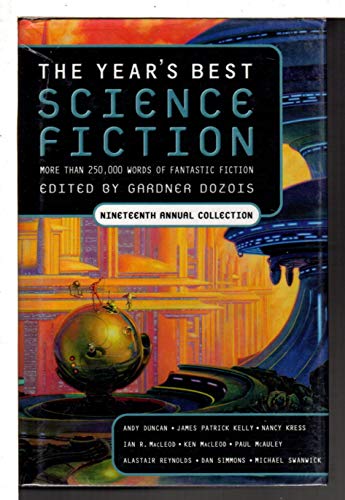
Inhaltsangabe
A new edition of the acclaimed annual anthology collects more than two dozen science fiction tales written in the previous year that includes pieces by such authors as Nancy Kress, Michael Swanwick, Geoff Ryman, Allen Steele, Robert Reed, Charles Stross, Michael Cassott, and other talented authors.
Die Inhaltsangabe kann sich auf eine andere Ausgabe dieses Titels beziehen.
Über die Autorin bzw. den Autor
Gardner Dozois has been working in the science fiction field for more than thirty years. Since 1985, he has been the editor of Asimov's Science Fiction magazine, during which time he has received the Hugo Award for Best Editor twelve times. He lives in Philadelphia, Pennsylvania.
Auszug. © Genehmigter Nachdruck. Alle Rechte vorbehalten.
The Year's Best Science Fiction: Nineteenth Edition
New Light on the Drake Equation
IAN R. MACLEOD
British writer Ian R. MacLeod was one of the hottest new writers of the nineties, and, as we travel into the new century ahead, his work continues to grow in power and deepen in maturity. MacLeod has published a slew of strong stories in Interzone, Asimov's Science Fiction, Weird Tales, Amazing, and The Magazine of Fantasy and Science Fiction, among other markets. Several of these stories made the cut for one or another of the various "Best of the Year" anthologies. In 1990, in fact, he appeared in three different "Best of the Year" anthologies with three different stories, certainly a rare distinction. His first novel, The Great Wheel, was published to critical acclaim in 1997, followed by a major collection of his short work, Voyages by Starlight. In 1999, he won the World Fantasy Award with his brilliant novella "The Summer Isles," and followed it up in 2000 by winning another World Fantasy Award for his novelette "The Chop Girl." MacLeod lives with his wife and young daughter in the West Midlands of England, and is at work on several new novels.
Here he paints a brilliant and moving portrait of one man's persistent belief in his vision across the span of an entire life-time--in the face of mounting odds and a dream that seems to be dying ... .
As he did on the first Wednesday of every month, after first finishing off the bottle of wine he'd fallen asleep with, then drinking three bleary fingers of absinthe, and with an extra slug for good measure, Tom Kelly drove down into St. Hilaire to collect his mail and provisions. The little town was red-brown, shimmering in the depths of the valley, flecked with olive trees, as he slewed the old Citroën around the hairpins from his mountain. Up to the east, where the karst rose in a mighty crag, he could just make out the flyers circling against the sheer white drop if he rubbed his eyes and squinted, and the glint of their wings as they caught the morning thermals. But Tom felt like a flyer of sorts himself, now the absinthe was fully in his bloodstream. He let the Citroën's piebald tires, the skid of the grit and the pull of the mountain, take him endlessly downwards. Spinning around the bends blind and wrong-side with the old canvas roof flapping, in and out of the shadows, scattering sheep in the sweet hot roar of the antique motor, Tom Kelly drove down from his mountain towards the valley.
In the bureau de poste, Madame Brissac gave him a smile that seemed even more patronising than usual.
"Any messages?" he croaked.
She blinked slowly. "One maybe two." Bluebottles circled the close air, which smelled of boiled sweets and Gitanes and Madame Brissac. Tom swayed slightly in his boots. He wiped off some of the road grit which had clung to the stubble on his face. He picked a stain from off his tee-shirt, and noticed as he did so that a fresh age spot was developing on the back of his right hand. It would disappoint her, really, if he took a language vial and started speaking fluent French after all these years--or even if he worked at it the old way, using bookplates and audio samples, just as he'd always been promising himself. It would deprive her of their small monthly battle.
"Then, ah, je voudrais ..." He tried waving his arms.
"You would like to have?"
"Yes please. Oui. Ah--s'il vous plait ..."
Still the tepid pause, the droning bluebottles. Or Madame Brissac could acquire English, Tom thought, although she was hardly likely to do it for his sake.
"You late." She said eventually.
"You mean--"
Then the door banged open in a crowded slab of shadows and noise and a cluster of flyers, back from their early morning spin on the thermals, bustled up behind Tom with skinsuits squealing, the folded tips of their wings bumping against the brown curls of sticky flypaper which the bluebottles had been scrupulously avoiding. These young people, Tom decided as he glanced back at them, truly were like bright alien insects in their gaudy skinsuits, their thin bodies garishly striped with the twisting logos of sports companies and their wings, a flesh of fine silk stretched between feathery bones, then folded up behind their backs like delicate umbrellas. And they were speaking French, too; speaking it in loud high voices, but overdoing every phrase and gesture and emphasis in the way that people always did when they were new to a language. They thought that just because they could understand each other and talk sensibly to their flying instructor and follow the tour guide and order a drink at the bar that they were jabbering away like natives, but then they hadn't yet come up against Madame Brissac, who would be bound to devise some bureaucratic twist or incomprehension which would send them away from here without whatever particular form or permission it was that they were expecting. Tom turned back to Madame Brissac and gave her a grin from around the edges of his gathering absinthe headache. She didn't bother to return it. Instead, she muttered something that sounded like I'm Judy.
"What? Voulez-vous repeter?"
"Is Thursday."
"Ah. Je comprends. I see ..." Not that he did quite, but the flyers were getting impatient and crowding closer to him, wings rustling with echoes of the morning air that had recently been filling them and the smell of fresh sweat, clean endeavour. How was it, Tom wondered, that they could look so beautiful from a distance, and so stupid and ugly close up? But Thursday--and he'd imagined it was Wednesday. Of course he'd thought that it was Wednesday, otherwise he wouldn't be here in St. Hilaire, would he? He was a creature of habit, worn in by the years like the grain of the old wood of Madame Brissac's counter. So he must have lost track, and/or not bothered to check his calendar back up on the mountain. An easy enough mistake to make, living the way he did. Although ...
"You require them? Yes?"
"S'il vous plait ..."
At long last, Madame Brissac was turning to the pigeonholes where she kept his and a few other message cards filed according to her own alchemic system. Putting them in one place, labelled under Kelly; Tom--or American; Drunk; Elderly; Stupid--was too simple for her.Neither had Tom ever been able to see a particular pattern which would relate to the source of the cards, which were generally from one or other of his various academic sponsors and came in drips and drabs and rushes, but mostly drabs. Those old brown lines of wooden boxes, which looked as if they had probably once held proper old-fashioned letters and telegrams, and perhaps messages and condolences from the World Wars, and the revolutionary proclamations of the sans-culottes, and decrees from the Sun King, and quite possibly even the odd pigeon, disgorged their contents to Madame Brissac's quick hands in no way that Tom could ever figure. He could always ask, of course, but that would just be an excuse for a raising of Gallic eyebrows and shoulders in mimed incomprehension. After all, Madame Brissac was Madame Brissac, and the flyers behind him were whispering, fluttering, trembling like young egrets, and it was none of his business.
There were market stalls lined across the Place de la Revolution, which had puzzled Tom on his way into the bureau de poste, but no longer. The world was right and he was wrong. This was Thursday. And his habitual café was busier than usual, although the couple who were occupying his table got up at his approach and strolled off, hand in hand, past the heaped and shadowed displays of breads and fruits and cheeses. The girl had gone for an Audrey...
„Über diesen Titel“ kann sich auf eine andere Ausgabe dieses Titels beziehen.
Suchergebnisse für The Year's Best Science Fiction: Nineteenth Annual...

Beispielbild für diese ISBN
The Year's Best Science Fiction: Nineteenth Annual Collection
Anbieter: World of Books (was SecondSale), Montgomery, IL, USA
Verkäuferbewertung 5 von 5 Sternen

Zustand: Acceptable. Item in good condition. Textbooks may not include supplemental items i.e. CDs, access codes etc. Artikel-Nr. 00071112930
Gebraucht kaufen
EUR 4,00
Versand gratis
Versand innerhalb von USA
Versand innerhalb von USA
Anzahl: 1 verfügbar
Beispielbild für diese ISBN
The Years Best Science Fiction
Anbieter: World of Books (was SecondSale), Montgomery, IL, USA
Verkäuferbewertung 5 von 5 Sternen
Zustand: Good. Item in good condition. Textbooks may not include supplemental items i.e. CDs, access codes etc. Artikel-Nr. 00102140664
Gebraucht kaufen
EUR 4,00
Versand gratis
Versand innerhalb von USA
Versand innerhalb von USA
Anzahl: 1 verfügbar
Beispielbild für diese ISBN
The Year's Best Science Fiction: Nineteenth Annual Collection
Anbieter: ThriftBooks-Dallas, Dallas, TX, USA
Verkäuferbewertung 5 von 5 Sternen
Hardcover. Zustand: Good. No Jacket. Pages can have notes/highlighting. Spine may show signs of wear. ~ ThriftBooks: Read More, Spend Less. Artikel-Nr. G0312288786I3N00
Gebraucht kaufen
EUR 8,22
Versand gratis
Versand innerhalb von USA
Versand innerhalb von USA
Anzahl: 1 verfügbar
Beispielbild für diese ISBN
The Year's Best Science Fiction: Nineteenth Annual Collection
Anbieter: ThriftBooks-Atlanta, AUSTELL, GA, USA
Verkäuferbewertung 5 von 5 Sternen
Hardcover. Zustand: Good. No Jacket. Pages can have notes/highlighting. Spine may show signs of wear. ~ ThriftBooks: Read More, Spend Less. Artikel-Nr. G0312288786I3N00
Gebraucht kaufen
EUR 8,22
Versand gratis
Versand innerhalb von USA
Versand innerhalb von USA
Anzahl: 1 verfügbar
Beispielbild für diese ISBN
The Year's Best Science Fiction
Anbieter: Better World Books, Mishawaka, IN, USA
Verkäuferbewertung 5 von 5 Sternen
Zustand: Good. 19th Edition. Former library copy. Pages intact with minimal writing/highlighting. The binding may be loose and creased. Dust jackets/supplements are not included. Includes library markings. Stock photo provided. Product includes identifying sticker. Better World Books: Buy Books. Do Good. Artikel-Nr. 3181721-6
Gebraucht kaufen
EUR 8,75
Versand gratis
Versand innerhalb von USA
Versand innerhalb von USA
Anzahl: 1 verfügbar
Beispielbild für diese ISBN
The Year's Best Science Fiction
Anbieter: Better World Books, Mishawaka, IN, USA
Verkäuferbewertung 5 von 5 Sternen
Zustand: Very Good. 19th Edition. Pages intact with possible writing/highlighting. Binding strong with minor wear. Dust jackets/supplements may not be included. Stock photo provided. Product includes identifying sticker. Better World Books: Buy Books. Do Good. Artikel-Nr. 4466382-6
Gebraucht kaufen
EUR 8,75
Versand gratis
Versand innerhalb von USA
Versand innerhalb von USA
Anzahl: 1 verfügbar
Foto des Verkäufers
THE YEAR'S BEST SCIENCE FICTION: Nineteenth (19th) Annual Collection.
Verlag:
St Martin's, New York, 2002
ISBN 10: 0312288786
ISBN 13: 9780312288785
Gebraucht
Hardcover
Erstausgabe
Anbieter: Bookfever, IOBA (Volk & Iiams), Ione, CA, USA
Verkäuferbewertung 5 von 5 Sternen
Zustand: NEAR FINE. First printing. Another in this series of award-winning anthologies. A collection of 26 stories - described on the front cover as 'more than 250,000 words of fantastic fiction.' Authors include Andy Duncan, James Patrick Kelly, Nancy Kress, Allen M. Steele, Ian McLeod, Paul McAuley, Dan Simmons, Michael Swanwick, Alastair Reynolds, Robert Reed and others. 708 pp. Near fine in near fine dust jacket (toning to pages, some sunning to spine of dj). Artikel-Nr. 88989
Gebraucht kaufen
EUR 31,58
EUR 4,40 Versand
Versand innerhalb von USA
Versand innerhalb von USA
Anzahl: 1 verfügbar
Foto des Verkäufers
THE YEAR'S BEST SCIENCE FICTION: Nineteenth (19th) Annual Collection.
Verlag:
St Martin's, New York, 2002
ISBN 10: 0312288786
ISBN 13: 9780312288785
Gebraucht
Hardcover
Signiert
Anbieter: Bookfever, IOBA (Volk & Iiams), Ione, CA, USA
Verkäuferbewertung 5 von 5 Sternen
Zustand: FINE. Book club edition. SIGNED by FOUR authors: by Dozois on the title page and also SIGNED at their stories by James Patrick Kelly ('Undone'), Nancy Kress ('Computer Virus'), and Allen M. Steele ('The Days Between.') Another in this series of award-winning anthologies. A collection of 26 stories - described on the front cover as 'more than 250,000 words of fantastic fiction.' Other authors include Andy Duncan, Ian McLeod, Paul McAuley, Dan Simmons, Michael Swanwick, Alastair Reynolds, Robert Reed and others. 708 pp. Very near fine in a fine dustjacket (line on bottom edge.). Artikel-Nr. 28938
Gebraucht kaufen
EUR 32,03
EUR 4,40 Versand
Versand innerhalb von USA
Versand innerhalb von USA
Anzahl: 1 verfügbar
Foto des Verkäufers
The Year's Best Science Fiction: Nineteenth Annual Collection
Verlag:
St. Martin's Press, 2002
ISBN 10: 0312288786
ISBN 13: 9780312288785
Gebraucht
Hardcover
Erstausgabe
Anbieter: Southampton Books, Sag Harbor, NY, USA
Verkäuferbewertung 5 von 5 Sternen
Hardcover. Zustand: Like New. First Edition. First Edition, First Printing. Not price-clipped. Published by St. Martin's Press, 2002. Octavo. Hardcover. Book is like new with light toning to the page ends. Dust jacket is like new with very light edgewear.100% positive feedback. 30 day money back guarantee. NEXT DAY SHIPPING! Excellent customer service. Please email with any questions. All books packed carefully and ship with free delivery confirmation/tracking. All books come with free bookmarks. Ships from Sag Harbor, New York. Artikel-Nr. 386852
Gebraucht kaufen
EUR 32,03
EUR 4,43 Versand
Versand innerhalb von USA
Versand innerhalb von USA
Anzahl: 1 verfügbar