
Verwandte Artikel zu Making Peace With the Things in Your Life: Why Your...
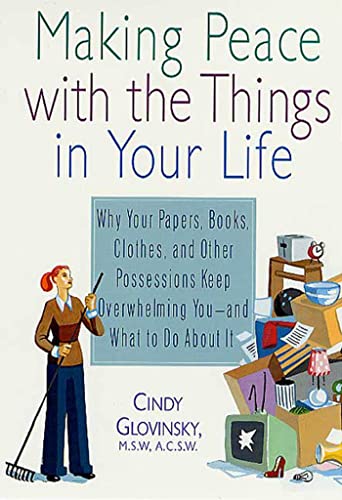
Making Peace With the Things in Your Life: Why Your Papers, Books, Clothes, and Other Possessions Keep Overwhelming You and What to Do About It - Softcover
Inhaltsangabe
Do you spend much of your time struggling against the growing ranks of papers, books, clothes, housewares, mementos, and other possessions that seem to multiply when you're not looking? Do these inanimate objects, the hallmarks of busy modern life, conspire to fill up every inch of your space, no matter how hard you try to get rid of some of them and organize the rest? Do you feel frustrated, thwarted, and powerless in the face of this ever-renewing mountain of stuff?
Help is on the way. Cindy Glovinsky, practicing psychotherapist and personal organizer, is uniquely qualified to explain this nagging, even debilitating problem -- and to provide solutions that really work. Writing in a supportive, nonjudmental tone, Glovinsky uses humorous examples, questionnaires, and exercises to shed light on the real reasons why we feel so overwhelmed by papers and possessions and offers individualized suggestions tailored to specific organizing problems.
Whether you're drowning in clutter or just looking for a new way to deal with the perennial challenge of organizing and managing material things, this fresh and reassuring approach is sure to help. Making Peace with the Things in Your Life will help you cut down on your clutter and cut down on your stress!
Die Inhaltsangabe kann sich auf eine andere Ausgabe dieses Titels beziehen.
Über die Autorin bzw. den Autor
Cindy Glovinsky, M.S.W., A.C.S.W., is a licensed psychotherapist and personal organizer. The program director of the National Study Group on Chronic Disorganization, she has presented at the National Association of Professional Organizers conference. She lives in Ann Arbor, Michigan.
Auszug. © Genehmigter Nachdruck. Alle Rechte vorbehalten.
Making Peace With The Things In Your Life
Why Your Papers, Books, Clothes, And Other Possessions Keep Overwhelming You And What To Do About It
By Cindy GlovinskySt. Martin's Press
Copyright © 2002 Cindy Glovinsky, M.S.W, A.C.S.W
All rights reserved.
ISBN: 978-0-312-28488-6All rights reserved.
Contents
Acknowledgments,
Introduction,
PART I RETHINKING THINGS,
CHAPTER 1. People and Things,
CHAPTER 2. How You Look at Things,
PART II YOU AND YOUR THINGS: TAKING INVENTORY,
CHAPTER 3. Where Your Things Come From,
CHAPTER 4. What You Do with Things While You Have Them,
CHAPTER 5. How Your Things Leave You — or Don't Leave You,
CHAPTER 6. Things and Feelings,
PART III WHY THINGS KEEP OVERWHELMING YOU,
CHAPTER 7. Things and Your Situation,
CHAPTER 8. Things and the Brain,
CHAPTER 9. The Four Brain-Based Troubles with Things,
CHAPTER 10. Your Things and Their Things,
PART IV WHAT TO DO ABOUT THINGS,
CHAPTER 11. Taking a Look at Things,
CHAPTER 12. Getting Started with Things,
CHAPTER 13. Moving Things Along,
CHAPTER 14. When Things Get Stuck,
CHAPTER 15. Peace with Your Things,
Notes,
Appendix,
Sources,
Further Reading,
CHAPTER 1
PEOPLE AND THINGS
Silver tea sets. Rock collections. Electric sanders. Stock certificates, marriage licenses, college diplomas, hundred-dollar bills. Blankies, hunting rifles, VCRs, computers, grandfather clocks. Boats. BMWs, Lamborginis, SUVs. The complete works of William Shakespeare. Stradivarius violins. The Mona Lisa. The Pyramids. Toothpicks, hooks and eyes, bottle caps, twist ties, cotton balls, brass fasteners, paper clips, dominos, buttons, knives, forks, and spoons.
None of us owns a single, solitary Thing permanently. Each of our Things flows through our fingers temporarily, on its way to somewhere else. Some Things are passed down from generation to generation; others are used for an instant and thrown away, recycled to form new Things, or allowed to dissolve into earth or ocean or air. Some Things become symbols of Things unseen, worshipped in temples constructed solely for their preservation or burned to ashes with incantations against them, others live humbler, more mundane lives: a pot, a stove, a coat, a hat, solid and comfortable, always there for us when we need them, beloved old friends.
Each of us has our own unique style of approaching the Things in our lives. Ruthie Bagger loves to shop for bargains, stockpiling shoes and Tupperware, candles and boxes of greeting cards. Jason Stickshift goes into a rage if anyone touches his car. Griselda Backglance still keeps all of Herbie's Things exactly as he left them even though her husband has been dead for nearly twenty years. Harry Openhand never lets a guest leave his house without a gift. Millie Squalor tosses her clothes carelessly into a heap; Nancy Neatfreak hangs up each garment carefully as she takes it off. Little Marty Gemini screams, "Don't touch MY blocks!" when anyone approaches his tower; Little Mickey Gemini carries his blocks one by one to give to each person around the room.
A lot goes into determining how you and your Things get along. As with most areas of human experience, this is a combination of nature and nurture. Nature consists of genetically programmed "brain wiring," i.e., how much of different types of chemicals you have in your brain and how they're distributed and used. Certain types of brain wiring may predispose you to dysfunctional Thing habits: from hoarding unnecessary Things, to heedless tossing rather than careful placing, to random piling rather than logical systematizing, to fearfully holding on to your Things instead of joyfully sharing them.
Nurture includes the influences not only of childhood caregivers but of family, friends, co-workers, culture, community, nation, and world throughout your life. Little Marty's parents may teach him to share or not to share. Millie's husband may accept her messiness or take issue with it. Ruthie's buying behavior may or may not be encouraged by aggressive, manipulative advertising.
As with people, a dysfunctional relationship with Things is a preoccupied relationship. We are preoccupied with the need to acquire, the need to organize, and the need to hang on to Things, putting off living until we have perfected our control over the material world, which always seems to elude us. Some folks are frustrated by never acquiring the one Thing that will satisfy them, others by their inability to get rid of Things they no longer use. Many feel overwhelmed by piles of Things that seem to breed like rabbits. Others spend hours perfecting already adequate systems, arranging and rearranging, filing and refiling, never feeling organized enough.
The good news is that no matter what your brain is like and no matter what has happened to you, you do not have to remain at war with your Things. Every one of us has the ability to develop healthy Thing-management skills. This means learning to say no to yourself about excess Things, to let go of those Things you can no longer use or enjoy, and to effectively organize and maintain the Things you keep, so that instead of taxing your energy they serve your needs and beautify your life.
To achieve this, all you need is the willingness to take an honest look at yourself.
THINGS AS AN ISSUE
For some of us, Things have become an Issue. An issue is a conflict that is always with you, a little black cloud that hangs over you day and night, no matter where you go, blocking out the sun. You can never quite enjoy yourself as long as an issue continues to hover. An issue prevents you from becoming who you truly are. An issue fills you with shame, often coupled with secrecy. An issue about Things means that you feel that some aspect of your behavior in relation to Things is OUT OF CONTROL.
There are many ways that your behavior may be out of control with Things. Psychotherapists' favorite diagnosis and treatment manual, currently known as the DSM-IV-TR, contains a number of psychiatric disorders with symptoms relating to Things, including, among others:
• Developmental Coordination Disorder (Dropping Things)
• Attention Deficit/Hyperactivity Disorder (Losing Things)
• Kleptomania (Stealing Things)
• Intermittent Explosive Disorder (Smashing Things)
• Schizophrenia (Seeing Things that aren't there)
• Phobias (Avoiding Things)
• Obsessive-Compulsive Disorder (Overorganizing Things)
• Obsessive-Compulsive Personality Disorder (Hoarding Things)
• Pica (Eating nonedible Things)
• Anorexia (Not eating edible Things)
• Pathological Gambling (Risking Things)
• Fetishism (Having sex with Things)
• Pyromania (Setting Things on fire)
• Autism (Staring at Things for a very long time)
Of course, you don't have to qualify for any of these diagnoses to have a Thing issue. The most common issue with Things isn't listed in the DSM-IV at all. This is the issue of clutter. When clutter is perpetual, long-lasting, and resistant to change, organizers call this "chronic disorganization," a term first used by Judith Kolberg, founder of the National Study Group on Chronic Disorganization. When you're chronically disorganized, you feel that you are in constant danger of being buried alive by your Things.
Although millions of people struggle with clutter and chronic...
„Über diesen Titel“ kann sich auf eine andere Ausgabe dieses Titels beziehen.
Suchergebnisse für Making Peace With the Things in Your Life: Why Your...

Beispielbild für diese ISBN
Making Peace with the Things i
Anbieter: World of Books (was SecondSale), Montgomery, IL, USA
Verkäuferbewertung 5 von 5 Sternen

Zustand: Acceptable. Item in acceptable condition! Textbooks may not include supplemental items i.e. CDs, access codes etc. Artikel-Nr. 00105618314
Gebraucht kaufen
EUR 4,44
Versand gratis
Versand innerhalb von USA
Versand innerhalb von USA
Anzahl: 1 verfügbar
Beispielbild für diese ISBN
Making Peace with the Things i
Anbieter: World of Books (was SecondSale), Montgomery, IL, USA
Verkäuferbewertung 5 von 5 Sternen
Zustand: Good. Item in good condition. Textbooks may not include supplemental items i.e. CDs, access codes etc. Artikel-Nr. 00091787125
Gebraucht kaufen
EUR 4,44
Versand gratis
Versand innerhalb von USA
Versand innerhalb von USA
Anzahl: 8 verfügbar
Beispielbild für diese ISBN
Making Peace with the Things in Your Life: Why Your Papers, Books, Clothes, and Other Possessions Keep Overwhelming You and What to Do About It
Verlag:
St. Martin's Griffin (edition First Edition), 2002
ISBN 10: 0312284888
ISBN 13: 9780312284886
Gebraucht
Paperback
Erstausgabe
Anbieter: BooksRun, Philadelphia, PA, USA
Verkäuferbewertung 5 von 5 Sternen
Paperback. Zustand: Very Good. First Edition. It's a well-cared-for item that has seen limited use. The item may show minor signs of wear. All the text is legible, with all pages included. It may have slight markings and/or highlighting. Artikel-Nr. 0312284888-11-1
Gebraucht kaufen
EUR 4,70
Versand gratis
Versand innerhalb von USA
Versand innerhalb von USA
Anzahl: 3 verfügbar
Beispielbild für diese ISBN
Making Peace with the Things in Your Life: Why Your Papers, Books, Clothes, and Other Possessions Keep Overwhelming You and What to Do About It
Anbieter: ThriftBooks-Dallas, Dallas, TX, USA
Verkäuferbewertung 5 von 5 Sternen
Paperback. Zustand: Very Good. No Jacket. May have limited writing in cover pages. Pages are unmarked. ~ ThriftBooks: Read More, Spend Less. Artikel-Nr. G0312284888I4N00
Gebraucht kaufen
EUR 5,90
Versand gratis
Versand innerhalb von USA
Versand innerhalb von USA
Anzahl: 1 verfügbar
Beispielbild für diese ISBN
Making Peace with the Things in Your Life: Why Your Papers, Books, Clothes, and Other Possessions Keep Overwhelming You and What to Do About It
Anbieter: ThriftBooks-Phoenix, Phoenix, AZ, USA
Verkäuferbewertung 5 von 5 Sternen
Paperback. Zustand: Very Good. No Jacket. May have limited writing in cover pages. Pages are unmarked. ~ ThriftBooks: Read More, Spend Less. Artikel-Nr. G0312284888I4N00
Gebraucht kaufen
EUR 5,90
Versand gratis
Versand innerhalb von USA
Versand innerhalb von USA
Anzahl: 1 verfügbar
Beispielbild für diese ISBN
Making Peace with the Things in Your Life: Why Your Papers, Books, Clothes, and Other Possessions Keep Overwhelming You and What to Do About It
Anbieter: ThriftBooks-Atlanta, AUSTELL, GA, USA
Verkäuferbewertung 5 von 5 Sternen
Paperback. Zustand: Fair. No Jacket. Readable copy. Pages may have considerable notes/highlighting. ~ ThriftBooks: Read More, Spend Less. Artikel-Nr. G0312284888I5N00
Gebraucht kaufen
EUR 5,90
Versand gratis
Versand innerhalb von USA
Versand innerhalb von USA
Anzahl: 1 verfügbar
Beispielbild für diese ISBN
Making Peace with the Things in Your Life: Why Your Papers, Books, Clothes, and Other Possessions Keep Overwhelming You and What to Do About It
Anbieter: ThriftBooks-Dallas, Dallas, TX, USA
Verkäuferbewertung 5 von 5 Sternen
Paperback. Zustand: Good. No Jacket. Pages can have notes/highlighting. Spine may show signs of wear. ~ ThriftBooks: Read More, Spend Less. Artikel-Nr. G0312284888I3N00
Gebraucht kaufen
EUR 5,90
Versand gratis
Versand innerhalb von USA
Versand innerhalb von USA
Anzahl: 1 verfügbar
Beispielbild für diese ISBN
Making Peace with the Things in Your Life: Why Your Papers, Books, Clothes, and Other Possessions Keep Overwhelming You and What to Do About It
Anbieter: ThriftBooks-Atlanta, AUSTELL, GA, USA
Verkäuferbewertung 5 von 5 Sternen
Paperback. Zustand: Very Good. No Jacket. May have limited writing in cover pages. Pages are unmarked. ~ ThriftBooks: Read More, Spend Less. Artikel-Nr. G0312284888I4N00
Gebraucht kaufen
EUR 5,90
Versand gratis
Versand innerhalb von USA
Versand innerhalb von USA
Anzahl: 1 verfügbar
Beispielbild für diese ISBN
Making Peace with the Things in Your Life : Why Your Papers, Books, Clothes, and Other Possessions Keep Overwhelming You and What to Do about It
Verlag:
St. Martin's Press, 2002
ISBN 10: 0312284888
ISBN 13: 9780312284886
Gebraucht
Softcover
Erstausgabe
Anbieter: Better World Books: West, Reno, NV, USA
Verkäuferbewertung 5 von 5 Sternen
Zustand: Good. 1st. Pages intact with minimal writing/highlighting. The binding may be loose and creased. Dust jackets/supplements are not included. Stock photo provided. Product includes identifying sticker. Better World Books: Buy Books. Do Good. Artikel-Nr. 4342949-6
Gebraucht kaufen
EUR 6,09
Versand gratis
Versand innerhalb von USA
Versand innerhalb von USA
Anzahl: 1 verfügbar
Beispielbild für diese ISBN
Making Peace with the Things in Your Life : Why Your Papers, Books, Clothes, and Other Possessions Keep Overwhelming You and What to Do about It
Verlag:
St. Martin's Press, 2002
ISBN 10: 0312284888
ISBN 13: 9780312284886
Gebraucht
Softcover
Erstausgabe
Anbieter: Better World Books, Mishawaka, IN, USA
Verkäuferbewertung 5 von 5 Sternen
Zustand: Good. 1st. Former library copy. Pages intact with minimal writing/highlighting. The binding may be loose and creased. Dust jackets/supplements are not included. Includes library markings. Stock photo provided. Product includes identifying sticker. Better World Books: Buy Books. Do Good. Artikel-Nr. 4604817-6
Gebraucht kaufen
EUR 6,09
Versand gratis
Versand innerhalb von USA
Versand innerhalb von USA
Anzahl: 1 verfügbar