Inhaltsangabe
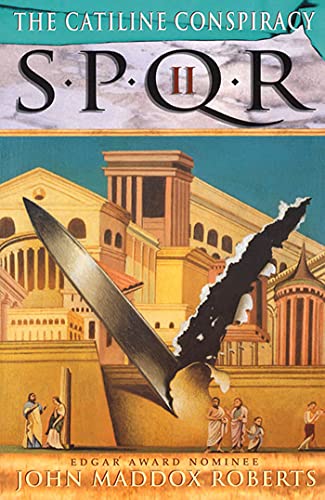
It was a summer of glorious triumph for the mighty Roman Republic. Her invincible legions had brought all foreign enemies to their knees. But in Rome there was no peace. The streets were flooded with the blood of murdered citizens, and there were rumors of more atrocities to come. Decius Caecilius Metellus the Younger was convinced a conspiracy existed to overthrow the government-a sinister cabal that could only be destroyed from within. But admission into the traitorous society of evil carried a grim price: the life of Decius's closest friend...and maybe his own.
Die Inhaltsangabe kann sich auf eine andere Ausgabe dieses Titels beziehen.
Über die Autorin bzw. den Autor
John Maddox Roberts is the author of numerous works of science fiction and fantasy in addition to his SPQR series set in ancient Rome. He and his wife live in New Mexico.
Auszug. © Genehmigter Nachdruck. Alle Rechte vorbehalten.
SPQR II: The Catiline Conspiracy
By John Maddox RobertsSt. Martin's Press
Copyright © 1991 John Maddox Roberts
All rights reserved.
ISBN: 978-0-312-27706-2All rights reserved.
CHAPTER 1
That summer we received the news that Mithridates was dead. It was hard to credit at first. Mithridates had been a thorn in our side for so long that he seemed like a force of nature, as immutable as sunrise. Only the oldest citizens could remember a time when Mithridates had not been there to plague us. He died old and friendless, somewhere in the Cimmerian Bosphorus, plotting yet another sally against Rome, this time an invasion of Italy by way of the Danube. He was the most consistent of enemies and we would miss him.
The news came in the midst of a splendid summer, one of the finest in living memory. It was a time of peace and prosperity. The civil wars of Marius and Sulla were fast fading from memory, the horrors of their murders and proscriptions seeming to belong to another age. Everywhere, Rome was victorious. In the East, Pompey was the overwhelming victor. He had smashed the Mediterranean pirates and then he had gone on to subdue Asia, Pontus and Armenia, robbing Lucullus of the final glory for which he had fought so long and so honorably. Crete had been subdued after a long and desultory campaign. Who was left to threaten Rome? Carthage had been exterminated generations before, its ruins plowed under and sown with salt so that nothing would grow there. The East, from Cilicia to Palestine, was under the Roman heel, only remote Parthia remaining independent. To the south, Egypt was a joke, fat and indolent as an overfed crocodile. Africa and Numidia were muzzled. In the west, Spain was a taxpaying province. To the north were some Gallic tribes that had not yet been civilized, wearing long hair and trousers and providing the comic playwrights with good material for laughs.
The answer, of course, was that we Romans would ourselves provide the enemy. We were poised on the brink of yet another series of civil wars, convulsions so vast that they would be fought all over the world. The wars were still years in the future, but as I look back upon it, that was the last summer of the old Republic. It died in the fall.
None of that was apparent at the time, though. There are those who would argue that it never truly died, that our esteemed First Citizen actually restored the Republic. That is the talk of fools and toadies. I am now too old to care what the First Citizen thinks of me, so I will describe these events as I lived them. If his ancestor, the Divine Julius, comes out looking less than godlike, it is because I knew Caius Julius back then and the First Citizen didn't. Hardly surprising, considering that the First Citizen was born that year. Fitting, in a way.
None of these weighty matters troubled us that summer. The most serious political controversy of the day was the action of the Praetor Otho. Four years before, as Tribune of the People, he had introduced a law reserving fourteen rows of seats in the theater for the equites, the moneyed-but-not-noble class. Now, as praetor, he upheld it. There were no riots, but he was hissed every time he went to the theater.
The great event of the season was the triumph of Lucullus. He had returned to Italy almost four years earlier and had petitioned the senate for permission to celebrate a triumph in recognition of his victories over Mithridates and Tigranes. Pompey had manipulated the Tribunes to block this, but Lucullus had finally been granted permission. Until that time, he had been compelled, by ancient custom, to dwell outside the walls of Rome, where he had company. Quintus Marcius Rex, the victor of Cilicia, and
„Über diesen Titel“ kann sich auf eine andere Ausgabe dieses Titels beziehen.
Weitere beliebte Ausgaben desselben Titels

Suchergebnisse für Spqr Ii: The Catiline Conspiracy: 2 (Spqr Roman Mysteries)

Beispielbild für diese ISBN
The Catiline Conspiracy (SPQR II)
Anbieter: Wonder Book, Frederick, MD, USA
Verkäuferbewertung 5 von 5 Sternen

Zustand: Good. Good condition. A copy that has been read but remains intact. May contain markings such as bookplates, stamps, limited notes and highlighting, or a few light stains. Artikel-Nr. Y08B-05166
Beispielbild für diese ISBN
SPQR II: the Catiline Conspiracy : A Mystery
Anbieter: Better World Books, Mishawaka, IN, USA
Verkäuferbewertung 5 von 5 Sternen
Zustand: Very Good. Used book that is in excellent condition. May show signs of wear or have minor defects. Artikel-Nr. 8371684-6
Beispielbild für diese ISBN
SPQR II: the Catiline Conspiracy : A Mystery
Anbieter: Better World Books, Mishawaka, IN, USA
Verkäuferbewertung 5 von 5 Sternen
Zustand: Good. Used book that is in clean, average condition without any missing pages. Artikel-Nr. 3181491-6
Beispielbild für diese ISBN
Spqr II: The Catiline Conspiracy: A Mystery
Anbieter: ThriftBooks-Phoenix, Phoenix, AZ, USA
Verkäuferbewertung 5 von 5 Sternen
Paperback. Zustand: Very Good. No Jacket. May have limited writing in cover pages. Pages are unmarked. ~ ThriftBooks: Read More, Spend Less. Artikel-Nr. G0312277067I4N00
Beispielbild für diese ISBN
Spqr II: The Catiline Conspiracy: A Mystery
Anbieter: ThriftBooks-Reno, Reno, NV, USA
Verkäuferbewertung 5 von 5 Sternen
Paperback. Zustand: Very Good. No Jacket. Missing dust jacket; May have limited writing in cover pages. Pages are unmarked. ~ ThriftBooks: Read More, Spend Less. Artikel-Nr. G0312277067I4N01
Beispielbild für diese ISBN
Spqr II: The Catiline Conspiracy: A Mystery
Anbieter: ThriftBooks-Reno, Reno, NV, USA
Verkäuferbewertung 5 von 5 Sternen
Paperback. Zustand: Good. No Jacket. Pages can have notes/highlighting. Spine may show signs of wear. ~ ThriftBooks: Read More, Spend Less. Artikel-Nr. G0312277067I3N00
Beispielbild für diese ISBN
Spqr II: The Catiline Conspiracy: A Mystery
Anbieter: ThriftBooks-Reno, Reno, NV, USA
Verkäuferbewertung 5 von 5 Sternen
Paperback. Zustand: Very Good. No Jacket. May have limited writing in cover pages. Pages are unmarked. ~ ThriftBooks: Read More, Spend Less. Artikel-Nr. G0312277067I4N00
Beispielbild für diese ISBN
Spqr II: The Catiline Conspiracy: A Mystery
Anbieter: ThriftBooks-Dallas, Dallas, TX, USA
Verkäuferbewertung 5 von 5 Sternen
Paperback. Zustand: Very Good. No Jacket. Former library book; May have limited writing in cover pages. Pages are unmarked. ~ ThriftBooks: Read More, Spend Less. Artikel-Nr. G0312277067I4N10
Beispielbild für diese ISBN
Spqr II: The Catiline Conspiracy: A Mystery
Anbieter: ThriftBooks-Dallas, Dallas, TX, USA
Verkäuferbewertung 5 von 5 Sternen
Paperback. Zustand: Very Good. No Jacket. May have limited writing in cover pages. Pages are unmarked. ~ ThriftBooks: Read More, Spend Less. Artikel-Nr. G0312277067I4N00
Beispielbild für diese ISBN
Spqr II: The Catiline Conspiracy: A Mystery
Anbieter: ThriftBooks-Dallas, Dallas, TX, USA
Verkäuferbewertung 5 von 5 Sternen
Paperback. Zustand: Good. No Jacket. Pages can have notes/highlighting. Spine may show signs of wear. ~ ThriftBooks: Read More, Spend Less. Artikel-Nr. G0312277067I3N00