
Verwandte Artikel zu The Change Agents: Decoding the New Work Force and...
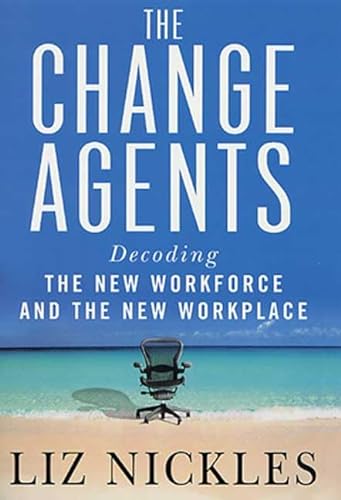
Inhaltsangabe
An expert on marketing and brand development dives headfirst into the internet to hunt for the forces underpinning its revolutionary effects on business, revealing a workforce under fire from the constant expectation of change. 20,000 first printing.
Die Inhaltsangabe kann sich auf eine andere Ausgabe dieses Titels beziehen.
Über die Autorin bzw. den Autor
Liz Nickles is a nationally recognized expert in strategic marketing and brand development. Her research firm, Nickles & Ashcraft, pioneered the assumptions about women in the workplace and teens in the twenty-first century. She is currently director of branding, marketing and advertising at Credit Suisse First Boston. She lives in Westchester County, NY with her husband and son.
^\
Liz Nickles is a nationally recognized expert in strategic marketing and brand development. Her research firm, Nickles & Ashcraft, pioneered the assumptions about women in the workplace and teens in the twenty-first century. She is currently director of branding, marketing and advertising at Credit Suisse First Boston. She lives in Westchester County, NY with her husband and son.
Auszug. © Genehmigter Nachdruck. Alle Rechte vorbehalten.
1
PASSING THE SWORD
BlackBerries. We’ve got to get them their BlackBerries. Have the BlackBerries been ordered?” The mood in the New York conference room of one of the world’s largest financial institutions was tense. Over the speakerphone in the middle of the table, one of the senior officers, let’s call him Mr. Euro, sounded uncharacteristically anxious as he called in from France. Even in his absence, those around the table could imagine him at the moment: iconically dressed in suit, crisply impeccable button-down shirt, tie, and gold cuff links—in spite of the recent global edict for five-day-a-week”business casual.” Mr. Euro was one of the more conservative bastions of the old school. But, as was becoming clear in the meeting, even his stolid foundations were crumbling.
The six people around the conference table leaned closer to the speakerphone, styluses poised at the screens of their Palm Pilots, ready to carry out Mr. Euro’s wishes. He wished for BlackBerries. Now.
Mr. Euro was not talking about a field trip to the blackberry patch or a foray to the gourmet produce stand. The BlackBerry was, at the moment of this conversation in the spring of 2000, the newest, hippest, and most in-demand technology toy—a handheld, wireless device that allows access to and sending of e-mail from anywhere. Forget the archaic pager or the paleolithic cell phone. The BlackBerry had become the must-have business accessory, the Prada electronic of the backpack/briefcase set. As such, the younger associates had recently put in a demand for BlackBerries—among other things. However, this particular firm, being on the leading edge—or so they had thought—had actually anticipated this and had proactively initiated the process of harvesting BlackBerries for its employees even before this latest request had hit.
One of the midlevel executives shifted uncomfortably in his chair as he addressed the speakerphone. “Um, we’ve got good news and bad news on that.” The good news was that the Tech department had gone on a quest to get the BlackBerries at a lower price, which it had achieved; the bad news was that this cost-consciousness had delayed the process a good month.
Over the speakerphone, Mr. Euro’s voice tightened, although he did not raise it. He was a very polite man, more given to understatement. “Well, that is not good. We need to accelerate this process.” Styluses flew across tiny electronic tablets an ocean away. “Now they’re going to think we got the BlackBerries because they demanded them. We won’t get credit.”
They being the young associates. We being the senior management of the firm.
What’s not wrong but different about this picture?
The executives sitting in the meeting exchanged glances. Everyone sitting there knew the answer: This was a pivotal moment, one of those instances when everything is about to change, when the bottom card is being pulled from the carefully constructed house.
Even a year before, the young associates on Wall Street—or new, first-year hires at almost any traditional company, for as far back as anybody could remember—were the voiceless slave labor of the organization. They were invisible. They were learning, contributing, gaining necessary expertise and momentum, but they were also doing something that was, once upon a time, quaintly referred to as “paying their dues.”
Remember the trainee? I can assure you the Baby Boomers do, because they spent the first quarter of their careers being one. They got the coffee. They answered the phones. They typed their fingerprints off. They canceled their vacations. They practically licked their bosses’ feet—and were lucky, if not always happy, to do it. Because they knew this was the way in, the first step in the long arc that would lead, say, forty years hence, to the gold watch, as it had for their fathers (and, in rare but heroic instances, mothers) before.
I remember my first job at an advertising agency. I was a junior junior copywriter. After my first client lunch, I was soundly berated by my boss. I stared at him, bewildered: I had spoken intelligently about the account, been polite and knowledgeable —so why the scolding? As I was quickly to learn, it had to do with the food. The client had ordered dessert. Nobody else had ordered dessert, including me. Especially me. “It’s called ‘Eat the dessert!’” my boss said, exasperated—actually, he was yelling—the implication being that I should have known my place in the pecking order, which was the rock bottom. “If the client orders dessert, the junior member of the team—that being you—orders dessert too. And eats it!” Every Baby Boomer I have ever worked with has stories like this.
Fast forward to the conference room in New York, where this firm, along with other firms on the Street, was trying to make sense of a paradigm shift that seemed to them to have dropped from the sky. The culture was traditionally one of the most selective, and most demanding, that a new graduate could join. Just one year before the BlackBerry meeting, the territory was familiar, expected, and reeked of the status quo. It was the world of three-piece suits and ties for men; dark-colored skirt suits, blouses, and heels for women. Today it was five-day-a-week business casual (to assist in the re-wardrobing, Banana Republic opened an in-office shop on one investment bank’s New York premises; the firm sent out the notice over the intranet). And, lurking around the corner, concierge service.
For decades, the elite young financial recruits, the cream of the Harvards, Whartons, and Stanfords of the world, could look forward to hundred-hour workweeks crunching numbers, dredging research, and assembling pitch books and reports from behind the scenes. Their status within the firms, according to a junior analyst quoted in a front-page article in the New York Times, was a “general perception of inferior creatures.” This was, simply, the way it was. It was the price paid for a career path in financial services, for a shot at the megabonuses somewhere down the line. It was unimaginable that a junior staffer would confront, say, a Bruce Wasserstein or Henry Kravis with anything more bold than “Good morning, sir.”
But in an instant, things were different. New hirees, strong in self-confidence if short on experience, were making demands. Yesterday’s self-termed slave labor force had wrested control of the tiller, and the captains of the ship were charting a new course.
George Anders, senior editor and Silicon Valley bureau chief of Fast Company magazine, observed “more of a sense of ‘I’m here, I’m ready for responsibility. Let me go do it.’ I think, by and large, this is good. We don’t need a version of the old German apprentice system where at age thirty-six you were finally declared a master craftsman and you could begin doing whatever it was you wanted to do.”
Upheaval at Salomon Smith Barney was also cited in the same piece in the New York Times. “The youngest workers are having their dues paid for them,” trumpeted the article, headlined “At a Wall Street Firm, Junior Voices Roar.” A twenty-three-year-old analyst had submitted a list of demands that detailed thirty-six ways the firm could retain their junior members (in addition to their $70,000-a-year salaries). The list included—in part—concierge service, videotape return service, free toothbrushes for business trips, stock...
„Über diesen Titel“ kann sich auf eine andere Ausgabe dieses Titels beziehen.
Suchergebnisse für The Change Agents: Decoding the New Work Force and...

Beispielbild für diese ISBN
The Change Agents: Decoding the New Work Force and Workplace
Verlag:
St. Martin's Press (edition First Edition), 2001
ISBN 10: 0312275358
ISBN 13: 9780312275358
Gebraucht
Hardcover
Erstausgabe
Anbieter: BooksRun, Philadelphia, PA, USA
Verkäuferbewertung 5 von 5 Sternen

Hardcover. Zustand: Fair. First Edition. With dust jacket. The item might be beaten up but readable. May contain markings or highlighting, as well as stains, bent corners, or any other major defect, but the text is not obscured in any way. Artikel-Nr. 0312275358-7-1-29
Gebraucht kaufen
EUR 5,37
Versand gratis
Versand innerhalb von USA
Versand innerhalb von USA
Anzahl: 1 verfügbar
Beispielbild für diese ISBN
The Change Agents : Decoding the New Workforce and the New Workplace
Verlag:
St. Martin's Press, 2001
ISBN 10: 0312275358
ISBN 13: 9780312275358
Gebraucht
Hardcover
Erstausgabe
Anbieter: Better World Books: West, Reno, NV, USA
Verkäuferbewertung 5 von 5 Sternen
Zustand: Good. 1st. Former library copy. Pages intact with minimal writing/highlighting. The binding may be loose and creased. Dust jackets/supplements are not included. Includes library markings. Stock photo provided. Product includes identifying sticker. Better World Books: Buy Books. Do Good. Artikel-Nr. 45646683-75
Gebraucht kaufen
EUR 8,37
Versand gratis
Versand innerhalb von USA
Versand innerhalb von USA
Anzahl: 1 verfügbar