
Verwandte Artikel zu The Year's Best Fantasy and Horror: Thirteenth Annual...
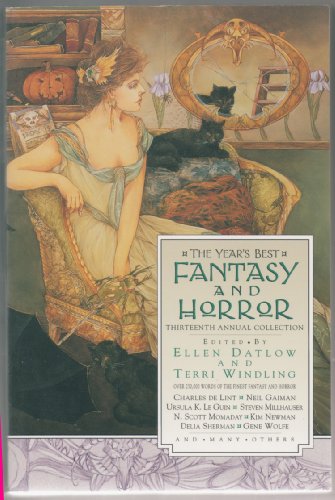
The Year's Best Fantasy and Horror: Thirteenth Annual Collection (Year's Best Fantasy & Horror) - Softcover
Inhaltsangabe
The thirteenth volume of the World Fantasy Award-winning series includes year-end synopses in publishing, movies, and comics, as well as contributions by such authors as Robert Girardi and Gene Wolfe. Simultaneous. notable authors. Simultaneous. 25,000 first printing.
Die Inhaltsangabe kann sich auf eine andere Ausgabe dieses Titels beziehen.
Über die Autorin bzw. den Autor
Ellen Datlow is the acclaimed editor of such anthologies as Sirens and other Daemon Lovers (with Terri Windling), Blood Is Not Enough, Lethal Kisses, and Off Limits, and has won the World Fantasy Award five times. She lives in New York City and currently edits fiction for SCIFI.COM.
Terri Windling won the Mythopoeic Award for her first adult novel, The Wood Wife. She has edited numerous books and anthologies, including The Essential Bordertown and Black Heart, Ivory Bones, the most recent in a series of contemporary fairy tale anthologies, edited with Ellen Datlow. Honored five times with the World Fantasy Award, she divides her time between Devon, England, and Tucson, Arizona.
Terri Windling won the Mythopoeic Award for her first adult novel, The Wood Wife. She has edited numerous books and anthologies, including The Essential Bordertown and Black Heart, Ivory Bones, the most recent in a series of contemporary fairy tale anthologies, edited with Ellen Datlow. Honored five times with the World Fantasy Award, she divides her time between Devon, England, and Tucson, Arizona.
Auszug. © Genehmigter Nachdruck. Alle Rechte vorbehalten.
The Year's Best Fantasy and Horror: Thirteenth Annual Collection
Summation 1999: Fantasy
TERRI WINDLING
Welcome to the thirteenth edition of The Year's Best Fantasy and Horror. This anthology series was created to be an annual celebration of the best in nonrealist literature--ranging from magic realism (à la Márquez) to imaginary world fiction (à la Tolkien), as well as from dark stories of supernatural magic to those of psychological horror. By combining works from the genres of "fantasy" and "horror," along with magical tales from "mainstream fiction," Ellen and I seek to ignore the limiting boundaries that strict genre categorization places upon contemporary writers. Thus all nonrealist writing rooted in myth, magic, and surrealism is eligible for inclusion in this collection, which contains selections from sources as diverse as The Magazine of Fantasy & Science Fiction and The New Yorker. This fantasy/horror/mainstream combination reflects the wide spectrum of magical fiction published each year in English-language publications--and we are firm believers in the idea that the three fields are greatly enriched when their stories are viewed side by side. But for those readers who maintain a diehard preference for fantasy over horror, or vice versa, please note that the fantasy stories carry my initials after their introductions, horror tales carry Ellen Datlow's, and stories in the shadow realm between carry both our initials (with the acquiring editor listed first).
This introductory summation, for those new to the series, provides an overview of fantasy publishing in the year just past, with lists of recommended novels, nonfiction, children's books, art books, etc. Usually at this point I wax on a bit about what a great year it was in the fantasy field, for we've been blessed by many such lately. But 1999, I'm sorry to report from the trenches, was not a banner year. Short fiction was as strong as ever (as you'll see from the stories in this book), but novel-length fiction was disappointing. There was a handful of excellent books (such as Minions of the Moon by Richard Bowes, in genre, and Prince by Ib Michael, in mainstream fiction), but nothing close to the glorious abundance of extraordinary novels that have appeared in the last few years. I've been pondering the question of why this should be so, as well as talking to editors and publishers, and the explanation is a simple one. I don't believe we're witnessing a sudden decline of interest in magical fiction;rather, 1999's lackluster offerings are a direct result of the particularly sterling year we had in 1998. Many of the fantasy field's top authors gave us their best efforts in 1998 (Guy Gavriel Kay, George R. R. Martin, Patricia A. McKillip, Sean Stewart, Sean Russell, and Jane Yolen, to name just a few of them), and were absent from the publishing lists while working on their next books. These writers, as well as the field at large, seemed to be catching their breaths in 1999, making it a good year to check out some of the newer talent, such as Elizabeth Haydon, Thomas Harlan, China Miéville, Judy Budnitz, and Valery Leith.
The slimmer than usual offering of quality fantasy fiction for adult readers contrasts with a bumper crop of thoroughly enchanting novels in the children's book field. Love Harry Potter or hate him, there's no denying that he's had a massive impact on the New York publishing industry. It's still too soon to tell whether a significant portion of Harry Potter fans will move on to other fantasy books (as readers did in the wake of Tolkien's bestsellerdom in the 1970s), but my best guess is that a number of them will, now that the word "fantasy" has lost its faint whiff of disrepute in the children's book field. (This, despite the fact that so much classic children's fiction--Carroll, Nesbit, Eager, Baum, Lewis, Tolkien, etc.--is indisputably fantastic in both senses of the word.) Already we're seeing a surge in the amount of children's fantasy being published, with bigger advertising budgets and expectations. According to editors at several publishing houses, this is a trend that's only just beginning--and one that bodes well for the larger fantasy genre, considering that several of the field's best writers once came to us from children's books. We have not only J. K. Rowling to thank for this, but also the brilliant Philip Pullman, whose best-selling books The Golden Compass and The Subtle Knife are complex, hard-hitting, and literary enough to gladden any discerning reader's heart--and to ensure that "children's fantasy" isn't limited to light, humorous books of the Potter sort. (The most interesting article on the Potter phenomenon I read this past year, by the way, is "Harry Potter's Girl Trouble," about the dubious role of female characters in Rowling's series. This insightful piece by Christine Schoefer can be found in the archives of Salon magazine, www.salon.com).
While Rowling and Potter will probably be the dominant influences in magical children's fiction for some time to come, in adult fiction (both in the genre and the mainstream) Gabriel García Márquez continues to be a strong inspiration for young writers from Latin and non-Latin cultures alike, as do, to a lesser extent, other magic realist/surrealist authors like Jorge Luis Borges, Italo Calvino, Isaac Bashevis Singer, Ben Okri, and Angela Carter. Judging from the books that have crossed my desk in the last thirteen years, I believe it is impossible to overstate the impact Márquez has had on late-twentieth century fiction the world over. In our country, One Hundred Years of Solitude is a book that, more than any other, gives young writers the permission and the courage to stray from the path of strict realism (and Gordon Lish-style minimalism) to which creative writing graduate programs all over the country seem so determined to steer them. In the fantasy genre, a particularly Márquezean way of explicating the modern world through quiet moments of transcendent enchantment can be found in the works of quite a number of our top writers (Crowley, Fowler, Carroll, Goldstein, etc.), while Angela Carter's sensuous,folkloric work has inspired a modern renaissance in adult fairy-tale fiction. At the same time, literary Tolkienesque fantasy (aka imaginary world or traditional fantasy) has not disappeared--1998 marked a strong resurgence of the form. The year 1999, it must be noted, only brought us a very few good novels of the type, but this spike downward seems to be temporary, as I've already received several good Tolkienesque novels to review for the year 2000.
On the whole, the lines drawn (by publishers, bookstore managers, and critics) between mainstream fiction and genre fiction continue to get blurrier every year, and I long for a day when all these books sit side by side on a shelf marked Fiction. Modern bookselling being what it is, however, books are still organized and sold by category labels, leading a group of writers from the fantasy and science fiction genres to come up with a label of their own: interstitial fiction. Here's a brief excerpt from the somewhat (but not entirely) tongue-in-cheek Interstitial Arts Manifesto:
Perhaps you've had this experience. You read a book, go to a gallery opening, attend a concert. You come out exhilarated, excited, enthralled. "It was great!" you tell your friends. "I loved it!" "So, what is it?" they ask. "It was ..." You think for a moment. "Sort of ..." You wave your hands helplessly in the air. "Different," you conclude weakly. Pressed, you can find analogies. A book is a "magic realist Victorian biography in the guise of a mystery novel." A painting is "symbolist Renaissance...
„Über diesen Titel“ kann sich auf eine andere Ausgabe dieses Titels beziehen.
Suchergebnisse für The Year's Best Fantasy and Horror: Thirteenth Annual...

Beispielbild für diese ISBN
The Year's Best Fantasy and Horror: null
Anbieter: World of Books (was SecondSale), Montgomery, IL, USA
Verkäuferbewertung 5 von 5 Sternen

Paperback. Zustand: Good. Artikel-Nr. 00110237007
Gebraucht kaufen
EUR 6,12
Versand gratis
Versand innerhalb von USA
Versand innerhalb von USA
Anzahl: 1 verfügbar
Beispielbild für diese ISBN
The Year's Best Fantasy and Horror : Thirteenth Annual Collection
Anbieter: ThriftBooks-Reno, Reno, NV, USA
Verkäuferbewertung 5 von 5 Sternen
Paperback. Zustand: Good. No Jacket. Pages can have notes/highlighting. Spine may show signs of wear. ~ ThriftBooks: Read More, Spend Less. Artikel-Nr. G031226416XI3N00
Gebraucht kaufen
EUR 6,13
Versand gratis
Versand innerhalb von USA
Versand innerhalb von USA
Anzahl: 1 verfügbar
Beispielbild für diese ISBN
The Year's Best Fantasy and Horror : Thirteenth Annual Collection
Anbieter: ThriftBooks-Phoenix, Phoenix, AZ, USA
Verkäuferbewertung 5 von 5 Sternen
Paperback. Zustand: Very Good. No Jacket. May have limited writing in cover pages. Pages are unmarked. ~ ThriftBooks: Read More, Spend Less. Artikel-Nr. G031226416XI4N00
Gebraucht kaufen
EUR 6,13
Versand gratis
Versand innerhalb von USA
Versand innerhalb von USA
Anzahl: 1 verfügbar
Beispielbild für diese ISBN
The Year's Best Fantasy and Horror : Thirteenth Annual Collection
Anbieter: ThriftBooks-Dallas, Dallas, TX, USA
Verkäuferbewertung 5 von 5 Sternen
Paperback. Zustand: Fair. No Jacket. Readable copy. Pages may have considerable notes/highlighting. ~ ThriftBooks: Read More, Spend Less. Artikel-Nr. G031226416XI5N00
Gebraucht kaufen
EUR 6,13
Versand gratis
Versand innerhalb von USA
Versand innerhalb von USA
Anzahl: 1 verfügbar
Beispielbild für diese ISBN
The Year's Best Fantasy and Horror : Thirteenth Annual Collection
Anbieter: ThriftBooks-Atlanta, AUSTELL, GA, USA
Verkäuferbewertung 5 von 5 Sternen
Paperback. Zustand: Very Good. No Jacket. May have limited writing in cover pages. Pages are unmarked. ~ ThriftBooks: Read More, Spend Less. Artikel-Nr. G031226416XI4N00
Gebraucht kaufen
EUR 6,13
Versand gratis
Versand innerhalb von USA
Versand innerhalb von USA
Anzahl: 2 verfügbar
Beispielbild für diese ISBN
The Year's Best Fantasy and Horror : Thirteenth Annual Collection
Anbieter: ThriftBooks-Dallas, Dallas, TX, USA
Verkäuferbewertung 5 von 5 Sternen
Paperback. Zustand: Good. No Jacket. Pages can have notes/highlighting. Spine may show signs of wear. ~ ThriftBooks: Read More, Spend Less. Artikel-Nr. G031226416XI3N00
Gebraucht kaufen
EUR 6,13
Versand gratis
Versand innerhalb von USA
Versand innerhalb von USA
Anzahl: 1 verfügbar
Beispielbild für diese ISBN
The Year's Best Fantasy and Horror : Thirteenth Annual Collection
Anbieter: ThriftBooks-Atlanta, AUSTELL, GA, USA
Verkäuferbewertung 5 von 5 Sternen
Paperback. Zustand: Good. No Jacket. Pages can have notes/highlighting. Spine may show signs of wear. ~ ThriftBooks: Read More, Spend Less. Artikel-Nr. G031226416XI3N00
Gebraucht kaufen
EUR 6,13
Versand gratis
Versand innerhalb von USA
Versand innerhalb von USA
Anzahl: 1 verfügbar
Beispielbild für diese ISBN
The Year's Best Fantasy and Horror : Thirteenth Annual Collection
Anbieter: ThriftBooks-Dallas, Dallas, TX, USA
Verkäuferbewertung 5 von 5 Sternen
Paperback. Zustand: Very Good. No Jacket. May have limited writing in cover pages. Pages are unmarked. ~ ThriftBooks: Read More, Spend Less. Artikel-Nr. G031226416XI4N00
Gebraucht kaufen
EUR 6,13
Versand gratis
Versand innerhalb von USA
Versand innerhalb von USA
Anzahl: 2 verfügbar
Beispielbild für diese ISBN
The Year's Best Fantasy and Horror : Thirteenth Annual Collection
Anbieter: ThriftBooks-Reno, Reno, NV, USA
Verkäuferbewertung 5 von 5 Sternen
Paperback. Zustand: Very Good. No Jacket. May have limited writing in cover pages. Pages are unmarked. ~ ThriftBooks: Read More, Spend Less. Artikel-Nr. G031226416XI4N00
Gebraucht kaufen
EUR 6,13
Versand gratis
Versand innerhalb von USA
Versand innerhalb von USA
Anzahl: 1 verfügbar
Foto des Verkäufers
The Year's Best Fantasy and Horror : Thirteenth Annual Collection
Anbieter: Southampton Books, Sag Harbor, NY, USA
Verkäuferbewertung 5 von 5 Sternen
Paperback. Zustand: Like New. FIRST THUS. First Edition Thus. Published by St. Martin's Griffin, 2000. Octavo. Paperback. Book is like new. Artikel-Nr. 561981
Gebraucht kaufen
EUR 13,79
EUR 4,45 Versand
Versand innerhalb von USA
Versand innerhalb von USA
Anzahl: 1 verfügbar