
Verwandte Artikel zu Don't Tell Me What to Do, Just Send Money: The...
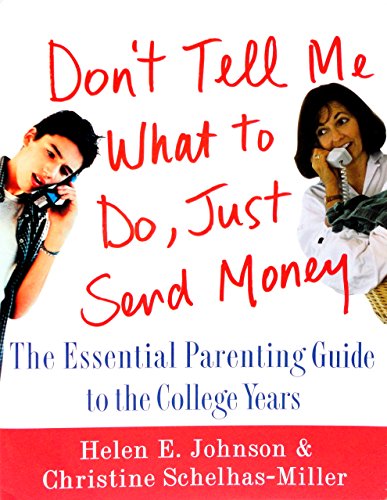
Don't Tell Me What to Do, Just Send Money: The Essential Parenting Guide to the College Years - Softcover
Inhaltsangabe
Finally, a Dr. Spock for College Parents
Does your daughter call home in tears over the latest "crisis," leaving you feeling helpless and concerned? Is your son confused about his major? When children leave for college many parents feel uncertain about their shifting role. By emphasizing the importance of being a mentor, Don't Tell Me What to Do, Just Send Money shows that parents may have lost control over their college student, but they haven't lost influence.
Brimming with humorous case examples and realistic dialogues, this comprehensive guide covers the fundamental college issues, including:
* Preparing for College: what to bring, how to stay in touch, and how to handle money
* Adjusting Socially: roommates, stress, time management, and Greek life
* The Search for Identity: intimate relationships, choosing a major, and lifestyle and value decisions
* Handling Crises: depression, drug and alcohol abuse, dropping out, and eating disorders
* Postgraduate Choices: job hunting, internships, and graduate schools
Does your daughter call home in tears over the latest "crisis," leaving you feeling helpless and concerned? Is your son confused about his major? When children leave for college many parents feel uncertain about their shifting role. By emphasizing the importance of being a mentor, Don't Tell Me What to Do, Just Send Money shows that parents may have lost control over their college student, but they haven't lost influence.
Brimming with humorous case examples and realistic dialogues, this comprehensive guide covers the fundamental college issues, including:
* Preparing for College: what to bring, how to stay in touch, and how to handle money
* Adjusting Socially: roommates, stress, time management, and Greek life
* The Search for Identity: intimate relationships, choosing a major, and lifestyle and value decisions
* Handling Crises: depression, drug and alcohol abuse, dropping out, and eating disorders
* Postgraduate Choices: job hunting, internships, and graduate schools
Die Inhaltsangabe kann sich auf eine andere Ausgabe dieses Titels beziehen.
Über die Autorin bzw. den Autor
Helen Johnson founded and directed Cornell University's first Parents' Program. She has worked for more than twenty-five years in higher education as a writer, career center director, assistant dean of students, and program manager. She is the parent of two recent college graduates and lives in Chapel Hill, North Carolina.
Christine Schelhas-Miller teaches adolescent development in the department of human development at Cornell University and is a consultant to independent, secondary schools on issues related to adolescent development. For over twenty years she has worked in higher education, providing academic, personal, and career counseling to students. She is the parent of two children and lives in Ithaca, New York.
Christine Schelhas-Miller teaches adolescent development in the department of human development at Cornell University and is a consultant to independent, secondary schools on issues related to adolescent development. For over twenty years she has worked in higher education, providing academic, personal, and career counseling to students. She is the parent of two children and lives in Ithaca, New York.
Rezensionen
This concrete, easy-to-use guide is designed to help anxious parents support and understand their newly fledged children as they weather the slings and arrows of the first year of college. Johnson (Assistant Dean of Students/Cornell) and Schelhas-Miller (Adolescent Development/Cornell) possess decades of professional experience as college counselors, and their easy expertise is obvious. Despite glib overtones--the work at times reads like a transcript from a Power Point talk given at a generic freshman orientation--the authors address difficult issues with varying degrees of success. Certain basic assumptions--parental acceptance of teen sex (even to the point of providing off-to-college birth control pills) and the equally underplayed acceptance of underage drinking and drugging--might be obstacles for some readers, as might gender- and class-based generalizations, such as those addressed to young women on campus and individuals who are the first in their (immigrant) family to attend college. Despite these caveats, however, most potential first-year situations--from academic probation and credit-card sprees to date rape and eating disorders--are discussed in level, clear language designed to help parents allow their children to cope. The authors' main message (that parenting style should evolve from daily caregiving to more of a mentoring relationship) is clear and consistent, and seems sane and grounded guidance.Both a useful guide and a literary security blanket, offering familiar comforts and good, solid advice in a text-dense sea of boxes, lists, and resources for further reading. -- Copyright © 2000 Kirkus Associates, LP. All rights reserved.
Auszug. © Genehmigter Nachdruck. Alle Rechte vorbehalten.
Introduction
Congratulations! You have made it through eighteen years of parenting and your child is ready to embark on that great personal journey called the college years. You are not alone if you feel a mixture of excitement and dread as you send your child off to college. Few parents really know what to expect from the college years. At best, you may have a slim brochure from the school's admissions office telling you about the academic and social aspects of college life for your child. And you will certainly have heard from the office that collects tuition. But what about your adjustment to the changes about to take place?
As your child grew up, you had plenty of advice about child rearing from books, family members, and friends. You probably noticed that these resources dwindled as your child approached the teen years. Somehow talking about teens and their developmental issues is harder than talking about toilet training and the adjustment to nursery school. Why? Because the issues get scarier and your teenager's need to pull away from the family and create a separate identity can be both troubling and rewarding. You may be confused and even embarrassed by your child's behavior as he experiments with being an adult. This happens most dramatically during the college years.
Parents of our generation have been, and continue to be, more involved in our children's education and development than any generation in American history. We are the parents who took childbirth classes, debated the merits of nursery schools, arranged play dates, carpooled to soccer games, organized violin lessons, and took the grand college tour. We have consumed parenting "how to" books in record numbers. But, until now, there has not been a practical guide that offers concrete advice on how to manage the challenges and changes that accompany our children's college years.
What parent hasn't waited anxiously for a phone call from college and then not received one? What parent hasn't asked, "What is my role now that my child is away from home?" "Why does my child seem so independent one minute but confused and indecisive the next?" "How will I know if my child is in trouble and what should I do about it?" "Who is this person with a new tattoo and an attitude sitting at the Thanksgiving dinner table?" "Why does she seem to reject all of the values we taught her?" "Will my child get a good job after college and have her own health insurance?" "What in the world will he do with a degree in art history?" And what parent hasn't questioned the cost of college and wondered if it was worth it?
Drawing on adolescent development theory and our years of experience with undergraduates and parents, we provide practical advice to parents on these and other questions. Through the use of dialogues and scenarios, this book demonstrates how parents can adjust their expectations to anticipate the inevitable transformation in the parent-child relationship. We encourage parents to adopt a mentor/advisor role, showing, through actual examples, how important it is to relinquish control and instead provide guidance and support. We also offer communication and problem-solving strategies that support the development of a healthy adult-to-adult relationship that will serve you well in the years to come.
Each of us has had more than two decades of experience working with college students and their parents at small liberal arts colleges, state schools, and some of America's most prestigious universities. Our insights result from focus group research with both parents and undergraduates, as well as from years of counseling and program development, including parent-orientation programs, parents weekends, and new student orientations.
Focus groups conducted in seven cities across the country with parents of college students revealed how eager they are for practical information and advice. Parents from Long Island to San Francisco had similar worries about their children's college experience-safety and health, adjustment issues, money concerns, sex and drugs, academic success, and career prospects. Most of all, they were confused about their new role in their children's lives. Our research highlighted the unique challenges that parents encounter as their children become legal adults, but far from independent. We also conducted focus groups with college juniors and found that parents continue to play a significant role in students' decision making, especially when those students were examining their values and beliefs, or facing critical life choices.
Students in Chrissie's course in adolescent development at Cornell University are required to write and analyze an autobiography of their adolescence. Reading more than one hundred autobiographies each year has given her an intimate view of the lives of today's college students. These autobiographies typically include candid descriptions of relationships, sex, drugs, families, emotional problems, and other personal matters.
As director of the Parents' Program at Cornell University, Helen surveyed more than twelve thousand parents from all parts of the country to determine their primary concerns and to find out what information they expected from the university. Helen also corresponded with more than six thousand parents in response to specific problems, and counseled more than two thousand parents by telephone and in person on a variety of issues.
This book will help you cope with the major issues that face parents of college students today. It will show you how to achieve a new relationship with your emerging adult child by understanding the developmental changes that will occur during the college years and by examining and managing the expectations you have for your child.
You have a fascinating job ahead as your child goes off to college. While you will always be your child's parent, the college years signal a change in that relationship-a change this book will help you to understand and even celebrate. You've done the hard work of raising a child capable of going to college and you deserve recognition, consideration, and support. We trust this book will encourage and sustain you during this change.
Congratulations! You have made it through eighteen years of parenting and your child is ready to embark on that great personal journey called the college years. You are not alone if you feel a mixture of excitement and dread as you send your child off to college. Few parents really know what to expect from the college years. At best, you may have a slim brochure from the school's admissions office telling you about the academic and social aspects of college life for your child. And you will certainly have heard from the office that collects tuition. But what about your adjustment to the changes about to take place?
As your child grew up, you had plenty of advice about child rearing from books, family members, and friends. You probably noticed that these resources dwindled as your child approached the teen years. Somehow talking about teens and their developmental issues is harder than talking about toilet training and the adjustment to nursery school. Why? Because the issues get scarier and your teenager's need to pull away from the family and create a separate identity can be both troubling and rewarding. You may be confused and even embarrassed by your child's behavior as he experiments with being an adult. This happens most dramatically during the college years.
Parents of our generation have been, and continue to be, more involved in our children's education and development than any generation in American history. We are the parents who took childbirth classes, debated the merits of nursery schools, arranged play dates, carpooled to soccer games, organized violin lessons, and took the grand college tour. We have consumed parenting "how to" books in record numbers. But, until now, there has not been a practical guide that offers concrete advice on how to manage the challenges and changes that accompany our children's college years.
What parent hasn't waited anxiously for a phone call from college and then not received one? What parent hasn't asked, "What is my role now that my child is away from home?" "Why does my child seem so independent one minute but confused and indecisive the next?" "How will I know if my child is in trouble and what should I do about it?" "Who is this person with a new tattoo and an attitude sitting at the Thanksgiving dinner table?" "Why does she seem to reject all of the values we taught her?" "Will my child get a good job after college and have her own health insurance?" "What in the world will he do with a degree in art history?" And what parent hasn't questioned the cost of college and wondered if it was worth it?
Drawing on adolescent development theory and our years of experience with undergraduates and parents, we provide practical advice to parents on these and other questions. Through the use of dialogues and scenarios, this book demonstrates how parents can adjust their expectations to anticipate the inevitable transformation in the parent-child relationship. We encourage parents to adopt a mentor/advisor role, showing, through actual examples, how important it is to relinquish control and instead provide guidance and support. We also offer communication and problem-solving strategies that support the development of a healthy adult-to-adult relationship that will serve you well in the years to come.
Each of us has had more than two decades of experience working with college students and their parents at small liberal arts colleges, state schools, and some of America's most prestigious universities. Our insights result from focus group research with both parents and undergraduates, as well as from years of counseling and program development, including parent-orientation programs, parents weekends, and new student orientations.
Focus groups conducted in seven cities across the country with parents of college students revealed how eager they are for practical information and advice. Parents from Long Island to San Francisco had similar worries about their children's college experience-safety and health, adjustment issues, money concerns, sex and drugs, academic success, and career prospects. Most of all, they were confused about their new role in their children's lives. Our research highlighted the unique challenges that parents encounter as their children become legal adults, but far from independent. We also conducted focus groups with college juniors and found that parents continue to play a significant role in students' decision making, especially when those students were examining their values and beliefs, or facing critical life choices.
Students in Chrissie's course in adolescent development at Cornell University are required to write and analyze an autobiography of their adolescence. Reading more than one hundred autobiographies each year has given her an intimate view of the lives of today's college students. These autobiographies typically include candid descriptions of relationships, sex, drugs, families, emotional problems, and other personal matters.
As director of the Parents' Program at Cornell University, Helen surveyed more than twelve thousand parents from all parts of the country to determine their primary concerns and to find out what information they expected from the university. Helen also corresponded with more than six thousand parents in response to specific problems, and counseled more than two thousand parents by telephone and in person on a variety of issues.
This book will help you cope with the major issues that face parents of college students today. It will show you how to achieve a new relationship with your emerging adult child by understanding the developmental changes that will occur during the college years and by examining and managing the expectations you have for your child.
You have a fascinating job ahead as your child goes off to college. While you will always be your child's parent, the college years signal a change in that relationship-a change this book will help you to understand and even celebrate. You've done the hard work of raising a child capable of going to college and you deserve recognition, consideration, and support. We trust this book will encourage and sustain you during this change.
„Über diesen Titel“ kann sich auf eine andere Ausgabe dieses Titels beziehen.
Suchergebnisse für Don't Tell Me What to Do, Just Send Money: The...

Beispielbild für diese ISBN
Dont Tell Me What to Do Just S
Verlag:
Golden Guides from St. Martin's Press, 2000
ISBN 10: 0312263740
ISBN 13: 9780312263744
Gebraucht
Softcover
Anbieter: World of Books (was SecondSale), Montgomery, IL, USA
Verkäuferbewertung 5 von 5 Sternen

Zustand: Acceptable. Item in acceptable condition! Textbooks may not include supplemental items i.e. CDs, access codes etc. Artikel-Nr. 00108364321
Gebraucht kaufen
EUR 5,27
Versand gratis
Versand innerhalb von USA
Versand innerhalb von USA
Anzahl: 1 verfügbar
Beispielbild für diese ISBN
Dont Tell Me What to Do Just S
Verlag:
Golden Guides from St. Martin's Press, 2000
ISBN 10: 0312263740
ISBN 13: 9780312263744
Gebraucht
Softcover
Anbieter: World of Books (was SecondSale), Montgomery, IL, USA
Verkäuferbewertung 5 von 5 Sternen
Zustand: Good. Item in good condition. Textbooks may not include supplemental items i.e. CDs, access codes etc. Artikel-Nr. 00054303169
Gebraucht kaufen
EUR 5,27
Versand gratis
Versand innerhalb von USA
Versand innerhalb von USA
Anzahl: 8 verfügbar
Beispielbild für diese ISBN
Dont Tell Me What to Do Just S
Verlag:
Golden Guides from St. Martin's Press, 2000
ISBN 10: 0312263740
ISBN 13: 9780312263744
Gebraucht
Softcover
Anbieter: World of Books (was SecondSale), Montgomery, IL, USA
Verkäuferbewertung 5 von 5 Sternen
Zustand: Very Good. Item in very good condition! Textbooks may not include supplemental items i.e. CDs, access codes etc. Artikel-Nr. 00103446733
Gebraucht kaufen
EUR 5,27
Versand gratis
Versand innerhalb von USA
Versand innerhalb von USA
Anzahl: 2 verfügbar
Beispielbild für diese ISBN
Don't Tell Me What to Do, Just Send Money: The Essential Parenting Guide to the College Years
ISBN 10: 0312263740
ISBN 13: 9780312263744
Gebraucht
Paperback
Erstausgabe
Anbieter: BooksRun, Philadelphia, PA, USA
Verkäuferbewertung 5 von 5 Sternen
Paperback. Zustand: Very Good. First Edition. It's a well-cared-for item that has seen limited use. The item may show minor signs of wear. All the text is legible, with all pages included. It may have slight markings and/or highlighting. Artikel-Nr. 0312263740-11-1
Gebraucht kaufen
EUR 5,28
Versand gratis
Versand innerhalb von USA
Versand innerhalb von USA
Anzahl: 1 verfügbar
Beispielbild für diese ISBN
Don't Tell Me What to Do, Just Send Money: The Essential Parenting Guide to the College Years
ISBN 10: 0312263740
ISBN 13: 9780312263744
Gebraucht
Paperback
Erstausgabe
Anbieter: BooksRun, Philadelphia, PA, USA
Verkäuferbewertung 5 von 5 Sternen
Paperback. Zustand: Very Good. First Edition. It's a well-cared-for item that has seen limited use. The item may show minor signs of wear. All the text is legible, with all pages included. It may have slight markings and/or highlighting. Artikel-Nr. 0312263740-11-22
Gebraucht kaufen
EUR 5,47
Versand gratis
Versand innerhalb von USA
Versand innerhalb von USA
Anzahl: 1 verfügbar
Beispielbild für diese ISBN
Don't Tell Me What to Do, Just Send Money: The Essential Parenting Guide to the College Years
Verlag:
Golden Guides from St. Martin's Press, 2000
ISBN 10: 0312263740
ISBN 13: 9780312263744
Gebraucht
Paperback
Anbieter: ThriftBooks-Dallas, Dallas, TX, USA
Verkäuferbewertung 5 von 5 Sternen
Paperback. Zustand: As New. No Jacket. Pages are clean and are not marred by notes or folds of any kind. ~ ThriftBooks: Read More, Spend Less. Artikel-Nr. G0312263740I2N00
Gebraucht kaufen
EUR 5,94
Versand gratis
Versand innerhalb von USA
Versand innerhalb von USA
Anzahl: 1 verfügbar
Beispielbild für diese ISBN
Don't Tell Me What to Do, Just Send Money: The Essential Parenting Guide to the College Years
Verlag:
Golden Guides from St. Martin's Press, 2000
ISBN 10: 0312263740
ISBN 13: 9780312263744
Gebraucht
Softcover
Anbieter: Wonder Book, Frederick, MD, USA
Verkäuferbewertung 5 von 5 Sternen
Zustand: As New. Like New condition. A near perfect copy that may have very minor cosmetic defects. Artikel-Nr. L06F-00647
Gebraucht kaufen
EUR 6,40
Versand gratis
Versand innerhalb von USA
Versand innerhalb von USA
Anzahl: 1 verfügbar
Beispielbild für diese ISBN
Don't Tell Me What to Do, Just Send Money: The Essential Parenting Guide to the College Years
Verlag:
Golden Guides from St. Martin's Press, 2000
ISBN 10: 0312263740
ISBN 13: 9780312263744
Gebraucht
Softcover
Anbieter: Wonder Book, Frederick, MD, USA
Verkäuferbewertung 5 von 5 Sternen
Zustand: Very Good. Very Good condition. A copy that may have a few cosmetic defects. May also contain light spine creasing or a few markings such as an owner's name, short gifter's inscription or light stamp. Artikel-Nr. Z14M-01236
Gebraucht kaufen
EUR 6,40
Versand gratis
Versand innerhalb von USA
Versand innerhalb von USA
Anzahl: 1 verfügbar
Beispielbild für diese ISBN
Don't Tell Me What to Do, Just Send Money : The Essential Parenting Guide to the College Years
Verlag:
St. Martin's Press, 2000
ISBN 10: 0312263740
ISBN 13: 9780312263744
Gebraucht
Softcover
Erstausgabe
Anbieter: Better World Books, Mishawaka, IN, USA
Verkäuferbewertung 5 von 5 Sternen
Zustand: Good. 1st. Pages intact with minimal writing/highlighting. The binding may be loose and creased. Dust jackets/supplements are not included. Stock photo provided. Product includes identifying sticker. Better World Books: Buy Books. Do Good. Artikel-Nr. 38383176-6
Gebraucht kaufen
EUR 7,36
Versand gratis
Versand innerhalb von USA
Versand innerhalb von USA
Anzahl: 1 verfügbar
Beispielbild für diese ISBN
Don't Tell Me What to Do, Just Send Money : The Essential Parenting Guide to the College Years
Verlag:
St. Martin's Press, 2000
ISBN 10: 0312263740
ISBN 13: 9780312263744
Gebraucht
Softcover
Erstausgabe
Anbieter: Better World Books, Mishawaka, IN, USA
Verkäuferbewertung 5 von 5 Sternen
Zustand: Very Good. 1st. Pages intact with possible writing/highlighting. Binding strong with minor wear. Dust jackets/supplements may not be included. Stock photo provided. Product includes identifying sticker. Better World Books: Buy Books. Do Good. Artikel-Nr. 41132104-6
Gebraucht kaufen
EUR 7,36
Versand gratis
Versand innerhalb von USA
Versand innerhalb von USA
Anzahl: 1 verfügbar