
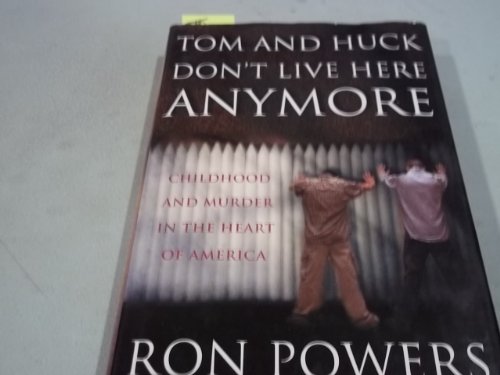
Verwandte Artikel zu Tom and Huck Don't Live Here Anymore: Childhood...
Inhaltsangabe
The Pulitzer Prize-winning co-author of
Die Inhaltsangabe kann sich auf eine andere Ausgabe dieses Titels beziehen.
Über die Autorin bzw. den Autor
Ron Powers is the co-writer of The New York Times bestseller Flags of Our Father and the author of eight books, including Dangerous Water, a biography of young Samuel Clemens. Winner of the Pulitzer Prize for criticism, he lives in Middlebury, Vermont.
Auszug. © Genehmigter Nachdruck. Alle Rechte vorbehalten.
Tom and Huck Don't live here Anymore
1
ROBIE AND WILL
Late on a Tuesday afternoon in November 1997, around suppertime, two sixteen-year-old Missouri boys got into a 1988 Ford Bronco II and went out looking for some way to pass the time before heading over to the local Baptist college to watch a basketball game. They slipped into the continental cortege, the perpetual flow of kids in cars looking for something to do, some way to break through the blankness.
Their town was Hannibal, Missouri--"America's Home Town," as it billed itself in tourist brochures, a salute to its legacy as the boyhood home of Mark Twain. The teenagers were named William D. Hill and Robie Wilson. Wilson (he pronounced his name "Robbie"), a serious-faced boy with short-cut blond hair and a sturdy build, was the son of a Hannibal city councilman and letter carrier named Kyle Wilson. He did not live with his father, who was twice divorced, but with his mother and her new husband. Hill, also blond, was an athlete, tall and muscular. He had recently moved to town from Iowa with his mother and stepfather.
With Hill at the wheel, the two kids cruised around town for a while, looking for girls, for friends, for anything besides what they knew was and wasn't there.
Not much to do.
They stopped for a snack at a fast-food franchise, then headed out onto the streets again.
It was around six P.M. when they spotted the jogger.
They had found themselves rolling aimlessly along Pleasant Street--Pleasant Street of America's Home Town. The figure trotting toward them, up the grade, was a sixty-one-year-old machinist with Car Quest Auto Parts and an amateur railroad enthusiast named James Walker. Like Robie, he was a lifelong Hannibal resident. An army veteran, he had been married to Virginia Elliott Walker since 1957. Virginia, a pale and soft-spoken woman, had for a time served as the president of the Helen Cornelius Fan Club. Ms. Cornelius, a Hannibal native and country-western singer, had enjoyed some success as a three-time winner on the Ted Mack Amateur Hour and later as an RCA recording artist in the 1970s. Her best-known hits were "We Still Sing Love Songs in Missouri" and "Tweedle-de-dee." The couple had one son, Michael Ray Walker, who lived in St. Louis.
Just now, James Walker was about midway through his five-mile run, which he made several times a week, always along the same route. He was at work on his goal of completing fifty-seven miles of running by the end of the month. Another fifty-seven, to be chalked up in December, would give him a thousand miles of running for the year.
Pleasant Street is an east-west road, both arterial and residential, near the western edge of town, two lanes of asphalt, no sidewalks. It had originated as a wooden plank road in about 1835, some sixteen years after first settlement, by a man named Fry, who cut it through three miles of hardwood forest in return for half of the fledgling town's remaining unsold lots. 1835 was the year of the birth, near Hannibal, of Samuel Langhorne Clemens--Mark Twain, the great mythifier of American boyhood.
Winter dusk had settled in on this November afternoon. The streetlights had been turned on, and Walker was wearing his customary bright yellow shorts, reflective vest, and orange fluorescent hat.
Walker chugged eastward on Pleasant, on the left side of the road, facing traffic. Hill and Wilson cruised westward on the downgrade. As they drew near the approaching figure, one of the boys--it was never conclusively established which--asked the other, "Do you want to door him?"
It was William Hill, the owner of the Bronco and a promising high school baseball player, who had clued Robie Wilson in on "dooring"or "awarding the door prize." The two had talked about it the previous summer, while idly tooling around a small lake. "Dooring" was a car stunt pulled occasionally in Iowa high school parking lots. It entailed a driver drawing alongside a student on foot while the frontseat passenger opened the door, giving the student an unexpected whack.
On this Tuesday, though, the recipient was to be not a high school student but an elderly man. And the "door prize" was to be administered not at a parking-lot crawl but at thoroughfare speed.
The Bronco closed on Walker in the 2500 block of Pleasant, a longish stretch in which the edge of the asphalt gave directly onto steep grassy lawn. The unsuspecting Walker had no route of escape.
What happened next differs slightly in the retelling by each boy. In either version, they made two runs at Walker before they struck the man.
William Hill later testified that it was Robie's idea to "door" the running man. Hill went along with it more or less offhandedly.
On the first pass, Hill swerved in Walker's direction, but perhaps because of the wind, Robie Wilson had trouble pushing the door open. "I missed him," he told Hill. Hill would testify that Robie urged him to go back.
Hill was reluctant, he said, but drove to the bottom of Pleasant and turned around. The Bronco retraced its route up the grade, overtook Walker, and continued up Pleasant a little way. Then Will Hill U-turned and made his second run.
Robie insisted that the first time they passed Walker, nothing happened; there was no discussion about "dooring." At the bottom of Pleasant, Hill made a right turn onto U.S. Highway 61 and headed north toward Hannibal--La Grange College, the site of the game. But after a block, Hill turned right again and looped back along a road parallel to Walker's route.
Whichever version of the story was correct, the Bronco was soon bearing down on James Walker for a second time.
Reemerging on Pleasant, with the trotting figure in his sights, Hill angled the car toward the man and, according to Robie, ordered Robie to open the door. Scared and confused, Robie complied.
Whatever the truth, James Walker paid the consequences. He never grasped what was about to happen. As the car approached,he made no effort to dodge out of the way. Robie Wilson pushed his door open. The onrushing steel caught Walker full in the face with explosive impact. The window glass burst, sending an eruption of shards back into the Bronco and outward along the pavement. The force was such that the window behind the passenger's seat shattered as well.
Robie Wilson glanced back at the collapsed figure and yelled, "Go! Go! Go!" Hill gunned his damaged car down Pleasant Street. He veered left into a more secluded, curving street called Shepherd Place, hurried along its tree-lined downhill contours until its terminus at St. Mary's Avenue. There he turned left again and took off along the central spine of Hannibal. At some point, Hill turned right off that spine--now Broadway--and plunged the Bronco down into one of the town's older, shabbier enclaves: a latticework of short, sharply angled streets fronted by century-old bungalows with peeling white paint; by sheds, freestanding garages, truck gardens. He drove a couple of blocks through this area to Market Street, a long and narrow winding hive of taverns and storefront businesses, early-century brick and wood frame, that once had teemed with raucous honky-tonk nightlife but now lay mostly dust-caked, abandoned, and Gothic. He pulled up near a cramped little bar and pool hall called the Water Hole, where he knew he could find his stepfather.
The Water Hole and the sagging storefronts alongside it formed a line of decay that was interrupted, less than a block to the east, by a jarringly spotless structure, all right angles and chrome and assertive colors. It spread, still under construction, like a nesting starship that had touched down on a dead planet. This was a half-completed service...
„Über diesen Titel“ kann sich auf eine andere Ausgabe dieses Titels beziehen.
Suchergebnisse für Tom and Huck Don't Live Here Anymore: Childhood...

Beispielbild für diese ISBN
Tom and Huck Don't Live Here Anymore: Childhood and Murder in the Heart of America
Anbieter: World of Books (was SecondSale), Montgomery, IL, USA
Verkäuferbewertung 5 von 5 Sternen

Hardback. Zustand: Good. If thou seest life after death, then what is death but a dream?In a world where to live is to dream, to wake is to die- again and again and again- dying until we reach the end- the End of Dreams. Upon the abrupt death of her exalted father, the young and beautiful Stella Eiren, heiress to all things good and golden is suddenly thrust from a life full of promise into realms bleak and brutal. Clinging to threads of sanity amidst incomprehensible nightmares, stalked by foul monsters and even fouler men, she strives for survival, for love, for family, for an impossible truth at the heart of all things- striving again and again and again- striving till the end- the End of Dreams. Artikel-Nr. 00106374180
Gebraucht kaufen
EUR 4,67
Versand gratis
Versand innerhalb von USA
Versand innerhalb von USA
Anzahl: 4 verfügbar
Beispielbild für diese ISBN
Tom and Huck Don't Live Here Anymore
Anbieter: ThriftBooks-Dallas, Dallas, TX, USA
Verkäuferbewertung 5 von 5 Sternen
Hardcover. Zustand: Good. No Jacket. Former library book; Pages can have notes/highlighting. Spine may show signs of wear. ~ ThriftBooks: Read More, Spend Less. Artikel-Nr. G031226240XI3N10
Gebraucht kaufen
EUR 5,94
Versand gratis
Versand innerhalb von USA
Versand innerhalb von USA
Anzahl: 1 verfügbar
Beispielbild für diese ISBN
Tom and Huck Don't Live Here Anymore
Anbieter: ThriftBooks-Atlanta, AUSTELL, GA, USA
Verkäuferbewertung 5 von 5 Sternen
Hardcover. Zustand: Very Good. No Jacket. May have limited writing in cover pages. Pages are unmarked. ~ ThriftBooks: Read More, Spend Less. Artikel-Nr. G031226240XI4N00
Gebraucht kaufen
EUR 5,94
Versand gratis
Versand innerhalb von USA
Versand innerhalb von USA
Anzahl: 1 verfügbar
Beispielbild für diese ISBN
Tom and Huck Don't Live Here Anymore
Anbieter: ThriftBooks-Dallas, Dallas, TX, USA
Verkäuferbewertung 5 von 5 Sternen
Hardcover. Zustand: Good. No Jacket. Missing dust jacket; Pages can have notes/highlighting. Spine may show signs of wear. ~ ThriftBooks: Read More, Spend Less. Artikel-Nr. G031226240XI3N01
Gebraucht kaufen
EUR 5,94
Versand gratis
Versand innerhalb von USA
Versand innerhalb von USA
Anzahl: 1 verfügbar
Beispielbild für diese ISBN
Tom and Huck Don't Live Here Anymore
Anbieter: ThriftBooks-Atlanta, AUSTELL, GA, USA
Verkäuferbewertung 5 von 5 Sternen
Hardcover. Zustand: Good. No Jacket. Pages can have notes/highlighting. Spine may show signs of wear. ~ ThriftBooks: Read More, Spend Less. Artikel-Nr. G031226240XI3N00
Gebraucht kaufen
EUR 5,94
Versand gratis
Versand innerhalb von USA
Versand innerhalb von USA
Anzahl: 1 verfügbar
Beispielbild für diese ISBN
Tom and Huck Don't Live Here Anymore
Anbieter: ThriftBooks-Reno, Reno, NV, USA
Verkäuferbewertung 5 von 5 Sternen
Hardcover. Zustand: Very Good. No Jacket. May have limited writing in cover pages. Pages are unmarked. ~ ThriftBooks: Read More, Spend Less. Artikel-Nr. G031226240XI4N00
Gebraucht kaufen
EUR 5,94
Versand gratis
Versand innerhalb von USA
Versand innerhalb von USA
Anzahl: 1 verfügbar
Beispielbild für diese ISBN
Tom and Huck Don't Live Here Anymore
Anbieter: ThriftBooks-Reno, Reno, NV, USA
Verkäuferbewertung 5 von 5 Sternen
Hardcover. Zustand: Good. No Jacket. Former library book; Pages can have notes/highlighting. Spine may show signs of wear. ~ ThriftBooks: Read More, Spend Less. Artikel-Nr. G031226240XI3N10
Gebraucht kaufen
EUR 5,94
Versand gratis
Versand innerhalb von USA
Versand innerhalb von USA
Anzahl: 1 verfügbar
Beispielbild für diese ISBN
Tom and Huck Don't Live Here Anymore
Anbieter: ThriftBooks-Dallas, Dallas, TX, USA
Verkäuferbewertung 5 von 5 Sternen
Hardcover. Zustand: Good. No Jacket. Pages can have notes/highlighting. Spine may show signs of wear. ~ ThriftBooks: Read More, Spend Less. Artikel-Nr. G031226240XI3N00
Gebraucht kaufen
EUR 5,94
Versand gratis
Versand innerhalb von USA
Versand innerhalb von USA
Anzahl: 1 verfügbar
Beispielbild für diese ISBN
Tom and Huck Don't Live Here Anymore
Anbieter: ThriftBooks-Atlanta, AUSTELL, GA, USA
Verkäuferbewertung 5 von 5 Sternen
Hardcover. Zustand: Very Good. No Jacket. Former library book; May have limited writing in cover pages. Pages are unmarked. ~ ThriftBooks: Read More, Spend Less. Artikel-Nr. G031226240XI4N10
Gebraucht kaufen
EUR 5,94
Versand gratis
Versand innerhalb von USA
Versand innerhalb von USA
Anzahl: 1 verfügbar
Beispielbild für diese ISBN
Tom and Huck Don't Live Here Anymore : Childhood and Murder in the Heart of America
Verlag:
St. Martin's Press, 2001
ISBN 10: 031226240X
ISBN 13: 9780312262402
Gebraucht
Hardcover
Erstausgabe
Anbieter: Better World Books, Mishawaka, IN, USA
Verkäuferbewertung 5 von 5 Sternen
Zustand: Good. 1st. Pages intact with minimal writing/highlighting. The binding may be loose and creased. Dust jackets/supplements are not included. Stock photo provided. Product includes identifying sticker. Better World Books: Buy Books. Do Good. Artikel-Nr. 41757877-6
Gebraucht kaufen
EUR 7,16
Versand gratis
Versand innerhalb von USA
Versand innerhalb von USA
Anzahl: 1 verfügbar