
Verwandte Artikel zu The Truth About the Irish
Inhaltsangabe
If you're looking for a field guide to leprechauns, The Truth About the Irish is not the book for you. But if you can handle a frank and funny look into the minds and hearts of Irish people, you've been touched by that fabled Irish luck. Covering all things Irish from Blarney to Yeats, renowned literary and cultural critic Terry Eagleton separates the myths from the reality with his priceless blend of sidesplitting humor, caustic commentary, and the honest lowdown on the beloved and bewildering country of Ireland.
Die Inhaltsangabe kann sich auf eine andere Ausgabe dieses Titels beziehen.
Über die Autorin bzw. den Autor
Terry Eagleton is Wharton Professor of English Literature at St. Catherine's College, Oxford. One of the world's leading literary critics, his many academic books include Literary Theory: An Introduction. He is also author of the play Saint Oscar and the novel Saints and Scholars, along with two widely acclaimed studies of Ireland, Heathcliffe and the Great Hunger and Crazy John and the Bishop.
Rezensionen
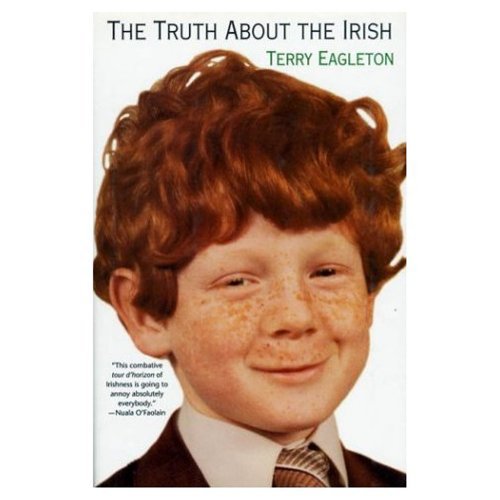
YA-Who was Maud Gonne? What is a bodhr n? What is the explanation for the phrase "Celtic tiger?" Eagleton offers his views on these and other things Irish in this very readable, sometimes irreverent book. Using an encyclopedic format, he covers the entire alphabet in this slim volume. He starts, naturally, with alcohol. "The image of the Irish as heavy drinkers," he insists, "was often based on Irish immigrants abroad rather than those at home. And immigrants have sorrows they need to drown." Along the way to the letter Z, he discusses such matters as "hedge schools," where Catholic children received their education, usually outdoors, in the era of British rule; "Kells, Book of," regarded by some as decadent because of its obsessive attention to art; "Patrick," Ireland's patron saint, about whom very little is actually known; and other interesting and amusing sidelights to Irish society and culture. The articles are short, ranging from one paragraph to five pages, and are interspersed with humorous line drawings. The size of the book, the length and style of the articles, and the very engaging boy on the cover will appeal to YAs with any interest at all in the Emerald Isle.-Pamela B. Rearden, Centreville Regional Library, Fairfax County, VA
Copyright 2000 Cahners Business Information, Inc.
Although arranged in an A-to-Z format under such words as "oirish," "blarney," and "famine" and labeled as humor by the publisher, this is more insightful and even scathing than sidesplitting. The prolific Irish literary scholar (English, Oxford) has taken on all of the myths and shibboleths of his former homeland and exposed them with his caustic wit. Leprechauns, fairies, and "begorrah" are the first to go, but Eagleton also tackles unemployment, the Irish temperament, literary idols such as Joyce and Yeats, and the morass of Irish politics, northern and southern. Although he inevitably tends to oversimplify, and the level of previous knowledge required varies from entry to entry, Eagleton gives a realistic, no-shamrocks-and-shillelaghs view of life in modern Ireland. Previously published in Ireland, this work includes line drawings by Tom Mathews. Recommended for academic and specialized collections.
-Shelley Cox, Southern Illinois Univ., Carbondale
Copyright 2000 Reed Business Information, Inc.
Eagleton's very cheeky look at the Irish tickles as it informs. Relating the A to Zs of Irish life and culture in brief essays arranged by subject, the Oxford literature professor (Heathcliffe and the Great Hunger; Literary Theory; etc.) employs a mix of statistics and playful humor to point out that, among other things, the Irish are not the biggest drinkers in the world (except for Greece and Italy, they have the lowest per-capita consumption in the E.U.). Avowed revolutionaries, they harbor a tendency, says Eagleton, toward ineptitude: in the 1916 Easter Rebellion "the rebels themselves were mostly poets and intellectuals, rarely the most promising material for a military scrap." Yet they have a fine tradition of strong, independent women, from the pirate Grace O'Malley of the 16th century to revolutionary Maud Gonne and presidents Robinson and MacAleese in the 20th century. Fond of having a good time, the Irish tend to be very religious--when they aren't in one of their anti-clerical moods. The common expletive "fugghan" is the closest most of the population comes to using Gaelic (a Welsh word meaning "wild, untamed"). Eagleton emphasizes that the Irish are proud of their new economic firepower, dubbing themselves the "Celtic Tiger" and making an industry out of James Joyce, who fled Ireland to get away from them. With wry affection, he traces the roots of many customs in Ireland's history as an impoverished colony, and observes that its people may be changing with the country's recent prosperity. The Ancient Order of Hibernians may despise Eagleton's candor, but most Irish will greet it with a smile and a wink. (Mar.)
Copyright 2000 Cahners Business Information, Inc.
„Über diesen Titel“ kann sich auf eine andere Ausgabe dieses Titels beziehen.
Suchergebnisse für The Truth About the Irish

Beispielbild für diese ISBN
The Truth about the Irish
Anbieter: World of Books (was SecondSale), Montgomery, IL, USA
Verkäuferbewertung 5 von 5 Sternen

Hardback. Zustand: Fair. If you're looking for a field guide to leprechauns, The Truth About the Irish is not the book for you. But if you can handle a frank and funny look into the minds and hearts of Irish people, you've been touched by that fabled Irish luck. Covering all things Irish from Blarney to Yeats, renowned literary and cultural critic Terry Eagleton separates the myths from the reality with his priceless blend of sidesplitting humor, caustic commentary, and the honest lowdown on the beloved and bewildering country of Ireland. Artikel-Nr. 00103510027
Gebraucht kaufen
EUR 4,49
Versand gratis
Versand innerhalb von USA
Versand innerhalb von USA
Anzahl: 1 verfügbar
Beispielbild für diese ISBN
The Truth about the Irish
Anbieter: World of Books (was SecondSale), Montgomery, IL, USA
Verkäuferbewertung 5 von 5 Sternen
Hardback. Zustand: Good. If you're looking for a field guide to leprechauns, The Truth About the Irish is not the book for you. But if you can handle a frank and funny look into the minds and hearts of Irish people, you've been touched by that fabled Irish luck. Covering all things Irish from Blarney to Yeats, renowned literary and cultural critic Terry Eagleton separates the myths from the reality with his priceless blend of sidesplitting humor, caustic commentary, and the honest lowdown on the beloved and bewildering country of Ireland. Artikel-Nr. 00099787126
Gebraucht kaufen
EUR 4,49
Versand gratis
Versand innerhalb von USA
Versand innerhalb von USA
Anzahl: 1 verfügbar
Beispielbild für diese ISBN
The Truth about the Irish
Anbieter: World of Books (was SecondSale), Montgomery, IL, USA
Verkäuferbewertung 5 von 5 Sternen
Hardback. Zustand: Very Good. If you're looking for a field guide to leprechauns, The Truth About the Irish is not the book for you. But if you can handle a frank and funny look into the minds and hearts of Irish people, you've been touched by that fabled Irish luck. Covering all things Irish from Blarney to Yeats, renowned literary and cultural critic Terry Eagleton separates the myths from the reality with his priceless blend of sidesplitting humor, caustic commentary, and the honest lowdown on the beloved and bewildering country of Ireland. Artikel-Nr. 00104665330
Gebraucht kaufen
EUR 4,49
Versand gratis
Versand innerhalb von USA
Versand innerhalb von USA
Anzahl: 4 verfügbar
Beispielbild für diese ISBN
The Truth About the Irish
Verlag:
St. Martin's Press (edition 1), 2000
ISBN 10: 0312254881
ISBN 13: 9780312254889
Gebraucht
Hardcover
Anbieter: BooksRun, Philadelphia, PA, USA
Verkäuferbewertung 5 von 5 Sternen
Hardcover. Zustand: Very Good. 1. With dust jacket. It's a well-cared-for item that has seen limited use. The item may show minor signs of wear. All the text is legible, with all pages included. It may have slight markings and/or highlighting. Artikel-Nr. 0312254881-11-1-29
Gebraucht kaufen
EUR 4,75
Versand gratis
Versand innerhalb von USA
Versand innerhalb von USA
Anzahl: 2 verfügbar
Beispielbild für diese ISBN
The Truth About the Irish
Anbieter: Wonder Book, Frederick, MD, USA
Verkäuferbewertung 5 von 5 Sternen
Zustand: Very Good. Very Good condition. Very Good dust jacket. A copy that may have a few cosmetic defects. May also contain light spine creasing or a few markings such as an owner's name, short gifter's inscription or light stamp. Artikel-Nr. V01C-03303
Gebraucht kaufen
EUR 6,41
Versand gratis
Versand innerhalb von USA
Versand innerhalb von USA
Anzahl: 1 verfügbar
Beispielbild für diese ISBN
Truth about the Irish
Anbieter: Better World Books, Mishawaka, IN, USA
Verkäuferbewertung 5 von 5 Sternen
Zustand: Very Good. Pages intact with possible writing/highlighting. Binding strong with minor wear. Dust jackets/supplements may not be included. Stock photo provided. Product includes identifying sticker. Better World Books: Buy Books. Do Good. Artikel-Nr. 16171517-20
Gebraucht kaufen
EUR 6,56
Versand gratis
Versand innerhalb von USA
Versand innerhalb von USA
Anzahl: 1 verfügbar
Beispielbild für diese ISBN
The Truth About the Irish
Anbieter: ThriftBooks-Atlanta, AUSTELL, GA, USA
Verkäuferbewertung 5 von 5 Sternen
Hardcover. Zustand: Very Good. No Jacket. May have limited writing in cover pages. Pages are unmarked. ~ ThriftBooks: Read More, Spend Less. Artikel-Nr. G0312254881I4N00
Gebraucht kaufen
EUR 6,66
Versand gratis
Versand innerhalb von USA
Versand innerhalb von USA
Anzahl: 1 verfügbar
Beispielbild für diese ISBN
THE TRUTH ABOUT THE IRISH
Verlag:
NY, St. Martin's Press, (March 2000),, 2000
ISBN 10: 0312254881
ISBN 13: 9780312254889
Gebraucht
Hardcover
Anbieter: Alkahest Books, Deerfield, IL, USA
Verkäuferbewertung 5 von 5 Sternen
Hardcover. NY, St. Martin's Press, (March 2000), 2000. Hardcover. first U. S. ed. Pages 181 pp.,8vo, hardcover, first U. S. ed. Book and dust jacket in fine condition. Review slip laid in. ISBN: 0-312-25488-1. Artikel-Nr. 7891
Gebraucht kaufen
EUR 9,17
EUR 6,24 Versand
Versand innerhalb von USA
Versand innerhalb von USA
Anzahl: 1 verfügbar