
Verwandte Artikel zu Large Target
Inhaltsangabe
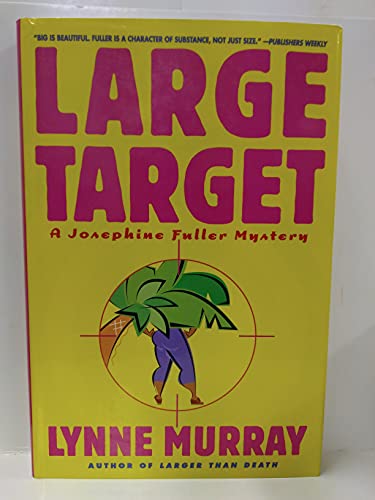
Lynne Murray's first mystery featuring Josephine Fuller--published by a small press-- netted an astounding 12,000 hardcover copies! In a heated auction, St. Martin's bought paperback rights and ultimately secured a multi-book hard/soft deal for future Josephine Fuller mysteries. We couldn't be happier to have such a fun, fresh and well reviewed series.
Josephine Fuller is a "woman of size" and proud of it. Working as an investigator for San Diego philanthropist Alicia Madrone, she evaluates potential charities worthiness of Ms. Madrone's money and does the occasional odd favor. Now Josephine is asked to look into a young lady's involvement with a mysterious band of do-gooders. Its' an easy job that quickly gets messy.
Josephine Fuller is a "woman of size" and proud of it. Working as an investigator for San Diego philanthropist Alicia Madrone, she evaluates potential charities worthiness of Ms. Madrone's money and does the occasional odd favor. Now Josephine is asked to look into a young lady's involvement with a mysterious band of do-gooders. Its' an easy job that quickly gets messy.
Die Inhaltsangabe kann sich auf eine andere Ausgabe dieses Titels beziehen.
Über die Autorin bzw. den Autor
Lynne Murray was born in Decatur, Illinois and grew up in Texas, Alaska, Washington and Southern California. She now lives in San Francisco. She has published numerous articles in local and national newspapers and magazines and has written and directed a play. Her first Josephine Fuller Mystery, Larger Than Death, is available from St. Martin's Press.
Auszug. © Genehmigter Nachdruck. Alle Rechte vorbehalten.
A woman of my size is supposed to be invisible—a factor that often proves useful in my line of work. My job is philanthropic troubleshooting. Such inquiries have to be discreet to be worth anything at all. As a woman weighing over two hundred pounds, my very existence bothers some people to the point where they erase me from the landscape. They look, and turn away. So I do my job, go home, take off the please-ignore-me black polyester pantsuit, and put on my preferred red silk lounging pajamas.
My name is Josephine Fuller and I make my living as an investigator of sorts, judging the worthiness of candidates for the charitable grants of Alicia Madrone, a woman whose personal fortune exceeds the gross national product of several small developing nations.
It was a June Sunday in San Diego when I went back to work—one month after my best friend, Nina, was murdered. She was a second mother to me. My own mother had been dead two years when I first met Nina, selling plus-sized clothes from her Pike’s Place Market store in Seattle, looking like the kind of blond cherub Renaissance painters adored. She lived her life as a woman of size who never apologized or compromised. I was a miserable fifteen year-old when we met and Nina taught me how to be a confident large woman. It wasn’t right that she should be gone from the world. Rather than consolation, it seemed a kind of twisted irony that I had inherited her cat along with her worldly possessions. Worse yet, I had a yearning for her grieving lover. I just wanted everything back the way it had been. Leaving Seattle wouldn’t bring my friend back to life. But if I buried myself in my work at least I could avoid thinking about it for a while.
So I escaped. Mrs. Madrone welcomed me back with an assignment to make some confidential inquiries in San Diego. I brought the cat; in the depth of grief I couldn’t bear to part with him. I wound up in a Point Loma house party trying to blend into the wallpaper, hoping to discreetly discover for my employer whether a friend’s daughter was, to put it bluntly, insane.
I took a cab from the San Diego Airport across the Coronado Bridge to Mrs. Madrone’s rarified hideout—a Southern California version of an Italian villa built around a fountain in a tiled courtyard. It functioned like a small hotel, though most of the guests were traveling executives in the Madrone corporate empire. Once in the room, I opened Raoul’s cat carrier and checked on the tranquilized gray Persian. He was snoring. I left food, water, and litter within easy reach.
The top floor had been customized for Mrs. Madrone’s wheelchair with ramps and hardwood floors. They hadn’t done anything, however, to accommodate her personal assistant’s lean height. Ambrose had to duck his immaculately barbered red head to lead me through the door to Mrs. Madrone’s private apartment. His laser blue eyes hadn’t relaxed in the mellow San Diego afternoon. He acknowledged the June climate to the point of wearing all white cotton, a shirt with a banded collar and trousers that looked vaguely Edwardian, as if he planned to take his coffee break with Vita Sackville-West. He showed me into a room bathed in sunlight, the central heating cranked up hot enough to grow orchids. I’d been in enough conversations with Mrs. Madrone by now to expect to sweat.
She wheeled her chair around to face me. She had been looking out over San Diego Harbor’s turquoise waters. It had been over a month since her attendance at my friend’s funeral, a gesture that both touched me deeply and surprised the hell out of me. As pale and drawn as ever, from her once-blond gray hair to her barely pink lips, her sharp dark eyes held an element of anxiety that I had never seen before.
“Sally Rhymer and I were at school together,” she said. “She and the admiral are divorced now, she won’t be at the gathering this afternoon. But Sally is worried about her daughter—little Amy. That’s how I think of her, though she’s a grown woman with a child of her own. Ambrose will give you the information. Amy has begun spending time away from her husband and young child to work with dying people. This, uh, calling . . . Does that sound sane to you?”
“I don’t know. Is it a religious thing?”
“If so, it’s something she picked up recently,” Mrs. Madrone said, classifying religion with communicable diseases.
She waited for further comment.
“I’m no expert,” I managed to say.
“It’s common sense I’m hoping for here,” Mrs. Madrone said, worrying a thread on her sweater sleeve. “Go talk to her, see what you think. She’ll be at her brother, Dwight’s, house. Sally is coming over in the morning. We can hear your impressions then.” She turned her chair toward the window to signal that our business was done. Mrs. Madrone never wasted words.
On the way out, Ambrose handed me an information packet, including a map and the keys to Mrs. Madrone’s silver Lexus. He gave me brief instructions about how to deactivate the alarm with the key chain remote to keep the car from yelping. It did anyway, of course, sounding like an annoyed bloodhound.
Dwight and Colleen Rhymer lived at the northern end of the Point Loma peninsula, up from the Naval Training Center. Parking the car near their house, I mentally thanked Ambrose for suggesting that I borrow the Lexus. The silver status symbol slipped right in and looked at home with the cluster of high-priced Detroit and foreign metal parked in front of the house. Ambrose was usually right about these things.
A black Lincoln Town Car with a “Two Star” vanity license plate was parked on two gravel strips with grass growing between them, an old-fashioned driveway that ran alongside the house to a just-visible backyard cottage.
A deeply tanned, coltishly thin woman greeted me at the door, peering out from under brown bangs that hid her eyebrows. She wore a casually elegant white tank top with gold shorts roughly the same color as the heavy gold-link chains around her neck and wrist. She smiled inquiringly at me. Behind her I could hear music, a Frank Sinatra ballad, competing with a babble of party voices. I wondered if the woman in shorts was wary of me. Standing on her doorstep in a turquoise raw silk blouse and skirt I must have looked as though the missionary’s wife had dressed up one of Gauguin’s South Sea island ladies and sent her round to distribute pamphlets. The pearl comb holding my hair up and the matching pearl-with-seashell earrings put me over the top. I was way overdressed.
“Oh, yes,” she said, standing aside and beckoning me in. “Mrs. Madrone’s assistant called and said you’d meet Amy here. I’m Colleen Rhymer, Dwight’s wife.”
“Beautiful house you have,” I said, stepping into the foyer and taking in the cathedral ceilings and polished wood floor that continued up a winding stairway to the next level balcony. Any reply she might have made vanished, drowned out by the deafening roar of an airplane that vibrated the Venetian blinds with the force of a minor earthquake.
“Amazingly inexpensive, too—and every twenty minutes or so I’m reminded why.” She made a sardonic mouth and raised her eyebrows even farther into her bangs.
I laughed sympathetically, and she beckoned me along the hall. “Still, this is paradise compared to most of the places Dwight has been stationed.” We passed mounted color photos of battleships, aircraft carriers, and fighter jets to a back bedroom. “You can put your things here if you’d like.”
I left my purse on the bed with my sweater over it. I lingered looking out the window where a flagstone patio gave way to a few cactus plants bordering the backyard cottage.
“Did the property come with an extra house?”
She raised her eyebrows up under her bangs again. “Yes, we can have our in-laws come and visit forever if we want to. Except that wouldn’t be wise because we do have weapons in the house. Come on, let’s put a drink in your hand so you’ll fit in.”
Either she was always sarcastic, or sensed a kindred spirit. Or maybe Colleen Rhymer was so over-the-top angry today that she was letting off steam in front of total strangers and she simply didn’t give a damn. I liked her already.
She led me past a carpeted dining room where a few guests were grazing at a buffet. I followed her into the kitchen. A tall, stout man with lizard-tanned skin straightened abruptly and shut the kitchen cupboard. His startlingly pale blue eyes glared at us. He turned on his heel and left the kitchen.
“My father-in-law, the admiral,” Colleen Rhymer said with a wave and slight bow, seemingly introducing me to the man’s retreating backside. “An hour ago he switched from beer to diet soda with great public fanfare. But he has to splash some bourbon into the soda every half hour or so. Come on, you’ll want to meet Dwight.”
I took a can of soda from an ice chest and followed her into the living room. It was a bit early for alcohol. Dwight was even taller than his father and substantially leaner, but still a teddy bear next to his thin wife. He had the same ruddy complexion, a bit less sunbaked, and the same silvery-blue eyes. I knew he was a navy officer. His dark hair was regulation short and his polo shirt and madras pants had the ironed look of a uniform. Everything this man owned would be a uniform of some sort. He shook my hand, only making eye contact for a distractedly polite second. His nails were bitten to nearly nothing. He kept glancing past me, over my shoulder across the living room. I was invisible already.
Of course maybe he was staring at his father. The stocky white-haired admiral had parked his soda and picked up a Minicam. He was now down on the floor aiming it up the skirt o...
„Über diesen Titel“ kann sich auf eine andere Ausgabe dieses Titels beziehen.
Suchergebnisse für Large Target

Beispielbild für diese ISBN
Large Target: A Josephine Fuller Mystery
Anbieter: ThriftBooks-Atlanta, AUSTELL, GA, USA
Verkäuferbewertung 5 von 5 Sternen

Hardcover. Zustand: Very Good. No Jacket. Former library book; May have limited writing in cover pages. Pages are unmarked. ~ ThriftBooks: Read More, Spend Less. Artikel-Nr. G0312254563I4N10
Gebraucht kaufen
EUR 6,82
Versand gratis
Versand innerhalb von USA
Versand innerhalb von USA
Anzahl: 1 verfügbar
Beispielbild für diese ISBN
Large Target : A Josephine Fuller Mystery
Anbieter: Better World Books, Mishawaka, IN, USA
Verkäuferbewertung 5 von 5 Sternen
Zustand: Good. Former library copy. Pages intact with minimal writing/highlighting. The binding may be loose and creased. Dust jackets/supplements are not included. Includes library markings. Stock photo provided. Product includes identifying sticker. Better World Books: Buy Books. Do Good. Artikel-Nr. 45654176-6
Gebraucht kaufen
EUR 8,58
Versand gratis
Versand innerhalb von USA
Versand innerhalb von USA
Anzahl: 1 verfügbar
Beispielbild für diese ISBN
Large Target: A Josephine Fuller Mystery
Anbieter: Robinson Street Books, IOBA, Binghamton, NY, USA
Verkäuferbewertung 4 von 5 Sternen

Hardcover. Zustand: As New. Prompt Shipment, shipped in Boxes, Tracking PROVIDEDFirst edition. Near fine rear endpaper creased in fine dust jacket. Artikel-Nr. bing43626
Gebraucht kaufen
EUR 12,43
EUR 8,49 Versand
Versand innerhalb von USA
Versand innerhalb von USA
Anzahl: 1 verfügbar
Beispielbild für diese ISBN
Large Target: A Josephine Fuller Mystery
Anbieter: Robinson Street Books, IOBA, Binghamton, NY, USA
Verkäuferbewertung 4 von 5 Sternen
Hardcover. Zustand: Very Good. Prompt Shipment, shipped in Boxes, Tracking PROVIDEDvery good condition with clean pages and dust jacket. Artikel-Nr. ware47sm0005
Gebraucht kaufen
EUR 12,43
EUR 8,49 Versand
Versand innerhalb von USA
Versand innerhalb von USA
Anzahl: 1 verfügbar
Beispielbild für diese ISBN
LARGE TARGET.
Verlag:
St Martin's, New York, 2000
ISBN 10: 0312254563
ISBN 13: 9780312254568
Gebraucht
Hardcover
Erstausgabe
Signiert
Anbieter: Bookfever, IOBA (Volk & Iiams), Ione, CA, USA
Verkäuferbewertung 5 von 5 Sternen
Zustand: FINE. First printing. Second mystery featuring Josephine Fuller, a 'woman of size' and proud of it, set in southern California. Promotional flyer laid in. SIGNED on the title page in silver. Fine in fine dust jacket. Artikel-Nr. 30622
Gebraucht kaufen
EUR 27,15
EUR 4,42 Versand
Versand innerhalb von USA
Versand innerhalb von USA
Anzahl: 1 verfügbar
Beispielbild für diese ISBN
Large Target
Anbieter: Revaluation Books, Exeter, Vereinigtes Königreich
Verkäuferbewertung 5 von 5 Sternen
Hardcover. Zustand: Brand New. 258 pages. 9.75x6.75x1.50 inches. In Stock. Artikel-Nr. 0312254563
Neu kaufen
EUR 80,35
EUR 14,77 Versand
Versand von Vereinigtes Königreich nach USA
Versand von Vereinigtes Königreich nach USA
Anzahl: 1 verfügbar