
Verwandte Artikel zu The Last English King
Inhaltsangabe
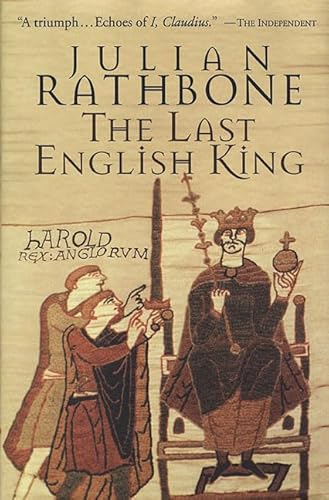
On September 27, 1066, Duke William of Normandy sailed for England with hundreds of ships and over 8,000 men. King Harold of England, weakened by a ferocious Viking invasion from the north, could muster little defense. At the Battle of Hastings of October 14, he was outflanked, quickly defeated, and killed by William's superior troops. The course of English history was altered forever.
Three years later, Walt, King Harold's only surviving bodyguard, is still emotionally and physically scarred by the loss of his king and his country. Wandering through Asia Minor, headed vaguely for the Holy Land, he meets Quint, a renegade monk with a healthy line of skepticism and a hearty appetite for knowledge. It is he who persuades Walt, little by little, to tell his extraordinary story.
And so begins a roller-coaster ride into an era of enduring fascination. Weaving fiction round fact, Julian Rathbone brings to vibrant, exciting, and often amusing life the shadowy figures and events that preceded the Norman Conquest. We see Edward, confessing far more than he ever did in the history books. We meet the warring nobles of Mercia and Wessex; Harold and his unruly clan; Canute's descendants with their delusions of grandeur; predatory men, pushy women, subdued Scots , and wily Welsh. And we meet William of Normandy, a psychotic thug with interesting plans for the "racial sanitation" of the Euroskepics across the water.
Peppered with discussions on philosophy. dentistry, democracy, devils, alcohol, illusions, and hygiene, The Last English King raises issues, both daring and delightful, that question the nature of history itself. Where are the lines between fact, interpretation, and re-creation? Did the French really stop for a two-hour lunch during the Battle of Hastings?
Die Inhaltsangabe kann sich auf eine andere Ausgabe dieses Titels beziehen.
Über die Autorin bzw. den Autor
Julian Rathbone is the author of many books, including Joseph and King Fisher Lives, both of which were shortlisted for the Booker Prize. He lives in Dorset, England.
Rezensionen
For over 25 years, Rathbone has been producing political thrillers and was nominated for the Booker Prize twice. In his new novel, he takes us to England at a time when "the civilization of the English reached its zenithAit turned its back on the savagery of war and embraced hedonistic willingness to live as well as one can." After losing his honor and his hands at the Battle of Hastings in 1066 while attempting to defend King Harold II of England against the invader, William of Normandy, Walt sets out on a personal pilgrimage across Europe. Joined in his self-imposed exile by Quint, a renegade, apostate monk, he tells his story of politics, intrigue, and battle as seen through the eyes of a king's bodyguard. Rathbone's spare style aptly expresses the horror of war and its aftermath. Anachronisms abound in this work and were deliberately included by the author. Some readers may be amused; others will find them a distraction. For larger historical fiction collections.AJane Baird, Anchorage Municipal Libs., AK
Copyright 1999 Reed Business Information, Inc.
Though better known for his political thrillers, British writer Rathbone is also the author of several mainstream novels, two of which (Joseph and King Fisher Lives) were shortlisted for the Booker Prize. This richly detailed historical novel tells the story of the great Norman-Saxon battle of Hastings in 1066, as remembered by Walt Edwinson, or the Wanderer, one of King Harold Godwinson's bodyguards. Battle scarred and numb, Walt is plagued with guilt for merely losing his hand and not his life when Harold is killed at Hastings. Instead of returning to the wife and child who desperately need him in Norman-ruled England, Walt condemns himself to wander, since his desire to live and return to his wife and home are what caused him to fail his King. In Byzantium, Walt encounters a traveling ex-monk and scholar, Quint ("nothing more, nothing less"), and together they embark on a vividly described journey through the medieval eastern end of the Mediterranean. Quint's impressive knowledge of religion and philosophy and his anachronistic grasp of the tenets of modern psychology help fill in the blanks of the story that Walt recounts: of the reign of King Edward, the ascent of William the Bastard and King Harold and the historic battle for the throne of England. The story suggests that Walt at last finds redemption through the retelling, despite the novel's tragic ending (revealed in the book's first chapter), but Walt's friendship with Quint also provides important consolation. Rathbone takes considerable historical liberties, writing in contemporary vernacular modern prose and painting King Edward as a man more interested in Harold's fetching brother Tostig than in the sister, whom he is slated to marry. However, Rathbone defends his decisions convincingly in an author's note, and his narrative presents an interesting interpretation of a tumultuous period in English history. (Nov.)
Copyright 1999 Reed Business Information, Inc.
William the Conqueror defeated King Harold at the Battle of Hastings in 1066, and three years later Walt, one of Harold's personal guards, is wandering continental Europe as a broken man. He encounters Quint, an ex-monk, and together they decide to travel to the Holy Land. On their journey, Walt finally begins to heal by telling his story to Quint, who, in turn, invents some very modern psychological terms to describe Walt's condition while he relates this testosterone-driven narrative. Walt was taken from his home as a child and trained to serve his king, and his entire life revolved around Harold. He was an eyewitness to Harold's and William's machinations to usurp power from each other, and he is now overwhelmed by guilt because he survived while his hero was killed in battle. With this personal account of the rivalry of two great leaders, Rathbone presents an intimate perspective on key historical events, offers a portrait of Harold as a compassionate leader, and paints a vivid picture of medieval life. Patty Engelmann
A dark-hued lament for the loss of jolly old England a millennium ago, when psychopath William the Conqueror used a bagful of tricks to best good King Harold, this saga from the wide-ranging Rathbone (Blame Hitler, p. 1076, etc.) has its moments but can't sustain them The story comes out in the halting, painful recollections of Walt, one of Harold's inner circle of advisers and bodyguards who has wandered far from the Battle at Hastings in 1066, where he lost his right hand as well as his king. Dazed and feverish, Walt has crossed Europe before meeting fellow traveler Quint outside of Constantinople; the ex-monk, realizing Walt has within him a tale that will pass many a weary mile on the road, suggests he pay their way on a journey to the Holy Land. As Walt recalls the time leading up to the Norman invasion, when competing bids for the English throne gave rise to intrigues like the one that brought Harold to Normandy to be tricked by William's magician into swearing an oath of fealty that would later haunt him, an adventure en route brings them into the company of that same tricksterwhom Walt had seen drop dead in Hastings. The conjurer expresses remorse for his earlier role and offers his own memories of William's preparations, while Walt describes the desperate days after Harold's coronation, when, faced not only with the Norman threat but another from the north, he had also to quell dissent from within. Walt, healing slowly as he lets go of his grief at not having died with his king, decides to go home before reaching Jerusalem, but not before providing the blow-by-blow details of Harold's heroic last stand. Popping the clutch once too often in shifting between memory, history, and life on the road, but, still, an often haunting evocation of a tumultuous time of glory and grief. -- Copyright ©1999, Kirkus Associates, LP. All rights reserved.
„Über diesen Titel“ kann sich auf eine andere Ausgabe dieses Titels beziehen.
Suchergebnisse für The Last English King

Beispielbild für diese ISBN
The Last English King
Anbieter: World of Books (was SecondSale), Montgomery, IL, USA
Verkäuferbewertung 5 von 5 Sternen

Hardback. Zustand: Good. Artikel-Nr. CIN0312242131G
Gebraucht kaufen
EUR 4,11
Versand gratis
Versand innerhalb von USA
Versand innerhalb von USA
Anzahl: 1 verfügbar
Beispielbild für diese ISBN
The Last English King
Anbieter: ThriftBooks-Dallas, Dallas, TX, USA
Verkäuferbewertung 5 von 5 Sternen
Hardcover. Zustand: Good. No Jacket. Pages can have notes/highlighting. Spine may show signs of wear. ~ ThriftBooks: Read More, Spend Less. Artikel-Nr. G0312242131I3N00
Gebraucht kaufen
EUR 6,54
Versand gratis
Versand innerhalb von USA
Versand innerhalb von USA
Anzahl: 1 verfügbar
Beispielbild für diese ISBN
The Last English King
Verlag:
St. Martin's Press, 1999
ISBN 10: 0312242131
ISBN 13: 9780312242138
Gebraucht
Hardcover
Erstausgabe
Anbieter: Better World Books, Mishawaka, IN, USA
Verkäuferbewertung 5 von 5 Sternen
Zustand: Good. 1st. Former library copy. Pages intact with minimal writing/highlighting. The binding may be loose and creased. Dust jackets/supplements are not included. Includes library markings. Stock photo provided. Product includes identifying sticker. Better World Books: Buy Books. Do Good. Artikel-Nr. 3181358-6
Gebraucht kaufen
EUR 7,25
Versand gratis
Versand innerhalb von USA
Versand innerhalb von USA
Anzahl: 1 verfügbar
Beispielbild für diese ISBN
The Last English King
Verlag:
St. Martin's Press, 1999
ISBN 10: 0312242131
ISBN 13: 9780312242138
Gebraucht
Hardcover
Erstausgabe
Anbieter: Better World Books, Mishawaka, IN, USA
Verkäuferbewertung 5 von 5 Sternen
Zustand: Good. 1st. Pages intact with minimal writing/highlighting. The binding may be loose and creased. Dust jackets/supplements are not included. Stock photo provided. Product includes identifying sticker. Better World Books: Buy Books. Do Good. Artikel-Nr. 9739667-75
Gebraucht kaufen
EUR 7,25
Versand gratis
Versand innerhalb von USA
Versand innerhalb von USA
Anzahl: 1 verfügbar
Beispielbild für diese ISBN
The Last English King
Anbieter: World of Books (was SecondSale), Montgomery, IL, USA
Verkäuferbewertung 5 von 5 Sternen
Hardback. Zustand: Very Good. Artikel-Nr. CIN0312242131VG
Gebraucht kaufen
EUR 10,93
Versand gratis
Versand innerhalb von USA
Versand innerhalb von USA
Anzahl: 1 verfügbar
Beispielbild für diese ISBN
The Last English King
Verlag:
St. Martin's Press, 1999
ISBN 10: 0312242131
ISBN 13: 9780312242138
Gebraucht
Hardcover
Erstausgabe
Anbieter: Better World Books Ltd, Dunfermline, Vereinigtes Königreich
Verkäuferbewertung 5 von 5 Sternen
Zustand: Very Good. 1st. Former library copy. Pages intact with possible writing/highlighting. Binding strong with minor wear. Dust jackets/supplements may not be included. Includes library markings. Stock photo provided. Product includes identifying sticker. Better World Books: Buy Books. Do Good. Artikel-Nr. 12415311-75
Gebraucht kaufen
EUR 5,83
EUR 5,96 Versand
Versand von Vereinigtes Königreich nach USA
Versand von Vereinigtes Königreich nach USA
Anzahl: 1 verfügbar
Beispielbild für diese ISBN
The Last English King
Anbieter: WorldofBooks, Goring-By-Sea, WS, Vereinigtes Königreich
Verkäuferbewertung 5 von 5 Sternen
Paperback. Zustand: Very Good. The book has been read, but is in excellent condition. Pages are intact and not marred by notes or highlighting. The spine remains undamaged. Artikel-Nr. GOR006569894
Gebraucht kaufen
EUR 20,11
EUR 6,68 Versand
Versand von Vereinigtes Königreich nach USA
Versand von Vereinigtes Königreich nach USA
Anzahl: 1 verfügbar