
Verwandte Artikel zu The Key: How to Write Damn Good Fiction Using the Power...
Inhaltsangabe
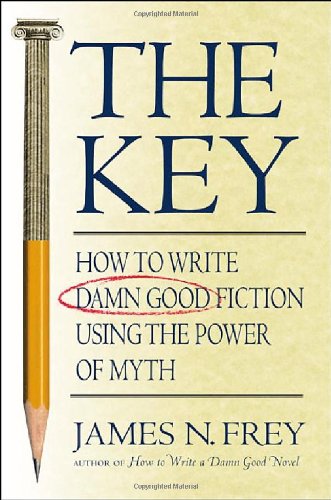
In his widely read guides How to Write a Damn Good Novel and How to Write a Damn Good Novel II: Advanced Techniques, popular novelist and fiction-writing coach James N. Frey showed tens of thousands of writers how--starting with rounded, living, breathing, dynamic characters--to structure a novel that sustains its tension and development and ends in a satisfying, dramatic climax.
Now, in The Key, Frey takes his no-nonsense, "Damn Good" approach and applies it to Joseph Campbell's insights into the universal structure of myths. Myths, says Frey, are the basis of all storytelling, and their structures and motifs are just as powerful for contemporary writers as they were for Homer. Frey begins with the qualities found in mythic heros--ancient and modern--such as the hero's special talent, his or her wound, status as an "outlaw," and so on. He then demonstrates how the hero is initiated--sent on a mission, forced to learn the new rules, tested, and suffers a symbolic death and rebirth--before he or she can return home. Using dozens of classical and contemporary novels and films as models, Frey shows how these motifs and forms work their powerful magic on the reader's imagination.
The Key is designed as a practical step-by-step guide for fiction writers and screen writers who want to shape their own ideas into a mythic story.
Now, in The Key, Frey takes his no-nonsense, "Damn Good" approach and applies it to Joseph Campbell's insights into the universal structure of myths. Myths, says Frey, are the basis of all storytelling, and their structures and motifs are just as powerful for contemporary writers as they were for Homer. Frey begins with the qualities found in mythic heros--ancient and modern--such as the hero's special talent, his or her wound, status as an "outlaw," and so on. He then demonstrates how the hero is initiated--sent on a mission, forced to learn the new rules, tested, and suffers a symbolic death and rebirth--before he or she can return home. Using dozens of classical and contemporary novels and films as models, Frey shows how these motifs and forms work their powerful magic on the reader's imagination.
The Key is designed as a practical step-by-step guide for fiction writers and screen writers who want to shape their own ideas into a mythic story.
Die Inhaltsangabe kann sich auf eine andere Ausgabe dieses Titels beziehen.
Über die Autorin bzw. den Autor
James N. Frey is the author of two internationally best-selling books on the craft of fiction writing, How to Write a Damn Good Novel and How to Write a Damn Good Novel II: Advanced Techniques, as well as nine novels. He has taught at the University of California at Berkeley, Extension, the Squaw Valley Community of Writers, and the Oregon Writers' Colony, and he is a featured speaker at writers' conferences throughout the United States and in Europe. He lives with his--he says, "truly heroic"--wife, Liza, in Berkeley, California.
Auszug. © Genehmigter Nachdruck. Alle Rechte vorbehalten.
The Key
1
The Awesome Power of Myth
The Storyteller's Magic
As a storyteller, you practice a kind of magic, the most powerful magic on earth. You are a mythopoet, a maker of myth, and it is myth that consciously and subconsciously guides every human being on this planet, for good or ill.
Bunk, you say. Myths are old and dead and have no meaning to modern man.
Better think again.
Think about communism and its mythology. One-fourth of the people on earth still live under communism, despite the recent changes in Eastern Europe and the former Soviet Union. The communists constructed a mythology that they called "scientific." But as Martin Day in The Many Meanings of Myth (1984) points out, "The blissful perfection of its ultimate goal, anarchy, follows the party line of Elysium Islands of the Blest, Valhalla, Utopia, New Atlantis, Erewhon, and the Big Rock Candy Mountain."
Millions of people are being imprisoned and put to deathin the name of the communist myth in Cuba, Serbia, China, and Tibet. And many more will die in its name before the myth is dead and buried.
We in the West, too, have our mythologies. The Free Man, as an example. Think you're a "free" American? Tell it to the IRS.
Happiness is a new Buick, the ad men tell us. Smoking will make you good-looking and bristling with health, they told us for years, and look how many millions believed it! Thousands of deaths a year are caused by smoking in the United States, a catastrophe of epic proportions--yet the Marlboro Man ropes in scores of new smokers every hour. Martin Day concludes that modern man, "shorn of his rhetoric and his pretense," is governed by his mythical dreams just as much as are the "Trobriand Islanders and the Kwakiutl Indians."
Be careful when you say something is "just a myth."
The hundreds of Spanish conquistadors who gave their lives looking for the Fountain of Youth are ample testament to the power of myth. So were the Nirvana-seeking Buddhist monks in Saigon during the Vietnam War who poured gasoline on themselves and set themselves on fire while sitting in the lotus position. So are the screaming teenage girls at a rock concert. All have been swallowed up by mythic images.
Aping the mythic figures of John Wayne, Randolph Scott, and Hopalong Cassidy, young Americans a generation ago headed off to Vietnam to "kick a little ass." The myth of the all-powerful American cowboy hero ran into the brick wall of reality. It's no coincidence that as America came to the realization that the ass-kicking image of itself was false,the popularity of Western films and books collapsed. The myth of the invincible Western hero was dead.
Remember the story of Pandora from Greek mythology? She's the young woman who, out of curiosity, disobeyed a rule from On High and opened a box (some say a jar) she wasn't supposed to open, and in so doing let loose all the evils of the world.
You could search the wide world over, and you wouldn't find a single individual who thinks that the evils of the world can be blamed on poor, maligned Pandora. The old gal is dead now and is dismissed as "just a myth" by every single human being on the planet.
But you will have no trouble at all finding people who believe it is manifestly true that the evils of the world can be blamed on a young woman named Eve, who disobeyed a rule from On High and ate an apple she shouldn't have, and that brought evil into the world. To hundreds of millions of true believers, the Adam and Eve myth is absolutely, historically true. Millions of faithful believe it is as true as the fact that the sun shines in the daytime. For them, the Adam and Eve myth is a working myth.
In fact, the church to which I belong teaches that the Adam and Eve story happened to real people, just the way it's set down in the Good Book. In my church, if you dared suggest that the Adam and Eve business in the Garden of Eden was "just a myth" made up to explain the mysterious workings of nature to a primitive people, as is the case with Pandora, you would be hooted down, jeered, and branded a blasphemer; you might even be stoned in the parking lot.
When a myth is believed as true, it's a powerful force.People have been killing each other over myths and their interpretation since, well, who knows? Probably since before Pandora opened the box and before Eve tasted that juicy red pippin, which, by the way, many scholars now believe was actually a pomegranate.
Hundreds of millions of people in the world believe Muhammad leaped into Heaven, leaving behind a hole in the ground in the shape of a foot where he launched himself. They also believe that if you die in a jihad, a holy war, you go right to Heaven. In fact, millions of eager young men proved the force of the myth by charging machine guns while screaming, "God is great!" in one of the bloodiest wars in human history, the Iranian-Iraqi war of 1980 to 1988, which had 2.7 million casualties, including over a million deaths. To the soldiers who so gleefully martyred themselves, there was no question about it: the Muhammadan myth is manifestly true; Muhammad leaped into Heaven, and you can go there too if you die in a jihad.
Just a myth, you say?
Because of the power of men to create myth, Percy Shelley, the nineteenth-century poet, called poets and fiction writers "the unacknowledged legislators of the world."
When Goethe's The Sorrows of Young Werther came out in 1814, it was an instant success. It was the story of a young man so obsessed by an unrequited love that he kills himself--a monomythic story of a hero transformed (albeit in a negative way) by love. Over the next few decades, hundreds of young men were found dead with a pistol in one hand, a love note in the other, and a copy of Young Werther in their back pockets.
Just a myth, you say?
When Secretary of the Interior Seward met Harriet Beecher Stowe, author of Uncle Tom's Cabin (1852), he said, "So this is the young lady who started it all." He meant the War Between the States, of course. Her story, a monomythic masterpiece, was largely a product of her imagination; it depicted slavery as hell on earth and gave impetus to the abolitionist movement and the already-growing war fever.
So would you say her fantastic creation, which led to one of the bloodiest wars in history, was just a myth?
To say the pen is mightier than the sword is to trivialize the pen. The pen is far mightier than a sword; it's mightier than an atom bomb. Mightier than all the atom bombs ever created.
See Leni Riefenstahl's Triumph of the Will (1935), and you can see the effect of the Nazi myth on its followers. Myth indeed is a potent force.
You, as a fiction writer, have the pen in your hand. What you create may have an enormous impact on individuals, communities, nations, the world--and world history.
The ancient peoples of the world knew the power of the word. In the Old Testament, the Hebrew Scriptures, God created the heavens and the earth not by waving a magic wand, but by speaking words. The ancients believed that your soul was your breath; that words, created by breath, came from your soul, from the immortal part of your being; hence, they were sacred. And powerful.
The Gospel of John in the New Testament begins: In the beginning was the Word, and the Word was with God, and the Word was God.
And the Word ... was God.
Indeed it was. And still is.
The Evolution of Storytelling
Reflect for a moment on the first storytellers.
Human beings first began to bury objects with their dead--jewelry, weapons, pottery, and so on--around...
„Über diesen Titel“ kann sich auf eine andere Ausgabe dieses Titels beziehen.
Suchergebnisse für The Key: How to Write Damn Good Fiction Using the Power...

Beispielbild für diese ISBN
The Key: How to Write Damn Good Fiction Using the Power of Myth
Anbieter: World of Books (was SecondSale), Montgomery, IL, USA
Verkäuferbewertung 5 von 5 Sternen

Zustand: Very Good. Item in very good condition! Textbooks may not include supplemental items i.e. CDs, access codes etc. Artikel-Nr. 00109968292
Gebraucht kaufen
EUR 4,57
Versand gratis
Versand innerhalb von USA
Versand innerhalb von USA
Anzahl: 1 verfügbar
Beispielbild für diese ISBN
The Key: How to Write Damn Good Fiction Using the Power of Myth
Anbieter: World of Books (was SecondSale), Montgomery, IL, USA
Verkäuferbewertung 5 von 5 Sternen
Zustand: Acceptable. Item in acceptable condition! Textbooks may not include supplemental items i.e. CDs, access codes etc. Artikel-Nr. 00102450732
Gebraucht kaufen
EUR 4,57
Versand gratis
Versand innerhalb von USA
Versand innerhalb von USA
Anzahl: 1 verfügbar
Beispielbild für diese ISBN
The Key: How to Write Damn Good Fiction Using the Power of Myth
Anbieter: World of Books (was SecondSale), Montgomery, IL, USA
Verkäuferbewertung 5 von 5 Sternen
Zustand: Good. Item in good condition and has highlighting/writing on text. Used texts may not contain supplemental items such as CDs, info-trac etc. Artikel-Nr. 00084911195
Gebraucht kaufen
EUR 4,57
Versand gratis
Versand innerhalb von USA
Versand innerhalb von USA
Anzahl: 1 verfügbar
Beispielbild für diese ISBN
The Key: How to Write Damn Good Fiction Using the Power of Myth
Verlag:
St. Martin's Press (edition 1), 2000
ISBN 10: 0312241976
ISBN 13: 9780312241971
Gebraucht
Hardcover
Anbieter: BooksRun, Philadelphia, PA, USA
Verkäuferbewertung 5 von 5 Sternen
Hardcover. Zustand: Very Good. 1. With dust jacket. It's a well-cared-for item that has seen limited use. The item may show minor signs of wear. All the text is legible, with all pages included. It may have slight markings and/or highlighting. Artikel-Nr. 0312241976-11-1-29
Gebraucht kaufen
EUR 4,58
Versand gratis
Versand innerhalb von USA
Versand innerhalb von USA
Anzahl: 1 verfügbar
Beispielbild für diese ISBN
The Key: How to Write Damn Good Fiction Using the Power of Myth
Anbieter: ThriftBooks-Dallas, Dallas, TX, USA
Verkäuferbewertung 5 von 5 Sternen
Hardcover. Zustand: Very Good. No Jacket. Former library book; May have limited writing in cover pages. Pages are unmarked. ~ ThriftBooks: Read More, Spend Less. Artikel-Nr. G0312241976I4N10
Gebraucht kaufen
EUR 5,99
Versand gratis
Versand innerhalb von USA
Versand innerhalb von USA
Anzahl: 1 verfügbar
Beispielbild für diese ISBN
The Key: How to Write Damn Good Fiction Using the Power of Myth
Anbieter: ThriftBooks-Atlanta, AUSTELL, GA, USA
Verkäuferbewertung 5 von 5 Sternen
Hardcover. Zustand: Very Good. No Jacket. May have limited writing in cover pages. Pages are unmarked. ~ ThriftBooks: Read More, Spend Less. Artikel-Nr. G0312241976I4N00
Gebraucht kaufen
EUR 5,99
Versand gratis
Versand innerhalb von USA
Versand innerhalb von USA
Anzahl: 1 verfügbar
Beispielbild für diese ISBN
The Key: How to Write Damn Good Fiction Using the Power of Myth
Anbieter: ThriftBooks-Atlanta, AUSTELL, GA, USA
Verkäuferbewertung 5 von 5 Sternen
Hardcover. Zustand: Very Good. No Jacket. Missing dust jacket; May have limited writing in cover pages. Pages are unmarked. ~ ThriftBooks: Read More, Spend Less. Artikel-Nr. G0312241976I4N01
Gebraucht kaufen
EUR 5,99
Versand gratis
Versand innerhalb von USA
Versand innerhalb von USA
Anzahl: 1 verfügbar
Beispielbild für diese ISBN
The Key : How to Write Damn Good Fiction Using the Power of Myth
Verlag:
St. Martin's Press, 2000
ISBN 10: 0312241976
ISBN 13: 9780312241971
Gebraucht
Hardcover
Erstausgabe
Anbieter: Better World Books, Mishawaka, IN, USA
Verkäuferbewertung 5 von 5 Sternen
Zustand: Very Good. 1st. Former library copy. Pages intact with possible writing/highlighting. Binding strong with minor wear. Dust jackets/supplements may not be included. Includes library markings. Stock photo provided. Product includes identifying sticker. Better World Books: Buy Books. Do Good. Artikel-Nr. 10736275-75
Gebraucht kaufen
EUR 6,17
Versand gratis
Versand innerhalb von USA
Versand innerhalb von USA
Anzahl: 1 verfügbar
Beispielbild für diese ISBN
The Key : How to Write Damn Good Fiction Using the Power of Myth
Verlag:
St. Martin's Press, 2000
ISBN 10: 0312241976
ISBN 13: 9780312241971
Gebraucht
Hardcover
Erstausgabe
Anbieter: Better World Books: West, Reno, NV, USA
Verkäuferbewertung 5 von 5 Sternen
Zustand: Good. 1st. Former library copy. Pages intact with minimal writing/highlighting. The binding may be loose and creased. Dust jackets/supplements are not included. Includes library markings. Stock photo provided. Product includes identifying sticker. Better World Books: Buy Books. Do Good. Artikel-Nr. 5058549-6
Gebraucht kaufen
EUR 6,17
Versand gratis
Versand innerhalb von USA
Versand innerhalb von USA
Anzahl: 1 verfügbar
Beispielbild für diese ISBN
The Key: How to Write Damn Good Fiction Using the Power of Myth
Anbieter: Wonder Book, Frederick, MD, USA
Verkäuferbewertung 5 von 5 Sternen
Zustand: Very Good. Very Good condition. Like New dust jacket. A copy that may have a few cosmetic defects. May also contain light spine creasing or a few markings such as an owner's name, short gifter's inscription or light stamp. Artikel-Nr. V05B-06166
Gebraucht kaufen
EUR 6,41
Versand gratis
Versand innerhalb von USA
Versand innerhalb von USA
Anzahl: 1 verfügbar