
Verwandte Artikel zu Rebellion
Inhaltsangabe
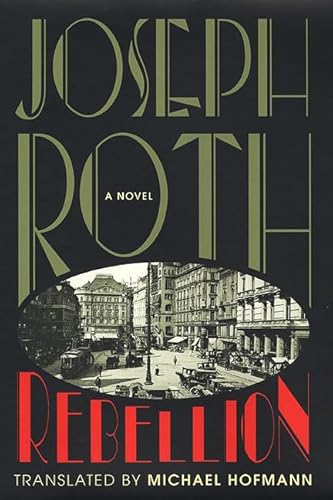
Andreas Pum, after losing a leg in World War I, returns home to play the barrel-organ for a living, only to have his beliefs in authority tested after he fights with a man of higher standing.
Die Inhaltsangabe kann sich auf eine andere Ausgabe dieses Titels beziehen.
Auszug. © Genehmigter Nachdruck. Alle Rechte vorbehalten.
1
THE 24TH MILITARY HOSPITAL was a cluster of shacks on the edge of the city. It would have taken an able-bodied man a good half hour’s walk to reach it from the end of the tramline. The tram went into the world, the big city and life. But to the inmates of the 24th Military Hospital the tram was out of reach.
They were blind or halt. They limped. They had shattered spines. They were waiting to have limbs amputated, or had recently had them amputated. The War was in the dim and distant past. They had forgotten about squad drill, about the Sergeant Major, the Captain, the Company, the Chaplain, the Emperor’s birthday, the parade, the trenches, going over the top. They had made their own individual peace with the enemy. Now they were readying themselves for the next war: against pain, against artificial limbs, against crippledom, against hunchbacks, against sleepless nights, and against the healthy and the hale.
Only Andreas Pum was content with things as they were. He had lost a leg and been given a medal. There were many who had no medal, even though they had lost more than merely a leg. They had lost both arms or both legs. Or they would be bedridden for the rest of their lives, because there was something the matter with their spinal fluid. Andreas Pum rejoiced when he saw the sufferings of the others.
He believed in a just god. One who handed out shrapnel, amputations, and medals to the deserving. Viewed in the correct light, the loss of a leg wasn’t so very bad, and the joy of receiving a medal was considerable. An invalid might enjoy the respect of the world. An invalid with a medal could depend on that of the government.
The government is something that overlies man like the sky overlies the earth. What comes from it may be good or ill, but it cannot be other than great and all-powerful, unknowable and mysterious, even though on occasion it may be understood by an ordinary person.
Some of his comrades curse at the government. According to them, they have been treated unjustly. As if the War hadn’t been a necessity! As if its consequences were not inevitably pain, amputations, hunger, and sickness! What were they grumbling about? They had no God, no Emperor, no Fatherland. They were no better than heathens. “Heathens” is the best term for someone who opposes the determinations of a government.
It was a warm Sunday morning in April, and Andreas Pum was sitting on one of the crude white wooden benches that had been put out on the lawn in front of the hospital shacks. Almost all of the other benches were occupied by two or three convalescents, sitting together and talking. Only Andreas was on his own, rejoicing in the designation he had come up with for his comrades.
They were heathens, no less than people who were sent to prison for perjury, theft, assault, or murder. What possessed people to kill, steal, swindle, and desert? The fact that they were heathens.
If someone had happened to ask Andreas just then what heathens are, he would have replied: criminals who are in prison, or perhaps still at large. Andreas Pum was highly delighted with his notion of “heathens.” The word satisfied him; it answered his swirling questions and solved many riddles. It absolved him of the necessity of continuing to reflect and to think about the others. Andreas was happy with his word. At the same time, it gave him a feeling of superiority to his comrades chattering away on the other benches. Some of them were more badly hurt and had no medals. Was that unjust? Why were they cursing? Why were they complaining? Were they worried about their future? If they continued to be so obdurate, they really would have every reason to worry. They were digging their own graves! Why should the government look out for its enemies? Himself, though, Andreas Pum, it surely would look out for.
And—while the sun moved briskly and confidently toward its zenith in the cloudless sky, becoming ever more radiant and even a little summery—Andreas Pum contemplated the years ahead. The government will have found him a little postage stamp concession or a place as an attendant in a shady park or a cool museum. So there he sits, with his cross on his chest; soldiers salute him, a passing general gives him a pat on the back, and little children are terrified of him. Not that he does them any harm, he just makes sure they don’t go running around on the grass. Or visitors to the museum buy their catalogs and postcards from him, though to them he is not an ordinary tradesman, but more like a kind of state official. It’s not beyond possibility that a widow may present herself, childless or maybe with a child, or a spinster. A well-situated invalid with a pension is not a bad match, and after a war men are in short supply.
The jangle of a bell skipped across the lawn in front of the shacks, announcing lunch. The invalids got up with difficulty and staggered, propped up on one another, toward the long wooden refectory building. Andreas swiftly bent down to pick up his crutches, and hobbled away in pursuit of his comrades. He wasn’t quite convinced by their pain. He, too, had to suffer. But see how quickly he can move when the lunch bell summons!
Naturally, he overtakes all the halt and the blind, and those men whose shattered spines are so crooked that their backs are parallel to the ground they walk on. They call out after Andreas Pum, but he has no intention of waiting for them.
There was gruel, as there always was on Sundays. The invalids intoned their regular Sunday complaint: gruel is boring. But Andreas didn’t find it at all boring. He raised the bowl to his lips and drank it down, having vainly trawled through it with his spoon a couple of times. The others looked on, and hesitantly followed his example. He kept the bowl at his lips a long time, and peered over the edge of it at his comrades. He saw that they liked the gruel, too, and their complaining had been all for show. They’re heathens! crowed Andreas to himself, and he put his bowl down.
The dried vegetables, which the others called “barbed wire,” were less to his liking. Nevertheless, he finished his plate. It gave him the satisfying feeling of having done his duty, as though he had polished up his rusty rifle. He regretted that there was no NCO on hand to inspect the plates. His plate was as clean as his conscience. A sunbeam struck the china, and it gleamed. It looked like a check mark from Heaven.
That afternoon brought the long-awaited visit of Princess Mathilde in a nurse’s uniform. Andreas, who was in charge of the ward on his wing, stood at attention in the doorway. The princess shook his hand, and he bowed in spite of himself, for he had resolved to stay at attention. His crutches fell to the ground, and Princess Mathilde’s lady-in-waiting stooped to pick them up.
The princess left, followed by the head sister, the head doctor, and the priest. “Old harlot!” shouted a man from the second row of beds. “Shut your face!” cried Andreas. The others laughed. Andreas lost his temper. “Make your beds!” he ordered, even though the blankets were all double-folded, as they had to be. No one moved. One or two even started filling their pipes.
Then Engineer Lang, a private first class, who had lost his right arm and whom Andreas respected, said: “Don’t get all het up, Andreas, we’re all poor buggers here!”
The barracks became very quiet; everyone looked at the engineer, as Lang stood in front of Andreas and spoke.
It wasn’t clear whether he was addressing Andreas, or all of them, or just talking to himself. He looked out the window and...
„Über diesen Titel“ kann sich auf eine andere Ausgabe dieses Titels beziehen.
Suchergebnisse für Rebellion

Beispielbild für diese ISBN
Rebellion: A Novel
Anbieter: World of Books (was SecondSale), Montgomery, IL, USA
Verkäuferbewertung 5 von 5 Sternen

Zustand: Good. Item in good condition. Textbooks may not include supplemental items i.e. CDs, access codes etc. Artikel-Nr. 00053003336
Gebraucht kaufen
EUR 3,21
Versand gratis
Versand innerhalb von USA
Versand innerhalb von USA
Anzahl: 2 verfügbar
Beispielbild für diese ISBN
Rebellion : A Novel
Verlag:
St. Martin's Press, 1999
ISBN 10: 0312205740
ISBN 13: 9780312205744
Gebraucht
Hardcover
Erstausgabe
Anbieter: Better World Books, Mishawaka, IN, USA
Verkäuferbewertung 5 von 5 Sternen
Zustand: Good. 1st. Former library copy. Pages intact with minimal writing/highlighting. The binding may be loose and creased. Dust jackets/supplements are not included. Includes library markings. Stock photo provided. Product includes identifying sticker. Better World Books: Buy Books. Do Good. Artikel-Nr. 3180496-6
Gebraucht kaufen
EUR 7,18
Versand gratis
Versand innerhalb von USA
Versand innerhalb von USA
Anzahl: 1 verfügbar
Beispielbild für diese ISBN
Rebellion : A Novel
Verlag:
St. Martin's Press, 1999
ISBN 10: 0312205740
ISBN 13: 9780312205744
Gebraucht
Hardcover
Erstausgabe
Anbieter: Better World Books, Mishawaka, IN, USA
Verkäuferbewertung 5 von 5 Sternen
Zustand: Good. 1st. Pages intact with minimal writing/highlighting. The binding may be loose and creased. Dust jackets/supplements are not included. Stock photo provided. Product includes identifying sticker. Better World Books: Buy Books. Do Good. Artikel-Nr. 9537793-6
Gebraucht kaufen
EUR 7,18
Versand gratis
Versand innerhalb von USA
Versand innerhalb von USA
Anzahl: 1 verfügbar
Beispielbild für diese ISBN
Rebellion: A Novel
Anbieter: ThriftBooks-Dallas, Dallas, TX, USA
Verkäuferbewertung 5 von 5 Sternen
Hardcover. Zustand: Very Good. No Jacket. May have limited writing in cover pages. Pages are unmarked. ~ ThriftBooks: Read More, Spend Less. Artikel-Nr. G0312205740I4N00
Gebraucht kaufen
EUR 10,24
Versand gratis
Versand innerhalb von USA
Versand innerhalb von USA
Anzahl: 1 verfügbar
Beispielbild für diese ISBN
Rebellion
Anbieter: Sigrun Wuertele buchgenie_de, Altenburg, Deutschland
Verkäuferbewertung 5 von 5 Sternen
Zustand: gut - gebraucht. Mängelexemplar (Buchschnitt nicht begradigt), leichte Gebrauchsspuren, Schutzhülle leicht berieben, sonst sehr guter Zustand Zustand: 3, gut - gebraucht, , , Rebellion , Roth, Joseph; Hofmann, Michael. Artikel-Nr. BU036822
Gebraucht kaufen
EUR 12,96
EUR 37,99 Versand
Versand von Deutschland nach USA
Versand von Deutschland nach USA
Anzahl: 1 verfügbar