
Verwandte Artikel zu Calculus Made Easy: Being a Very-Simplest Introduction...
Calculus Made Easy: Being a Very-Simplest Introduction to Those Beautiful Methods of Reckoning Which Are Generally Called by the Terrifying Names of the Differential calc - Hardcover
Inhaltsangabe
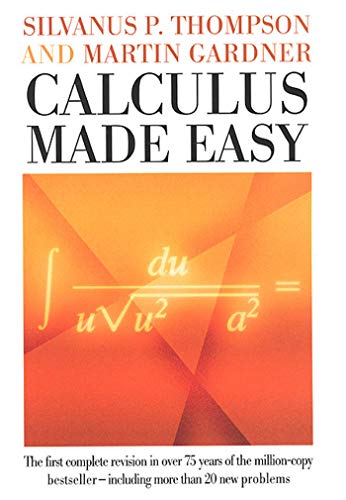
Calculus Made Easy by Silvanus P. Thompson and Martin Gardner has long been the most popular calculus primer.
This major revision of the classic math text makes the subject at hand still more comprehensible to readers of all levels. With a new introduction, three new chapters, modernized language and methods throughout, and an appendix of challenging and enjoyable practice problems, Calculus Made Easy has been thoroughly updated for the modern reader.
Die Inhaltsangabe kann sich auf eine andere Ausgabe dieses Titels beziehen.
Über die Autorin bzw. den Autor
Silvanus P. Thompson, born in 1851, was elected to the Royal Society in 1891. He wrote numerous technical books and manuals on electricity, magnetism, dynamos, and optics, as well as several popular biographies of prominent scientists. Thompson died in 1916.
Martin Gardner, born in 1914, has written several reviews for The New York Review of Books and was a Scientific American columnist for over twenty-five years. He lives in Hendersonville, North Carolina.
Auszug. © Genehmigter Nachdruck. Alle Rechte vorbehalten.
Calculus Made Easy
By Silvanus P. Thompson, Martin GardnerSt. Martin's Press
Copyright © 1998 Martin Gardner
All rights reserved.
ISBN: 978-0-312-18548-0All rights reserved.
Contents
Cover,
Title Page,
Copyright Notice,
Preface to the 1998 Edition,
Preliminary Chapters by Martin Gardner,
1. What Is a Function?,
2. What Is a Limit?,
3. What Is a Derivative?,
Calculus Made Easy by Silvanus P. Thompson,
Publisher's Note on the Third Edition,
Prologue,
I. To Deliver You from the Preliminary Terrors,
II. On Different Degrees of Smallness,
III. On Relative Growings,
IV. Simplest Cases,
V. Next Stage. What to Do with Constants,
VI. Sums, Differences, Products, and Quotients,
VII. Successive Differentiation,
VIII. When Time Varies,
IX. Introducing a Useful Dodge,
X. Geometrical Meaning of Differentiation,
XI. Maxima and Minima,
XII. Curvature of Curves,
XIII. Partial Fractions and Inverse Functions,
XIV. On True Compound Interest and the Law of Organic Growth,
XV. How to Deal with Sines and Cosines,
XVI. Partial Differentiation,
XVII. Integration,
XVIII. Integrating as the Reverse of Differentiating,
XIX. On Finding Areas by Integrating,
XX. Dodges, Pitfalls, and Triumphs,
XXI. Finding Solutions,
XXII. A Little More about Curvature of Curves,
XXIII. How to Find the Length of an Arc on a Curve,
Table of Standard Forms,
Epilogue and Apologue,
Answers to Exercises,
Appendix:,
Some Recreational Problems Relating to Calculus, by Martin Gardner,
Index,
About the Authors,
Books by Martin Gardner,
Copyright,
CHAPTER 1
WHAT IS A FUNCTION?
No concept in mathematics, especially in calculus, is more fundamental than the concept of a function. The term was first used in a 1673 letter written by Gottfried Wilhelm Leibniz, the German mathematician and philosopher who invented calculus independently of Isaac Newton. Since then the term has undergone a gradual extension of meaning.
In traditional calculus a function is defined as a relation between two terms called variables because their values vary. Call the terms x and y. If every value of x is associated with exactly one value of y, then y is said to be a function of x. It is customary to use x for what is called the independent variable, and y for what is called the dependent variable because its value depends on the value of x.
As Thompson explains in Chapter 3, letters at the end of the alphabet are traditionally applied to variables, and letters elsewhere in the alphabet (usually first letters such as a,b,c ...) are applied to constants. Constants are terms in an equation that have a fixed value. For example, in y = ax + b, the variables are x and y, and a and b are constants. If y = 2x + 7, the constants are 2 and 7. They remain the same as x and y vary.
A simple instance of a geometrical function is the dependence of a square's area on the length of its side. In this case the function is called a one-to-one function because the dependency goes both ways. A square's side is also a function of its area.
A square's area is the length of its side multiplied by itself. To express the area as a function of the side, let y be the area, x the side, then write y = x2 It is assumed, of course, that x and y are positive.
A slightly more complicated example of a one-to-one function is the relation of a square's side to its diagonal. A square's diagonal is the hypotenuse of an isosceles right triangle. We know from the Pythagorean theorem that the square of the hypotenuse equals the sum of the squares of the other two sides. In this case the sides are equal. To express the diagonal as a function of the square's side, let y be the diagonal, x the side, and write y=[square root of 2 x2] or more simply y=x [square root of 2] to express the side as a function of the diagonal, let y be the side, x the diagonal, and write y=[square root of 2 x2/2], or more simply y= x/[square root of 2] .
The most common way to denote a function is to replace y, the dependent variable, by f(x) — f being the first letter of "function." Thus y = f(x) = x2 means that y, the dependent variable, is the square of x. Instead of, say, y = 2x – 7, we write y = f(x) = 2x – 7. This means that y, a function of x, depends on the value of x in the expression 2x – 7. In this form the expression is called an explicit function of x. If the equation has the equivalent form of 2x – y – 7 = 0, it is called an implicit function of x because the explicit form is implied by the equation. It is easily obtained from the equation by rearranging terms. Instead of f(x), other symbols are often used.
If we wish to give numerical values to x and y in the example y = f(x) = 2x – 7, we replace x by any value, say 6, and write y = f(6) = (2 · 6) – 7, giving the dependent variable y a value of 5.
If the dependent variable is a function of a single independent variable, the function is called a function of one variable. Familiar examples, all one-to-one functions, are:
The circumference or area of a circle in relation to its radius.
The surface or volume of a sphere in relation to its radius.
The log of a number in relation to the number.
Sines, cosines, tangents, and secants are called trigonometric functions. Logs are logarithmic functions. Exponential functions are functions in which x, the independent variable, is an exponent in a equation, such as y = 2 There are, of course, endless other examples of more complicated one-variable functions which have been given names.
Functions can depend on more than one variable. Again, there are endless examples. The hypotenuse of a right triangle depends on its two sides, not necessarily equal. (The function of course involves three variables, but it is called a two-variable function because it has two independent variables.) If z is the hypotenuse, we know from the Pythagorean theorem that z=[square root of x2+y2. Note that this is not a one-to-one function. Knowing x and y gives z a unique value, but knowing z does not yield unique values for x and y.
Two other familiar examples of a two-variable function, neither one-to-one, are the area of a triangle as a function of its altitude and base, and the area of a right circular cylinder as a function of its radius and height.
Functions of one and two variables are ubiquitous in physics. The period of a pendulum is a function of its length. The distance covered by a dropped stone and its velocity are each functions of the elapsed time since it was dropped. Atmospheric pressure is a function of altitude. A bullet's energy is a two-variable function dependent on its mass and velocity. The electrical resistance of a wire depends on the length of the wire and the diameter of its circular cross section.
Functions...
„Über diesen Titel“ kann sich auf eine andere Ausgabe dieses Titels beziehen.
Suchergebnisse für Calculus Made Easy: Being a Very-Simplest Introduction...

Beispielbild für diese ISBN
Calculus Made Easy
Anbieter: Better World Books, Mishawaka, IN, USA
Verkäuferbewertung 5 von 5 Sternen

Zustand: Good. Pages intact with minimal writing/highlighting. The binding may be loose and creased. Dust jackets/supplements are not included. Stock photo provided. Product includes identifying sticker. Better World Books: Buy Books. Do Good. Artikel-Nr. 4267115-6
Gebraucht kaufen
EUR 12,93
Versand gratis
Versand innerhalb von USA
Versand innerhalb von USA
Anzahl: 1 verfügbar
Beispielbild für diese ISBN
Calculus Made Easy: Being a Very-Simplest Introduction to Those Beautiful Methods of Reckoning Which Are Generally Called by the Terrifying Names of the Differential calc
Anbieter: medimops, Berlin, Deutschland
Verkäuferbewertung 5 von 5 Sternen
Zustand: very good. Gut/Very good: Buch bzw. Schutzumschlag mit wenigen Gebrauchsspuren an Einband, Schutzumschlag oder Seiten. / Describes a book or dust jacket that does show some signs of wear on either the binding, dust jacket or pages. Artikel-Nr. M00312185480-V
Gebraucht kaufen
EUR 29,56
EUR 10,00 Versand
Versand von Deutschland nach USA
Versand von Deutschland nach USA
Anzahl: 2 verfügbar
Beispielbild für diese ISBN
Calculus Made Easy: Being a Very-Simplest Introduction to Those Beautiful Methods of Reckoning Which Are Generally Called by the Terrifying Names of the Differential calc
Anbieter: Revaluation Books, Exeter, Vereinigtes Königreich
Verkäuferbewertung 5 von 5 Sternen
Hardcover. Zustand: Brand New. revised subsequent edition. 330 pages. 9.00x6.00x1.25 inches. In Stock. Artikel-Nr. __0312185480
Neu kaufen
EUR 28,94
EUR 11,66 Versand
Versand von Vereinigtes Königreich nach USA
Versand von Vereinigtes Königreich nach USA
Anzahl: 1 verfügbar
Beispielbild für diese ISBN
Calculus Made Easy
Anbieter: Majestic Books, Hounslow, Vereinigtes Königreich
Verkäuferbewertung 4 von 5 Sternen

Zustand: New. pp. 336. Artikel-Nr. 8220243
Neu kaufen
EUR 34,67
EUR 7,58 Versand
Versand von Vereinigtes Königreich nach USA
Versand von Vereinigtes Königreich nach USA
Anzahl: 3 verfügbar
Beispielbild für diese ISBN
Calculus Made Easy: Being a Very-Simplest Introduction to Those Beautiful Methods of Reckoning Which Are Generally Called by the Terrifying Names of the Differential calc
Anbieter: Revaluation Books, Exeter, Vereinigtes Königreich
Verkäuferbewertung 5 von 5 Sternen
Hardcover. Zustand: Brand New. revised subsequent edition. 330 pages. 9.00x6.00x1.25 inches. In Stock. Artikel-Nr. xr0312185480
Neu kaufen
EUR 31,95
EUR 11,66 Versand
Versand von Vereinigtes Königreich nach USA
Versand von Vereinigtes Königreich nach USA
Anzahl: 1 verfügbar
Beispielbild für diese ISBN
Calculus Made Easy
Anbieter: Kennys Bookstore, Olney, MD, USA
Verkäuferbewertung 5 von 5 Sternen
Zustand: New. 1998. 4th Edition. hardcover. . . . . . Books ship from the US and Ireland. Artikel-Nr. V9780312185480
Neu kaufen
EUR 35,68
EUR 9,15 Versand
Versand innerhalb von USA
Versand innerhalb von USA
Anzahl: Mehr als 20 verfügbar