Satanism (Zondervan Guide to Cults and Religious Movements) - Softcover
Buch 7 von 14: Zondervan Guide to Cults and Religious Movements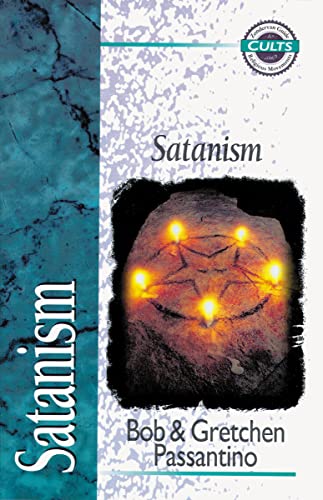
Inhaltsangabe
Belief in Satan worship is often viewed as an embarrassing throwback to the superstitions of another time. And "selling your soul to the Devil"? Nothing more than an overworked theme in literature and opera. To the contrary, Bob and Gretchen Passantino show how, in the midst of prevailing attitudes of skepticism and disbelief, Satanism has made unprecedented inroads into our society.
Die Inhaltsangabe kann sich auf eine andere Ausgabe dieses Titels beziehen.
Über die Autorinnen und Autoren
Bob and Gretchen Passantino are the directors of Answers in Action, an organization dedicated to Christian discipleship and a Christian worldview. They have worked in cult apologetics for more than twenty years and are the authors of several books.
Alan W. Gomes (PhD, Fuller Theological Seminary) is associate professor of historical theology and chairman of the department of theology at Talbot School of Theology, Biola University.
Von der hinteren Coverseite
Belief in Satan worship is often viewed as an embarrassing throwback to the superstitions of another time. And "selling your soul to the Devil"? Nothing more than an overworked theme in literature and opera. To the contrary, Bob and Gretchen Passantino show how, in the midst of prevailing attitudes of skepticism and disbelief, Satanism has made unprecedented inroads into our society.
Auszug. © Genehmigter Nachdruck. Alle Rechte vorbehalten.
SatanismCopyright 1995 by Bob and Gretchen Passantino, dba, G. P. PublisherServicesRequests for information should be addressed to:Zondervan Publishing HouseGrand Rapids, Michigan 49530Library of Congress Cataloging-in-Publication DataPassantino, Robert.Satanism / Bob and Gretchen Passantino.p. cm. --- (Zondervan guide to cults and religious movements)Includes bibliographical references.ISBN: 0-310-70451-0 (softcover)1. Satanism---Controversial literature. 2. Satanism---United States---Controversial literature. I. Passantino, Gretchen. II. Title. III. Series.BF1548.P37 1995133.4'22---dc20 95-8262CIPAll Scripture quotations, unless otherwise indicated, are taken from theHoly Bible: New International Version. NIV. Copyright 1973, 1978,1984 by International Bible Society. Used by permission of ZondervanPublishing House. All rights reserved.All rights reserved. No part of this publication may be reproduced, stored ina retrieval system, or transmitted in any form or by any means---electronic,mechanical, photocopy, recording, or any other---except for brief quotationsin printed reviews, without the prior permission of the publisher.Edited by James E. RuarkInterior design by Art JacobsPrinted in the United States of America95 96 97 98 99 00 / ?DP/ 10 9 8 7 6 5 4 3 2 1To Dr. Walter R. Martin (1928--1989)A personal friend, teacher, and mentor who wrote the first Zondervan serieson cults (1950s). He taught us never to give up and to contendearnestly for the faith once for all entrusted to the saints (Jude 3) .SatanismCopyright Bob and Gretchen Passantino, dba, G. P. Publisher ServicesRequests for information should be addressed to:Zondervan, Grand Rapids, Michigan 49530Library of Congress Cataloging-in-Publication DataPassantino, RobertSatanism / Bob and Gretchen Passantino, authorsp. cm. --- (Zondervan guide to cults and religious movements)Includes bibliographical references.ISBN-10: 0-310-70451-0 (softcover)ISBN-13: 978-0-310-70451-5 (softcover)1. Satanism --- Controversial literature. 1. Satanism --- United States ---Controversial literature I. Passantino, Gretchen. II. Title. III. Series.BF1548.P37 1995133.4'22 --- dc20 95-8262CIPAll Scripture quotations, unless otherwise indicated, are taken from the Holy Bible: NewInternational Version. NIV. Copyright 1973, 1978, 1984 by International Bible Society.Used by permission of Zondervan Publishing House. All rights reserved.All rights reserved. No part of this publication may be reproduced, stored in a retrievalsystem, or transmitted in any form or by any means---electronic, mechanical, photocopy,recording, or any other---except for brief quotations in printed reviews, without the priorpermission of the publisher.Edited by Patti PicardiInterior design by Art JacobsPrinted in the United States of America05 06 07 08 09 10 / ? / 9 8 7 6 5 4 3 2 1How to Use This BookThe Zondervan Guide to Cults and Religious Movements comprises sixteenvolumes, treating many of the most important groups and belief systemsconfronting the Christian church today. This series distills the most importantfacts about each and presents a well-reasoned, cogent Christian response. Theauthors in this series are highly qualified, well-respected professional Christianapologists with considerable expertise on their topics.We have designed the structure and layout to help you find the informationyou need as quickly as possible. All the volumes are written in outlineform, which allows us to pack substantial content into a short book. Withsome exceptions, each book contains, first, an introduction to the cult, movement,or belief system. The introduction gives a brief history of the group, itsorganizational structure, and vital statistics such as membership. Second, thetheology section is arranged by doctrinal topic, such as God, Christ, sin, andsalvation. The movement's position is set forth objectively, primarily from itsown official writings. The group's teachings are then refuted point by point,followed by an affirmative presentation of what the Bible says about the doctrine.The third section is a discussion of witnessing tips. While each witnessingencounter must be handled individually and sensitively, this sectionprovides some helpful general guidelines, including both dos and don'ts. Thefourth section contains annotated bibliographies, listing works by the groupsthemselves and books written by Christians in response. Fifth, each book hasa parallel comparison chart, with direct quotations from the cultic literaturein the left column and the biblical refutation on the right. Some of the booksconclude with a glossary.One potential problem with a detailed outline is that it is easy to loseone's place in the overall structure. Therefore, we have provided graphical'signposts' at the top of the odd numbered pages. Functioning like a 'you arehere' map in a shopping mall, these graphics show your place in the outline,including the sections that come before and after your current position.(Those familiar with modern computer software will note immediately theresemblance to a 'drop-down' menu bar, where the second-level choices varydepending on the currently selected main menu item.) In the theology sectionwe have also used 'icons' in the margins to make clear at a glance whether thematerial is being presented from the cultic or Christian viewpoint. For example,in the Mormonism volume the sections presenting the Mormon positionare indicated with a picture resembling the angel Moroni in the margin; thebiblical view is shown by a drawing of the Bible.We hope you will find these books useful as you seek 'to give an answerto everyone who asks you to give the reason for the hope that you have' (1Peter 3:15).---Alan W. Gomes, Ph.D.Series EditorPart I:IntroductionA glow of new light is borne out of the night and Lucifer is risen, once moreto proclaim: 'This is the age of Satan! Satan Rules the Earth!' (Anton SzandorLaVey, The Satanic Bible, 23).[God] having disarmed the powers and authorities, he made a public spectacleof them, triumphing over them by the cross (The Holy Bible, Col. 2:15).I. What Is Satanism?A. The Difficulty of Classifying Satanists1. Contemporary satanists defy easy classification. This is partly becauseof the independent nature of satanism and partly because of satanists'desire for secrecy.2. If satanists could be characterized in one term, it would be 'self-serving.'That is, one's own needs, desires, beliefs, and goals are supreme.Consequently, it is to be expected that satanism could have almost asmany definitions as practitioners.B. The Worship of 'Satan' the Common Factor1. 'Contemporary satanism is a form of religious belief and expressionholding to the worship of Satan, whether Satan is defined as a supernaturalperson, a deity, a devil, a supernatural force, a natural force,an innate human force, or, most commonly, the self.'12. Most satanists, such as Church of Satan founder Anton SzandorLaVey, are strict materialistic iconoclasts who worship themselves2and use the term 'Satan' to symbolize their rejection of Christianity,which they define as self-sacrificing, self-debasing, self-denying, oppressive,and powerless. These satanists do not believe in the existenceof any spiritual being, Satan or God; they believe in the power of theself.3. Some satanists (usually self-styled teenage satanists who make uptheir own system) are not sure whether either God or Satan exists,but they practice their system as though Satan were a powerful spiritbeing who can give the worshiper power for self-indulgence. These satanistswould agree that 'Whatever the truth is, this works.'4.
„Über diesen Titel“ kann sich auf eine andere Ausgabe dieses Titels beziehen.
Weitere beliebte Ausgaben desselben Titels

Suchergebnisse für Satanism (Zondervan Guide to Cults and Religious Movements)

Beispielbild für diese ISBN
Satanism
Anbieter: Better World Books: West, Reno, NV, USA
Verkäuferbewertung 5 von 5 Sternen

Zustand: Good. Former library book; may include library markings. Used book that is in clean, average condition without any missing pages. Artikel-Nr. 13553807-75
Beispielbild für diese ISBN
Satanism
Anbieter: Better World Books, Mishawaka, IN, USA
Verkäuferbewertung 5 von 5 Sternen
Zustand: Good. Used book that is in clean, average condition without any missing pages. Artikel-Nr. 2878814-6
Beispielbild für diese ISBN
Satanism
Anbieter: Wonder Book, Frederick, MD, USA
Verkäuferbewertung 5 von 5 Sternen
Zustand: Very Good. Very Good condition. A copy that may have a few cosmetic defects. May also contain light spine creasing or a few markings such as an owner's name, short gifter's inscription or light stamp. Artikel-Nr. P09Q-00750
Beispielbild für diese ISBN
The Satanism
Anbieter: ThriftBooks-Atlanta, AUSTELL, GA, USA
Verkäuferbewertung 5 von 5 Sternen
Paperback. Zustand: Good. No Jacket. Pages can have notes/highlighting. Spine may show signs of wear. ~ ThriftBooks: Read More, Spend Less. Artikel-Nr. G0310704510I3N00
Beispielbild für diese ISBN
Satanism
Anbieter: ThriftBooks-Dallas, Dallas, TX, USA
Verkäuferbewertung 5 von 5 Sternen
Paperback. Zustand: Very Good. No Jacket. May have limited writing in cover pages. Pages are unmarked. ~ ThriftBooks: Read More, Spend Less. Artikel-Nr. G0310704510I4N00
Beispielbild für diese ISBN
Satanism
Anbieter: Majestic Books, Hounslow, Vereinigtes Königreich
Verkäuferbewertung 4 von 5 Sternen

Zustand: New. pp. 96. Artikel-Nr. 5787159
Neu kaufen
EUR 23,53
Versand:
EUR 7,44
Von Vereinigtes Königreich nach USA
Anzahl: 1 verfügbar
Foto des Verkäufers
Satanism (Zondervan Guide to Cults & Religious Movements)
Anbieter: NEPO UG, Rüsselsheim am Main, Deutschland
Verkäuferbewertung 5 von 5 Sternen
Taschenbuch. Zustand: Gut. 96 Seiten ex Library Book aus einer wissenschafltichen Bibliothek Sprache: Englisch Gewicht in Gramm: 114. Artikel-Nr. 229700
Gebraucht kaufen
EUR 8,90
Versand:
EUR 24,00
Von Deutschland nach USA
Anzahl: 1 verfügbar