
Verwandte Artikel zu Philippians, Volume 43: Revised Edition (43) (Word...
Philippians, Volume 43: Revised Edition (43) (Word Biblical Commentary, Band 43) - Hardcover
Buch 29 von 63: Word Biblical Commentary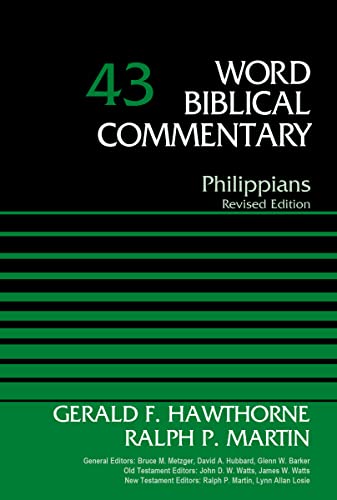
Inhaltsangabe
Over 2 million copies sold in The Word Biblical Commentary series.
This commentary series delivers the best in biblical scholarship from the leading scholars of our day who share a commitment to Scripture as divine revelation.
It emphasizes a thorough analysis of textual, linguistic, structural, and theological evidence, resulting in judicious and balanced insight into the meanings of the text in the framework of biblical theology. These widely acclaimed commentaries serve as exceptional resources for the professional theologian and instructor, the seminary or university student, the working minister, and everyone concerned with building theological understanding from a solid base of biblical scholarship.
Overview of Commentary Organization:
- Introduction—covers issues pertaining to the whole book, including context, date, authorship, composition, interpretive issues, purpose, and theology.
- Pericope Bibliography—a helpful resource containing the most important works that pertain to each particular pericope.
- Translation—the author’s own translation of the biblical text, reflecting the end result of exegesis and attending to Hebrew and Greek idiomatic usage of words, phrases, and tenses, yet in reasonably good English.
- Notes—the author’s notes to the translation that address any textual variants, grammatical forms, syntactical constructions, basic meanings of words, and problems of translation.
- Form/Structure/Setting—a discussion of redaction, genre, sources, and tradition as they concern the origin of the pericope, its canonical form, and its relation to the biblical and extra-biblical contexts in order to illuminate the structure and character of the pericope. Rhetorical or compositional features important to understanding the passage are also introduced here.
- Comment—verse-by-verse interpretation of the text and dialogue with other interpreters, engaging with current opinion and scholarly research.
- Explanation—brings together all the results of the discussion in previous sections to expose the meaning and intention of the text at several levels: (1) within the context of the book itself; (2) its meaning in the OT or NT; (3) its place in the entire canon; (4) theological relevance to broader OT or NT issues.
- General Bibliography—occurring at the end of each volume, this extensive bibliography contains all sources used anywhere in the commentary.
Die Inhaltsangabe kann sich auf eine andere Ausgabe dieses Titels beziehen.
Über die Autorinnen und Autoren
Gerald F. Hawthorne is Professor of Greek Emeritus, Wheaton College, Wheaton, Illinois, where he served on the faculty from 1953 to 1995. He is the author of The Presence and the Power: The Signficance of the Holy Spirit in the Life and Ministry of Jesus and editor, with Ralph P. Martin, of Dictionary of Paul and His Letters. He received the B.A. and M.A. degrees from Wheaton College and the Ph.D. from the University of Chicago.
Ralph P. Martin (1925-2013) was Distinguished Scholar in Residence at Fuller Theological Seminary and a New Testament Editor for the Word Biblical Commentary series. He earned the BA and MA from the University of Manchester, England, and the PhD from King's College, University of London. He was the author of numerous studies and commentaries on the New Testament, including Worship in the Early Church, the volume on Philippians in The Tyndale New Testament Commentary series. He also wrote 2 Corinthians and James in the WBC series.
Bruce M. Metzger (1914 – 2007) was a biblical scholar, textual critic, and a longtime professor at Princeton Theological Seminary. Metzger is widely considered one of the most influential New Testament scholars of the 20th century. He was a general editor of the Word Biblical Commentary (1997 - 2007).
David Allan Hubbard (1928 – 1996), former president and professor of Old Testament at Fuller Theological Seminary in Pasadena, California, was a recognized biblical scholar. In addition to over 30 books, he has written numerous articles for journals, periodicals, reference works. He was a general editor of the Word Biblical Commentary (1977 - 1996).
Glenn W. Barker (d. 1984) was a general editor of the Word Biblical Commentary (1977 - 1984).
Auszug. © Genehmigter Nachdruck. Alle Rechte vorbehalten.
Philippians, Volume 43
By Gerald F. Hawthorne, Ralph P. Martin, Bruce M. Metzger, David A. Hubbard, Glenn W. BarkerZONDERVAN
Copyright © 2004 Thomas Nelson, Inc.
All rights reserved.
ISBN: 978-0-310-52185-3All rights reserved.
Contents
Editors' Preface, ix,
Author's Preface to First Edition, x,
Preface to Revised Edition, xii,
Abbreviations, xiv,
Commentary Bibliography, xxiv,
General Bibliography, xxvi,
Introduction,
Authorship, xxviii,
The Integrity of Philippians, xxx,
The Recipients and Their City, xxxiv,
Place and Date of Writing, xxxix,
Paul's Opponents and the False Teachers at Philippi, 1,
Paul's Purposes for Writing Philippians, lv,
Outline of Philippians, lix,
Aspects of the Theology of Philippians, lx,
Text of the Letter, lxiii,
Exegesis and Rhetorical Analysis, with Special Reference to Philippians 2:6–11, lxiv,
Christology in Philippians, lxxiii,
Text and Commentary,
I. Introductory Section (1:1–11), 1,
A. Salutation (1:1–2), 1,
B. Thanksgiving and Prayer (1:3–11), 15,
II. News and Instructions (1:12–2:30), 36,
A. News about Paul (1:12–26), 36,
B. Instructions for the Church (1:27–2:18), 65,
1. To Stability in the Faith (1:27–30), 65,
2. To Harmony and Humility (2:1–4), 79,
3. Kerygmatic Center of the Letter: Christ, the Supreme Encouragement to Humility and Unselfishness (2:5–11), 90,
Excursus: On Kenosis, 121,
4. Application: To Obedience, with Paul as Model (2:12–18), 135,
C. News about Timothy and Epaphroditus and Their Role as Models (2:19–30), 151,
1. About Timothy (2:19–24), 151,
2. About Epaphroditus (2:25–30), 158,
III. Digression: Warning against False Teachings with Paul's Experience and Life as a Model to Follow (3:1–21), 170,
A. Warning against Circumcision and Pride in Human Achievements (3:1–3), 170,
B. Paul's Own Life, Past and Present: An Answer to Opponents (3:4–11), 178,
C. Warning against Perfection Now (3:12–16), 202,
D. Paul's Life: A Model to Imitate (3:17), 215,
E. Warning against Imitating Other Teachers (3:18–19), 220,
F. Paul's Hope in the Future and Unseen (3:20–21), 227,
IV. Exhortations to Harmony and Joy (4:1–9), 236,
V Gratitude Expressed for the Philippians' Generosity (4:10–20), 256,
VI. Conclusion (4:21–23), 278,
CHAPTER 1
Introductory Section (1:1–11)
A. Salutation (1:1–2)
Form/Structure/Setting
This section follows a set pattern, drawn from the Hellenistic world, that Paul uses as an introduction to all his letters. It has three basic parts to it, and each part always appears in the same order: (1) the sender's name, (2) the name of the person or persons to whom the letter is sent, and (3) the greeting.
Although quite unlike the twenty-first-century style of letter writing, this pattern, nevertheless, conforms closely to that of the letter form of the first century and earlier. It is reminiscent, on the one hand, of ancient Near Eastern letters (cf. Dan 4:1 [RSV]: "King Nebuchadnezzer to all peoples, nations, and languages, that dwell in all the earth: Peace be multiplied to you"; Ezra 7:12; 2 Bar. 78:2)—a fact that points to the possibility of Aramaic influence on Pauline epistolography, especially if one considers "seriously the proposal that the Captivity Letters ... were composed in Caesarea Maritima" (Fitzmyer, JBL 93 [1974] 201–25; and idem on the Aramaic origin of Phil 2:6–11 [CBQ50 (1988) 470–83]; see Martin, Hymn of Christ, chap. 2; yet this suggestion of Semitic background to Paul would be true no matter where he wrote). It also recalls, on the other hand, the personal letters of the Greco-Roman period published and discussed by Deissmann (see Light from the Ancient East, 148–217, and note this example: "Asclepiades, the son of Charmagon, to Portis, the son of Peramis, greeting [[TEXT NOT REPRODUCIBLE IN ASCII.]]" [152–53]; see also Hunt and Edgar, Select Papyri, 2:549–601; cf. Acts 15:23; Jas 1:1). Deissmann's division of written conversations in the Greek world between popular "letters" (Briefe) and the more literary "epistles" (Episteln) has been vigorously challenged in recent times. Its validity has been denied on the ground that Deissmann's dichotomy is too neat; his social analysis of early congregations as proletarian and illiterate is challenged by scholars such as Doty (Letters), and Deissmann failed to note the data from documents such as Seneca's Epistulae and the Cynic epistles. So we should conclude that while Paul retained his Jewish thought forms, Hellenism had an even greater influence on his epistolary habits. And we should not overlook the simple observation that, after all, he was writing in Greek to a Greek-reading audience.
Although Paul may have owed much to both East and West for the basic form of his letters, so that the introductions of his letters, like their models, invariably followed the pattern "A to B, greeting," his own contribution to the history of letter writing should not be denied. He often expanded these conventional formulas and infused them with deep theological or christological meaning (cf. Rom 1:1–7).
It is important to recognize this "literary" form, the letter form, for what it is. When Paul chose to express his ideas in this form, one can only surmise that he did so with a limited audience in mind—friends, for the most part, whom he knew personally and who, he knew, were facing particular problems of faith and life (the exception is the letter to the Colossians; see Col 2:1; 4:16, as well as Rom 1; Rom 16 with its many names is the exception to prove the rule). The content of his letters shows that Paul wrote with a keen awareness of apostolic authority, but the letter form seems to indicate that he had no intention of leaving behind him masterpieces of literature or theological treatises for the world (but see Malherbe, OJRS 5 [1977] 3–77, who notes that rhetorical theorists discussed the letter form). It is also to be recalled that Paul wrote letters to be read aloud in public (cf. Col 4:16), and this fact opens the questions of their rhetorical shape; see the Introduction, Exegesis and Rhetorical Analysis.
Comment
1 [TEXT NOT REPRODUCIBLE IN ASCII], "Paul and Timothy, slaves [or, servants] of Christ Jesus." The unique feature here is not that Paul links Timothy's name with his own, for Timothy was Paul's "son in the faith" (1 Cor 4:17), his close associate in the gospel (2 Cor 1:19), and his trusted emissary (Phil 2:19). Besides, Paul names other co-senders of his letters with him (1 Cor 1:1; 1 Thess 1:1; 2 Thess 1:1). Rather, the singularity lies in the fact that Paul permits the noun [TEXT NOT REPRODUCIBLE IN ASCII], "slaves," to stand in apposition to both his own name and Timothy's, a unique feature in the literary legacy left by Paul. In all other letters he puts a distance between himself and his colleagues by describing only himself as "slave," or "apostle," or "prisoner" of Christ Jesus—never anyone else. If ever he does add a descriptive title to a fellow worker, he does so only with the word [TEXT NOT REPRODUCIBLE IN ASCII], "brother" (1 Cor 1:1; 2 Cor 1:1; Gal 1:2; Col 1:1; Phlm 1). From this observation it is clear that...
„Über diesen Titel“ kann sich auf eine andere Ausgabe dieses Titels beziehen.
Suchergebnisse für Philippians, Volume 43: Revised Edition (43) (Word...

Beispielbild für diese ISBN
Philippians
Anbieter: Ria Christie Collections, Uxbridge, Vereinigtes Königreich
Verkäuferbewertung 5 von 5 Sternen

Zustand: New. In English. Artikel-Nr. ria9780310521853_new
Neu kaufen
EUR 45,85
EUR 13,31 Versand
Versand von Vereinigtes Königreich nach USA
Versand von Vereinigtes Königreich nach USA
Anzahl: Mehr als 20 verfügbar
Beispielbild für diese ISBN
Philippians, Volume 43: Revised Edition (Word Biblical Commentary)
Anbieter: Kennys Bookstore, Olney, MD, USA
Verkäuferbewertung 5 von 5 Sternen
Zustand: New. WBC series delivers the best in biblical scholarship, from the leading scholars who share a commitment to Scripture as divine revelation. It emphasizes a thorough analysis of textual, linguistic, structural, and theological evidence. The result is judicious and balanced insight into the meanings of the text in the framework of biblical theology. Series Editor(s): Martin, Ralph P.; Watts, John D. W.; Watts, James W.; Losie, Lynn Allan. Series: Word Biblical Commentary. Num Pages: 384 pages. BIC Classification: HRCF2; HRCG1. Category: (P) Professional & Vocational. Dimension: 235 x 159 x 31. Weight in Grams: 679. . 2015. Revised. Hardcover. . . . . Books ship from the US and Ireland. Artikel-Nr. V9780310521853
Neu kaufen
EUR 62,05
EUR 9,33 Versand
Versand innerhalb von USA
Versand innerhalb von USA
Anzahl: 15 verfügbar
Beispielbild für diese ISBN
Philippians: Vol 43
Anbieter: Revaluation Books, Exeter, Vereinigtes Königreich
Verkäuferbewertung 5 von 5 Sternen
Hardcover. Zustand: Brand New. new revised edition. 384 pages. 9.30x6.20x1.40 inches. In Stock. Artikel-Nr. 0310521858
Neu kaufen
EUR 60,55
EUR 14,74 Versand
Versand von Vereinigtes Königreich nach USA
Versand von Vereinigtes Königreich nach USA
Anzahl: 1 verfügbar