
Verwandte Artikel zu My Final Word: Holding Tight to the Issues That Matter...
Inhaltsangabe
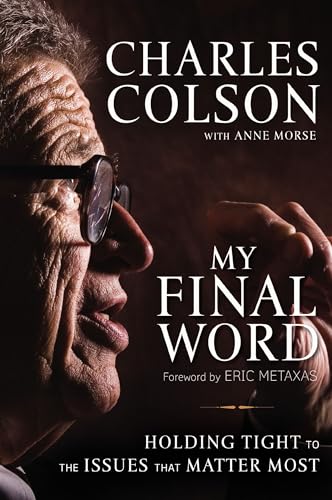
One of the most respected and influential Christian leaders of the last several decades, Chuck Colson engaged millions through his books, public speaking, and radio broadcasts.
In My Final Word, longtime Colson coauthor Anne Morse has selected and arranged pieces Colson wrote mostly during the last decade of his life, spotlighting what he saw as key topics of ongoing importance for Christian cultural engagement. Some of these issues include:
- crime and punishment
- natural law
- Islam
- same-sex marriage
- the persecution of Christians
- and more
Longtime readers and new readers alike will be struck by the power and immediacy of Colson’s arguments. My Final Word is a fitting end to Colson’s distinguished publishing career, a behind-the-scenes encounter with an influential thinker, and a needed call to an ongoing and relevant Christian public witness.
Die Inhaltsangabe kann sich auf eine andere Ausgabe dieses Titels beziehen.
Über die Autorinnen und Autoren
Chuck Colson was a popular and widely known author, speaker, and radio commentator. A former presidential aide to Richard Nixon and founder of the international ministry Prison Fellowship, he wrote several books that have shaped Christian thinking on a variety of subjects, including Born Again, Loving God, How Now Shall We Live?, The Good Life, and The Faith. His radio broadcast, BreakPoint, at one point aired to two million listeners. Chuck Colson donated all of his royalties, awards, and speaking fees to Prison Fellowship Ministries.
Anne Morse, a freelance writer, spent 18 years collaborating with Chuck Colson on BreakPoint Radio commentaries, Christianity Today columns, and four books. She is also the co-author of Prisoner of Conscience with former Congressman Frank Wolf of Virginia, and of a novel, Bedford Falls. She lives in Maryland with her husband.
Auszug. © Genehmigter Nachdruck. Alle Rechte vorbehalten.
My Final Word
By Charles Colson, Anne MorseZONDERVAN
Copyright © 2015 Chuck Colson Center for Christian Worldview
All rights reserved.
ISBN: 978-0-310-52064-1All rights reserved.
Contents
Foreword, 9,
Introduction, 11,
1. Apologetics, 15,
2. Bioethics and Life Issues, 37,
3. Christians and Public Life, 53,
4. Church and Culture, 69,
5. Crime, Punishment, and Justice, 95,
6. Happiness, 117,
7. Homosexuality and the Church, 131,
8. Islam versus Christianity, 153,
9. Judicial Usurpation, 171,
10. Persecution, 181,
11. Suffering, 189,
12. War of the Worldviews, 209,
Notes, 235,
CHAPTER 1
APOLOGETICS
The Question of Sin
The one thing a secular worldview can never provide is an answer to guilt and sin. Nor can it form the basis for reconciliation.
In fact, nothing apart from Judeo-Christian revelation can provide a basis for restoring a community that has been torn apart by sin — or offer hope of forgiveness and restoration to those who are burdened by sin. I have discovered while preaching in Hindu and Buddhist cultures that whenever I talk about forgiveness and a new life in Christ, eyes just bulge. This is something people haven't heard.
I remember in the Trevandrum prison in India, a thousand inmates looked up at me — outcasts, doomed to live with their sin for the rest of their lives, and then to have done to them in the next life what they did to someone in this life, which simply perpetuates evil. I told them they could be forgiven, that Christ died on the cross for their sins. The response was absolutely staggering.
I also remember the time I was in Japan, and met with a professor of comparative religion at the University of Yokohama. He was a Buddhist, of course, and had studied Born Again and used it as a textbook in his class on the Christian religion. He had asked to meet with me. We had a great conversation. I talked about forgiveness in the prisons and asked him how Buddhists could provide for forgiveness since there was no redemption, no Savior; no one had died for their sins. He said they had a new form of Buddhism called Pure Land Buddhism, where they can provide a level of forgiveness in the next life.
Buddhism, of course, is infinitely flexible; there is no one true God. There are simply stages of consciousness, and so to solve a dilemma — my question was how do you preach Buddhism in a prison — they simply invent a new sect or strain of belief to accommodate a particular need. It's almost amusing, but it also shows how bankrupt the system is.
Most secular thought today is parallel to Buddhism. It's really the same thing. We don't have a God in the secular world today, so we simply develop states of consciousness. We get in touch with our own feelings. We seek a higher state of consciousness or peace with nature.
How do you deal with the question of sin once you're aware of it? You can develop some better way to get in touch with your feelings and improve your self-esteem, but it won't solve the problem because the consequences of that guilt are there. You can't get rid of them. You can go to psychologists and they can try to help you get rid of the repressed memories and do all sorts of therapeutic gymnastics, but they can't get to the heart of the problem.
Only Christianity provides for that forgiveness and the subsequent healing that can take place in the individual's life and in the community. Kim Phuc, the little Vietnamese girl who became famous through a photograph showing her running naked after being burned by napalm, demonstrates this. If out of the horrors of war a young girl hideously burned can forgive those who dropped the bombs on her, then there is hope that the cycle of evil can be broken, guilt can be released, and people can be freed from bondage. This really is overcoming evil with good (Romans 12:21). There is no other way. Every secular system is doomed, as is Buddhism, as is Hinduism, as is Islam. It is only Jews and Christians who have a way out, and only the Christian has a way out by the grace of God.
This is an incredibly important and powerful apologetic.
Thank God for Peter Singer
I gave a lecture at Gordon-Conwell Theological Seminary titled "Thank God for Peter Singer." The thesis is that when you want to make an apologetic argument, the best thing you can do is to force your adversaries to embrace the logical conclusion of their own ideas.
I mentioned a little story about my recent discussion with an agnostic, which illustrates my point. I forced this man to take his statement that all religions are alike, and reconcile it with the exclusive truth claims of Christianity. I said all religions can't be alike; they can't all lead to the same place because Christianity specifically denies that. So if all religions are equally true, then Christianity's truth nullifies the other religions.
I then got into a discussion of the law of noncontradiction, and drove him into a corner where he eventually had no choice but to say, "I have to admit that some things are extra natural." He wouldn't agree to supernatural, but he did have to conclude extra, at which point I said, "Precisely." He could not defend a naturalistic explanation for his own proposition.
That's the most effective apologetic there is.
The Question of God
I am two-thirds of the way through Armand Nicholi's book The Question of God, which contrasts the teachings of Sigmund Freud and C. S. Lewis. It is filled with wonderful apologetics.
For example, it's extremely useful to understand the role of the superego in terms of conscience in Freud's analysis. Freud has substituted the superego for God; if your conscience is being informed, it is being informed by the superego. Well, superego is just a made-up name. There's no more scientific validity to that than there is in saying God speaks to you.
Nicholi's comparison of Freud's view on natural law and C. S. Lewis's was also brilliantly done. Even though you're getting an objective presentation of both viewpoints, readers will come away with a realization that Lewis's position is vastly superior, because we know within ourselves what is right or wrong. Everybody does. So has the superego been taught, character passed on from our earthly father, father to son? If so, how did the first father come to know what is right and wrong? He didn't have any father to pass anything on to him.
Freud's arguments just blow away in the breeze as you read this book. It's absolutely brilliant.
The Question of God is Comparative Worldview 101, built around two great minds. Armand also weaves the gospel in, telling the story of Lewis's transformation, and points out that Freud actually admired religious people.
Armand finds inconsistencies in Freud's statements, though he doesn't say that. For instance, Freud talks about the importance of moral law as if there were a moral law.
This is apologetics in its most important form.
Idolatry Alongside
While Moses is up on the mountain for forty days talking to the Lord and receiving the Ten Commandments, the people below start grumbling. Gathering around Aaron, they said, "Come, make us gods who will go before us." And then, dismissively, they add, "As for this fellow Moses who brought us out of Egypt, we don't know what has happened to him" (Exodus 32:1).
Notice how, in appealing to Aaron, the Israelites put down Moses as his competitor. In effect they say, "We don't know where this guy's gone. He's up...
„Über diesen Titel“ kann sich auf eine andere Ausgabe dieses Titels beziehen.
Suchergebnisse für My Final Word: Holding Tight to the Issues That Matter...

Beispielbild für diese ISBN
My Final Word Holding Tight to
Anbieter: World of Books (was SecondSale), Montgomery, IL, USA
Verkäuferbewertung 5 von 5 Sternen

Zustand: Acceptable. Item in acceptable condition! Textbooks may not include supplemental items i.e. CDs, access codes etc. Artikel-Nr. 00103100529
Gebraucht kaufen
EUR 3,71
Versand gratis
Versand innerhalb von USA
Versand innerhalb von USA
Anzahl: 2 verfügbar
Beispielbild für diese ISBN
My Final Word Holding Tight to
Anbieter: World of Books (was SecondSale), Montgomery, IL, USA
Verkäuferbewertung 5 von 5 Sternen
Zustand: Good. Item in good condition. Textbooks may not include supplemental items i.e. CDs, access codes etc. Artikel-Nr. 00087760030
Gebraucht kaufen
EUR 3,71
Versand gratis
Versand innerhalb von USA
Versand innerhalb von USA
Anzahl: 3 verfügbar
Beispielbild für diese ISBN
My Final Word Holding Tight to
Anbieter: World of Books (was SecondSale), Montgomery, IL, USA
Verkäuferbewertung 5 von 5 Sternen
Zustand: Very Good. Item in very good condition! Textbooks may not include supplemental items i.e. CDs, access codes etc. Artikel-Nr. 00078886947
Gebraucht kaufen
EUR 3,71
Versand gratis
Versand innerhalb von USA
Versand innerhalb von USA
Anzahl: 8 verfügbar
Beispielbild für diese ISBN
My Final Word: Holding Tight to the Issues that Matter Most
Anbieter: BooksRun, Philadelphia, PA, USA
Verkäuferbewertung 5 von 5 Sternen
Hardcover. Zustand: Fair. With dust jacket. The item might be beaten up but readable. May contain markings or highlighting, as well as stains, bent corners, or any other major defect, but the text is not obscured in any way. Artikel-Nr. 0310520649-7-1-29
Gebraucht kaufen
EUR 4,58
Versand gratis
Versand innerhalb von USA
Versand innerhalb von USA
Anzahl: 1 verfügbar
Beispielbild für diese ISBN
My Final Word : Holding Tight to the Issues That Matter Most
Anbieter: Better World Books, Mishawaka, IN, USA
Verkäuferbewertung 5 von 5 Sternen
Zustand: Good. Pages intact with minimal writing/highlighting. The binding may be loose and creased. Dust jackets/supplements are not included. Stock photo provided. Product includes identifying sticker. Better World Books: Buy Books. Do Good. Artikel-Nr. 10976754-6
Gebraucht kaufen
EUR 6,16
Versand gratis
Versand innerhalb von USA
Versand innerhalb von USA
Anzahl: 1 verfügbar
Beispielbild für diese ISBN
My Final Word : Holding Tight to the Issues That Matter Most
Anbieter: Better World Books, Mishawaka, IN, USA
Verkäuferbewertung 5 von 5 Sternen
Zustand: Very Good. Pages intact with possible writing/highlighting. Binding strong with minor wear. Dust jackets/supplements may not be included. Stock photo provided. Product includes identifying sticker. Better World Books: Buy Books. Do Good. Artikel-Nr. 8663419-6
Gebraucht kaufen
EUR 6,16
Versand gratis
Versand innerhalb von USA
Versand innerhalb von USA
Anzahl: 1 verfügbar
Beispielbild für diese ISBN
My Final Word: Holding Tight to the Issues That Matter Most
Anbieter: ThriftBooks-Dallas, Dallas, TX, USA
Verkäuferbewertung 5 von 5 Sternen
Hardcover. Zustand: Good. No Jacket. Pages can have notes/highlighting. Spine may show signs of wear. ~ ThriftBooks: Read More, Spend Less. Artikel-Nr. G0310520649I3N00
Gebraucht kaufen
EUR 6,30
Versand gratis
Versand innerhalb von USA
Versand innerhalb von USA
Anzahl: 1 verfügbar
Beispielbild für diese ISBN
My Final Word: Holding Tight to the Issues that Matter Most
Anbieter: Wonder Book, Frederick, MD, USA
Verkäuferbewertung 5 von 5 Sternen
Zustand: As New. Like New condition. Very Good dust jacket. A near perfect copy that may have very minor cosmetic defects. Artikel-Nr. I09A-03893
Gebraucht kaufen
EUR 6,40
Versand gratis
Versand innerhalb von USA
Versand innerhalb von USA
Anzahl: 1 verfügbar
Beispielbild für diese ISBN
My Final Word: Holding Tight to the Issues that Matter Most
Anbieter: Wonder Book, Frederick, MD, USA
Verkäuferbewertung 5 von 5 Sternen
Zustand: Very Good. Very Good condition. Very Good dust jacket. A copy that may have a few cosmetic defects. May also contain light spine creasing or a few markings such as an owner's name, short gifter's inscription or light stamp. Artikel-Nr. V22E-00186
Gebraucht kaufen
EUR 6,40
Versand gratis
Versand innerhalb von USA
Versand innerhalb von USA
Anzahl: 1 verfügbar
Beispielbild für diese ISBN
My Final Word : Holding Tight to the Issues That Matter Most
Anbieter: Better World Books Ltd, Dunfermline, Vereinigtes Königreich
Verkäuferbewertung 5 von 5 Sternen
Zustand: Good. Former library copy. Pages intact with minimal writing/highlighting. The binding may be loose and creased. Dust jackets/supplements are not included. Includes library markings. Stock photo provided. Product includes identifying sticker. Better World Books: Buy Books. Do Good. Artikel-Nr. 11141487-6
Gebraucht kaufen
EUR 5,70
EUR 5,88 Versand
Versand von Vereinigtes Königreich nach USA
Versand von Vereinigtes Königreich nach USA
Anzahl: 1 verfügbar