
Verwandte Artikel zu Seven Days That Divide the World: The Beginning According...
Inhaltsangabe
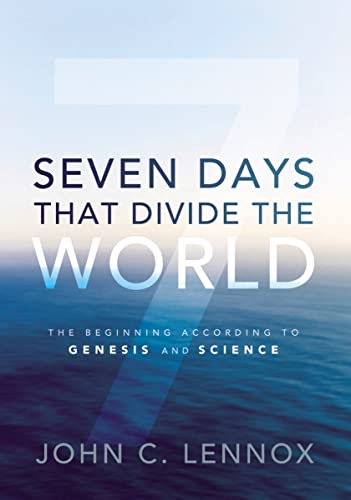
What did the writer of Genesis mean by “the first day”? Is it a literal week or a series of time periods? If I believe that the earth is 4.5 billion years old, am I denying the authority of Scripture?In response to the continuing controversy over the interpretation of the creation narrative in Genesis, John Lennox proposes a succinct method of reading and interpreting the first chapters of Genesis without discounting either science or Scripture. With examples from history, a brief but thorough exploration of the major interpretations, and a look into the particular significance of the creation of human beings, Lennox suggests that Christians can heed modern scientific knowledge while staying faithful to the biblical narrative. He moves beyond a simple response to the controversy, insisting that Genesis teaches us far more about the God of Jesus Christ and about God’s intention for creation than it does about the age of the earth. With this book, Lennox offers a careful yet accessible introduction to a scientifically-savvy, theologically-astute, and Scripturally faithful interpretation of Genesis.
Die Inhaltsangabe kann sich auf eine andere Ausgabe dieses Titels beziehen.
Über die Autorin bzw. den Autor
John C. Lennox (PhD, DPhil, DSc) is Professor of Mathematics in the University of Oxford, Fellow in Mathematics and the Philosophy of Science, and Pastoral Advisor at Green Templeton College, Oxford. He is author of God's Undertaker: Has Science Buried God? on the interface between science, philosophy, and theology. He lectures extensively in North America and in Eastern and Western Europe on mathematics, the philosophy of science, and the intellectual defense of Christianity, and he has publicly debated New Atheists Richard Dawkins and Christopher Hitchens. John is married to Sally; they have three grown children and four grandchildren and live near Oxford.
Auszug. © Genehmigter Nachdruck. Alle Rechte vorbehalten.
SEVEN DAYS THAT DIVIDE THE WORLD
THE BEGINNING ACCORDING TO GENESIS AND SCIENCEBy JOHN C. LENNOXZONDERVAN
Copyright © 2011 John C. LennoxAll right reserved.
ISBN: 978-0-310-49217-7
Contents
INTRODUCTION...................................................................11Chapter one BUT DOES IT MOVE? A LESSON FROM HISTORY...........................15Chapter Two BUT DOES IT MOVE? A LESSON ABOUT SCRIPTURE........................21Chapter Three BUT IS IT OLD? THE DAYS OF CREATION.............................39Chapter Four HUMAN BEINGS: A SPECIAL CREATION?................................67Chapter Five THE MESSAGE OF GENESIS 1.........................................91Appendix A A BRIEF BACKGROUND TO GENESIS......................................119Appendix B THE COSMIC TEMPLE VIEW.............................................130Appendix C THE BEGINNING ACCORDING TO GENESIS AND SCIENCE.....................150Appendix D TWO ACCOUNTS OF CREATION?..........................................156Appendix E THEISTIC EVOLUTION AND THE GOD OF THE GAPS.........................160NOTES..........................................................................184ACKNOWLEDGEMENTS...............................................................188GENERAL INDEX..................................................................189
Chapter One
BUT DOES IT MOVE? A LESSON FROM HISTORY
THIS BOOK IS ABOUT a very controversial topic. Disagreement about it has been rather acrimonious at times. However, even though I am Irish, I am not going to suggest that the best way to approach it is to have a good fight! Indeed, in order to get some kind of perspective on the way we handle controversy, I wish to go back to another major controversy, one that arose in the sixteenth century. If I had been writing a book at that time, I might well have been addressing the question, what are we to think of astronomer Nicholas Copernicus's suggestion that the earth moves, when Scripture seems to teach that the earth is immovably fixed in space?
This may not seen to be a huge deal nowadays, but at the time it was a very hot topic. The reason? In the fourth century BC the famous Greek philosopher Aristotle taught that the earth was fixed in the centre of the universe and that the sun, stars, and planets revolved around it. This fixed-earth view held sway for centuries even though, as early as 250 BC, Aristarchus of Samos proposed a heliocentric system. After all, it made a lot of sense to ordinary people: the sun appears to go round the earth; and, if the earth moves, why aren't we all flung off into space? Why does a stone, thrown straight up into the air, come straight down if the earth is rotating rapidly? Why don't we feel a strong wind blowing in our faces in the opposite direction to our motion? Surely the idea that the earth moves is absurd?
Aristotle's work was translated into Latin, and in the Middle Ages, with the aid of the massive intellect of Thomas Aquinas (1225–1274), it came to influence the Roman Catholic Church.
We note in passing that Aristotle believed not only that the universe was old, but that it had always existed. Aquinas had no difficulty reconciling an eternal universe with the existence of God as Creator in a philosophical sense, but he admitted that there was difficulty reconciling it with the Bible, since the Bible clearly said there had been a beginning. The fixed earth was different: it seemed to fit in well with what the Bible said. For instance:
Tremble before him, all the earth; yes, the world is established; it shall never be moved. (1 Chron. 16:30)
Yes, the world is established; it shall never be moved. (Ps. 93:1)
He set the earth on its foundations, so that it should never be moved. (Ps. 104:5)
For the pillars of the earth are the Lord's, and on them he has set the world. (1 Sam. 2:8)
Furthermore, the Bible seemed not only to teach that the earth was fixed; it seemed equally clearly to say that the sun moved:
In them he has set a tent for the sun, which comes out like a bridegroom leaving his chamber, and, like a strong man, runs its course with joy. Its rising is from the end of the heavens, and its circuit to the end of them, and there is nothing hidden from its heat. (Ps. 19:4–6)
The sun rises, and the sun goes down, and hastens to the place where it rises. (Eccl. 1:5)
So it is not surprising that when in 1543 Copernicus published his famous work On the Revolutions of the Celestial Orbs, in which he advanced the view that the earth and the planets orbited the sun, this startling new scientific theory was called into question by Protestants and Catholics alike. It is alleged that even before Copernicus published his book, Martin Luther had rejected the heliocentric point of view in rather strong terms in his Table Talk (1539):
There is talk of a new astrologer who wants to prove that the earth moves and goes around instead of the sky, the sun, the moon, just as if somebody were moving in a carriage or ship might hold that he was sitting still and at rest while the earth and the trees walked and moved. But that is how things are nowadays: when a man wishes to be clever he must ... invent something special, and the way he does it must needs be the best! The fool wants to turn the whole art of astronomy upside-down. However, as Holy Scripture tells us, so did Joshua bid the sun to stand still and not the earth.
Many of Luther's comments in Table Talk were made tongue in cheek, and there is considerable debate about the authenticity of this quote. Historian John Hedley Brooke writes, "Whether Luther really referred to Copernicus as a fool has been doubted, but in an off-the-cuff dismissal he remembered that Joshua had told the sun, not the earth, to stand still."
John Calvin, on the other hand, clearly believed that the earth was fixed: "By what means could it [the earth] maintain itself unmoved, while the heavens above are in constant rapid motion, did not its Divine Maker fix and establish it?"
Some years after Copernicus, in 1632, Galileo challenged the Aristotelian view in his famous book Dialogue concerning the Two Chief World Systems. This incident has gone down in history as an iconic example of how religion is antagonistic to science. Yet Galileo, far from being an atheist, was driven by his deep inner conviction that the Creator, who had "endowed us with senses, reason and intellect," intended us not to "forgo their use and by some other means to give us knowledge which we can attain by them." Galileo held that the laws of nature are written by the hand of God in the "language of mathematics" and that the "human mind is a work of God and one of the most excellent."
Galileo was attacked for his theory of a moving earth, first by the Aristotelian philosophers, and then by the Roman Catholic Church. The issue at stake was clear: Galileo's science was threatening the all-pervasive Aristotelianism of both academy and church. The conflict was far more between two "scientific" world-pictures than between science and religion. In the end, Galileo had to "recant" under pressure but still (according to the story) could not help muttering to his inquisitors, "But it does move."
There is, of course, no excuse whatsoever for the Roman Catholic Church's use of the Inquisition to muzzle Galileo, nor for its subsequently taking several centuries to rehabilitate him. Yet, again contrary to popular belief, Galileo was...
„Über diesen Titel“ kann sich auf eine andere Ausgabe dieses Titels beziehen.
Suchergebnisse für Seven Days That Divide the World: The Beginning According...

Beispielbild für diese ISBN
Seven Days That Divide the World: The Beginning According to Genesis and Science
Anbieter: ThriftBooks-Atlanta, AUSTELL, GA, USA
Verkäuferbewertung 5 von 5 Sternen

Hardcover. Zustand: Very Good. No Jacket. Missing dust jacket; May have limited writing in cover pages. Pages are unmarked. ~ ThriftBooks: Read More, Spend Less. Artikel-Nr. G0310492173I4N01
Gebraucht kaufen
EUR 9,38
Versand gratis
Versand innerhalb von USA
Versand innerhalb von USA
Anzahl: 1 verfügbar
Beispielbild für diese ISBN
Seven Days That Divide the World: The Beginning According to Genesis and Science
Anbieter: Wonder Book, Frederick, MD, USA
Verkäuferbewertung 5 von 5 Sternen
Zustand: Good. Good condition. Good dust jacket. A copy that has been read but remains intact. May contain markings such as bookplates, stamps, limited notes and highlighting, or a few light stains. Artikel-Nr. Q05Q-00651
Gebraucht kaufen
EUR 10,90
Versand gratis
Versand innerhalb von USA
Versand innerhalb von USA
Anzahl: 1 verfügbar
Beispielbild für diese ISBN
Seven Days That Divide the World : The Beginning According to Genesis and Science
Anbieter: Better World Books, Mishawaka, IN, USA
Verkäuferbewertung 5 von 5 Sternen
Zustand: Good. Pages intact with minimal writing/highlighting. The binding may be loose and creased. Dust jackets/supplements are not included. Stock photo provided. Product includes identifying sticker. Better World Books: Buy Books. Do Good. Artikel-Nr. 6241319-6
Gebraucht kaufen
EUR 12,99
Versand gratis
Versand innerhalb von USA
Versand innerhalb von USA
Anzahl: 2 verfügbar
Beispielbild für diese ISBN
Seven Days That Divide the World: The Beginning According to Genesis and Science
Anbieter: World of Books (was SecondSale), Montgomery, IL, USA
Verkäuferbewertung 5 von 5 Sternen
Hardback. Zustand: Very Good. What did the writer of Genesis mean by the first day? Is it a literal week or a series of time periods? If I believe that the earth is 4.5 billion years old, am I denying the authority of Scripture?In response to the continuing controversy over the interpretation of the creation narrative in Genesis, John Lennox proposes a succinct method of reading and interpreting the first chapters of Genesis without discounting either science or Scripture. With examples from history, a brief but thorough exploration of the major interpretations, and a look into the particular significance of the creation of human beings, Lennox suggests that Christians can heed modern scientific knowledge while staying faithful to the biblical narrative. He moves beyond a simple response to the controversy, insisting that Genesis teaches us far more about the God of Jesus Christ and about God's intention for creation than it does about the age of the earth. With this book, Lennox offers a careful yet accessible introduction to a scientifically-savvy, theologically-astute, and Scripturally faithful interpretation of Genesis. Artikel-Nr. 00108230641
Gebraucht kaufen
EUR 18,02
Versand gratis
Versand innerhalb von USA
Versand innerhalb von USA
Anzahl: 2 verfügbar
Beispielbild für diese ISBN
Seven Days That Divide the World: The Beginning According to Genesis and Science
Anbieter: World of Books (was SecondSale), Montgomery, IL, USA
Verkäuferbewertung 5 von 5 Sternen
Hardback. Zustand: Good. What did the writer of Genesis mean by the first day? Is it a literal week or a series of time periods? If I believe that the earth is 4.5 billion years old, am I denying the authority of Scripture?In response to the continuing controversy over the interpretation of the creation narrative in Genesis, John Lennox proposes a succinct method of reading and interpreting the first chapters of Genesis without discounting either science or Scripture. With examples from history, a brief but thorough exploration of the major interpretations, and a look into the particular significance of the creation of human beings, Lennox suggests that Christians can heed modern scientific knowledge while staying faithful to the biblical narrative. He moves beyond a simple response to the controversy, insisting that Genesis teaches us far more about the God of Jesus Christ and about God's intention for creation than it does about the age of the earth. With this book, Lennox offers a careful yet accessible introduction to a scientifically-savvy, theologically-astute, and Scripturally faithful interpretation of Genesis. Artikel-Nr. 00110769346
Gebraucht kaufen
EUR 18,02
Versand gratis
Versand innerhalb von USA
Versand innerhalb von USA
Anzahl: 3 verfügbar
Beispielbild für diese ISBN
Seven Days That Divide the World
Anbieter: Majestic Books, Hounslow, Vereinigtes Königreich
Verkäuferbewertung 4 von 5 Sternen

Zustand: New. pp. 192. Artikel-Nr. 4390426
Neu kaufen
EUR 37,83
EUR 7,69 Versand
Versand von Vereinigtes Königreich nach USA
Versand von Vereinigtes Königreich nach USA
Anzahl: 1 verfügbar
Beispielbild für diese ISBN
Seven Days That Divide the World: The Beginning According to Genesis and Science
Anbieter: medimops, Berlin, Deutschland
Verkäuferbewertung 5 von 5 Sternen
Zustand: very good. Gut/Very good: Buch bzw. Schutzumschlag mit wenigen Gebrauchsspuren an Einband, Schutzumschlag oder Seiten. / Describes a book or dust jacket that does show some signs of wear on either the binding, dust jacket or pages. Artikel-Nr. M00310492173-V
Gebraucht kaufen
EUR 36,75
EUR 10,00 Versand
Versand von Deutschland nach USA
Versand von Deutschland nach USA
Anzahl: 1 verfügbar
Beispielbild für diese ISBN
Seven Days That Divide the World: The Beginning According to Genesis and Science
Anbieter: Revaluation Books, Exeter, Vereinigtes Königreich
Verkäuferbewertung 5 von 5 Sternen
Hardcover. Zustand: Brand New. 192 pages. 4.50x5.25x0.75 inches. In Stock. Artikel-Nr. 0310492173
Neu kaufen
EUR 71,05
EUR 11,84 Versand
Versand von Vereinigtes Königreich nach USA
Versand von Vereinigtes Königreich nach USA
Anzahl: 1 verfügbar