
Verwandte Artikel zu A Skeptic's Guide to Faith: What It Takes to Make...
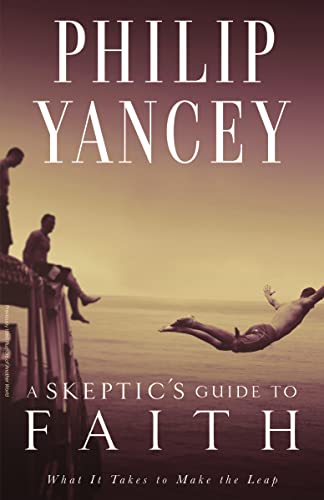
Inhaltsangabe
For those on the borderlands of belief, Philip Yancey confronts questions of faith and religion head-on.
If this is God's world, why doesn't it look more like it? For anyone who's ever wondered if the visible world is all there is—for anyone who feels like an empirical understanding of reality is missing something—bestselling author and fellow pilgrim Philip Yancey comes beside you to explore this tug between the visible and the invisible.
In the gentle, understanding voice of one who's been through skepticism, Yancey investigates questions like:
- What is the good life?
- Do my deepest experiences of beauty and pain have meaning?
- Is there life after death?
- If God does exist, why does this world seem to be coming apart at the seams?
- Does faith make any difference in my daily life?
A Skeptic's Guide to Faith, previously titled Rumors of Another World, reads like a conversation, inviting those skeptical of religion and turned off by the church to consider the possibility of an unseen world coexisting with our visible world. According to Yancey, "A thin membrane of belief separates the natural from the supernatural." What makes it so hard for some of us to cross that membrane? Look inside to find out. In this powerful read, Yancey tackles the tough questions and, in the process, comes up with a fresh new approach to this timeless topic
Die Inhaltsangabe kann sich auf eine andere Ausgabe dieses Titels beziehen.
Über die Autorin bzw. den Autor
Philip Yancey previously served as editor-at-large for Christianity Today magazine. He has written thirteen Gold Medallion Award-winning books and won two ECPA Book of the Year awards, for What's So Amazing About Grace? and The Jesus I Never Knew. Four of his books have sold over one million copies. He lives with his wife in Colorado. Learn more at philipyancey.com.
Von der hinteren Coverseite
What on earth are you missing?
Philip Yancey writes: “I am where you are . . . an ordinary person trying to figure things out. I love, I experience beauty and pain, my friends die, I weep, I live. And as I live I try to figure out if there is a God, and what difference would that make . . . This book comes out of my own search and is written on behalf of those who live outside of belief--that borderlands region between belief and unbelief.”
How many times have you heard someone say, “I'm spiritual but not religious?” Or perhaps you've had that thought yourself. For some people, religious faith seems to come easily, but for others it comes in a swirl of doubts and questions.
In A Skeptic's Guide to Faith, Philip Yancey confronts the questions head-on, from the stance of a skeptic. He asks, “Is the visible world around us all there is?” and then examines the apparent contradictions. If this is God's world, why doesn't it look more like it? Finally, the book considers how two worlds--the visible and invisible--might affect our daily lives. Does faith really make a difference day to day?
A Skeptic's Guide to Faith reads like a conversation, inviting those skeptical of religion and turned off by the church to consider the possibility of an unseen world coexisting with our visible world.
According to Yancey, “A thin membrane of belief separates the natural from the supernatural.”
What makes it so hard for some of us to cross that membrane?
Look inside to find out.
Auszug. © Genehmigter Nachdruck. Alle Rechte vorbehalten.
A Skeptic's Guide to Faith
By Philip YanceyZondervan
Copyright © 2009 Someone Cares Charitable TrustAll right reserved.
ISBN: 978-0-310-32502-4
Contents
A Note from the Author..................................91. Life in Part.........................................132. A Tug between Two Worlds.............................273. Paying Attention.....................................434. God Loveth Adverbs...................................595. Designer Sex.........................................736. Out of Order.........................................997. A Word Unsaid........................................1138. The Good Life........................................1279. The Gift of Guilt....................................14110. Why Believe?........................................16111. Earth Matters.......................................17912. Eyes of Faith.......................................19113. Practicing the Existence of God.....................20714. Stereoscopic Vision.................................225Acknowledgments.........................................245Sources.................................................247
Chapter One
Life in Part
The most beautiful thing we can experience is the mysterious. It is the source of all true art and science. He to whom this emotion is a stranger, who can no longer pause to wonder and stand rapt in awe, is as good as dead: his eyes are closed. Albert Einstein
More than ten million people in Europe and Asia have viewed a remarkable exhibition known as Body Worlds. A German professor invented a vacuum process called plastination, which replaces individual cells of the human body with brightly colored resins and epoxies, much as minerals replace the cells of trees in a petrified forest. As a result, he can preserve a human body, whole or stripped away to reveal its inner parts, and display the cadaver in an eerily lifelike pose.
I visited Body Worlds in a warehouse art gallery in London after an overnight flight from my home in Colorado. I was feeling the effects of jet lag until, on entering the gallery, I encountered the exhibition's signature piece: a man all muscles, tendons, and ligaments, his face peeled like a grape, with the entire rubbery organ of skin, flayed and intact, draped over his arm like a raincoat. Sleepiness immediately gave way to a morbid fascination.
For the next two hours I shuffled past the sixty preserved bodies artfully arranged among palm trees and educational displays. I saw a woman eight months pregnant, reclining as if on a couch, her insides opened to reveal the fetus resting head-down inside. Skinned athletes-a runner, swordsman, swimmer, and basketball player-assumed their normal poses to demonstrate the wonders of the skeletal and muscular systems. A chess player sat intently at a chessboard, his back stripped to the nerves of his spinal cord and his skull removed to reveal the brain.
One display hung the pink organs of the digestive system on a wire frame, descending from the tongue down to the stomach, liver, pancreas, intestines, and colon. A placard mentioned five million glands employed for digestion, and I could not help thinking of the combination of cured salmon, cinnamon rolls, yogurt, and fish and chips-sloshed together with at least a quart of airline coffee-challenging those glands inside me at that moment. Moving on, I learned that babies have no kneecaps at birth, that the body's total volume of blood filters through the kidneys every four minutes, that brain cells die if deprived of oxygen for even ten seconds. I viewed a liver shrunken from alcohol abuse, a tiny spot of cancer in a breast, globs of plaque clinging to the walls of arteries, lungs black from cigarette smoke, a urethra squeezed by an enlarged prostate gland.
When not observing the plastinated bodies, I observed the people observing the plastinated bodies. A young girl wearing all black, her midriff bare, with orange hair and a lip ring, roses tattooed on her arm, alert to all live bodies but barely noticing the preserved ones. A Japanese woman in a flowered silk dress and straw hat with matching straw platform shoes, very proper, staring impassively at each exhibit. A doctor ostentatiously showing off his knowledge to a beautiful young companion twenty years his junior. A know-it-all college student in a jogging suit explaining wrongly to his girlfriend that "of course, the right brain controls speech." Silent people pressing plastic audio wands to their ears, marching on cue like zombies from one display to the next.
The sharp scent of curry drifted in from outdoors, along with the throb of hip-hop music. Local merchants, sponsoring a curry festival, had blocked off several streets for bands and dancing. I moved to a window and watched the impromptu block party. Outside the gallery, life; inside, the plastinated residue of life.
Wherever Body Worlds had opened, in places like Switzerland and Korea, organized protests had followed, and the exhibition had papered one wall with news accounts of the demonstrations. Protesters believed that it affronted human dignity to take someone like a grandmother, with a family and home and name and maybe even an eternal destiny, and dissect and plastinate her, then put her on display for gawking tourists.
In response, Professor Gunther von Hagens had posted a vigorous statement defending his exhibition. He explained that the cadavers/ persons had before death voluntarily signed over their bodies for precisely this purpose. Indeed, he had a waiting list of thousands of prospective donors. He credited Christianity as being the religion most tolerant of this line of scientific research and included a brief history of the church and medicine. Bizarrely, the exhibition ended with two splayed corpses, all muscles and bones and bulging eyes, kneeling before a cross.
* * *
That groggy afternoon at Body Worlds highlighted for me two distinct ways of looking at the world. One takes apart while the other seeks to connect and put together. We live in an age that excels at the first and falters at the second.
The cadavers, dissected to expose bones, nerves, muscles, tendons, ligaments, blood vessels, and internal organs, demonstrate our ability to break something down-in this case, the human being-into its constituent parts. We are reductionistic, say the scientists, and therein lies the secret to advances in learning. We can reduce complex systems like the solar system, global weather patterns, and the human body into simpler parts in order to understand how things work.
The recent digital revolution is a triumph of the reducers, for computers work by reducing information all the way down to a 1 or a 0. Nearly every day a friend sends me jokes by email. Today, I got a list of questions to ponder, including these: Why is "abbreviated" such a long word? Why is the time of day with the slowest traffic called rush hour? Why isn't there mouse-flavored cat food? People with too much time on their hands come up with these jokes, type them into a computer, and post them electronically for the amusement of the rest of the world.
I think of all the steps involved. The jokester's computer registers a series of keystrokes, translates them into binary bits of data, and records them magnetically as a file on a hard disk. Later, communications software retrieves that file and translates it into a sequential code, which it sends over a modem...
„Über diesen Titel“ kann sich auf eine andere Ausgabe dieses Titels beziehen.
Suchergebnisse für A Skeptic's Guide to Faith: What It Takes to Make...

Beispielbild für diese ISBN
A Skeptic's Guide to Faith: What It Takes to Make the Leap
Anbieter: World of Books (was SecondSale), Montgomery, IL, USA
Verkäuferbewertung 5 von 5 Sternen

Zustand: Good. Item in good condition. Textbooks may not include supplemental items i.e. CDs, access codes etc. Artikel-Nr. 00102655394
Gebraucht kaufen
EUR 3,66
Versand gratis
Versand innerhalb von USA
Versand innerhalb von USA
Anzahl: 7 verfügbar
Beispielbild für diese ISBN
A Skeptic's Guide to Faith: What It Takes to Make the Leap
Anbieter: World of Books (was SecondSale), Montgomery, IL, USA
Verkäuferbewertung 5 von 5 Sternen
Zustand: Acceptable. Item in acceptable condition! Textbooks may not include supplemental items i.e. CDs, access codes etc. Artikel-Nr. 00102493177
Gebraucht kaufen
EUR 3,66
Versand gratis
Versand innerhalb von USA
Versand innerhalb von USA
Anzahl: 1 verfügbar
Beispielbild für diese ISBN
A Skeptic's Guide to Faith: What It Takes to Make the Leap
Anbieter: World of Books (was SecondSale), Montgomery, IL, USA
Verkäuferbewertung 5 von 5 Sternen
Zustand: Very Good. Item in very good condition! Textbooks may not include supplemental items i.e. CDs, access codes etc. Artikel-Nr. 00102279590
Gebraucht kaufen
EUR 3,66
Versand gratis
Versand innerhalb von USA
Versand innerhalb von USA
Anzahl: 1 verfügbar
Beispielbild für diese ISBN
A Skeptic's Guide to Faith: What It Takes to Make the Leap
Anbieter: BooksRun, Philadelphia, PA, USA
Verkäuferbewertung 5 von 5 Sternen
Paperback. Zustand: Fair. The item might be beaten up but readable. May contain markings or highlighting, as well as stains, bent corners, or any other major defect, but the text is not obscured in any way. Artikel-Nr. 0310325021-7-1
Gebraucht kaufen
EUR 4,60
Versand gratis
Versand innerhalb von USA
Versand innerhalb von USA
Anzahl: 1 verfügbar
Beispielbild für diese ISBN
A Skeptic's Guide to Faith: What It Takes to Make the Leap
Anbieter: Wonder Book, Frederick, MD, USA
Verkäuferbewertung 5 von 5 Sternen
Zustand: Good. Good condition. A copy that has been read but remains intact. May contain markings such as bookplates, stamps, limited notes and highlighting, or a few light stains. Artikel-Nr. J11C-02312
Gebraucht kaufen
EUR 6,33
Versand gratis
Versand innerhalb von USA
Versand innerhalb von USA
Anzahl: 2 verfügbar
Beispielbild für diese ISBN
A Skeptic's Guide to Faith: What It Takes to Make the Leap
Anbieter: Wonder Book, Frederick, MD, USA
Verkäuferbewertung 5 von 5 Sternen
Zustand: Very Good. Very Good condition. A copy that may have a few cosmetic defects. May also contain light spine creasing or a few markings such as an owner's name, short gifter's inscription or light stamp. Artikel-Nr. L07A-04017
Gebraucht kaufen
EUR 6,33
Versand gratis
Versand innerhalb von USA
Versand innerhalb von USA
Anzahl: 1 verfügbar
Beispielbild für diese ISBN
Skeptic's Guide to Faith
Anbieter: Better World Books: West, Reno, NV, USA
Verkäuferbewertung 5 von 5 Sternen
Zustand: Good. Pages intact with minimal writing/highlighting. The binding may be loose and creased. Dust jackets/supplements are not included. Stock photo provided. Product includes identifying sticker. Better World Books: Buy Books. Do Good. Artikel-Nr. 4106791-6
Gebraucht kaufen
EUR 6,47
Versand gratis
Versand innerhalb von USA
Versand innerhalb von USA
Anzahl: 1 verfügbar
Beispielbild für diese ISBN
Skeptic's Guide to Faith
Anbieter: Better World Books, Mishawaka, IN, USA
Verkäuferbewertung 5 von 5 Sternen
Zustand: Very Good. Pages intact with possible writing/highlighting. Binding strong with minor wear. Dust jackets/supplements may not be included. Stock photo provided. Product includes identifying sticker. Better World Books: Buy Books. Do Good. Artikel-Nr. 5737047-6
Gebraucht kaufen
EUR 6,47
Versand gratis
Versand innerhalb von USA
Versand innerhalb von USA
Anzahl: 1 verfügbar
Beispielbild für diese ISBN
Skeptic's Guide to Faith
Anbieter: Better World Books: West, Reno, NV, USA
Verkäuferbewertung 5 von 5 Sternen
Zustand: Very Good. Pages intact with possible writing/highlighting. Binding strong with minor wear. Dust jackets/supplements may not be included. Stock photo provided. Product includes identifying sticker. Better World Books: Buy Books. Do Good. Artikel-Nr. 5737047-6
Gebraucht kaufen
EUR 6,47
Versand gratis
Versand innerhalb von USA
Versand innerhalb von USA
Anzahl: 1 verfügbar
Beispielbild für diese ISBN
Skeptic's Guide to Faith
Anbieter: Better World Books, Mishawaka, IN, USA
Verkäuferbewertung 5 von 5 Sternen
Zustand: Good. Pages intact with minimal writing/highlighting. The binding may be loose and creased. Dust jackets/supplements are not included. Stock photo provided. Product includes identifying sticker. Better World Books: Buy Books. Do Good. Artikel-Nr. 4106791-6
Gebraucht kaufen
EUR 6,47
Versand gratis
Versand innerhalb von USA
Versand innerhalb von USA
Anzahl: 1 verfügbar