
Verwandte Artikel zu Genesis: The Covenant Comes to Life (Bringing the Bible...
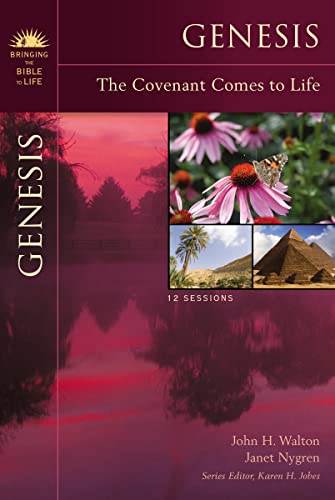
Inhaltsangabe
A series of Bible study guides following the format and content of the NIV Application Commentaries Series. Each study looks at the original meaning, bridging contexts, and contemporary significance of the text, and offers small group participants a better understanding and relevant application of the biblical material to their daily lives.
Die Inhaltsangabe kann sich auf eine andere Ausgabe dieses Titels beziehen.
Über die Autorinnen und Autoren
John H. Walton (PhD, Hebrew Union College) is professor emeritus of Old Testament at Wheaton College Graduate School. He is the author or coauthor of numerous books, including Old Testament Today, with Andrew E. Hill; volumes on Job and Genesis in the NIV Application Commentary series; the Lost World series; and Old Testament Theology for Christians. He was also coeditor, with Craig Keener, of the ECPA 2017 Bible of the Year winner, the NIV Cultural Backgrounds Study Bible.
Janet Nygren is currently the Women’s Ministry Coordinator for the Princeton Presbyterian Church (PCA) in Princeton, NJ.
Karen H. Jobes (PhD, Westminister Theological Seminary) is the Gerald F. Hawthorne Professor Emerita of New Testament Greek and Exegesis at Wheaton College and Graduate school in Wheaton, Illinois. The author of several works, she has also been involved in the NIV Bible translation. She and her husband, Forrest, live in Philadelphia and are members of an Evangelical Presbyterian Church.
Von der hinteren Coverseite
A series of Bible study guides following the format and content of the NIV Application Commentaries Series. Each study looks at the original meaning, bridging contexts, and contemporary significance of the text, and offers small group participants a better understanding and relevant application of the biblical material to their daily lives.
Auszug. © Genehmigter Nachdruck. Alle Rechte vorbehalten.
Bringing the Bible to Life: Genesis
By John H. Walton Janet Nygren Karen H. JobesZondervan
Copyright © 2008 John H. Walton, Janet Nygren and Karen H. JobesAll right reserved.
ISBN: 978-0-310-27648-7
Contents
Series Preface..............................................................................7Introduction................................................................................11Session 1 Creation (Genesis 1:1-2:3).......................................................13Session 2 Paradise Lost (Genesis 2:4-4:16).................................................23Session 3 The new World (Genesis 6:9-9:29; 11:1-9).........................................31Session 4 Abraham's new Calling (Genesis 11:27-14:24)......................................41Session 5 An Heir in the Making (Genesis 15:1-18:15).......................................51Session 6 Advances for the Covenant (Genesis 18:16-21:34)..................................59Session 7 A Test of Love (Genesis 22:1-19; 23:1-20; 25:1-11)...............................67Session 8 Twists and Turns 75 in the Covenant (Genesis 24; 25:19-28:9).....................59Session 9 A Journey of Faith (Genesis 28:10-33:20).........................................83Session 10 Hearts That Worship (Genesis 34-35; 37-38)......................................93Session 11 A Blessed nation (Genesis 39-41)................................................101Session 12 A new Beginning (Genesis 42-50).................................................109Leader's Notes..............................................................................119
Chapter One
SESSION 1 Creation Genesis 1:1-2:3
Most of us have some familiarity with Genesis 1 and the many hot debates that go along with it: creationism versus evolution, the question of the twenty-four-hour days of creation, the age of the earth-in general, how literally are we to understand this first book of the Bible? But think about it-many of the questions we try to answer looking at Genesis 1 were probably not on the minds of the original audience. The existence of God wasn't an issue-but rather, how many gods were there and who controlled what? What is the sun made of was much less important than will it rain on our crops and will we survive the next storm? Our questions today are the result of the most recent centuries of thinking framed by the scientific process-getting to the bottom of how things work. Instead of jumping into the modern debate, we're going to start by trying to put ourselves in the shoes of the Israelites who first heard this creation account, and think about the beginning from their point of view.
IN THE BEGINNING
Read Genesis 1:1-5.
1. Many conservative scholars are in general agreement that Moses was the principal, if not the only, author of Genesis. In that case, the first audience would have been the Israelites before they settled in the Promised Land. Thinking about their roots, and where they had been for hundreds of years in slavery, what cultural backgrounds were they most likely to be familiar with? What sorts of issues might they face in the wilderness for which they would turn to God for answers?
2. When we think about creation, our minds immediately jump to the origin of matter. What do John 1:3, Colossians 1:16-17, and Hebrews 11:3 say about God's role in creation? How does Romans 1:18-20 view this?
GOING DEFER
We live in a world far different from the world of the Old Testament. We must recognize the elements that distinguish these two worlds and make appropriate adjustments to our expectations. In our world, we believe reality is described most accurately in scientific terms. Mythology in the ancient world played the role that science plays in our modern world-it contained the explanation of how the world came into being and how it worked.
3. Comparing the beginning of Genesis to mythology does not make the creation story a myth, but rather gives us a window into the culture of that time. Mythology in the ancient Near East suggests the beginning as a period of chaos and darkness, with the elements themselves gradually taking on names and powers to explain the existence of forces familiar to everyone. For example, in Mesopotamia, the wind was understood to disrupt the waters and the waters became known by the name Tiamat-the goddess of the ocean. How do the first two verses of Genesis coincide with this description of ancient Near East mythology? How are they different?
4. If we try to understand the creation from a scientific perspective, the separation of light and darkness (causing day and night on the first day) sets us up for confusion when we compare it to God's creative acts on the fourth day (Gen. 1:14-19). This was not likely an issue for the original audience because they were not concerned about the mechanics. It's a lot more helpful to think about creation as an organizing process-creating roles and functions for each part of the cosmos. How does the creation of day and night bring order out of a formless and empty darkness?
ORGANIZING THE EARTH
Read Genesis 1:6-13.
5. It's not too hard to begin to see a pattern as God continues to create on subsequent days. What things do you find in common in the accounts for the second and third days of creation? What do these tell you about God?
GOING DEEPER
The initial verses we have studied reveal that God alone takes responsibility for imposing order on chaos. He demonstrates his power and sovereignty by bringing the cosmos into conformity with his purposes. He does not accomplish this through battle with cosmic monsters, as the rest of the ancient world portrayed it, but by simply speaking the functions into existence.
6. Try to think like an ancient Israelite now-that is, don't think about the structures that are being formed, but think about the functions of the things that are talked about in days two and three. How would you describe what is being formed on these days, and what importance would they have for you in the kind of life you live?
7. God created a world that could provide for its inhabitants and called it good. Think about the Israelites' fight for survival. Do you think they thought all of creation was good? Why or why not? Is our perspective today any different? What does it teach us about our relationship to God?
FILLING THE EARTH
Read Genesis 1:14-31.
8. When I prepare my garden in the spring, I have to think things through pretty carefully-both the order and the space I have. I can't plant seeds before I've prepared the soil properly, and I've got to make sure I've left enough room for young plants to look just right when they fill out and bloom. If you line up day one with day four, two with five, and three with six, what do you notice about God's planning and ordering of creation?
9. We often think of people as God's crowning touch to creation, made, as 1:26-27 describes, in God's image to rule the earth. In some ways, our culture exploits that belief; in other ways, it denies the significance of it. How do you see this working itself out in today's world? What do you suppose God's intention was?
GOING DEEPER
In the ancient worldview people were slaves to the gods with no...
„Über diesen Titel“ kann sich auf eine andere Ausgabe dieses Titels beziehen.
Suchergebnisse für Genesis: The Covenant Comes to Life (Bringing the Bible...

Beispielbild für diese ISBN
Genesis: The Covenant Comes to Life
Verlag:
HarperChristian Resources, 2008
ISBN 10: 0310276489
ISBN 13: 9780310276487
Gebraucht
Paperback
Anbieter: World of Books (was SecondSale), Montgomery, IL, USA
Verkäuferbewertung 5 von 5 Sternen

Paperback. Zustand: Good. A series of Bible study guides following the format and content of the NIV Application Commentaries Series. Each study looks at the original meaning, bridging contexts, and contemporary significance of the text, and offers small group participants a better understanding and relevant application of the biblical material to their daily lives. Artikel-Nr. 00098210876
Gebraucht kaufen
EUR 6,97
Versand gratis
Versand innerhalb von USA
Versand innerhalb von USA
Anzahl: 2 verfügbar
Beispielbild für diese ISBN
The Genesis: The Covenant Comes to Life
Verlag:
Harperchristian Resources, 2008
ISBN 10: 0310276489
ISBN 13: 9780310276487
Gebraucht
Paperback
Anbieter: ThriftBooks-Atlanta, AUSTELL, GA, USA
Verkäuferbewertung 5 von 5 Sternen
Paperback. Zustand: Very Good. No Jacket. Missing dust jacket; May have limited writing in cover pages. Pages are unmarked. ~ ThriftBooks: Read More, Spend Less. Artikel-Nr. G0310276489I4N01
Gebraucht kaufen
EUR 7,39
Versand gratis
Versand innerhalb von USA
Versand innerhalb von USA
Anzahl: 1 verfügbar
Beispielbild für diese ISBN
The Genesis: The Covenant Comes to Life
Verlag:
Harperchristian Resources, 2008
ISBN 10: 0310276489
ISBN 13: 9780310276487
Gebraucht
Paperback
Anbieter: ThriftBooks-Dallas, Dallas, TX, USA
Verkäuferbewertung 5 von 5 Sternen
Paperback. Zustand: Very Good. No Jacket. May have limited writing in cover pages. Pages are unmarked. ~ ThriftBooks: Read More, Spend Less. Artikel-Nr. G0310276489I4N00
Gebraucht kaufen
EUR 7,39
Versand gratis
Versand innerhalb von USA
Versand innerhalb von USA
Anzahl: 1 verfügbar
Beispielbild für diese ISBN
Genesis : The Covenant Comes to Life
Verlag:
HarperChristian Resources, 2008
ISBN 10: 0310276489
ISBN 13: 9780310276487
Gebraucht
Softcover
Anbieter: Better World Books, Mishawaka, IN, USA
Verkäuferbewertung 5 von 5 Sternen
Zustand: Good. Pages intact with minimal writing/highlighting. The binding may be loose and creased. Dust jackets/supplements are not included. Stock photo provided. Product includes identifying sticker. Better World Books: Buy Books. Do Good. Artikel-Nr. 13429104-6
Gebraucht kaufen
EUR 10,12
Versand gratis
Versand innerhalb von USA
Versand innerhalb von USA
Anzahl: 1 verfügbar
Beispielbild für diese ISBN
Genesis: The Covenant Comes to Life (Bringing the Bible to Life)
Verlag:
HarperChristian Resources, 2008
ISBN 10: 0310276489
ISBN 13: 9780310276487
Gebraucht
Paperback
Anbieter: WorldofBooks, Goring-By-Sea, WS, Vereinigtes Königreich
Verkäuferbewertung 5 von 5 Sternen
Paperback. Zustand: Very Good. The book has been read, but is in excellent condition. Pages are intact and not marred by notes or highlighting. The spine remains undamaged. Artikel-Nr. GOR010589041
Gebraucht kaufen
EUR 4,29
EUR 6,62 Versand
Versand von Vereinigtes Königreich nach USA
Versand von Vereinigtes Königreich nach USA
Anzahl: 1 verfügbar
Beispielbild für diese ISBN
Genesis: The Covenant Comes to Life (Bringing the Bible to Life)
Verlag:
HarperChristian Resources, 2008
ISBN 10: 0310276489
ISBN 13: 9780310276487
Gebraucht
Soft cover
Anbieter: Bookplate, Chestertown, MD, USA
Verkäuferbewertung 4 von 5 Sternen

Soft cover. Zustand: As New. Clean, unmarked, unread copy. BP/Bible Studies. Artikel-Nr. ABE-1649728103139
Gebraucht kaufen
EUR 9,20
EUR 7,59 Versand
Versand innerhalb von USA
Versand innerhalb von USA
Anzahl: 1 verfügbar
Beispielbild für diese ISBN
Genesis: The Covenant Comes to Life (Bringing the Bible to Life)
Anbieter: Ria Christie Collections, Uxbridge, Vereinigtes Königreich
Verkäuferbewertung 5 von 5 Sternen
Zustand: New. In English. Artikel-Nr. ria9780310276487_new
Neu kaufen
EUR 10,54
EUR 11,07 Versand
Versand von Vereinigtes Königreich nach USA
Versand von Vereinigtes Königreich nach USA
Anzahl: Mehr als 20 verfügbar
Beispielbild für diese ISBN
Genesis: The Covenant Comes to Life
Anbieter: Revaluation Books, Exeter, Vereinigtes Königreich
Verkäuferbewertung 5 von 5 Sternen
Paperback. Zustand: Brand New. 156 pages. 8.75x6.00x0.50 inches. In Stock. Artikel-Nr. x-0310276489
Neu kaufen
EUR 12,60
EUR 11,82 Versand
Versand von Vereinigtes Königreich nach USA
Versand von Vereinigtes Königreich nach USA
Anzahl: 2 verfügbar