
Verwandte Artikel zu The Minor Prophets, Job, Psalms, Proverbs, Ecclesiastes,...
The Minor Prophets, Job, Psalms, Proverbs, Ecclesiastes, Song of Songs (5) (Zondervan Illustrated Bible Backgrounds Commentary, Band 5) - Hardcover
Buch 1 von 29: Zondervan Illustrated Bible Backgrounds Commentary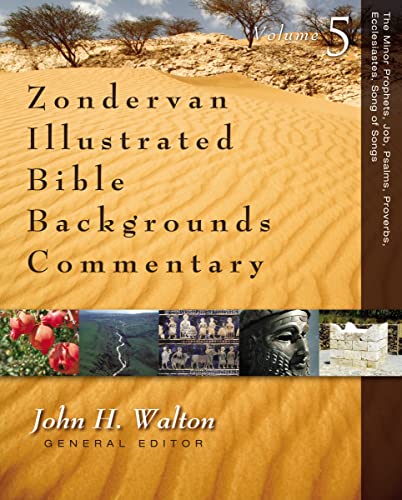
Inhaltsangabe
An image rich, passage-by-passage commentary that integrates textual and artifactual context from the ancient Near East to inform our understanding and interpretation of the Hebrew Bible—while remaining respectful to the inerrancy of Scripture.
Without a deep knowledge of the ancient cultures the Old Testament was born from, we can be tempted to impose our own culture on the text, potentially distorting it. This unique Bible backgrounds commentary examines:
- The history of the ancient Near East as a means of recovering knowledge of the events that shaped the lives of the people.
- The archaeology as a means of recovering the lifestyle reflected in the material cultures.
- The literature of the ancient Near East as a means of understanding the heart and soul of the people who inhabited the ancient world that Israel shared.
Detailed exegetical notes are combined with comparative discussions of the cultural settings that help scholars interpret the writings of the minor prophets (Hosea through Malachi) and books of wisdom and poetry; Job, Psalms, Proverbs, Ecclesiastes, and Song of Songs.
This volume of the celebrated Zondervan Illustrated Bible Backgrounds Commentary series brings these 17 books of the Bible into sharper focus—enabling scholars, pastors, and laity to access rich data from over one hundred and seventy years of explorations and excavations in the Near East.
THE ZONDERVAN ILLUSTRATED BIBLE BACKGROUNDS COMMENTARY SERIES
Invites you to enter the world of the Old Testament with a company of seasoned guides, experts who will give new insights into these cherished writings. Features:
- Over 2000 photographs, drawings, maps, diagrams, and charts provide a visual feast that breathes fresh life into the text.
- Passage-by-passage commentary presents archaeological findings, historical explanations, geographic insights, notes on manners and customs, and more.
- Analysis into the literature of the ancient Near East will open your eyes to new depths of understanding both familiar and unfamiliar passages.
- Written by an international team of 30 specialists, all top scholars in background studies.
Die Inhaltsangabe kann sich auf eine andere Ausgabe dieses Titels beziehen.
Über die Autorinnen und Autoren
John Hilber (PhD, Cambridge University) is professor of Old Testament at McMaster Divinity College, having previously taught at Dallas Theological Seminary and Grand Rapids Theological Seminary. He is author of Cultic Prophecy in the Psalms, Psalms in the Zondervan Illustrated Bible Background Commentary, Ezekiel: A Focused Commentary for Preaching and Teaching, Old Testament Cosmology and Divine Accommodation: A Relevance Theory Approach, and co-editor of Behind the Scenes of the Old Testament.
Tremper Longman III (PhD, Yale University) is a distinguished scholar and Professor Emeritus of Biblical Studies at Westmont College in Santa Barbara, California. He is on the advisory council of the BioLogos Foundation, and is the Old Testament editor for the revised Expositor's Bible Commentary and general editor for the Story of God Bible Commentary Old Testament, and has authored many articles and books on the Psalms and other Old Testament books.
Duane Garrett (Ph.D., Baylor Univerity) is John R. Sampey Professor of Old Testament Interpretation at Southern Baptist Theological Seminary.
J. Glen Taylor (Ph.D., Yale University), is associate professor of Old Testament, Wycliffe College and the School of Graduate Studies, University of Toronto.
Mark W. Chavalas (Ph.D., University of California at Los Angeles) is professor of History, at the University of Wisconsin-LaCrosse.
Von der hinteren Coverseite
Many today find the Old Testament a closed book. The cultural issues seem insurmountable and we are easily baffled by that which seems obscure. Furthermore, without knowledge of the ancient culture we can easily impose our own culture on the text, potentially distorting it. This series invites you to enter the Old Testament with a company of guides, experts that will give new insights into these cherished writings.Features include• Over 2000 photographs, drawings, maps, diagrams and charts provide a visual feast that breathes fresh life into the text.• Passage-by-passage commentary presents archaeological findings, historical explanations, geographic insights, notes on manners and customs, and more.• Analysis into the literature of the ancient Near East will open your eyes to new depths of understanding both familiar and unfamiliar passages. • Written by an international team of 30 specialists, all top scholars in background studies.
Auszug. © Genehmigter Nachdruck. Alle Rechte vorbehalten.
The Minor Prophets, Job, Psalms, Proverbs, Ecclesiastes, Song of Songs
Zondervan
Copyright © 2009 J. Glen TaylorAll right reserved.
ISBN: 978-0-310-25577-2
Contents
Acknowledgments......................................................viMethodology..........................................................ixGeneral Bibliography.................................................xviiAbbreviations........................................................xxHosea J. Glen Taylor................................................2Joel Mark W. Chavalas...............................................42Amos Philip S. Johnston.............................................54Obadiah Alan R. Millard.............................................90Jonah John H. Walton................................................100Micah Daniel M. Master..............................................120Nahum Alan R. Millard...............................................148Habakkuk Victor H. Matthews.........................................164Zephaniah Mark W. Chavalas..........................................178Haggai Kenneth G. Hoglund...........................................192Zechariah Kenneth G. Hoglund and John H. Walton.....................202Malachi Andrew E. Hill..............................................232Job Izak Cornelius..................................................246Psalms John W. Hilber...............................................316Proverbs Tremper Longman III........................................464Ecclesiastes Duane Garrett..........................................504Song of Songs Duane Garrett.........................................518Picture Index........................................................535
Chapter One
HOSEA by J. Glen TaylorIntroduction
Hosea prophesied from as early as the time of the Israelite king Jeroboam II (786-745 B.C.) to perhaps as late as the reign of the Judean king Hezekiah (725-686 B.C.). His prophetic ministry thus lasted between twenty and forty-five years. Most, if not all, of what is recorded in this prophecy took place before the conquest of Samaria by the Assyrians in 722 B.C.
It is odd that a book about an Israelite prophet ministering within the kingdom of Israel begins by mentioning the kings of Judah prior to the king of Israel. This suggests that the message of the book in its final form was primarily directed to the southern kingdom of Judah and at a later period when Hosea's preaching had become famous for its divine authority and abiding relevancy.
Extrabiblical evidence complements and supplements what 2 Kings 14:23-29 already tells us about life in Israel under Jeroboam II, first king over Hosea the public prophet. Historical evidence tells us that for more than a century before Tiglath-pileser III took the throne of Assyria late in the spring of 745 B.C., this tyrannical nation had tried to flex its muscles in Syria-Palestine, but with little effect because of economic and social instability. Thus far it had dealt no substantive blow to Israel but it had to Syria, Israel's neighbor and traditional rival to the north. Syria's losses were economically and militarily advantageous for Israel, allowing Jeroboam II to reclaim strategic territory to the north and east. As well, it inadvertently created a buffer zone that helped the elite in Israel to accumulate the wealth that, as Amos and Hosea eloquently remind us, they badly abused.
Such abuse of wealth might be reflected in the archaeological record at the former capital city of Tirzah (Tell el-Farah north; see 1 Kings 15:33; 16:8). There in stratum III, dating to the eighth century B.C., have been found solidly built, stately four-room houses in the neighborhood immediately south of an administrative headquarters, while further to the south was a cluster of four-roomed houses that were poorly built and shabbily aligned. Samaria, which had a large cluster of impressive building complexes outside her (especially to the south toward Shechem) possibly suggests a similar gap between the wealthy and rich.
History, especially as it relates to the other kings of Israel, sheds further light on Hosea's time. The murder of Jeroboam II's son Zechariah spelled an end not only to the Jehu dynasty (which held a record in Israel for longevity) but to any semblance of political stability in Israel. From then on, as one short-lived, illegitimate king replaced another, all that reigned with consistency was chaos itself. And it could not have come at a worse time for Israel. Starting with the kingdom of Urartu near Turkey in the north (743-740 B.C.) and moving progressively south over an additional three campaigns (738, 734, 733-732 B.C.), the Assyrian king Tiglathpileser III, a brilliant military strategist, systematically mobilized his army against the entire eastern Mediterranean seaboard in order to quell rebellions and to redirect needed goods along trade routes to Assyria.
Living in Israel at this time would have been much like living in an unruly Third World country today, where political stability and godly diplomacy were necessary (and were within reach), but where something close to anarchy prevailed, along with looting and other forms of lawlessness. This was a particularly tough pill for Israel to swallow, as she could still remember the sweet taste of peace and stability. For this to happen when a ruthless superpower threatened to devour the once mighty Israel no doubt stirred up feelings of both frustration and terror.
Assyria's foreign policy allowed kingdoms like Israel three main options: (1) submit voluntarily and pay tribute; (2) be conquered and pay tribute as an independent puppet state; or (3) be conquered and pay tribute as a full-fledged province of Assyria, with an Assyrian overseer. Israel graduated from options one to two under Tiglath-pileser III (campaigns of 738 B.C. and 732 respectively) and to option three under Sargon II (722 B.C.).
Each of these three stages of Israel's subjugation is attested in Assyrian sources. Records of Tiglath-pileser found on slabs at Calah record Menahem of Israel (745-737 B.C.) paying voluntary tribute:
I received tribute from Kushtashpi of Commagene, Rezon of Damascus, Menahem of Samaria, Hiram of Tyre, Sibittibi'li of Byblos (etc.).... gold, silver, tin, iron, elephant-hides, ivory, linen garments with multicolored trimmings, blue-dyed wool, purple-dyed wool, ebony-wood, boxwood-wood, whatever was precious (enough for a) royal treasure; also lambs whose stretched hides were dyed purple, (and) wild birds whose spread-out wings were dyed blue, (furthermore) horses, mules, large and small cattle, (male) camels, female camels with their foals.
Tiglath-pileser's annals also record Israel's ill-fated final king Hoshea being installed as a puppet king (in keeping with option two): "Israel [lit., Omri-Land] ... overthrew their king Pekah and I placed Hoshea as king over them. I received from them 10 talents of gold, 1,000 (?) talents of silver as their [tri]bute and brought them to Assyria."
Finally came option three. Annals from stone stabs and inscriptions on walls at Khorsabad contain this boast of the Assyrian king Sargon II: "I besieged and conquered Samaria, led away as booty 27,290 inhabitants of it. I formed from among them a contingent of 50 chariots and made remaining (inhabitants) assume their (social) positions. I installed over them an officer of mine and imposed upon them the tribute of the former king."
It may be helpful to...
„Über diesen Titel“ kann sich auf eine andere Ausgabe dieses Titels beziehen.
Suchergebnisse für The Minor Prophets, Job, Psalms, Proverbs, Ecclesiastes,...

Beispielbild für diese ISBN
The Minor Prophets, Job, Psalms, Proverbs, Ecclesiastes, Song of Songs
Anbieter: World of Books (was SecondSale), Montgomery, IL, USA
Verkäuferbewertung 5 von 5 Sternen

Hardback. Zustand: Good. Many today find the Old Testament a closed book. The cultural issues seem insurmountable and we are easily baffled by that which seems obscure. Furthermore, without knowledge of the ancient culture we can easily impose our own culture on the text, potentially distorting it. This series invites you to enter the Old Testament with a company of guides, experts that will give new insights into these cherished writings.Features include-Over 2000 photographs, drawings, maps, diagrams and charts provide a visual feast that breathes fresh life into the text.-Passage-by-passage commentary presents archaeological findings, historical explanations, geographic insights, notes on manners and customs, and more.-Analysis into the literature of the ancient Near East will open your eyes to new depths of understanding both familiar and unfamiliar passages. -Written by an international team of 30 specialists, all top scholars in background studies. Artikel-Nr. 00110272811
Gebraucht kaufen
EUR 16,52
Versand gratis
Versand innerhalb von USA
Versand innerhalb von USA
Anzahl: 1 verfügbar
Foto des Verkäufers
The Minor Prophets, Job, Psalms, Proverbs, Ecclesiastes, Song of Songs (5) (Zondervan Illustrated Bible Backgrounds Commentary)
Anbieter: Dream Books Co., Denver, CO, USA
Verkäuferbewertung 5 von 5 Sternen
Zustand: good. Gently used with minimal wear on the corners and cover. A few pages may contain light highlighting or writing, but the text remains fully legible. Dust jacket may be missing, and supplemental materials like CDs or codes may not be included. May be ex-library with library markings. Ships promptly! Artikel-Nr. DBV.0310255775.G
Gebraucht kaufen
EUR 18,78
Versand gratis
Versand innerhalb von USA
Versand innerhalb von USA
Anzahl: 1 verfügbar
Beispielbild für diese ISBN
The Minor Prophets, Job, Psalms, Proverbs, Ecclesiastes, Song of Songs
Anbieter: Better World Books: West, Reno, NV, USA
Verkäuferbewertung 5 von 5 Sternen
Zustand: Very Good. Former library copy. Pages intact with possible writing/highlighting. Binding strong with minor wear. Dust jackets/supplements may not be included. Includes library markings. Stock photo provided. Product includes identifying sticker. Better World Books: Buy Books. Do Good. Artikel-Nr. 19251170-6
Gebraucht kaufen
EUR 20,01
Versand gratis
Versand innerhalb von USA
Versand innerhalb von USA
Anzahl: 1 verfügbar
Beispielbild für diese ISBN
Minor Prophets, Job, Psalms, Proverbs, Ecclesiastes, Song of Songs
Anbieter: Kennys Bookstore, Olney, MD, USA
Verkäuferbewertung 5 von 5 Sternen
Zustand: New. Series: Zondervan Illustrated Bible Backgrounds Commentary. Num Pages: 592 pages, colour illustrations, black & white tables, maps, charts. BIC Classification: HRCF1; HRCG1. Category: (G) General (US: Trade). Dimension: 238 x 204 x 41. Weight in Grams: 1710. . 2009. Hardback. . . . . Books ship from the US and Ireland. Artikel-Nr. V9780310255772
Neu kaufen
EUR 95,44
EUR 9,40 Versand
Versand innerhalb von USA
Versand innerhalb von USA
Anzahl: 15 verfügbar
Beispielbild für diese ISBN
The Minor Prophets, Job, Psalms, Proverbs, Ecclesiastes, Song of Songs
Anbieter: Revaluation Books, Exeter, Vereinigtes Königreich
Verkäuferbewertung 5 von 5 Sternen
Hardcover. Zustand: Brand New. 557 pages. 9.50x7.50x1.75 inches. In Stock. Artikel-Nr. 0310255775
Neu kaufen
EUR 99,17
EUR 23,89 Versand
Versand von Vereinigtes Königreich nach USA
Versand von Vereinigtes Königreich nach USA
Anzahl: 1 verfügbar
Foto des Verkäufers
The Minor Prophets, Job, Psalms, Proverbs, Ecclesiastes, Song of Songs: 5
Anbieter: moluna, Greven, Deutschland
Verkäuferbewertung 5 von 5 Sternen
Gebunden. Zustand: New. KlappentextrnrnMany today find the Old Testament a closed book. The cultural issues seem insurmountable and we are easily baffled by that which seems obscure. Furthermore, without knowledge of the ancient culture we can easily impose our own cul. Artikel-Nr. 608245734
Neu kaufen
EUR 75,07
EUR 48,99 Versand
Versand von Deutschland nach USA
Versand von Deutschland nach USA
Anzahl: Mehr als 20 verfügbar
Foto des Verkäufers
The Minor Prophets, Job, Psalms, Proverbs, Ecclesiastes, Song of Songs : 5
Anbieter: AHA-BUCH GmbH, Einbeck, Deutschland
Verkäuferbewertung 5 von 5 Sternen
Buch. Zustand: Neu. Neuware - Many today find the Old Testament a closed book. The cultural issues seem insurmountable and we are easily baffled by that which seems obscure. Furthermore, without knowledge of the ancient culture we can easily impose our own culture on the text, potentially distorting it. This series invites you to enter the Old Testament with a company of guides, experts that will give new insights into these cherished writings.Features include\*Over 2000 photographs, drawings, maps, diagrams and charts provide a visual feast that breathes fresh life into the text.\*Passage-by-passage commentary presents archaeological findings, historical explanations, geographic insights, notes on manners and customs, and more.\*Analysis into the literature of the ancient Near East will open your eyes to new depths of understanding both familiar and unfamiliar passages. \*Written by an international team of 30 specialists, all top scholars in background studies. Artikel-Nr. 9780310255772
Neu kaufen
EUR 101,73
EUR 46,91 Versand
Versand von Deutschland nach USA
Versand von Deutschland nach USA
Anzahl: 2 verfügbar