
Verwandte Artikel zu The Power of Forgetting: Six Essential Skills to Clear...
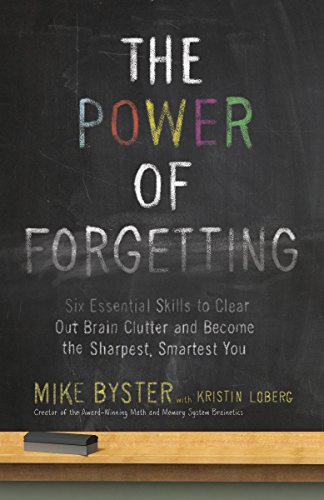
The Power of Forgetting: Six Essential Skills to Clear Out Brain Clutter and Become the Sharpest, Smartest You - Softcover
Inhaltsangabe
An uncommon guide for accomplishing more every day by engaging the unique skill of forgetting, from the creator of the award-winning memory training system Brainetics
Is it possible that the answer to becoming a more efficient and effective thinker is learning how to forget? Yes! Mike Byster will show you how mastering this extraordinary technique—forgetting unnecessary information, sifting through brain clutter, and focusing on only important nuggets of data—will change the quality of your work and life balance forever.
Using the six tools in The Power of Forgetting, you’ll learn how to be a more agile thinker and productive individual. You will overcome the staggering volume of daily distractions that lead to to brain fog, an inability to concentrate, lack of creativity, stress, anxiety, nervousness, angst, worry, dread, and even depression. By training your brain with Byster’s exclusive quizzes and games, you’ll develop the critical skills to become more successful in all that you do, each and every day.
Die Inhaltsangabe kann sich auf eine andere Ausgabe dieses Titels beziehen.
Über die Autorin bzw. den Autor
MIKE BYSTER is the creator of the award-winning memory system Brainetics and the founder of Brainetics, LLC.
Auszug. © Genehmigter Nachdruck. Alle Rechte vorbehalten.
CHAPTER 1
You Can Think Like a Genius
How It’s Possible to Develop a Genius Mind Regardless of IQ
We now accept the fact that learning is a lifelong process of keeping abreast of change. And the most pressing task is to teach people how to learn. --PETER DRUCKER
Imagine squaring a three-digit number in your head (for example, 392 times 392) within seconds without a calculator . . . or spelling “whistle-blower” in alphabetical order within ten seconds or less . . . or committing a two-hundred-digit number or twenty-page speech to memory that you can recite on the spot. Can such tasks be learned by anyone? Even you? Absolutely.
A more important question is this: Does being able to perform these mental stunts make you a genius? And if you could already tackle these challenges without first needing a lesson in useful strategies, does that make you a genius? We’re going to find out in this first chapter, which will provide the bedrock for the message of the entire book--that regardless of your innate talents, gifts, natural abilities, and even intelligence quotient (IQ), you can easily develop a set of skills that will make you think like a genius.
The Genie in Genius
If you’re like most people, the term “genius” is foreign to you because it doesn’t describe you. At least that’s what you think. But what if it could? Just what exactly is a genius? And more important, how can an “average” person become one? Is this possible? I’m going to attempt to answer these questions in this first chapter, ultimately proving that, yes, it is indeed possible for you to become a genius.
I think we all can agree that a genius is someone who embodies exceptional intellectual prowess, creativity, originality, or other natural ability to a degree that is typically associated with the achievement of unprecedented insight. Often such visionary outlooks translate into new discoveries that propel society forward and change how all of us live. Without geniuses, our understanding of mathematics, literature, and music would be completely different. Concepts that we now take for granted, like gravity, planetary orbits, and black holes, might still be undiscovered. Innovations that we can’t live without, such as computers, cell phones, and antibiotics and vaccines, could still be centuries away. So there’s no arguing that geniuses are central to advancements in science, technology, and our general understanding of how the world and the human body work. But what if the definition of genius encompassed a much broader array of accomplishments? What if each one of us possesses an inner genius that’s aching to come out and contribute to the world in some way, but just needs a gentle nudge? Interestingly, the word genius, which comes from Latin, literally means “attendant spirit present from birth.” This definition implies that we have an internal spirit who guards and protects us, giving rise to our natural abilities. In fact, from this word we get genie, as in the genie in the bottle of Arabian folklore.
We may never know precisely how one person ends up with the right balance of brainpower, intelligence, and supernatural creativity to become the type of genius who can keep company with Leonardo da Vinci, Thomas Edison, and Marie Curie (the first woman to win the Nobel Prize, for her contribution to physics), but for a moment I want you to believe that there’s a hidden genius, a special genie, within you--no matter how we define a genius. In fact, don’t even bother to define the word genius just yet. We’re going to explore the word and its many meanings in this chapter. For now, begin by simply pondering this question: what could you accomplish if you could think like a genius?
What’s in a Genius?
Although we can get one definition of genius from a dictionary, from a purely scientific standpoint we don’t really know how to define who or what a genius is. That’s right: we really don’t know how to explain genius exactly or what it really means, although sometimes, as Justice Potter Stewart once said of pornography, “we know it when we see it.”
If I were to ask you to name a few famous geniuses, you could probably come up with a handful. You’d think of people like Albert Einstein, who developed the theory of special relativity in 1905 and proved the existence of atoms, which are among the most elementary particles of the universe. He figured out that light behaves as both a particle and a wave, and he also developed his famous equation E = mc², which describes the relationship between matter and energy. Most of Einstein’s brainy work was done when he was in his twenties. Today’s genius physicists are trying to debunk some of Einstein’s grand theories, but I think we can all agree that Einstein will never lose his genius status in the history books. He also seems to be the default image for a modern genius, immortalized in our minds by photos taken of him during his later years--wild hair and all.
Then we have people like Wolfgang Amadeus Mozart, who started composing music when he was five years old. Mozart wrote hundreds of pieces before his death in 1760 at age thirty-five. In more recent times, you might consider the late Steve Jobs a genius, or filmmaker Steven Spielberg, champion chess player Bobby Fischer, theoretical physicist Stephen Hawking, businessman Warren Buffett, South African leader Nelson Mandela, Google founders Larry Page and Sergey Brin, or even Matt Groening, the creator of The Simpsons, to all be geniuses of one kind or another. Anyone you name shares a similar trait: an uncanny ability to do, discover, or create something extraordinary that has an enormous impact on society (with or without the wild hair and quirky personality, and with or without winning a Nobel Prize). And sometimes that “something” is just an idea, perspective, or point of view that shifts how we think and look at the world.
Geniuses might be fairly easy to identify, but defining exactly what makes one person a genius and not another is a little more complicated--borderline impossible. Why? Chiefly because genius is a broad and highly subjective concept that we can’t examine and study like we would a chemical reaction or weather patterns. Some believe that IQ tests are a way to measure and define a genius, but I don’t agree. True, I think we can all see eye to eye on the idea that a genius is a remarkably intelligent person who breaks new ground by using that intelligence in a productive or impressive way, but the real question we should be asking ourselves is this: What makes a person able to do all that? Is it having a more agile brain that has a unique operating system? Is it an instinctive knack for noticing things that other people might consider irrelevant?
For starters, it turns out that, like genius, intelligence can be difficult to quantify too. There is no “chart” that clearly defines different levels of intelligence from “dumb” to “smart.” Psychologists and neuroscientists study intelligence extensively. An entire field of study, known as psychometrics, is devoted to studying and measuring intelligence. But even within that field, experts don’t always agree on exactly what it is or how best to analyze it. And although intelligence is central to genius, not all geniuses score well on intelligence tests or perform well in school.
IQ tests are also standardized so that most people score between 90 and 110. When placed on a graph, the IQ test scores of a large group of people generally resemble a bell curve, with most people scoring in the average range. A common...
„Über diesen Titel“ kann sich auf eine andere Ausgabe dieses Titels beziehen.
Suchergebnisse für The Power of Forgetting: Six Essential Skills to Clear...

Beispielbild für diese ISBN
The Power of Forgetting: Six Essential Skills to Clear Out Brain Clutter and Become the Sharpest, Smartest You
Verlag:
Harmony/Rodale/Convergent, 2014
ISBN 10: 0307985873
ISBN 13: 9780307985873
Gebraucht
Softcover
Anbieter: World of Books (was SecondSale), Montgomery, IL, USA
Verkäuferbewertung 5 von 5 Sternen

Zustand: Good. Item in good condition. Textbooks may not include supplemental items i.e. CDs, access codes etc. Artikel-Nr. 00049276209
Gebraucht kaufen
EUR 4,03
Versand gratis
Versand innerhalb von USA
Versand innerhalb von USA
Anzahl: 13 verfügbar
Beispielbild für diese ISBN
The Power of Forgetting: Six Essential Skills to Clear Out Brain Clutter and Become the Sharpest, Smartest You
Verlag:
Harmony/Rodale/Convergent (edition ), 2014
ISBN 10: 0307985873
ISBN 13: 9780307985873
Gebraucht
Paperback
Anbieter: BooksRun, Philadelphia, PA, USA
Verkäuferbewertung 5 von 5 Sternen
Paperback. Zustand: Very Good. It's a well-cared-for item that has seen limited use. The item may show minor signs of wear. All the text is legible, with all pages included. It may have slight markings and/or highlighting. Artikel-Nr. 0307985873-11-1
Gebraucht kaufen
EUR 5,02
Versand gratis
Versand innerhalb von USA
Versand innerhalb von USA
Anzahl: 1 verfügbar
Beispielbild für diese ISBN
The Power of Forgetting : Six Essential Skills to Clear Out Brain Clutter and Become the Sharpest, Smartest You
Verlag:
Potter/Ten Speed/Harmony/Rodale, 2014
ISBN 10: 0307985873
ISBN 13: 9780307985873
Gebraucht
Softcover
Anbieter: Better World Books, Mishawaka, IN, USA
Verkäuferbewertung 5 von 5 Sternen
Zustand: Good. Former library copy. Pages intact with minimal writing/highlighting. The binding may be loose and creased. Dust jackets/supplements are not included. Includes library markings. Stock photo provided. Product includes identifying sticker. Better World Books: Buy Books. Do Good. Artikel-Nr. 391002-6
Gebraucht kaufen
EUR 6,16
Versand gratis
Versand innerhalb von USA
Versand innerhalb von USA
Anzahl: 2 verfügbar
Beispielbild für diese ISBN
The Power of Forgetting : Six Essential Skills to Clear Out Brain Clutter and Become the Sharpest, Smartest You
Verlag:
Potter/Ten Speed/Harmony/Rodale, 2014
ISBN 10: 0307985873
ISBN 13: 9780307985873
Gebraucht
Softcover
Anbieter: Better World Books, Mishawaka, IN, USA
Verkäuferbewertung 5 von 5 Sternen
Zustand: Good. Pages intact with minimal writing/highlighting. The binding may be loose and creased. Dust jackets/supplements are not included. Stock photo provided. Product includes identifying sticker. Better World Books: Buy Books. Do Good. Artikel-Nr. 5767630-6
Gebraucht kaufen
EUR 6,16
Versand gratis
Versand innerhalb von USA
Versand innerhalb von USA
Anzahl: 1 verfügbar
Beispielbild für diese ISBN
The Power of Forgetting: Six Essential Skills to Clear Out Brain Clutter and Become the Sharpest, Smartest You
Verlag:
Harmony/Rodale/Convergent, 2014
ISBN 10: 0307985873
ISBN 13: 9780307985873
Gebraucht
Softcover
Anbieter: Wonder Book, Frederick, MD, USA
Verkäuferbewertung 5 von 5 Sternen
Zustand: Good. Good condition. A copy that has been read but remains intact. May contain markings such as bookplates, stamps, limited notes and highlighting, or a few light stains. Artikel-Nr. M03A-06736
Gebraucht kaufen
EUR 6,40
Versand gratis
Versand innerhalb von USA
Versand innerhalb von USA
Anzahl: 1 verfügbar
Beispielbild für diese ISBN
The Power of Forgetting: Six Essential Skills to Clear Out Brain Clutter and Become the Sharpest, Smartest You
Verlag:
Harmony/Rodale/Convergent, 2014
ISBN 10: 0307985873
ISBN 13: 9780307985873
Gebraucht
Paperback
Anbieter: ThriftBooks-Atlanta, AUSTELL, GA, USA
Verkäuferbewertung 5 von 5 Sternen
Paperback. Zustand: Good. No Jacket. Pages can have notes/highlighting. Spine may show signs of wear. ~ ThriftBooks: Read More, Spend Less. Artikel-Nr. G0307985873I3N00
Gebraucht kaufen
EUR 6,67
Versand gratis
Versand innerhalb von USA
Versand innerhalb von USA
Anzahl: 1 verfügbar
Beispielbild für diese ISBN
The Power of Forgetting: Six Essential Skills to Clear Out Brain Clutter and Become the Sharpest, Smartest You
Verlag:
Harmony/Rodale/Convergent, 2014
ISBN 10: 0307985873
ISBN 13: 9780307985873
Gebraucht
Paperback
Anbieter: ThriftBooks-Dallas, Dallas, TX, USA
Verkäuferbewertung 5 von 5 Sternen
Paperback. Zustand: Very Good. No Jacket. May have limited writing in cover pages. Pages are unmarked. ~ ThriftBooks: Read More, Spend Less. Artikel-Nr. G0307985873I4N00
Gebraucht kaufen
EUR 6,67
Versand gratis
Versand innerhalb von USA
Versand innerhalb von USA
Anzahl: 1 verfügbar
Beispielbild für diese ISBN
The Power of Forgetting: Six Essential Skills to Clear Out Brain Clutter and Become the Sharpest, Smartest You
Verlag:
Harmony/Rodale/Convergent, 2014
ISBN 10: 0307985873
ISBN 13: 9780307985873
Gebraucht
Paperback
Anbieter: WorldofBooks, Goring-By-Sea, WS, Vereinigtes Königreich
Verkäuferbewertung 5 von 5 Sternen
Paperback. Zustand: Very Good. The book has been read, but is in excellent condition. Pages are intact and not marred by notes or highlighting. The spine remains undamaged. Artikel-Nr. GOR008367420
Gebraucht kaufen
EUR 12,51
EUR 6,59 Versand
Versand von Vereinigtes Königreich nach USA
Versand von Vereinigtes Königreich nach USA
Anzahl: 2 verfügbar
Beispielbild für diese ISBN
The Power of Forgetting Six Essential Skills to Clear out Brain Clutter and Become the Sharpest, Smartest You
Anbieter: PBShop.store UK, Fairford, GLOS, Vereinigtes Königreich
Verkäuferbewertung 5 von 5 Sternen
PAP. Zustand: New. New Book. Shipped from UK. Established seller since 2000. Artikel-Nr. GB-9780307985873
Neu kaufen
EUR 16,89
EUR 4,89 Versand
Versand von Vereinigtes Königreich nach USA
Versand von Vereinigtes Königreich nach USA
Anzahl: 1 verfügbar
Beispielbild für diese ISBN
The Power of Forgetting: Six Essential Skills to Clear Out Brain Clutter and Become the Sharpest, Smartest You
Anbieter: Ria Christie Collections, Uxbridge, Vereinigtes Königreich
Verkäuferbewertung 5 von 5 Sternen
Zustand: New. In English. Artikel-Nr. ria9780307985873_new
Neu kaufen
EUR 19,32
EUR 11,03 Versand
Versand von Vereinigtes Königreich nach USA
Versand von Vereinigtes Königreich nach USA
Anzahl: Mehr als 20 verfügbar